23 December 2025
Culture Escapes

A Journey Through Time: The Royal Tombs and the New Central Museum Building of Aigai in Vergina

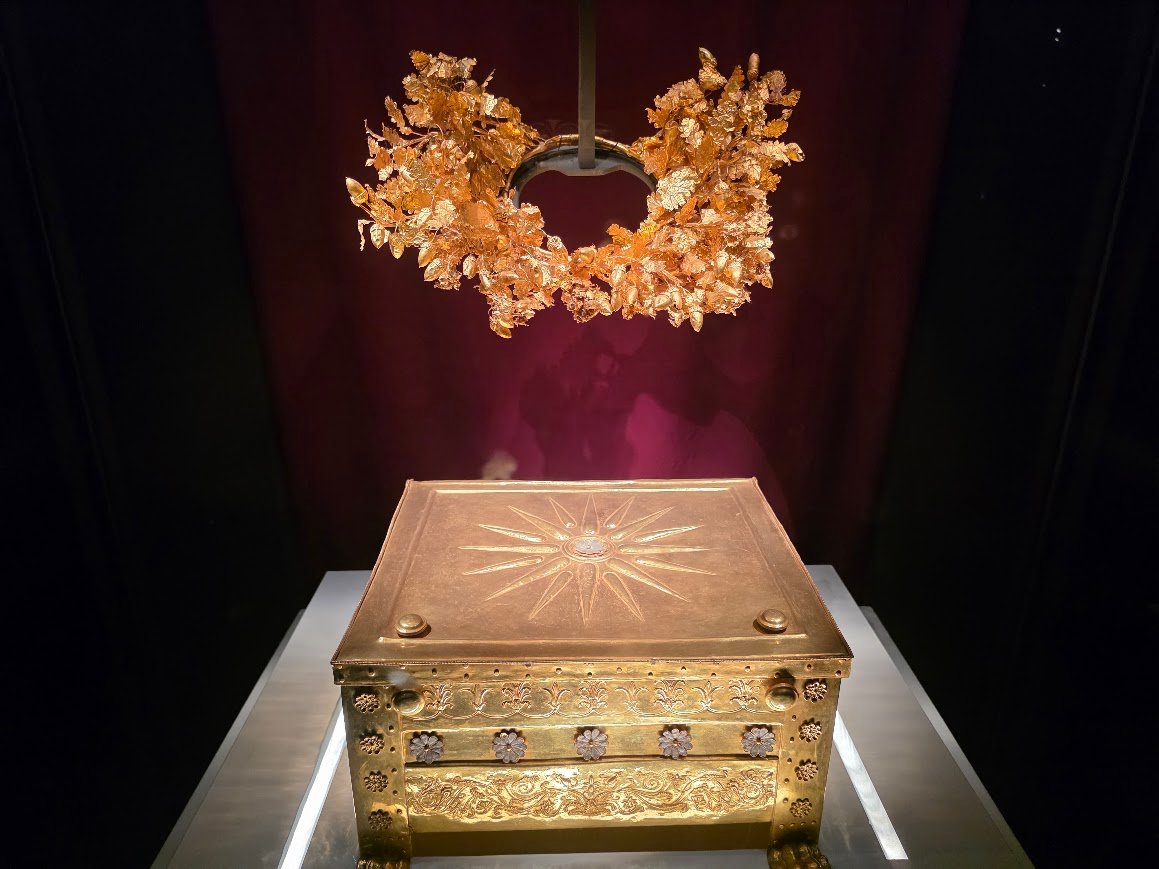
The golden larnax of Philip II of Macedon, discovered in 1977 by archaeologist Manolis Andronikos in the undisturbed Tomb II at the ancient royal burial site of Aigai (modern-day Vergina). Photo Credit: Xpat.Gr

Xpat.gr visited Vergina, ancient Aigai—the royal metropolis of the Macedonians
to explore the Museum of the Royal Tombs
and the New Central Museum Building of the Polycentric Museum of Aigai,
a journey we now share with you!

Standing on this quiet stretch of northern Greece, it is striking to remember that Aigai—today’s Vergina—was once the first capital of the Macedonian kingdom and the ancestral seat of the Temenid dynasty. It was home to Philip II (382–336 BCE), the king who consolidated Macedonian power and stabilised a fractured region.

From here, his son Alexander III—Alexander the Great (356–323 BCE)—would go on to reshape the ancient world. From this very site, Alexander eventually toppled the Persian Empire, carrying Greek culture deep into Asia and forging what we now call the Hellenistic world.

The material recovered at Aigai and displayed in its museums has profoundly reshaped scholarly understanding of Macedonian culture as an integral part of the Greek world during the Classical period. The craftsmanship revealed in the tombs—from metalwork and ceramics to ceremonial objects—combined with the decision to preserve several finds in situ, has established Vergina as a key reference point in European archaeology. Visiting the museums offers an intimate encounter with the people, rituals, and artistic traditions that shaped Classical Greece and paved the way for the Hellenistic age.

This article takes you inside two important museums, both integral parts of the Polycentric Museum of Aigai:

First: The Museum of the Royal Tombs – Display of Treasures

We begin our journey at the Museum of the Royal Tombs – Display of Treasures, located beneath the reconstructed Great Tumulus. Visitors step into a low-lit, subterranean space where the royal graves are preserved in situ, including the tomb of King Philip II.

Moving below ground level, one encounters gold wreaths, ceremonial armour, and ritual objects, all displayed with deliberate restraint, allowing the gravity of the setting to speak for itself. The museum immerses visitors in the solemn world of Macedonian burial practices while revealing the exceptional artistic mastery of the era.
Second: The New Central Museum Building

A short distance of 1.7 kilometres leads to a striking contrast: the New Central Museum Building, constructed of luminous white stone and flooded with natural light. Designed as the symbolic gateway to the archaeological site of Aigai, this contemporary museum places the tombs and treasures within a broader historical framework.

Here, the story expands beyond kings and burial ritual to explore the institutions, daily life, and cultural foundations of Ancient Macedonia, tracing the kingdom’s rise and its lasting influence on the wider Hellenistic world. History unfolds in light-filled galleries that feel analytical, open, and alive.

Together, these two museums offer a rare and balanced encounter with the past—one intimate and contemplative, the other expansive and explanatory. For those living in Greece or visiting for the first time, Vergina is more than an archaeological site: it is a reminder that some of the most far-reaching chapters of global history began in landscapes that still feel quiet, human, and deeply roo

Let’s explore how an extraordinary array of finds illuminates centuries of history.

Powered by GetYourGuide
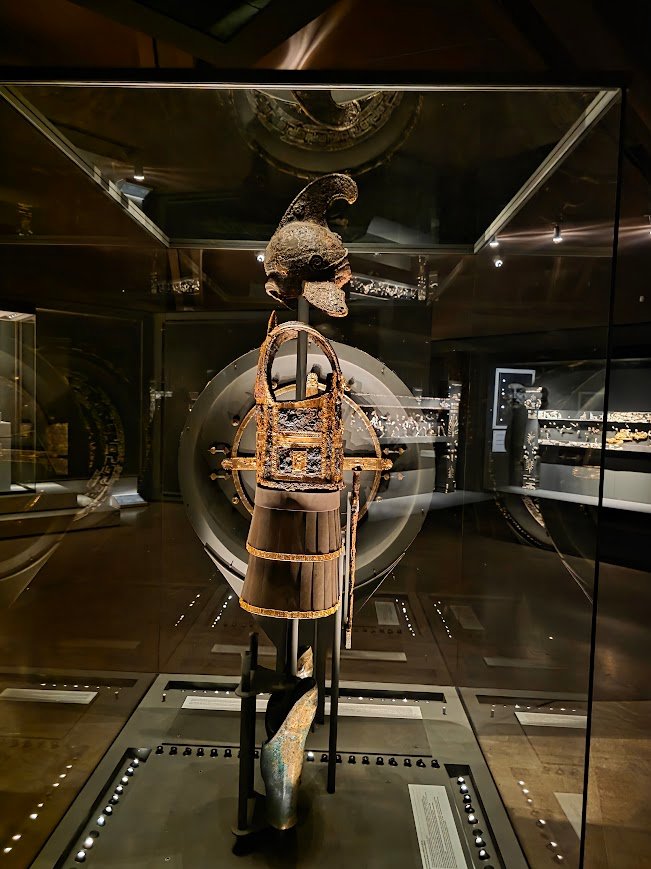
Displayed at the heart of the Royal Tombs Museum in Vergina, Philip II’s 2,300-year-old armor seems to bring the Macedonian king back into the living world. Excavated from the unlooted Tomb II by the renowned archaeologist Manolis Andronikos, it now stands alongside his golden ossuary, shield, and weapons, restoring the presence of a ruler who shaped Greek history.Polycentric Museum of Aigai / Royal Tombs – Display of Treasures — photo credit: Xpat.gr.
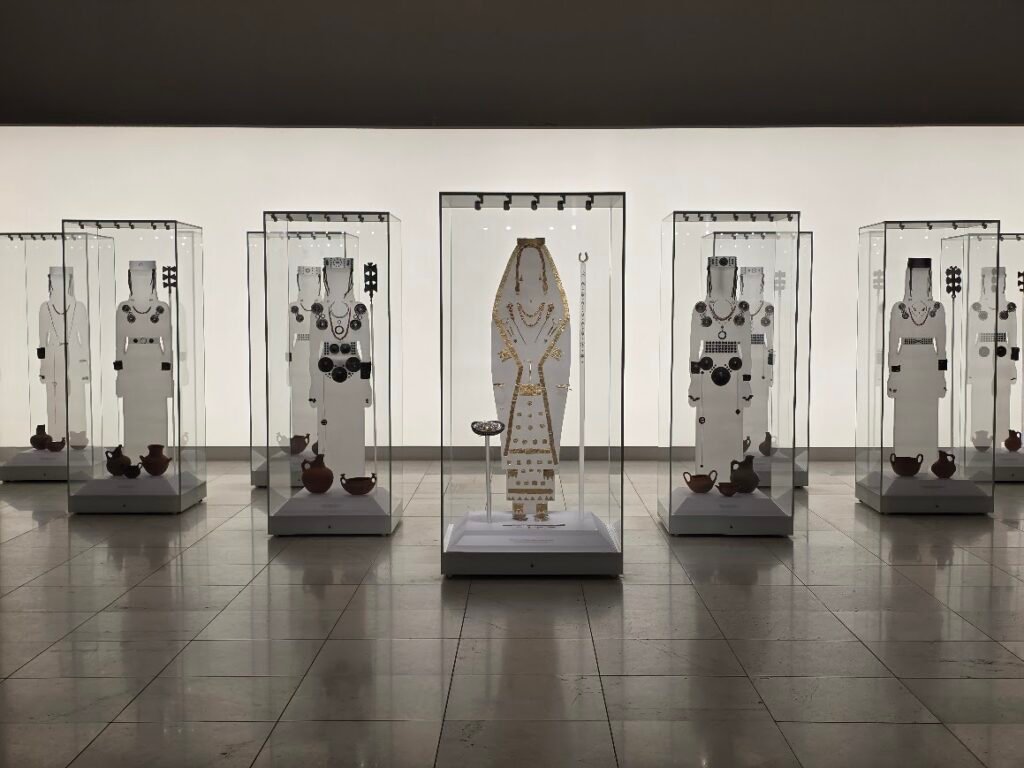
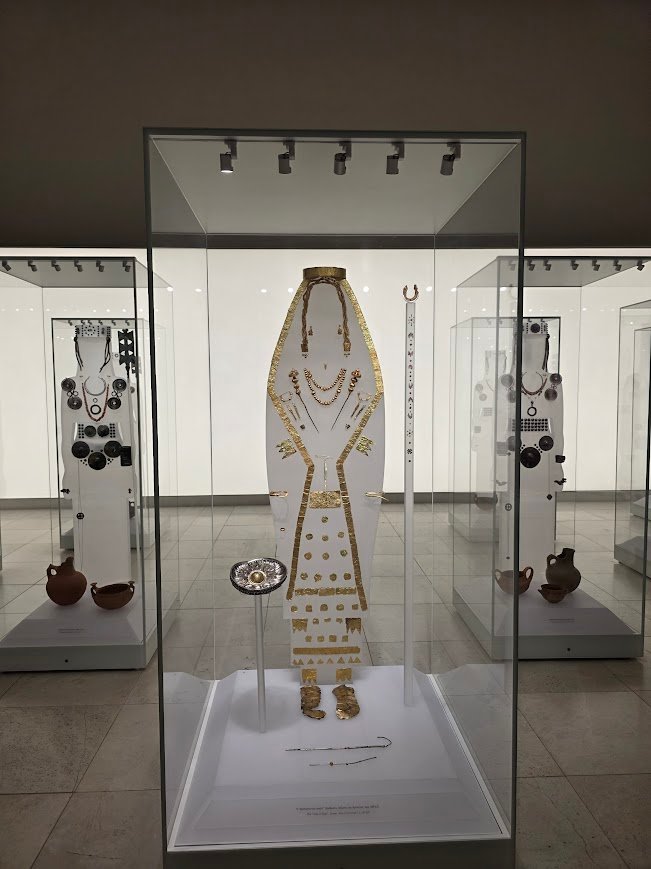
The “Lady of Aigai” (c. 495 BCE) — excavated in 1988 by archaeologist Angeliki Kottaridi, director of the Imathia Ephorate of Antiquities — identified as the Lydian wife of King Amyntas I of Macedon, seems to reappear before us in a standing, translucent, human-like form. She is adorned with the jewelry with which she was buried: gold earrings, a ribbon over her hair, a necklace of gold beads, silver pins ending in gold poppy-shaped spheres, and rosettes along with other delicate gold ornaments that once decorated and fastened her funerary garment. Her scepter and gold-soled slippers complete this striking reconstruction of a Macedonian queen.. Polycentric Museum of Aigai / Central Museum Building — photo credit: Xpat.gr

A Glimpse into Aigai’s Rich Heritage

The archaeological site of Aigai, inscribed on the UNESCO World Heritage Site in 1996, provides essential context for the treasures displayed in its museums. Among its most impressive remains is the monumental palace, dated to around 340 BCE, which ranks among the grandest buildings of the classical period with expansive courtyards and intricate mosaics. Nearby stands the theatre where Philip II was assassinated in 336 BCE during the wedding of his daughter Cleopatra of Macedon to Alexander I of Epirus; the ceremony, attended by many Greek dignitaries, turned tragic when Philip—appearing unprotected to seem approachable—was fatally stabbed by Pausanias of Orestis, a member of his bodyguard.

The site also preserves sacred precincts devoted to Eukleia and the Mother of the Gods, ancient fortification walls, and a vast royal necropolis: more than 500 tumuli (burial mounds) mark the cemetery and contain elite graves dating from the 11th to the 2nd centuries BCE. While the outdoor ruins convey Aigai’s scale and grandeur, the story of the ancient capital comes fully to life inside the museums, where the artefacts from these monumental contexts are exhibited and interpreted.
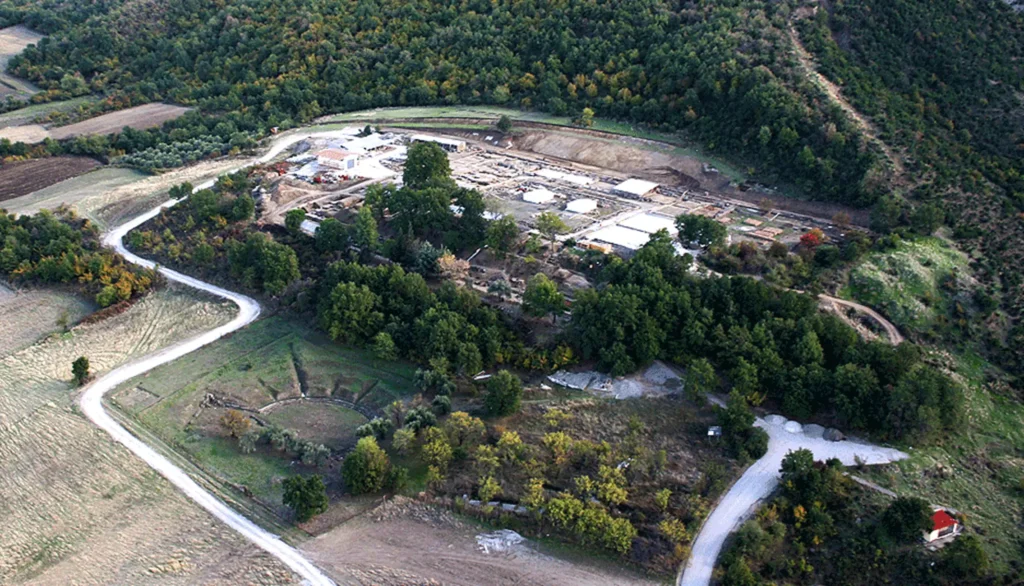
Aerial view of the archaeological site of Aigai showing the palace and theatre in Vergina, ancient capital of the Macedonians. Expats Athens, Expats Greece, Xpat.gr

Aerial view of the archaeological site of Aigai (UNESCO World Heritage Site), revealing the outline of the palace and theatre — the very landscape where Macedonia’s royal dynasty once shaped history.

Great Tumulus (Megali Toumba) – Excavations under Manolis Andronikos

The story of the excavation of Aigai’s royal tombs began in 1861, when French archaeologists Léon Heuzey and Henri Daumet uncovered the first Macedonian tomb — one of more than 540 burials that would subsequently be documented across the city’s necropolis, in use from the Early Iron Age to the Roman era. But it would take more than a century for the Great Tumulus to reveal its secrets.

Modern excavations reached a turning point between 1976 and 1980, under the renowned Greek archaeologist Manolis Andronikos (1919–1992), whose decades-long persistence would forever reshape our understanding of Macedonia’s royal past.

On 8 November 1977, Andronikos opened the Great Tumulus (Megali Toumba) and entered Tomb II, the only unlooted royal Macedonian tomb ever discovered, which he attributed to Philip II, father of Alexander the Great. Inside lay golden larnakes, ivory reliefs, and ceremonial armour, celebrated as “the find of the century.” That same year, he also uncovered the box-shaped Tomb of Persephone (Tomb I). In 1978, the unplundered Tomb of the Prince (Tomb III), believed to hold Alexander IV, was discovered. The remarkable ensemble of monuments at the Great Tumulus was completed by two additional structures, heavily damaged but historically significant. Adjacent to the Tomb of Persephone, the foundations of a heroon—a small stone above-ground structure honoring the deceased of the neighboring royal tomb, Philip II—were revealed. A few meters from these main burial monuments, in 1980, the remains of a third Macedonian tomb, which had suffered extensive destruction, were excavated. This tomb is known as the Tomb With the Free-Standing Columns (Tomb IV), dating to around 300 BCE.

“I can clearly recall the reaction I felt as I said to myself: ‘If the suspicion I had — that the tomb belongs to Philip — is true, and the golden larnax confirms this suspicion, then I was holding in my hands the larnax containing his bones. It is an incredible and terrifying thought, one that seems completely unreal.’ I believe I have never experienced such a thrill in my life, nor will I ever again.”

Manolis Andronikos, upon discovering Philip’s tomb, translated excerpt from The Chronicle of Vergina, Educational Foundation of the National Bank of Greece
Archaeological site of Aigai (Vergina): A general topographical plan, Expats Athens. Expats Greece
Archaeological site of Aigai (Vergina): A general topographical plan showing burials from all periods. Cluster A — the Great Tumulus (Megali Toumba), visible at the top left — is where archaeologist Manolis Andronikos uncovered in 1977 the tomb attributed to Philip II, along with its extraordinary treasures. (Ephorate of Antiquities of Imathia)
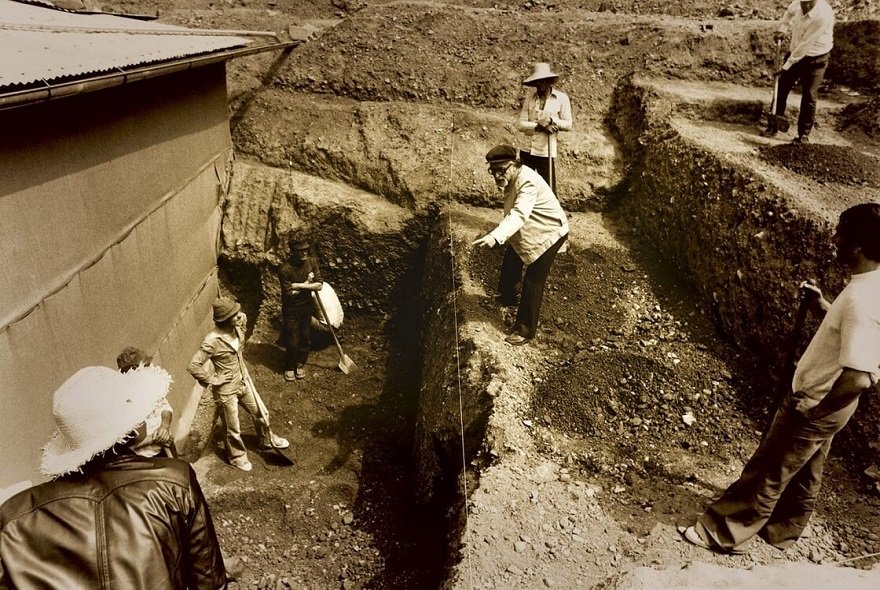
Aigai, Vergina, archaeologist Manolis Andronikos. Expats Athens. Expats Greece. Xpat.Gr
The picture shows archaeologist Manolis Andronikos at the center, overseeing the excavation of the Great Tumulus. The defining moment of his career is considered to be November 8, 1977, when—after decades of painstaking and persistent work at Vergina—he brought to light one of the most important archaeological monuments: the royal tomb of Philip II, king of Macedonia.
Aigai, Vergina, The Great Tumulus, Expats Greece, Xpat.Gr
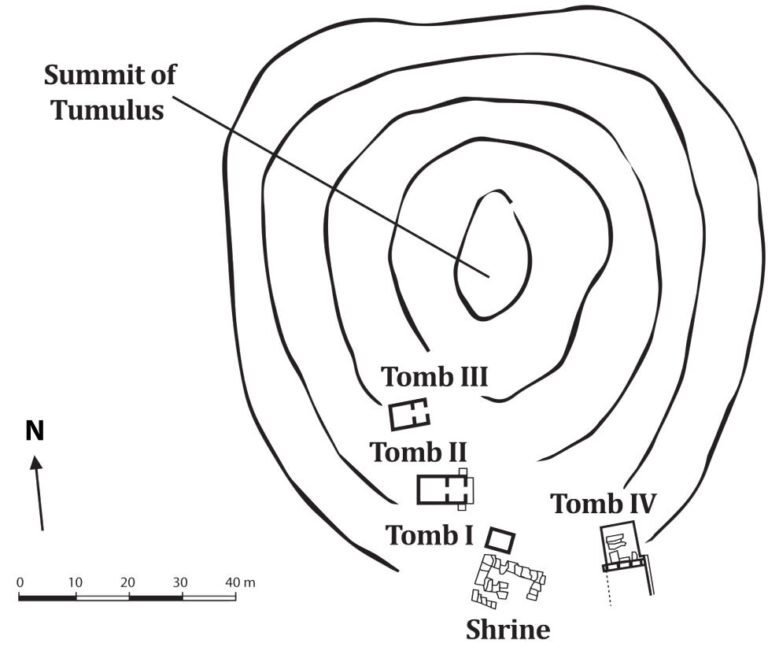
The relative positions of the tombs and shrine under the Great Tumulus. David Grant (2019).  Unearthing the Family of Alexander the Greatthe Remarkable Discovery of the Royal Tombs of Macedon,p. 48.
Tomb Ι: Tomb of Persephone, Tomb II: Tomb of Philip II,
Tomb III: Tomb of Alexander IV — “Tomb of the Prince”,
Tomb IV: Tomb with the Free Columns
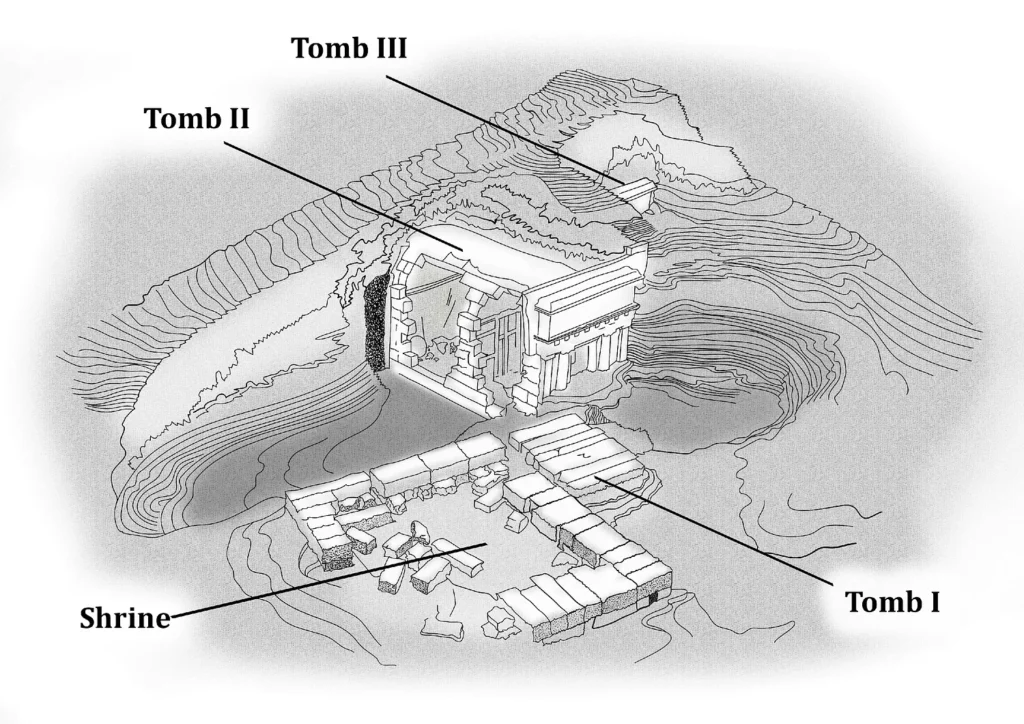
Model of the Shrine and Tombs inder the Great Tumulus, Vergina.
Model of the Shrine and Tombs inder the Great Tumulus, Vergina. David Grant (2019).  Unearthing the Family of Alexander the Greatthe Remarkable Discovery of the Royal Tombs of Macedon
Tomb Ι: Tomb of Persephone
Tomb II: Tomb of Philip II
Tomb III: Tomb of Alexander IV — “Tomb of the Prince”

1. Museum of the Royal Tombs – Display of Treasures

The Exterior

It is widely acknowledged that the excavation of earthen structures often entails an element of destruction; thus, the original Great Tumulus no longer exists in its original form. Instead, the Museum of the Royal Tombs—Display of Treasures has been thoughtfully constructed to simulate the Great Tumulus, serving as a protective shelter that preserves the authentic royal tombs within, which have undergone only minimal modern interventions to ensure their continued stability. This tumulus-shaped structure harmonizes with the ancient monuments it encases, showcasing both architectural ingenuity and a profound respect for history.

From the outside, the museum presents a serene grassy mound, an intentional design that invites curiosity. Since its opening in 1993, the museum allows visitors to traverse the tumulus much like the archaeologists who first unearthed these buried treasures.
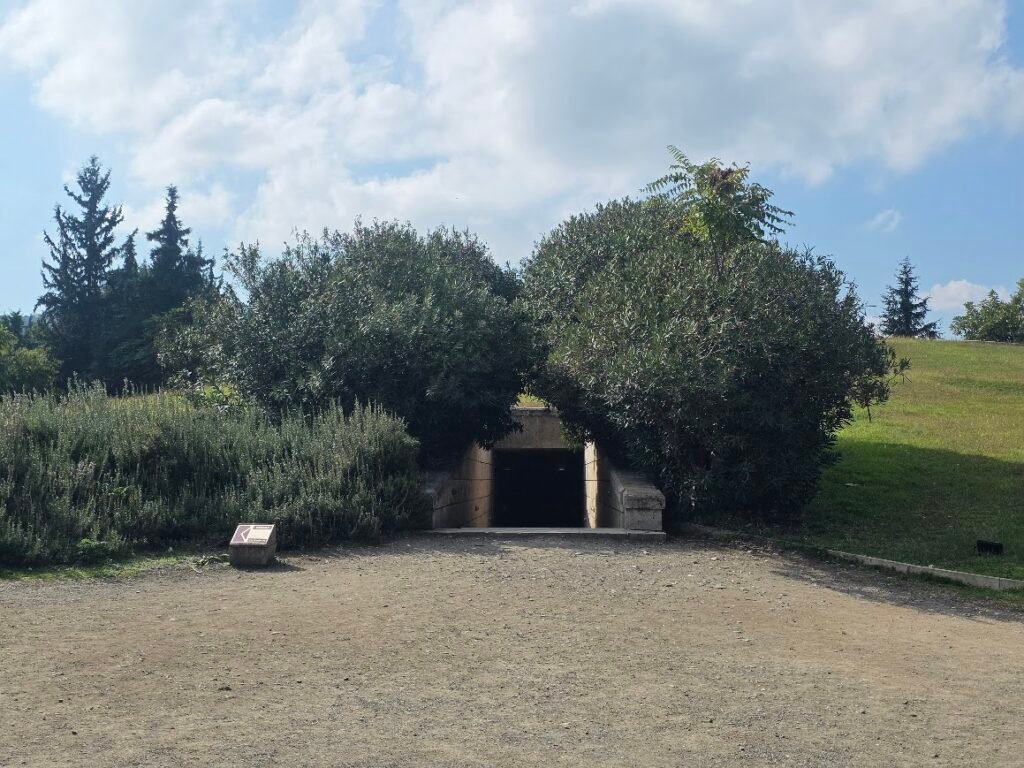
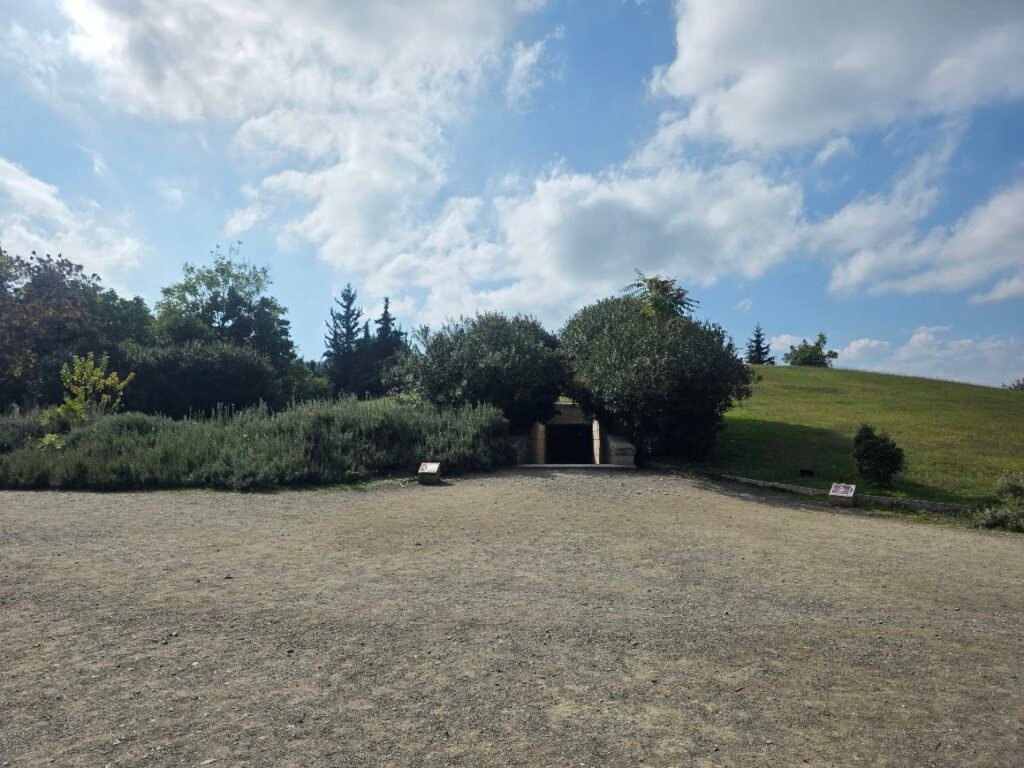
Entrance to the Museum of the Royal Tombs of Aigai built into a mound, preserving the tumuli in situ. Expats Athens, Expats Greece, Xpat.gr
Hidden in plain sight, the entrance to the Museum of the Royal Tombs invites you to uncover the treasures of Vergina. Built into a gentle mound, the museum preserves the tumuli in situ, offering a unique glimpse into ancient history. Polycentric Museum of Aigai / Royal Tombs – Display of Treasures — photo credit: Xpat.gr.

Museum of the Royal Tombs – Display of Treasures: Key Monuments of the Great Tumulus

Tomb I (Tomb of Persephone): Though looted, this tomb is renowned for its majestic fresco that adorns the walls of the burial chamber, depicting the abduction of Persephone by Hades. It serves as a vivid expression of ancient mythology and artistry.

Tomb II (Tomb of Philip II): The most famous tomb, identified by many archaeologists as belonging to King Philip II, father of Alexander the Great. It was unlooted and contained rich grave goods, including the golden larnax with the “Star of Vergina” (sixteen-pointed) holding the bones of the deceased, an elaborate golden oak wreath, the king’s armor, and various silver and gold vessels, alongside exquisitely carved ivory miniatures.

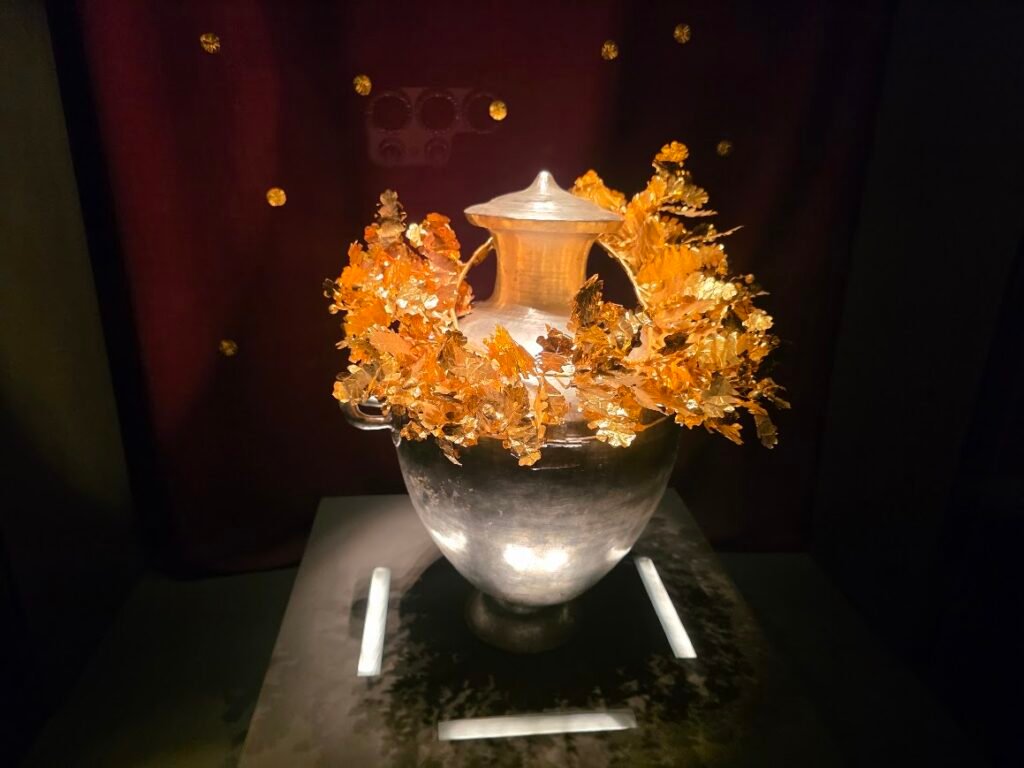
Tomb III (Tomb of Alexander IV — “Tomb of the Prince”): Believed to be the resting place of Alexander IV, the son of Alexander the Great and Roxana, this unlooted tomb features grave goods such as a silver hydria containing the remains of the deceased and a ceremonial golden wreath.

Tomb IV (Tomb With the Free-Standing Columns)Found in a heavily damaged state, this tomb dates back to around 300 BCE .

Heroon (Hero Shrine): Located near the tombs, this monumental structure is dedicated to the worship of deceased kings. Unfortunately, it was also found looted, reflecting the turbulent history that has surrounded these ancient treasures.

The Interior

Funerary StelaiTomb With the Free-Standing Columns (Tomb IV)Tomb of Persephone (Tomb I)

As you descend the gently sloping path into the depths of the museum, a profound shift in ambiance occurs—a blend of mysticism and reverence surrounds you. The air is thick with an ancient silence, as if the very stones themselves resonate with the weight of history and echoes of untold stories from a civilization that once thrived here.

Inside, dim lighting and cool air envelop guests, safeguarding the delicate frescoes, gold and ivory ornaments, and intricate metalwork housed within. This immersive environment guides visitors through a landscape rich with ancient rituals, enabling them to connect with the grandeur of a bygone civilization.

As your eyes adjust to the gentle dimness, the exhibits gradually unveil their secrets. You find yourself standing before imposing Funerary Stelai—or tombstones—adorned with intricate carvings that tell stories from the graves of ordinary Macedonians.

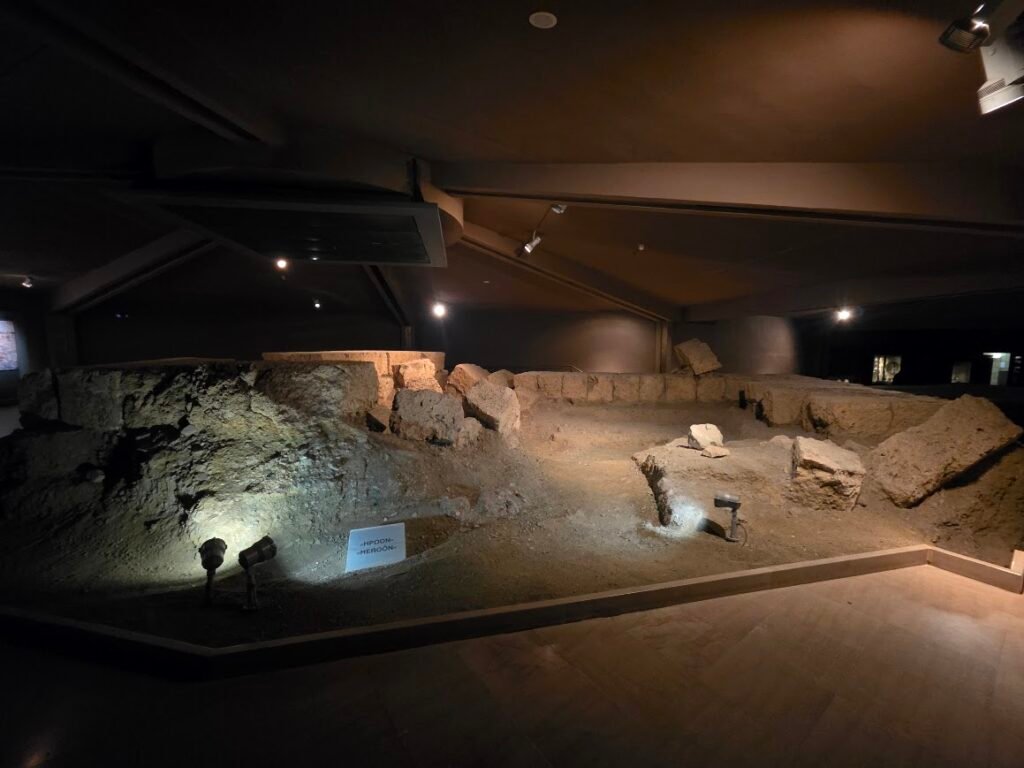
As you move deeper into the exhibit, you come across the remains of the Macedonian Tomb With the Free-Standing Columns (Tomb IV), a remarkable monument dating back to the 3rd century BCΕ, situated at the edge of the Great Tumulus. Nearby, you will find the Heroon, a structure dedicated to the cult of the eminent dead, and notably the only monument in the museum that stands above ground.

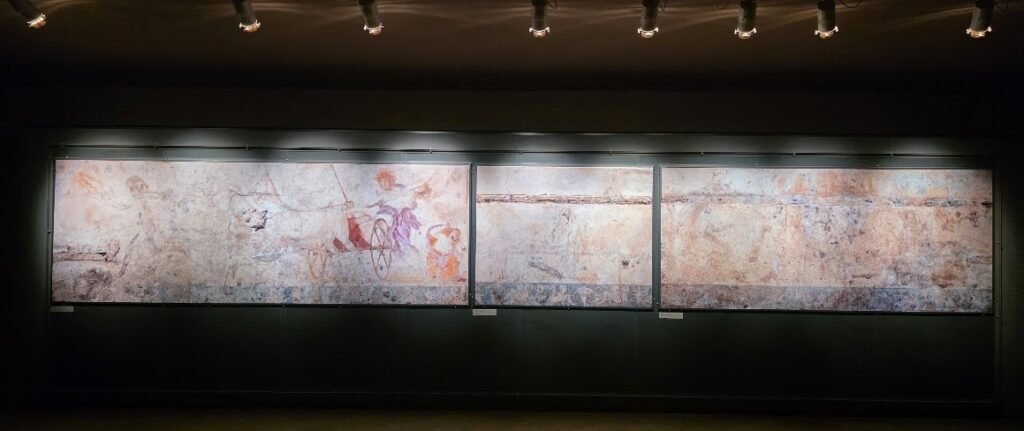
Behind the Heroon, a striking and faithful replica of the fresco that decorates the antechamber of Tomb I (the Tomb of Persephone ), invites you to witness a defining moment in mythology with its illustration of the Abduction of Persephone by HadesTomb I is an unfortunately plundered cist grave that is part of the royal burial complex of the Macedonian kings. Although there has been recent debate regarding the identity of its occupant, it is widely believed to be the tomb of one of Philip II’s seven wives, most likely Nicesipolis of Pherai. Upon excavation in 1977, exposure to atmospheric conditions caused rapid deterioration of the frescoes, resulting in plaster flaking and colors fading. This necessitated immediate conservation efforts that involved controlled reburial and chemical stabilization to preserve the murals.
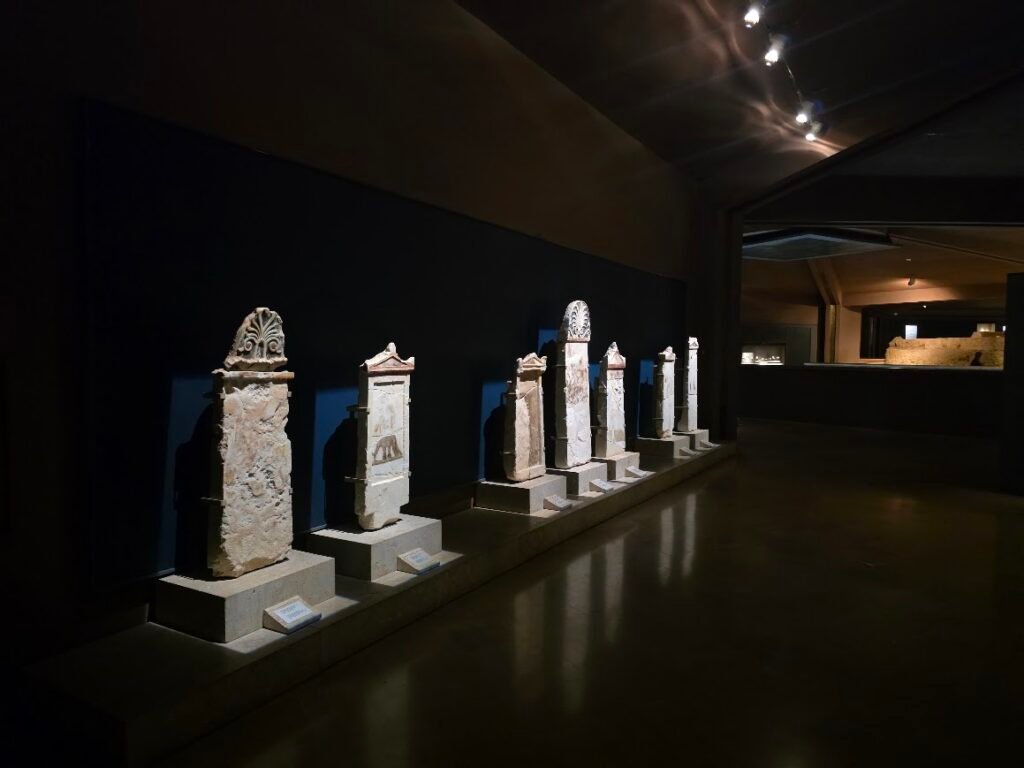
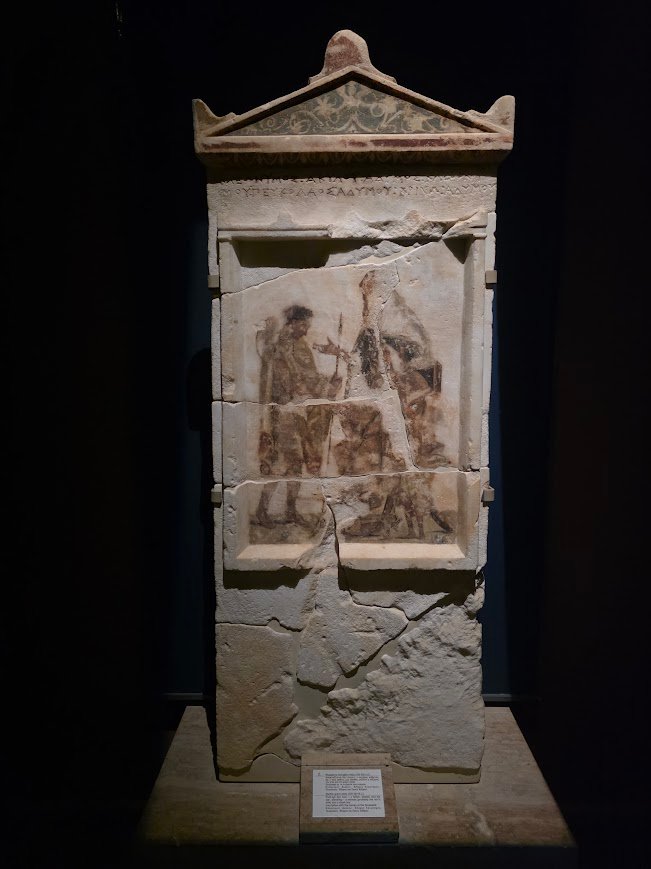
Marble funerary stelae from the Royal Tombs of Aigai with inscriptions of deceased Macedonian citizens. Expats Athens, Expats Greece, Xpat.gr
Marble Funerary Stelai – tombstones- appear in the necropolis of Aigai as early as the 5th century BCE, resembling those found in Attica, Thessaly, and other regions of Greece. A distinctive feature of the funerary stelae from Aigai is the preference for written representations, which are more common than ciseled works. This trend likely indicates the continuous presence of eminent painters working for the royal family in the area. Among these, 47 broken funerary slabs were uncovered in the vast mound covering the royal tombs. Dating to the second half of the 4th century BCE, these tombstones adorned the graves of ordinary Macedonian citizens, both men and women. Almost all of them bear inscriptions that mention the names of the deceased, with a total of 75 names recognized , all of which are Greek. Polycentric Museum of Aigai / Royal Tombs – Display of Treasures — photo credit: Xpat.gr.
Marble Funerary Stele (330-320 BCE) – tombstone – portrays two men: a seated father and his standing son, along with a woman, probably the son’s wife, and a small boy. The inscription includes the names of the deceased: «Κλεώνυμος, Ἀκύλου, Ἅδυμος, Κλεωνύμου, Πευκόλαος, Ἁδύμου, Κρινώ, Ἁδύμου». It translates to: Kleonymos, son of Akilas; Hadymos, son of Kleonymos; Peukolaos, son of Hadymos; and Krino, daughter of Hadymos. Polycentric Museum of Aigai / Royal Tombs – Display of Treasures — photo credit: Xpat.gr.
The so-called “Madonna'” of Aigai: A detailed view of a detached and serious young woman in gold and purple attire, represented on a grave stele from the 2nd half of the 4th century BCE. Polycentric Museum of Aigai / Royal Tombs – Display of Treasures — photo credit: Xpat.gr.
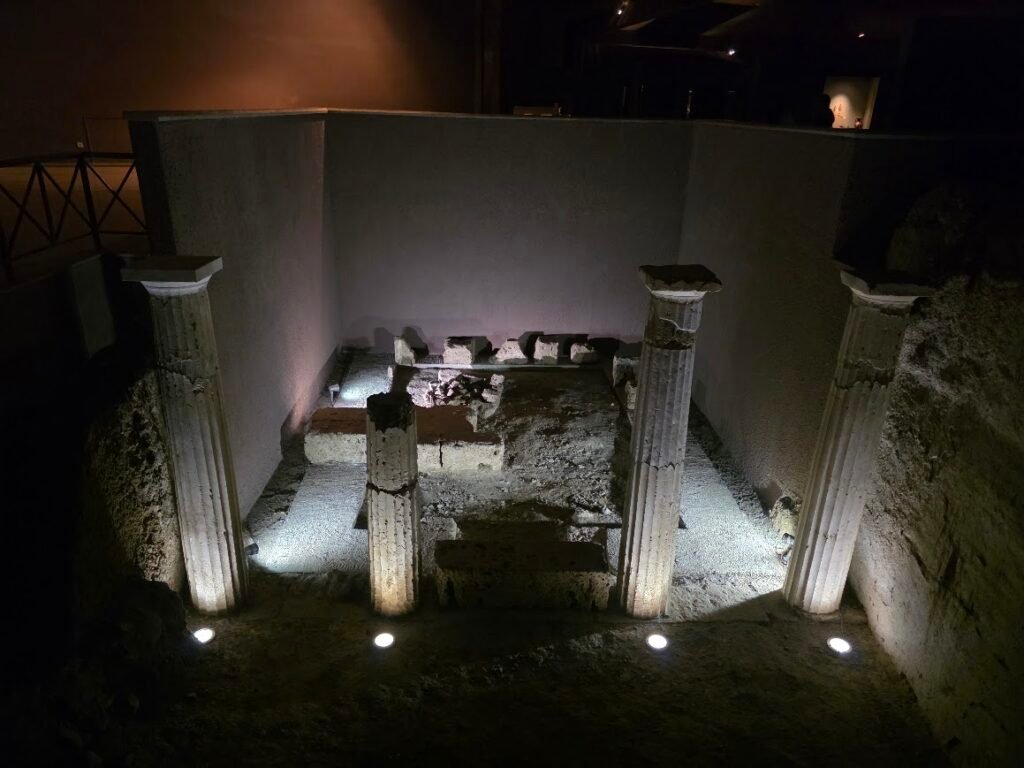
Ruins of the Macedonian Tomb with Free-Standing Columns (Tomb IV) from 3rd century BCE in the Museum of the Royal Tombs of Aigai. Expats Athens, Expats Greece, Xpat.gr
The ruins of the Macedonian Tomb With the Free-Standing Columns (Tomb IV) date to the 3rd century BCE. This monument has suffered substantial damage due to repeated plundering of its building materials and the removal of what were likely its most valuable artifacts. Originally, it featured an impressive entrance adorned with four Doric columns, of which only partial remains are preserved today. Polycentric Museum of Aigai / Royal Tombs – Display of Treasures — photo credit: Xpat.gr.
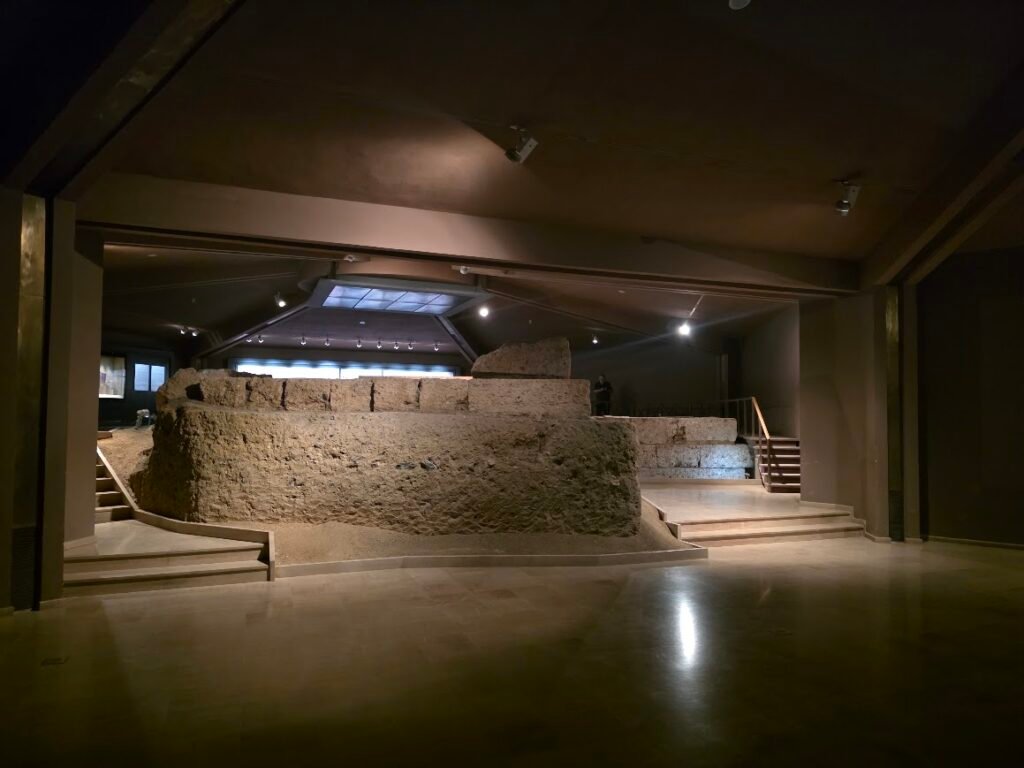
Site of the Heroon near the Tombs of Philip and Persephone at Aigai, possibly a cult temple for royal family worship. Expats Athens, Expats Greece, Xpat.gr, Museum of the Royal Tombs of Aigai
The Heroon: Located south-east of the Tomb of Philip and adjacent to the Tomb of Persephone, the Heroon was likely designed as a temple for the worship of prominent members of the royal family. Constructed shortly after Philip’s tomb, this site may have housed a cult statue of Philip himself. Unfortunately, the Heroon was destroyed in 274/3 BC during a plundering by Gallic mercenaries of Epirotean Pyrrhus, along with the Tomb of Persephone. Polycentric Museum of Aigai / Royal Tombs – Display of Treasures — photo credit: Xpat.gr.
Site of the Heroon near the Tombs of Philip and Persephone at Aigai, possibly a cult temple for royal family worship. Expats Athens, Expats Greece, Xpat.gr. Museum of the Royal Tombs of Aigai
The Heroon Polycentric Museum of Aigai / Royal Tombs – Display of Treasures — photo credit: Xpat.gr.
Fresco from Tomb I showing Hades abducting Persephone, with Hermes and seated Demeter, Museum of the Royal Tombs of Aigai. Expats Athens, Expats Greece, Xpat.gr
The replica of the fresco that adorns the antechamber of Tomb I, commonly known as the Tomb of Persephone, depicts the theme of Persephone’s abduction by Hades. The scene on the left captures the moment of the abduction of Persephone. Hades, or Pluto, the formidable king of the Underworld, is portrayed in his chariot, firmly grasping Persephone by the waist. Leading the way is Hermes Psychopompos who served as the conductor of souls into the afterlife. Behind the chariot, we see the figure of Persephone’s friend. In the central section of the composition sits the goddess Demeter, Persephone’s mother. Finally, in the right section, we encounter three seated female figures who are likely the Fates—Clotho, Lachesis, and Atropos. This elegantly executed mural, dating back to the mid-4th century BCE, is characterized by its reliance on drawing techniques, with incised underdrawings of the figures and a restrained yet exquisite use of color. Due to its delicate nature, the original artwork is kept away from exhibition lighting to preserve its integrity. Scholars hypothesize that this masterpiece may be attributed to the esteemed painter Nicomachus of Thebes, who was active during the same period. Polycentric Museum of Aigai / Royal Tombs – Display of Treasures — photo credit: Xpat.gr.
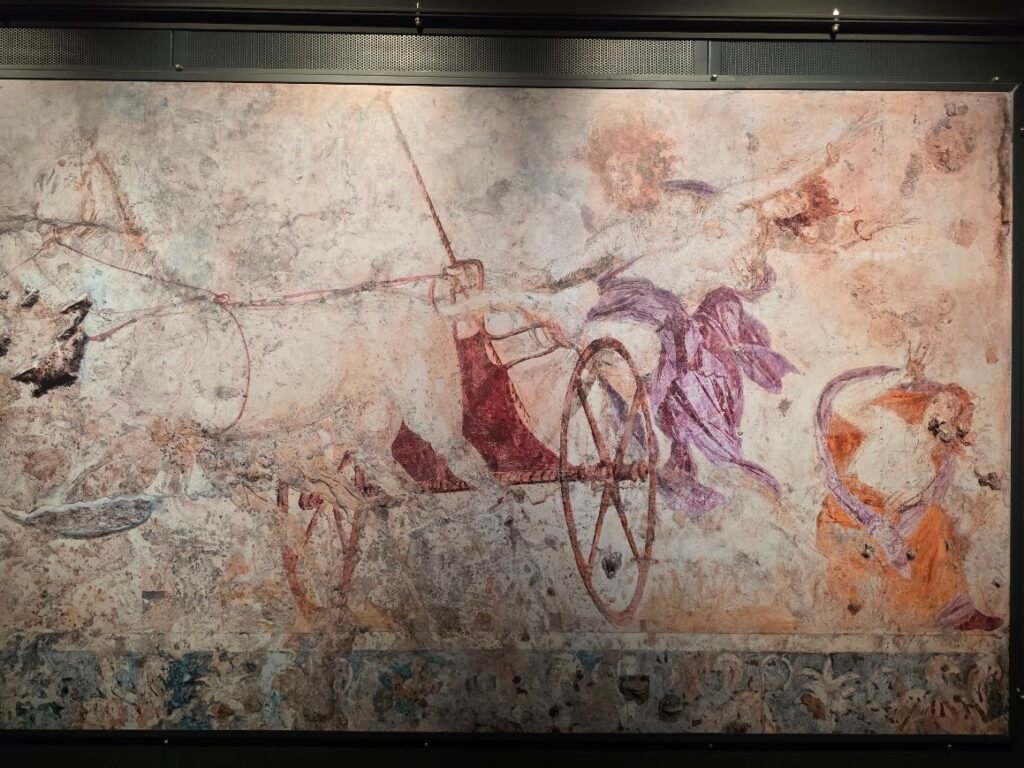
Close-up of the north wall fresco from Tomb I (Tomb of Persephone) showing Hades abducting Persephone, her flowing blond hair and crimson garment, and the distressed friend behind the chariot. Museum of the Royal Tombs of Aigai, Expats Athens, Expats Greece, Xpat.gr
Capturing a moment of profound emotion and drama, this close-up of the main composition from the north wall of Tomb I showcases the expressive power of the figures, highlighting the unparalleled beauty and perfection in the depiction of their faces and bodies. The frantic movement of the chariot is powerfully conveyed through Hades’s disheveled hair and Persephone’s flowing blond hair, along with her crimson garment, all swirling in the chaos of the dramatic abduction. She tries to escape him by raising her hands to the sky. Behind the departing chariot, Persephone’s friend—who, until a little while ago, was gathering flowers peacefully with her in the meadow—makes a gesture that reveals her fear and despair, embodying the heart-wrenching moment when their innocence is irrevocably shattered. Polycentric Museum of Aigai / Royal Tombs – Display of Treasures — photo credit: Xpat.gr.
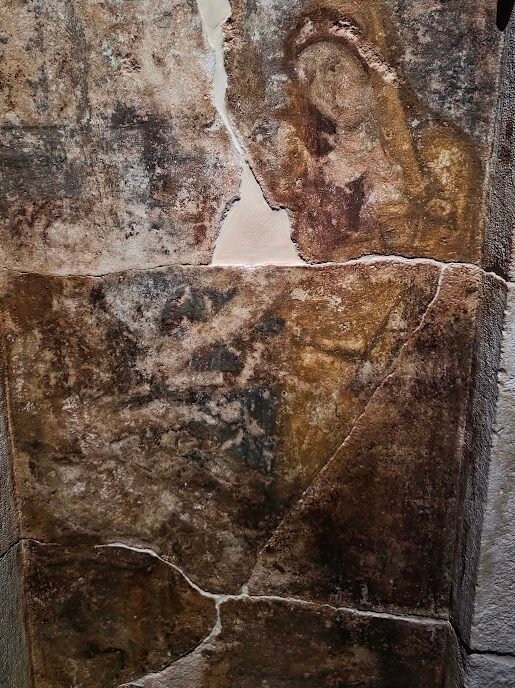
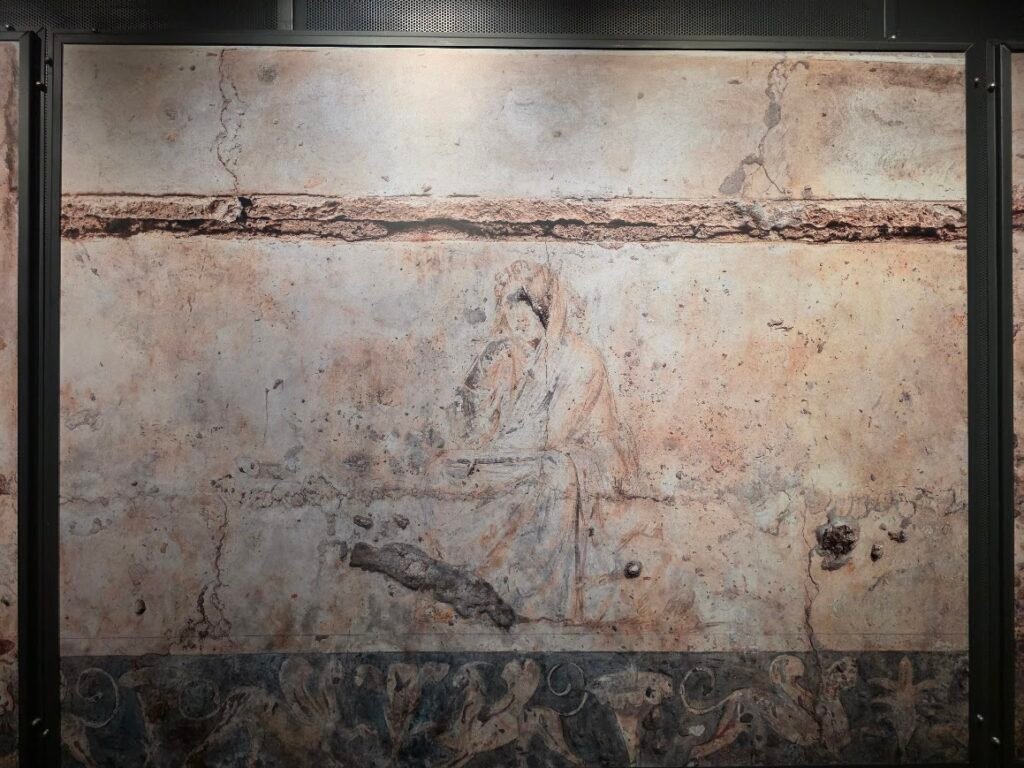
Close-up of the eastern wall fresco from Tomb I (Tomb of Persephone) showing a seated woman, likely Demeter, wrapped in her himation on the Agelastos Petra, mourning Persephone’s abduction. Museum of the Royal Tombs of Aigai, Expats Athens, Expats Greece, Xpat.gr
This close-up of the fresco adorning the eastern wall of Tomb I depicts a woman seated on a rock. The proximity of this figure to the fresco of Persephone’s abduction strongly suggests that she is the goddess Demeter, portrayed on the Agelastos Petra, the ‘sullen’ or ‘mirthless’ rock in Eleusis, where she mourned the abduction of her daughter, according to the myth. In this representation, Demeter is wrapped in her himation, an archaic mantle that evokes a Madonna-like image. Although Christianity emerged much later, this “Demeter Madonna” portrayal underscores the archetype of the grieving mother, emphasizing the profound maternal bond between Demeter and Persephone. Demeter’s sorrow resonates with contemporary observers, paralleling that of the Virgin Mary mourning Christ’s death and echoing themes of maternal grief that transcend time. Polycentric Museum of Aigai / Royal Tombs – Display of Treasures — photo credit: Xpat.gr.

Tomb of Philip II (Tomb II)

The Tomb of Philip II, referred to as Tomb II, stands as the stunning centerpiece of the Museum of Royal Tombs in Vergina, epitomizing the opulence of ancient Macedonian funerary traditions. Its layout reflects elite Macedonian burial practices, featuring a distinctive two-chamber design: a main burial chamber and a smaller antechamber. The main chamber held the cremated remains of Philip II (born 382 BCE—died 336 BCE), while the antechamber likely contained those of his royal wife, the Thracian princess Meda.

Sealed behind an impressive marble door and buried beneath a tumulus 110 meters in diameter and approximately 13 meters high, the tomb was preserved in remarkably low-oxygen conditions. This unique environment protected delicate organic materials—including wood and textiles—for more than two millennia. The structural ingenuity not only safeguarded the tomb’s contents but also thwarted ancient looters, allowing Tomb II to be discovered largely intact.

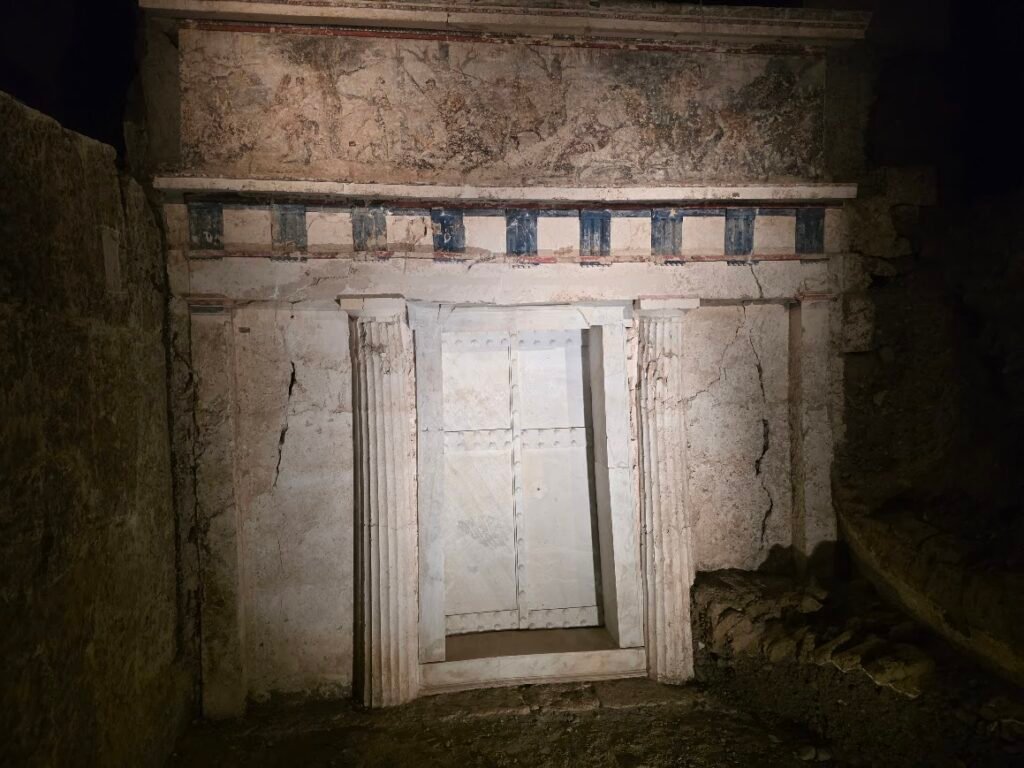
Visitors can descend to the site and admire the beautifully crafted Doric façade, an exquisite example of fourth-century BCE artistry. It features two friezes: a Doric frieze with triglyphs and metopes, and a taller Ionic frieze depicting a dramatic hunting scene—an iconography closely tied to Macedonian identity and royal authority.
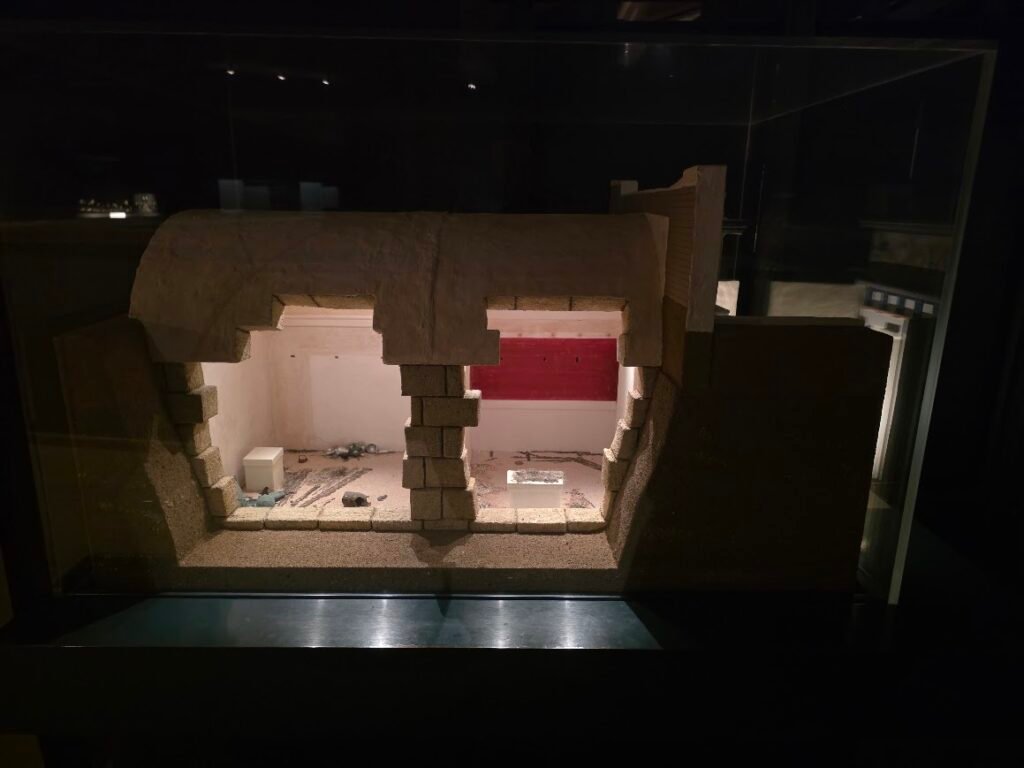
Scale model of the Tomb of Philip II of Macedon, showing the main chamber with Philip’s golden larnax and oak wreath, and the antechamber with his wife’s larnax and golden diadem. Museum of the Royal Tombs of Aigai, Expats Athens, Expats Greece, Xpat.gr
A scale model of the Tomb of Philip II of Macedon, housed in the Museum of the Royal Tombs of Aigai (Vergina, Greece). This model offers a glimpse into the tomb’s interior layout following its discovery. One can discern two chambers: The main chamber (left) contained a marble sarcophagus which housed a golden larnax, holding the cremated remains of Philip II and a gold oak wreath. The various items on the floor represent the rich grave goods found scattered by the archaeologists. The antechamber (right) contained a second marble sarcophagus and a smaller golden larnax with the remains of his royal wife and a golden diadem. Photo credit: Xpat.gr.
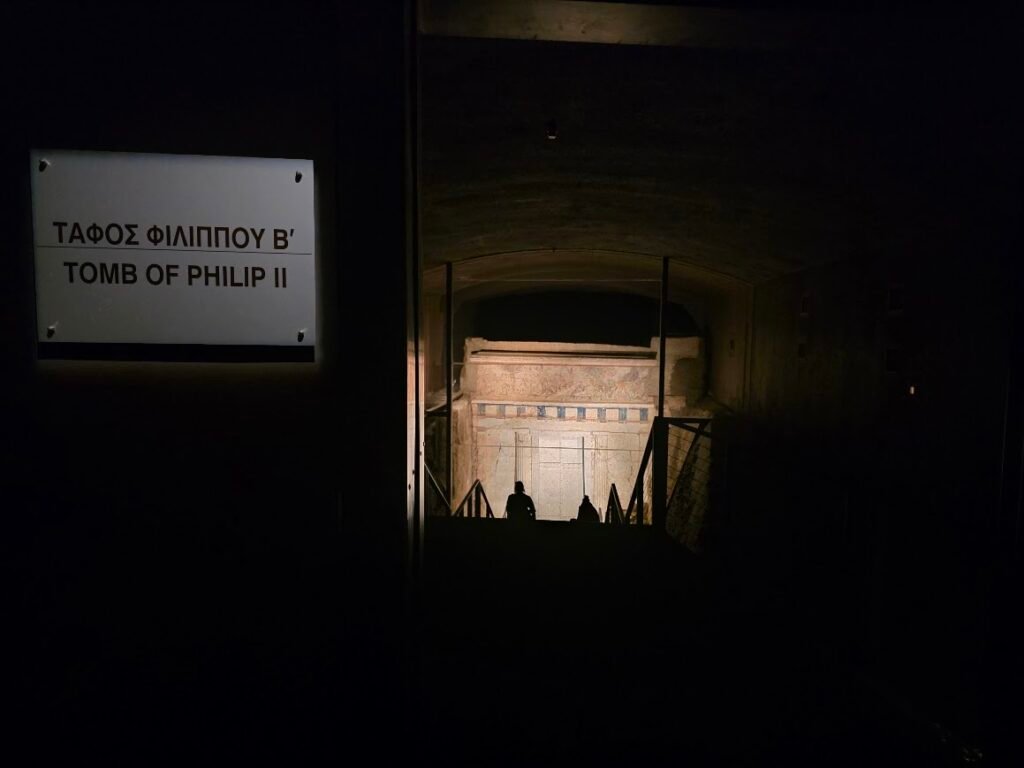
Entrance to the tomb of King Philip II, inviting visitors to descend into the historic site and reflect on the legacy of Macedonia’s great king. Museum of the Royal Tombs of Aigai, Expats Athens, Expats Greece, Xpat.gr
Standing at the threshold of history, this entrance beckons with awe and reverence as one prepares to descend the stairs into the majestic tomb of King Philip II. A place where echoes of a great civilization linger, inviting all who enter to reflect on the legacy of a remarkable leader. Polycentric Museum of Aigai / Royal Tombs – Display of Treasures — photo credit: Xpat.gr.
Façade of the Tomb of Philip II, designed as an ancient Greek temple with Doric half-columns, a marble door, and two friezes—including a Doric triglyph and metope frieze and an Ionic Hunt Frieze—symbolizing Macedonian royal power and identity. Museum of the Royal Tombs of Aigai, Expats Athens, Expats Greece, Xpat.gr
The impressive façade of the Tomb of Philip II (born 382 BCE—died 336 BCE)  is designed in the style of an ancient Greek temple, featuring Doric half-columns. Its grandeur and temple-like appearance symbolize the wealth, power, and semi-divine status of those interred within this royal complex, creating an eternal residence worthy of a king. The entrance is framed by a marble door, and above it features two friezes: a Doric frieze with triglyphs and metopes, and a taller Hunt Frieze, an Ionic frieze depicting a dramatic hunting scene—iconography closely tied to Macedonian identity and royal authority. Polycentric Museum of Aigai / Royal Tombs – Display of Treasures — photo credit: Xpat.gr.
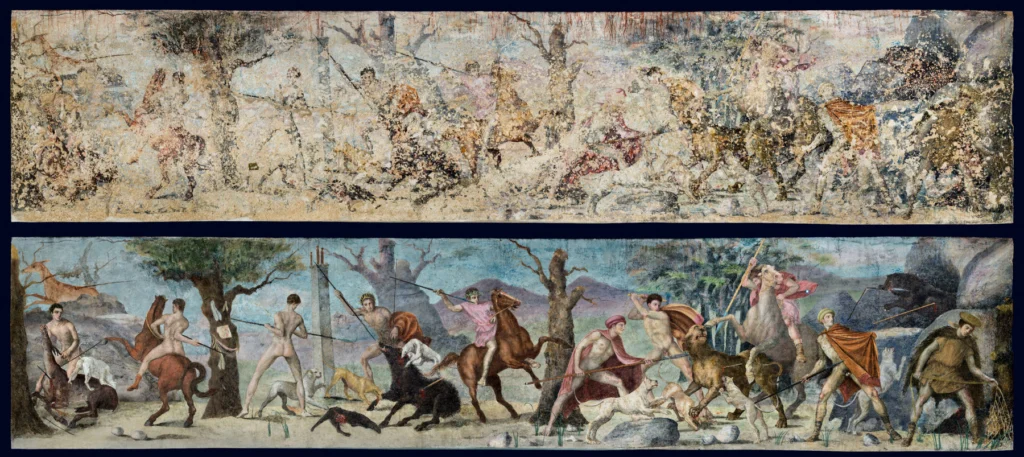
Close-up of the Hunt Frieze adorning the façade of Philip II’s tomb, depicting a dynamic hunting scene (photo credit: Christos Simatos). Below: A digital reconstruction of the frieze from the ReVis project, using multispectral imaging and historical analysis to reveal its original colors and details (photo credit: Charikleia Brecoulaki, Christos Simatos). Scholars debate whether the bearded rider represents Philip II and the youthful rider Alexander the Great, or whether the figures symbolize broader ideals of Macedonian kingship—bravery, leadership, and royal authority. Museum of the Royal Tombs of Aigai, Expats Athens, Expats Greece, Xpat.gr
Above: A close-up of the Hunt Frieze, the fresco featuring a hunting scene that beautifully adorns the façade of the tomb of Philip II. Photo Credit: Christos Simatos. Below: A digital reconstruction of the Hunt Frieze created as part of the ReVis project, an innovative interdisciplinary research initiative supported by the Hellenic Foundation for Research and Innovation (H.F.R.I.). This project combines cutting-edge analytical techniques, multispectral imaging, and historical research to reveal the original colors and iconographic elements of the frieze. ReVis aims to enhance the understanding and accessibility of this monumental masterpiece of Classical antiquity (5.56 m x 1.16 m). Photo Credit: Charikleia Brecoulaki, Christos Simatos. There has been ongoing debate regarding the identity of the figures depicted in the Hunt Frieze. Some scholars suggest that the bearded rider on the right represents Philip II, while the youthful rider in the center, wearing a wreath and clad in a purple chiton, is identified as Alexander the Great. However, other interpretations argue that these figures symbolize broader ideals of Macedonian kingship, emphasizing traits such as bravery and leadership rather than representing specific historical individuals.

Showcasing Celebrated Treasures from the Tomb of Philip II

Although visitors cannot enter the burial chambers of the Tomb of Philip II, the museum brings these spaces to life through an extraordinary selection of artifacts now on display. Together, they illuminate the lavish funerary rites of ancient Macedonians and the cultural world of its royal dynasty .

To appreciate these objects fully, it helps to understand the scale and ritual of Philip’s burial. Like the heroes of Homeric epic, Philip was cremated amid sumptuous offerings. The remains and objects from his funeral pyre —both sacred and ritually polluting—were gathered and deposited in the grave, which was then covered by a monumental tumulus of charred bricks, ash, and burned goods. Contemporary evidence suggests the pyre was a grand timber structure that echoed the size and splendor of the tomb itself. Reclining on a gold-and-ivory couch and clad in his panoply , the king was crowned with a golden oak wreath as he was delivered to the flames. Rich grave offerings, including dogs and horses, accompanied him; tradition records that one of his young wives, the Thracian princess Meda, joined him in death, reflecting the intense bonds of loyalty and dynasty.

The following highlights identify the museum’s principal displays from the royal tombs; photographic images and detailed captions follow in the next section.

  • Gold Larnax of King Philip II: The world‑famous 24‑carat gold chest that once contained Philip’s cremated remains, decorated with the 16‑rayed Sun of Vergina; found inside a marble sarcophagus in the main chamber.
  • Gold Larnax of Meda: A smaller gold larnax, likely belonging to Philip’s royal wife Meda, bearing a 12‑rayed sun emblem; recovered from a separate sarcophagus in the antechamber.
  • Gold Oak Wreath of Philip II: The wreath recovered from the main larnax, comprising hundreds of leaves and acorns and surviving in substantial weight despite partial melting on the pyre.
  • Gold Myrtle Wreath of Meda: The wreath placed on the antechamber couch and found within Meda’s larnax.
  • Gold and Purple Fabric of Meda: The richly colored textile in which Meda’s bones were wrapped.
  • Gold‑decorated Panoply of Philip II: The king’s iron and gold armor, the most complete classical panoply known, fitted to his frame and richly ornamented.
  • Gold image of Athena (detail of the cuirass): The small gold icon sewn onto Philip’s cuirass, invoking divine protection .
  • Gold and Ivory Shield of Philip II: A composite shield with gilt plates, ivory inlays, and an ivory‑gilt central group likely representing Achilles and Penthesileia .
  • Weaponry of Philip II (336 BCE): The full assemblage of arms and armor recovered from the tomb, including swords, spears, greaves, and associated fittings.
  • Weapons from the Main Chamber Threshold: The weapons and related gear found at the doorway to the main burial chamber, contextualizing the placement of grave goods.
  • Vessels for the Bathing of the Dead: Cauldrons, bowls, jugs, and related implements used in lustral bathing rites and deposited with the king.
  • Silver and Gold Diadem with the “Heracles knot”: A high‑status diadem combining precious metals and symbolic iconography.
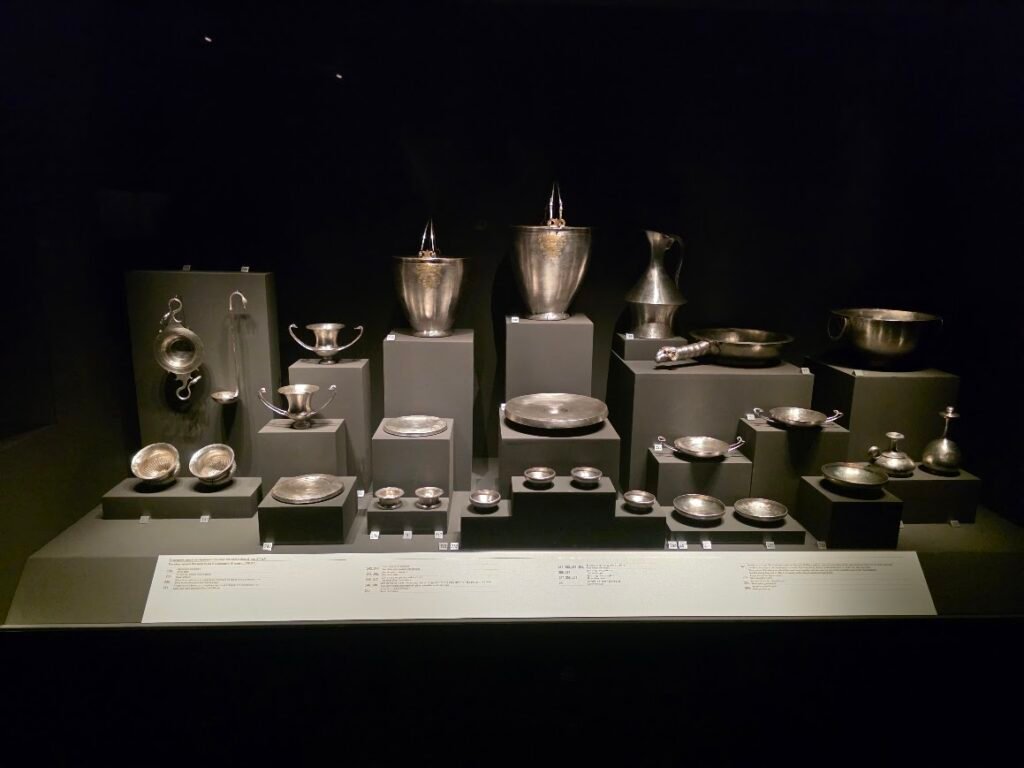
  • Banquet Utensils and Vessels: The exceptionally complete silver service intended for funerary feasting, illustrating elite dining ritual and craftsmanship.
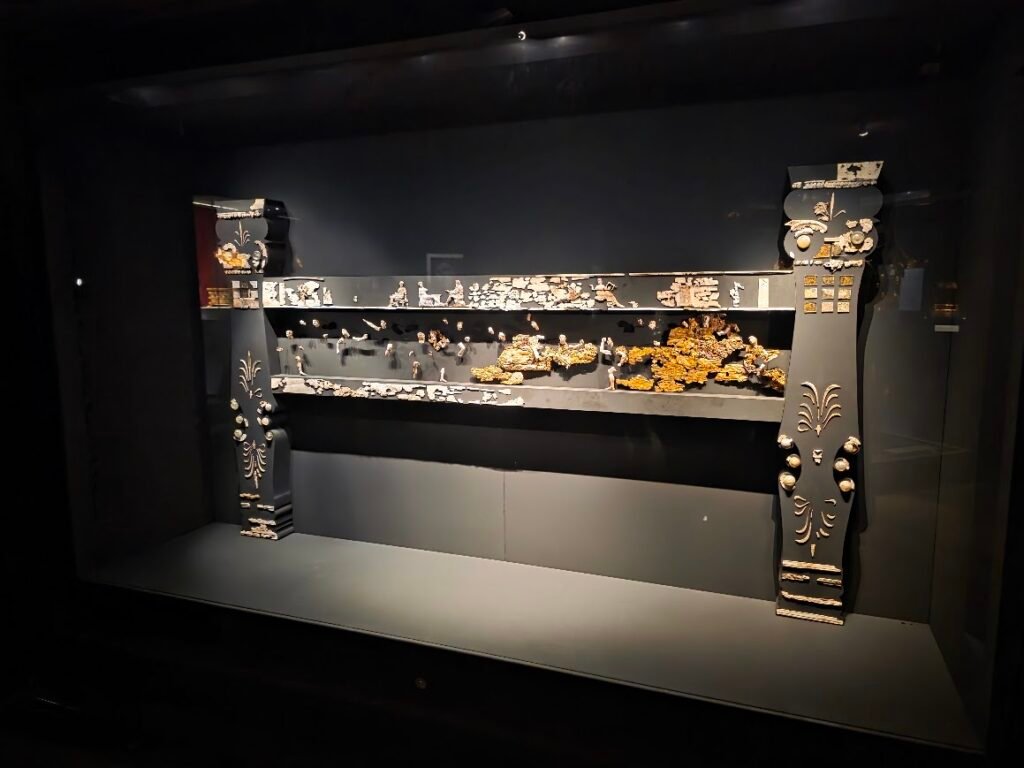
  • Gold‑and‑Ivory Couch from the Main Chamber: The spectacular couch with carved ivory and gold reliefs, including the hunting frieze and portrait heads .
  • Remains of the Funerary Pyre: Archaeological evidence of the monumental pyre that accompanied Philip’s cremation and sealed his tomb.

Treasures from Philip II’s Tomb: Images and Captions
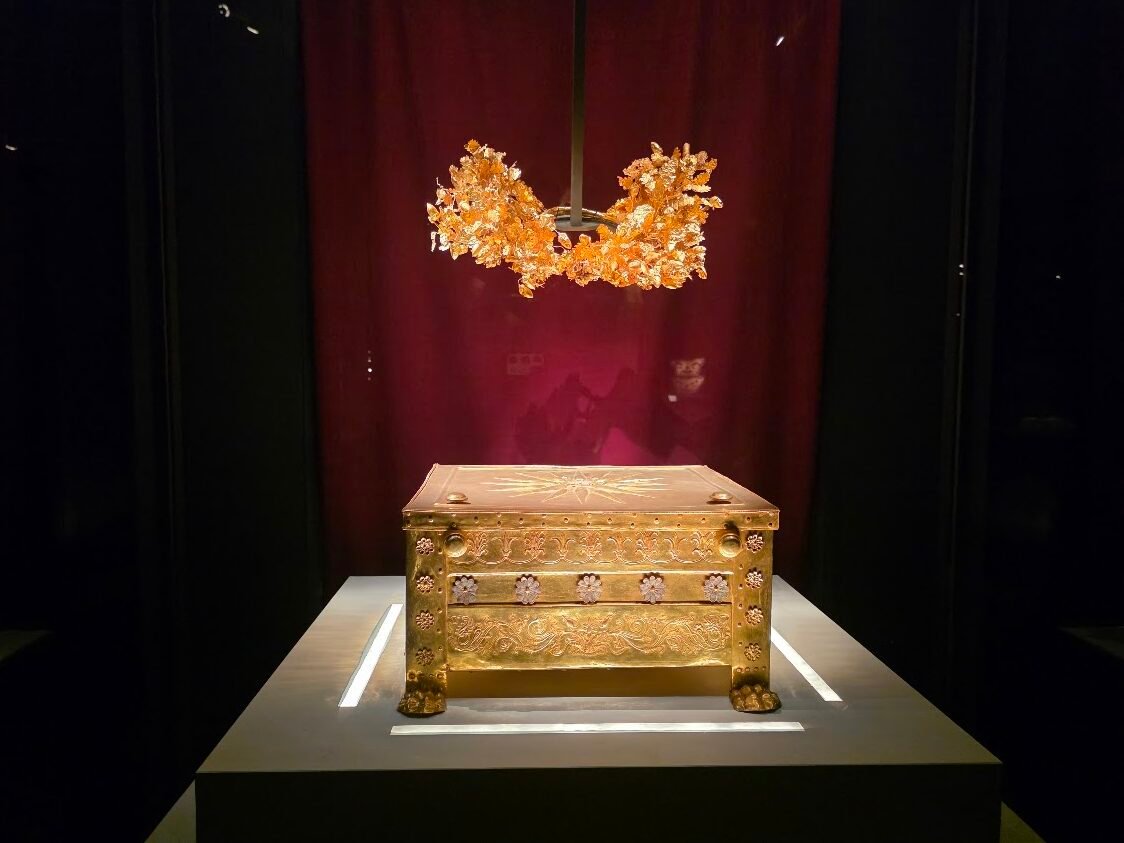
Gold Larnax of King Philip II with the Gold Oak Wreath that crowned him on the funeral pyre. This 4th-century BCE ash chest, crafted from hammered 24-karat gold and weighing 7.82 kg, features the 16-rayed Vergina Sun, rosettes, palmettes, lotus buds, and lion-paw feet. The wreath, with 313 leaves and 68 acorns, partially melted in the pyre, is the heaviest surviving Greek gold wreath. Museum of the Royal Tombs of Aigai, Expats Athens, Expats Greece, Xpat.gr
The Gold Larnax that once contained the bones of King Philip II, with the Gold Wreath of Oak Leaves, worn by him on the pyre, positioned above.
The Gold Larnax of Philip II is one of the most significant archaeological finds in Greek history and is the most admired display at the Museum of the Royal Tombs. This spectacular 4th-century BC ash-chest held his cremated remains and is made from thick sheets of hammered pure 24-karat gold, weighing approximately 8 kg (7,820 grams). Its lid is adorned with the 16-rayed Vergina Sun, a prominent symbol of the Macedonian royal family, along with two rosettes, the inner of which is filled with blue enamel. Relief palmettes and lotus buds frame five enameled rosettes on the sides, while the feet are embellished with rosettes and terminate in lion-paw designs. Inside the larnax lay the magnificent Gold Oak Wreath that crowned the deceased king. The wreath boasts 313 leaves and 68 acorns, with a surviving weight of 717 grams, having been partially melted in the pyre. It is the heaviest and most impressive wreath surviving from Greek antiquity and represents a remarkable achievement of a skilled goldsmith whose name remains unknown.. Polycentric Museum of Aigai / Royal Tombs – Display of Treasures — photo credit: Xpat.gr.
Gold Larnax and Gold Oak Wreath of King Philip II, crafted from 24-karat gold and originally used to hold his cremated remains. Museum of the Royal Tombs of Aigai, Expats Athens, Expats Greece, Xpat.gr
The Gold Larnax and Gold Oak Wreath of King Philip II. Polycentric Museum of Aigai / Royal Tombs – Display of Treasures — photo credit: Xpat.gr.
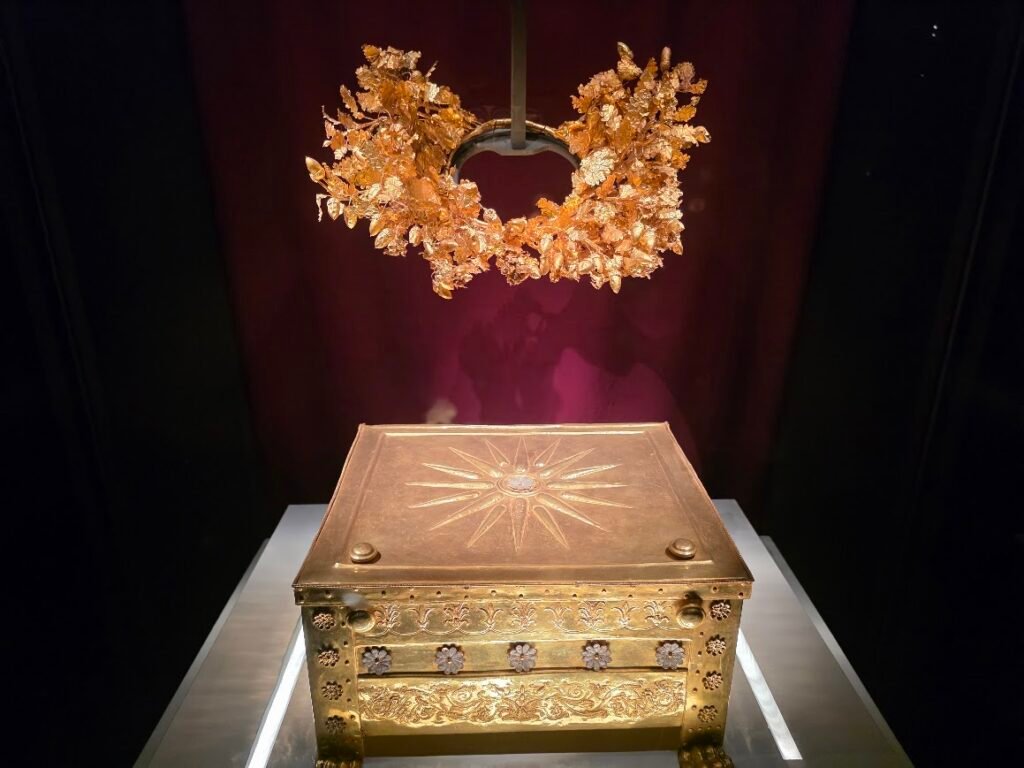
Gold Larnax and Gold Oak Wreath of King Philip II, featuring a lid decorated with the 16-rayed Vergina Sun. Museum of the Royal Tombs of Aigai, Expats Athens, Expats Greece, Xpat.gr
The Gold Larnax and Gold Oak Wreath of King Philip II. The lid of the larnax is adorned with the 16-rayed Vergina Sun. Polycentric Museum of Aigai / Royal Tombs – Display of Treasures — photo credit: Xpat.gr.
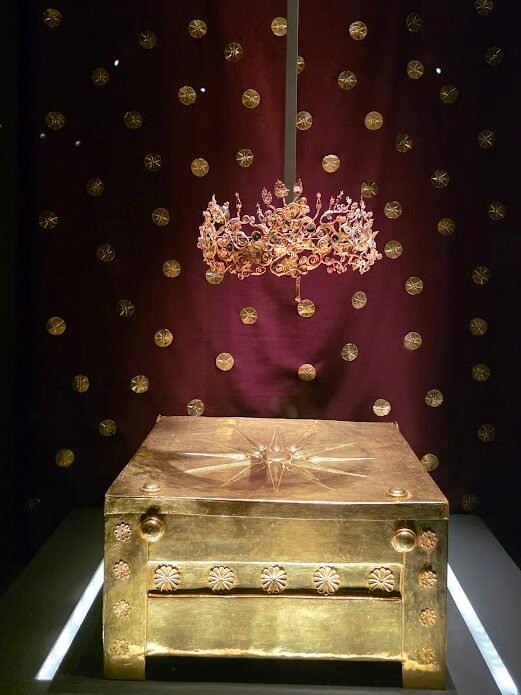
Gold Larnax and Gold Diadem of Meda, the young royal wife of Philip II, with the larnax once holding her remains and the diadem surviving the funeral pyre. Background shows golden star-embossed roundels from the antechamber of Philip’s tomb. Museum of the Royal Tombs of Aigai, Expats Athens, Expats Greece, Xpat.gr
The Gold Larnax and Gold Diadem of Meda. This display features the Gold Larnax, which contained the bones of a young royal wife, likely the Thracian princess Meda, who is believed to have accompanied Philip into the afterlife (336 BCE). The larnax was housed within a marble sarcophagus located in the tomb’s antechamber. Above the larnax is the superb Gold Diadem of Meda; which despite
passing through the flames of the funeral pyre, continues to be the most beautiful classical Greek jewel that we know of discovered alongside her remains. In the background, golden roundels embossed with stars, from the antechamber of Philip’s tomb. Polycentric Museum of Aigai / Royal Tombs – Display of Treasures — photo credit: Xpat.gr.
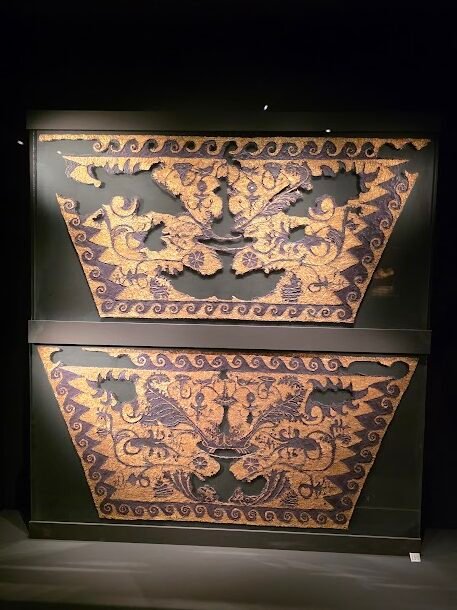
Gold and purple funerary fabric that wrapped the bones of Meda, highlighting royal burial customs. Museum of the Royal Tombs of Aigai, Expats Athens, Expats Greece, Xpat.gr
The Gold and Purple Fabric in which the bones of Meda were wrapped. Photo credit: Xpat.gr.
Gold myrtle wreath of Meda, originally placed on the gold and ivory couch in the antechamber. Museum of the Royal Tombs of Aigai, Expats Athens, Expats Greece, Xpat.gr
The Gold Myrtle Wreath of Meda, which was placed on the gold and ivory couch in the antechamber. Photo credit: Xpat.gr
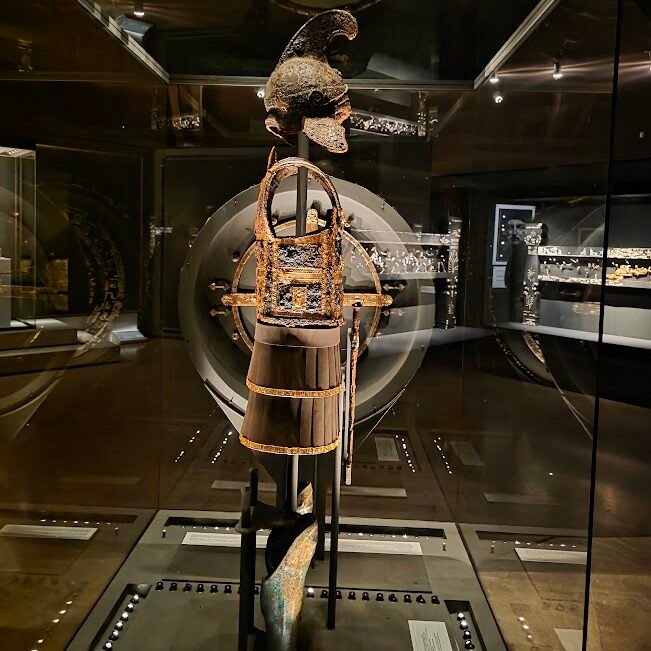
Gold-decorated panoply of Philip II, including iron-and-gold cuirass with lion-head fastenings, embossed iron helmet with Athena, and sword with ivory-adorned sheath. Museum of the Royal Tombs of Aigai, Expats Athens, Expats Greece, Xpat.gr
The gold-decorated panoply of Philip II. Discover the “resurrected” gold-ornamented panoply of the Macedonian king, likely worn during his proclamation as leader of all the Greeks and as he was delivered to the flames of the funerary pyre. This stunning iron-and-gold armour is the most complete and best-preserved panoply from ancient Greece, meticulously fitted to his frame.
The iron helmet showcases an embossed bust of the goddess Athena. The cuirass, a classic linen type reinforced with iron sheets and lined with leather, features elegant golden bands. The golden lion heads that fasten the cuirass serve not only as decorations but also as symbols of royal virtue.
The iron sword, trimmed with gold and paired with a wooden sheath adorned in ivory, reflects exquisite craftsmanship. The handle, or “apple,” is topped with a tiny golden helmet crowned by a sphinx. An embossed wild beast graces the cheek piece of the helmet, adding to the majestic aura of this remarkable artifact. Photo credit: Xpat.gr.
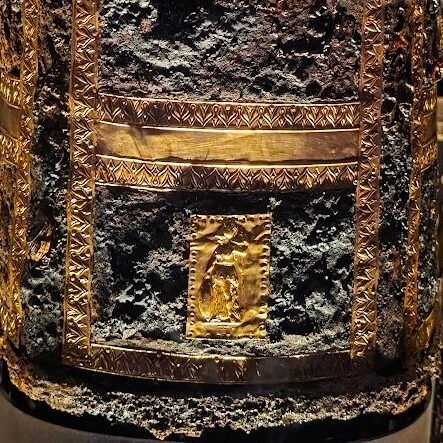
Close-up of the small gold depiction of Athena on Philip II’s iron cuirass, reminiscent of Phidias’ Athena Parthenos. Served as a talisman and symbol of protection for the king in battle. Museum of the Royal Tombs of Aigai, Expats Athens, Expats Greece, Xpat.gr
A close-up of the small gold image of Athena on Philip II’s iron-clad cuirass, evokes Phidias’ statue of Athena Parthenos that adorned the Parthenon. This golden icon symbolizes Athena as the defender, partner, and helper of all heroes. Sewn onto the right side, unprotected by the shield, it serves as the fighter’s talisman in battle. Similar to the amulets worn by soldiers in the Greek Christian tradition, which often feature saints or the Virgin Mary to invoke divine protection, Athena’s depiction on Philip’s cuirass exemplifies enduring Greek customs that transcend both time and religious boundaries. Photo credit: Xpat.gr.
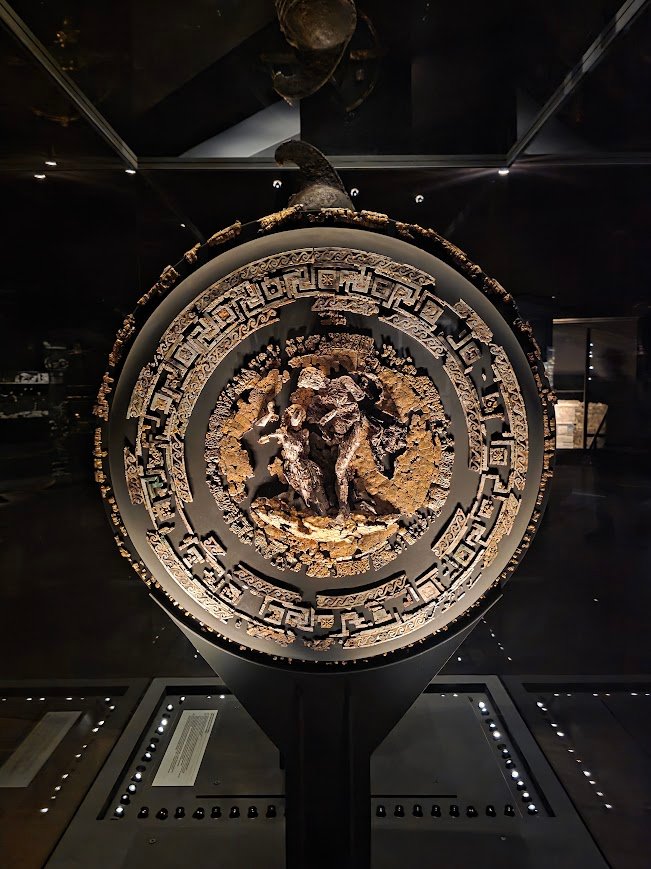
The gold and ivory shield of Philip II, featuring a central depiction of Achilles defeating the Amazon queen Penthesileia. Constructed from layered wood, leather, and cords, reinforced with gilded silver plates and detailed reliefs of lions, winged Victories, and Heracles’ club. The interior is coated in gilded stucco with ivory meanders and cast-glass inlays. Museum of the Royal Tombs of Aigai, Expats Athens, Expats Greece, Xpat.gr
The gold and ivory shield of Philip II. In the centre is Achilles defeating the Amazon queen Penthesileia. Constructed from layered wood, leather and cords, this shield was reinforced with gilded silver plates fastened to the interior by countless minute silver nails. These plates secure the suspension system — the handle that slipped over the warrior’s forearm and the grip by which he held it — and, together with metal bands and fittings, hold the layers in place. Decorative reliefs of lions and winged Victories, bearing ribbons to crown the victor, symbolise the owner’s courage and military success; a small plate showing the club of Heracles likely functioned as the king’s talisman. The inner face is entirely coated in gilded stucco, giving the impression of solid gold; ivory elements set into the stucco form meanders around the rim, their gaps filled with clear cast‑glass tiles — an outstanding technological feat of the age — behind which gold plates shine. At the centre is a gilt‑ivory group of a Greek warrior defeating an Amazon, probably representing the tragic meeting of Achilles and Penthesilea. Photo credit: Xpat.gr.
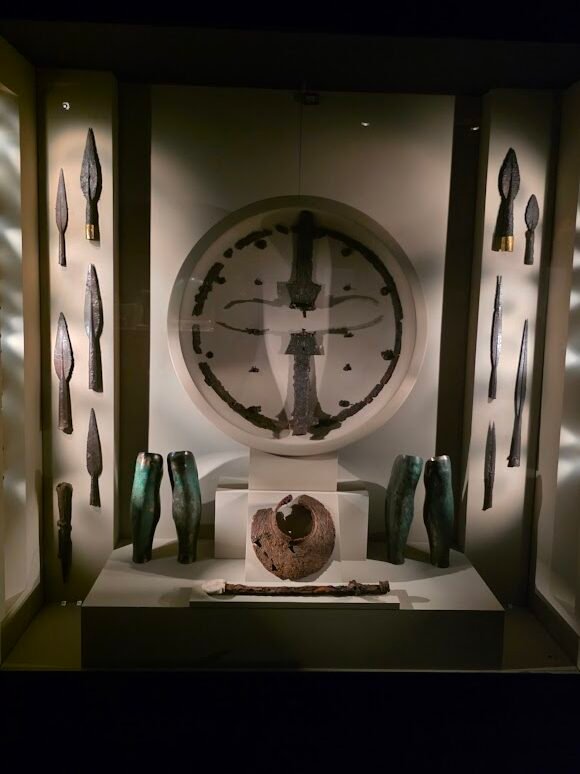
Weaponry of Philip II (336 BCE): Philip’s weapons and armor highlight the dual role of arms in Macedonian society—as essential tools in combat and as prestigious symbols of status. While typical burials in Aigai included two spears or javelins, occasionally a sword, and for the wealthiest, a helmet, Alexander the Great exceeded tradition for his father’s funeral, providing four complete suits of armor: one for the pyre and three as grave goods, all expertly crafted and trimmed with gold. Additional finds from the tomb include a wood, leather, and cloth shield reinforced with iron and decorated with embossed lions; a pectoral with iron plate; an iron sword with ivory-inlaid wooden sheath; two pairs of bronze greaves; an iron sarissa head; an iron spike for anchoring the spear; and nine iron spear and javelin heads, two with broad golden plates. Museum of the Royal Tombs of Aigai, Expats Athens, Expats Greece, Xpat.gr
The Weaponry of Philip II (336 BCE)
Weapons were to men what jewels were to women: valuable objects that served as partners in combat and symbols of status that accompanied the warrior and hunter to the grave. The Macedonians of Aigai traditionally placed two spears or javelins with their deceased, occasionally including a sword and, in rare cases for the exceptionally wealthy and eminent, a helmet. Nevertheless, during the burial of his father, Philip —the General-King who unified Macedonian rule and became the foremost general of all Greeks Alexander the Great went above and beyond previous customs by offering the deceased four complete suits of armour: one for the funeral pyre and three as grave goods. These suits were crafted by skilled artisans who incorporated the latest advancements in metallurgy. Furthermore, the armour was trimmed with gold.
In addition to the weapons offered in the funeral pyre and the suits of armour designated for the antechamber and the main chamber, the following items were discovered in the tomb, as depicted in the accompanying image: a shield made of wood, leather, and cloth, reinforced with iron bands and adorned with embossed lions; a pectoral enhanced with an iron plate; an iron sword with a wooden sheath inlaid with ivorytwo pairs of bronze greaves; an iron head of a sarissa; an iron spike used to anchor the spear into the ground; and nine iron spear and javelin heads, two of which were embellished with wide golden plates. Photo credit: Xpat.gr.
The weapons that were found on the doorstep of the main chamber of Philip II’s tomb (336 BCE)
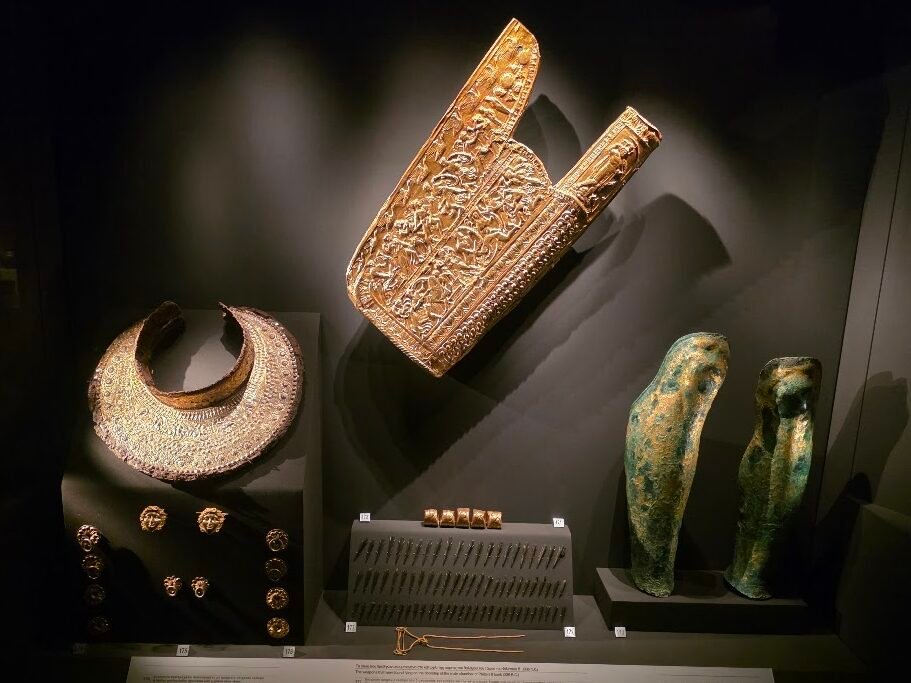
LEFT: leather pectoral decorated with a gilded silver sheet; Two gold molten gorgoneia (Medusa heads), ornaments of a linen cuirass that had disintegrated; golden rosettes and chain links, elements that were used for the fastening and decoration of the linen cuirass.
MIDDLE: Double golden pin with sheath and chain; A gilded silver sheet that covered the front and the underside of a leather gorytos (Thraco-Scythian quiver). On the greater part of its surface are depicted scenes from the conquest of a city, probably that of Troy. In the upper right corner there is the image of a fully armed warrior that can possibly be the god of war, Ares; 75 bronze arrowheadsGold ring-like plates that decorated the bow.
RIGHT: pair of gilded bronze greaves. Photo credit: Xpat.gr.

Vessels that were used for the bathing of the deceased King Philip II. According to the custom observed in Aigai since as early as the 6th century BCE, the vessels used for the bathing of the distinguished dead—usually a cauldron with its andiron and a wide-mouthed bowl—followed them to their graves. This is also the case for Philip II, but here there is no precedent, as the King’s tomb contained objects of such value and variety that they bring to mind the legendary baths of the Homeric heroes. Among them, we find an iron andiron alongside a bronze cauldron, where the water was heated; a bucket with a sponge; three wide-mouthed bowls; an enormous wash basin; a jug; a small basin with handles; and a big bowl. There was also a bronze tripod with the inscription “I am the trophy of Hera of Argos,” a trophy from the games held in honor of Hera, made about a hundred years earlier and preserved as an heirloom in the palace of the dynasty that took pride in its descent from Temenos, King of Argos. The ensemble was completed by an elegant bronze lantern with pan relief. A visible symbol of the Heraclide sovereign’s sacred authority is the silver and gold diadem with “Heracles
knot”
which the hero himself occasionally wore, as well as the bronze wine jug with a gorgon-shaped handle, which, together with the bronze patera (tray), served as the libation vessels necessary for the daily rituals performed by the King. The same is probably true for the torch. The few clay vessels found in the tomb—a wine jug, a perfume jar, and four salt-cellars —were, in all probability, the usual necessary objects for the funeral rites. Photo credit: Xpat.gr.
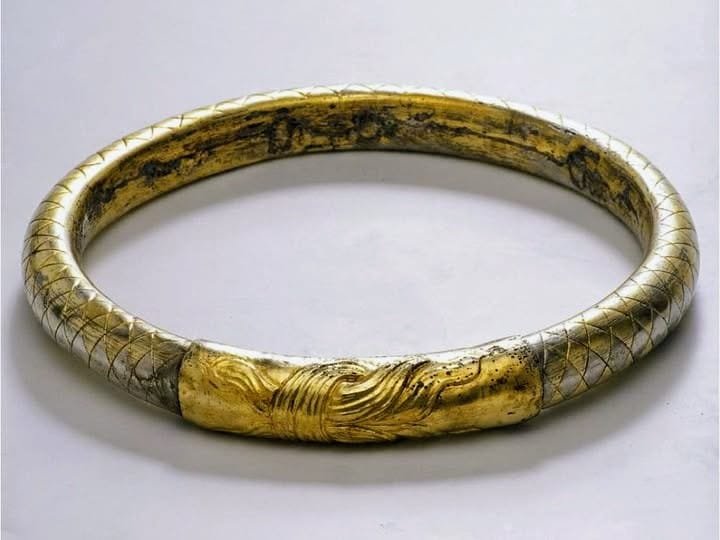
The Silver and Gold Diadem with “Heracles
knot”
of King Philip II, 350-336 BCE

This remarkable diadem features a silver cylinder adorned with incised lozenges that form a circle, secured by a cylinder embellished with a relief of the “Heracles knot.” Entirely gilded except for the central row of lozenges, it creates a striking bi-chrome effect reminiscent of woven textile cords. A unique homage to the girdle of Heracles, this diadem symbolizes the divine origin and high priestly status of the Macedonian Heracleid kings.
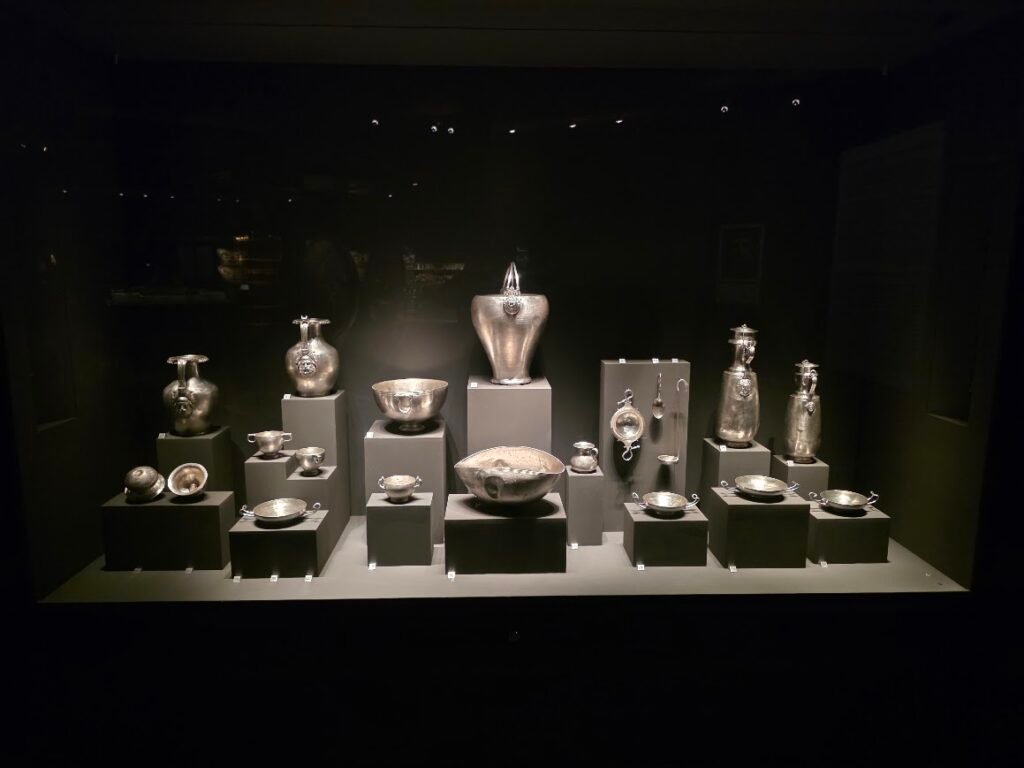
Banquet Utensils and Vessels from the Tomb of Philip II (336 BCE). The banquet, the central event of life on earth, was regarded by advocates of the Platonic ideal and other mystery cults—which promise that death is nothing more than the beginning of a new life—as the ultimate pledge of the delights of posthumous existence. Purified by the flames of the funeral pyre, like Heracles, the hero-king was believed to continue to live, feasting in the eternal banquets of the blessed under the radiant light of the Elysian Fields. Thus, in his tomb, alongside the gold-and-ivory couches, is placed a complete, splendid silver feast set that, in terms of quantity, luxury, and above all quality, is superior to anything of its kind found to date: a situla functioning as a krater where wine was mixed with water; two small amphorae topped with the heads of Heracles and Pan, probably holding especially precious wines; two wine jugs for serving, adorned with Silenus —whose gentle faces recall something of the noble countenance of Socrates as described by Plato; nine drinking vessels (bowls, handled cups), from the base of one of which a drunken Silenus smiles; an odd cup without a foot that seems unexpectedly reshaped perhaps to serve a special need; a small jug; a spoon; a ladle for serving wine; the necessary strainer; and a handled cup with a foot that resembles a fruit bowl. These objects attest to the ceremonial and symbolic importance of feasting for the Macedonian royal court and to the extraordinary skill of contemporary silversmiths. Polycentric Museum of Aigai / Royal Tombs – Display of Treasures — photo credit: Xpat.gr.
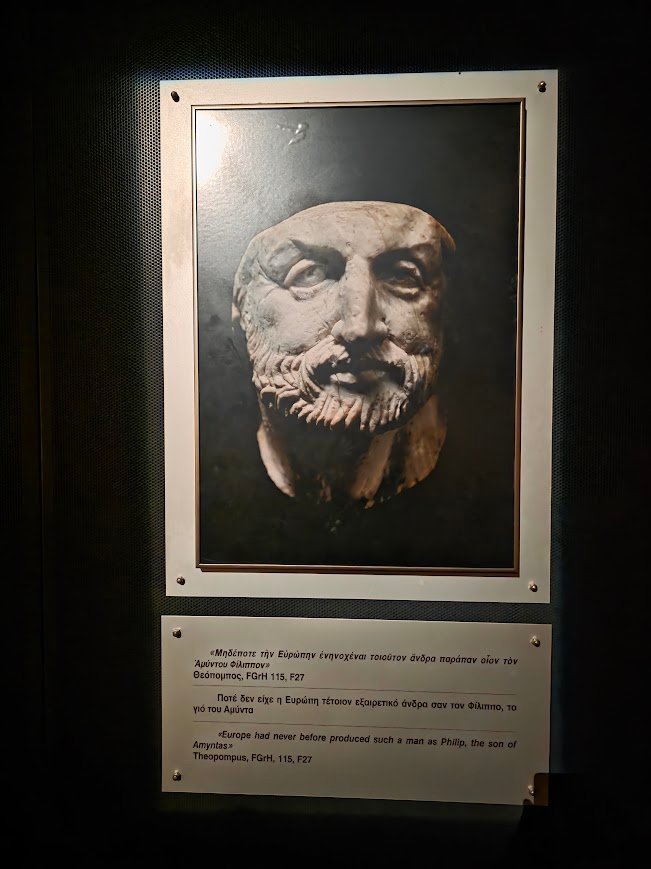
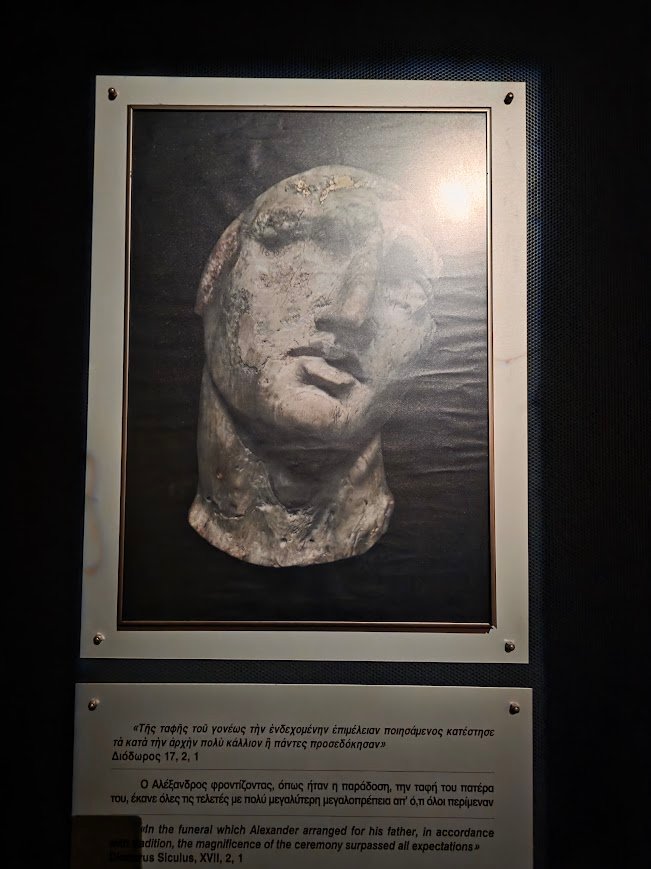
Portrait of Philip II. The remarkably realistic ivory head from the hunting frieze on the gold and ivory couch represents the most striking portrait of the Macedonian king found within his tomb chamber.“Europe had never before produced such a man as Philip, the son of Amyntas” (Theopompus, FGrH, 115, F27).
Gold-and-ivory couch from the burial chamber of the tomb of Philip II. The gold-and-ivory couch from the burial chamber of the tomb of Philip II features embellishments that are masterpieces of carved ivory and gold by the greatest artists of the time, showcasing authentic portraits of Philip and his son Alexander. The frieze depicts a royal hunt scene in which Philip, his young successor Alexander, and about a dozen royal relatives and companions are engaged in hunting. The heads of the figures in the frieze, despite their miniature size, are of momentous importance and without a doubt rank among the most remarkable studies of the human figure known from ancient art. While the theme mirrors the tomb’s facade wall painting, the most precious element is Philip’s own portrait—rendered with exceptional spirit and power, it ranks among the masterpieces of world art. Photo credit: Xpat.gr.
Portrait of Alexander the Great. As the ancient Greek historian Diodorus Siculus recorded, “In the funeral which Alexander arranged for his father, in accordance with tradition, the magnificence of the ceremony surpassed all expectations”—demonstrating the young king’s devotion to honoring Philip II’s legacy through unprecedented ceremonial grandeur.
The remains of the funerary pyre of Phillip II.
About The Funerary Pyre of Philip II:
According to ancient tradition, still alive in Aegai in the 4th century BCE, the dead king — together with the precious objects that had belonged to him in life — was consigned to a magnificent funerary pyre. The remains of the pyre were cast above the tomb, as was customary, presenting an image of splendour that alone would have sufficed to demonstrate that he stood above all others. On a platform of mud bricks smoothed with white mortar a monumental timber structure was erected which, judged by the iron nails and bronze fittings of its door, matched the tomb itself in size and luxury. Within this funerary house, reclining on an ornate gold-and-ivory couch and wearing his golden oak wreath, Philip was delivered to the flames. Thrown onto the pyre with him were weapons and garments, funerary wreaths, vessels of precious perfume, jars of oil and fruit; animals were also sacrificed — among them dogs and horses. After the burning, the king’s bones were carefully gathered, washed with wine, wrapped in purple cloth and placed, together with the wreath, in a golden larnax. The larnax was then secured inside a marble sarcophagus, the heavy door closed, and the tomb sealed for ever. Polycentric Museum of Aigai / Royal Tombs – Display of Treasures — photo credit: Xpat.gr.

Tomb of Alexander IV — “Tomb of the Prince” (Tomb III)

North‑west of Philip II’s tomb stands the so‑called Tomb of the Prince (c. 310–300 BCE), widely attributed to Alexander IV, the posthumous son of Alexander the Great and Roxane. Osteological analysis of the cremated remains—those of a youth of about 13–14 years —and the richness of the burial assemblage support this identification. Classical sources and later historians have long accused Cassander of responsibility for the prince’s premature death, a sombre backdrop to the site.

Architecturally the tomb echoes Philip’s vault on a reduced scale. Its stuccoed Doric façade once carried a painted frieze (now lost), and two relief shields beneath the frieze retain traces of their original decoration. Inside, the antechamber features a painted frieze of chariots; the burial chamber yielded a lavish array of gold and silver —chiefly banqueting vessels —alongside ivory objects weaponspottery and other grave goods. The cinerary urn is a silver hydria, its neck encircled by a gold oak wreath. A wooden mortuary couch richly inlaid with gold and ivory was also recovered; its decoration includes a striking scene of Dionysos accompanied by a flute‑player and a satyr.

Today the tomb’s finds are displayed in glass cabinets before the burial chamber, offering visitors an intimate encounter with the material culture of Macedonia’s royal house.
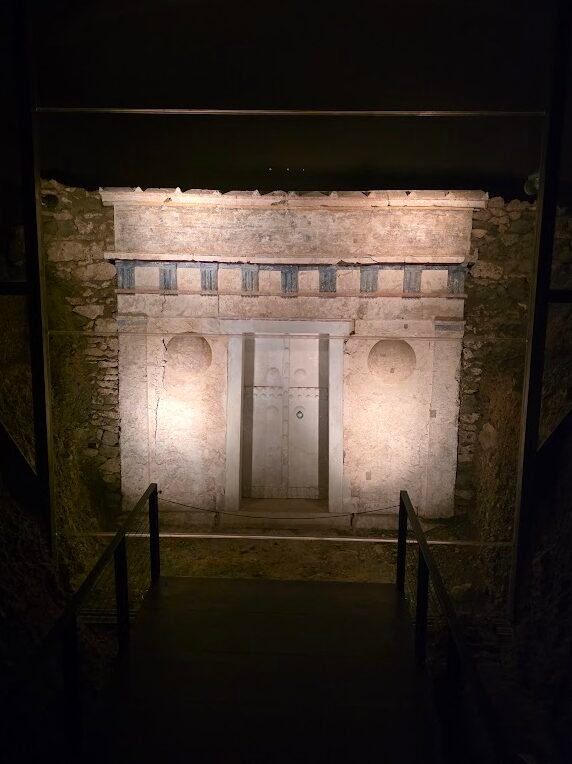
Tomb of Alexander IV (Tomb III), the so‑called Tomb of the Prince (c. 310–300 BCE). Stuccoed Doric façade with two relief shields beneath a now‑lost painted frieze. Polycentric Museum of Aigai / Royal Tombs – Display of Treasures — photo credit: Xpat.gr.
The silver cinerary hydria that held the bones of Alexander IV, accompanied by his gold oak wreath (310 BCE). Polycentric Museum of Aigai / Royal Tombs – Display of Treasures — photo credit: Xpat.gr.
The weapons, bathing vessels and other grave goods found in the Tomb of Alexander IV (c. 310 BCE). Polycentric Museum of Aigai / Royal Tombs – Display of Treasures — photo credit: Xpat.gr.
The silver vessels found in Alexander IV’s tomb (c. 310 BCE). Polycentric Museum of Aigai / Royal Tombs – Display of Treasures — photo credit: Xpat.gr.
Relief from the decoration on the gold and ivory couch of Alexander IV (310 BC).
A young flute-playing satyr is leading Dionysos and his companion to revellery. Polycentric Museum of Aigai / Royal Tombs – Display of Treasures — photo credit: Xpat.gr.
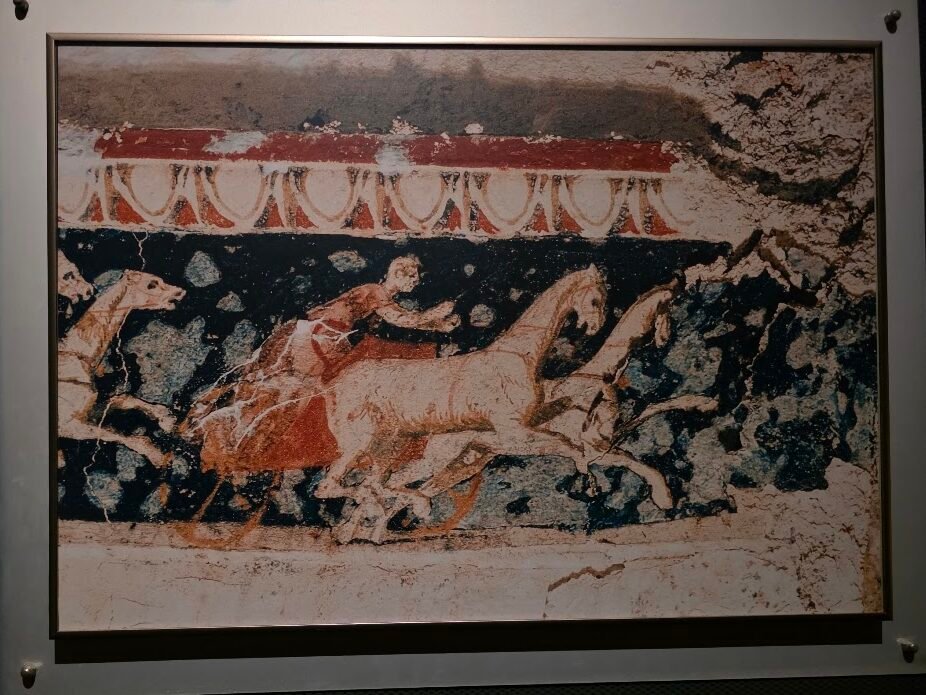
Replica of the chariot‑race scene from the painted frieze in the antechamber of the Tomb of Alexander IV (c. 310 BCE). Polycentric Museum of Aigai / Royal Tombs – Display of Treasures — photo credit: Xpat.gr.

2. Central Museum Building

After exploring the Museum of the Royal Tombs, our journey continues to the new Central Museum Building, a destination in its own right. Opened in late 2022 and located 1.7 kilometres from the Royal Tombs, this contemporary space offers a strikingly different experience. Where the tombs are dimly lit and intimate, focused almost exclusively on kings and funerary ritual, the Central Museum Building feels open and almost weightless, flooded with natural light and expansive volumes of white stone. Here, the story of royalty is presented alongside the lives of the ordinary citizens who once filled the city, creating a richer, more complete picture of ancient Aigai.

The Central Museum Building serves as the unifying core of the Polycentric Museum of Aigai, which includes Philip II’s Palace and Theater, the vast necropolis of Aigai, and the Museum of the Royal Tombs. It acts as the symbolic gateway to the archaeological site, guiding visitors through the history of Aigai, the culture of the Macedonians, and the wider Hellenistic Oikoumenē (World), while also housing the physical headquarters of the digital museum “Alexander the Great: From Aigai to Oikoumenē.”

Alongside the introductory exhibition, “A Window to the World of Alexander the Great,” the building unfolds through a sequence of displays: an architectural exhibition centred on a reconstructed section of the palace, a sculpture exhibition, the core exhibition “Aigai Memory,” the temporary exhibition “Oikoumenē Antídoron,” and an Art Gallery featuring works by contemporary artists.

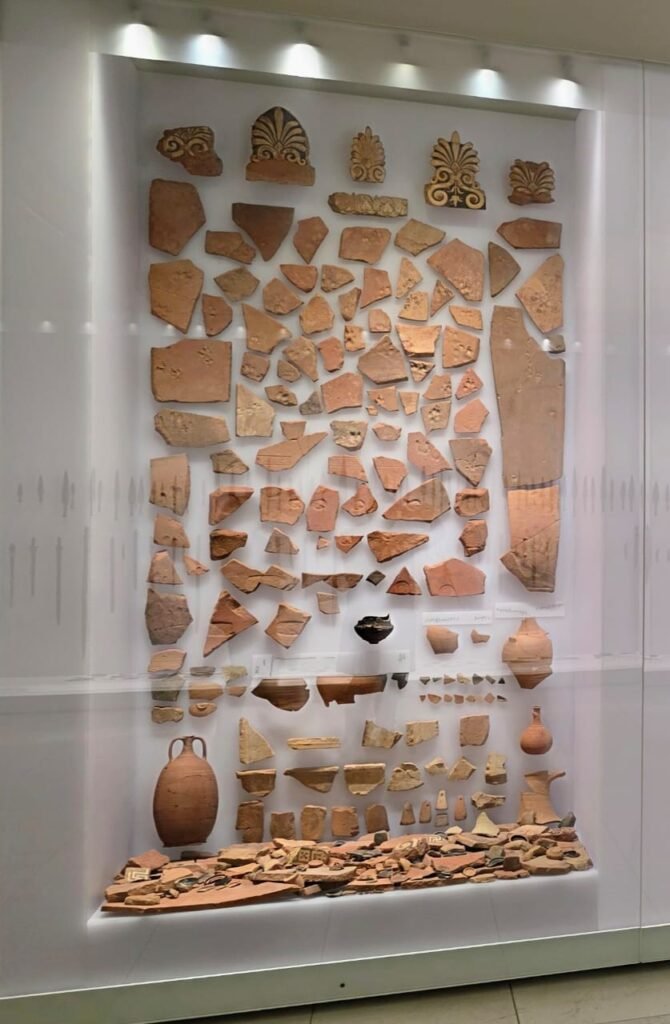
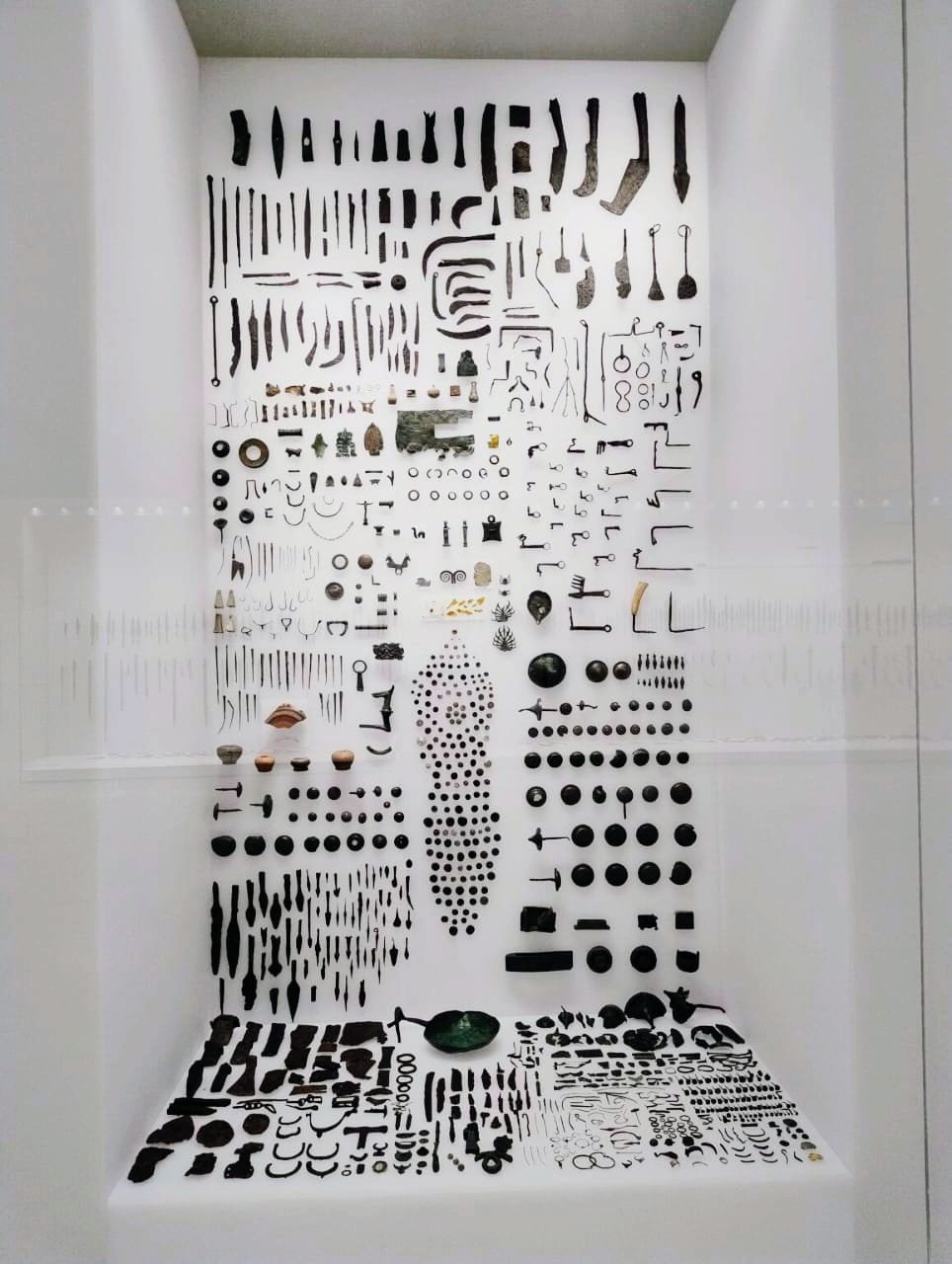
The main exhibition, “Aigai Memory,” brings the ancient city back into focus through what was broken, burned, or quietly abandoned. Fragments recovered from layers of destruction—everyday tools, weapons, symposium vessels, stamped roof tiles, and traces of women’s domestic lives, including jewelry, hairpins, makeup pots, and household keys—are woven into a narrative that reveals how life once unfolded in the Macedonian capital, from domestic routines to public ritual. The exhibition moves between the palace and the wider city, culminating in the remains of the monumental funeral pyres of the Temenids, where traces of power survive in ash, metal, and melted ornamentation. Its final galleries present ten richly adorned “Ladies of Aigai,” reconstructed with their full array of jewelry, underscoring the visibility, authority, and symbolic presence of elite women within the Macedonian royal world. Together, these objects transform absence into memory, allowing Aigai to be understood not as a ruin, but as a lived city

Many of the artefacts come from excavations carried out in recent years within the ancient city itself, and curators plan to regularly refresh the displays as new discoveries are made. With less than ten percent of Aigai excavated so far, the museum is not a conclusion, but an invitation—bringing an ancient city back into view, one fragment at a time.

Central Museum Building of Aigai: Images and Captions
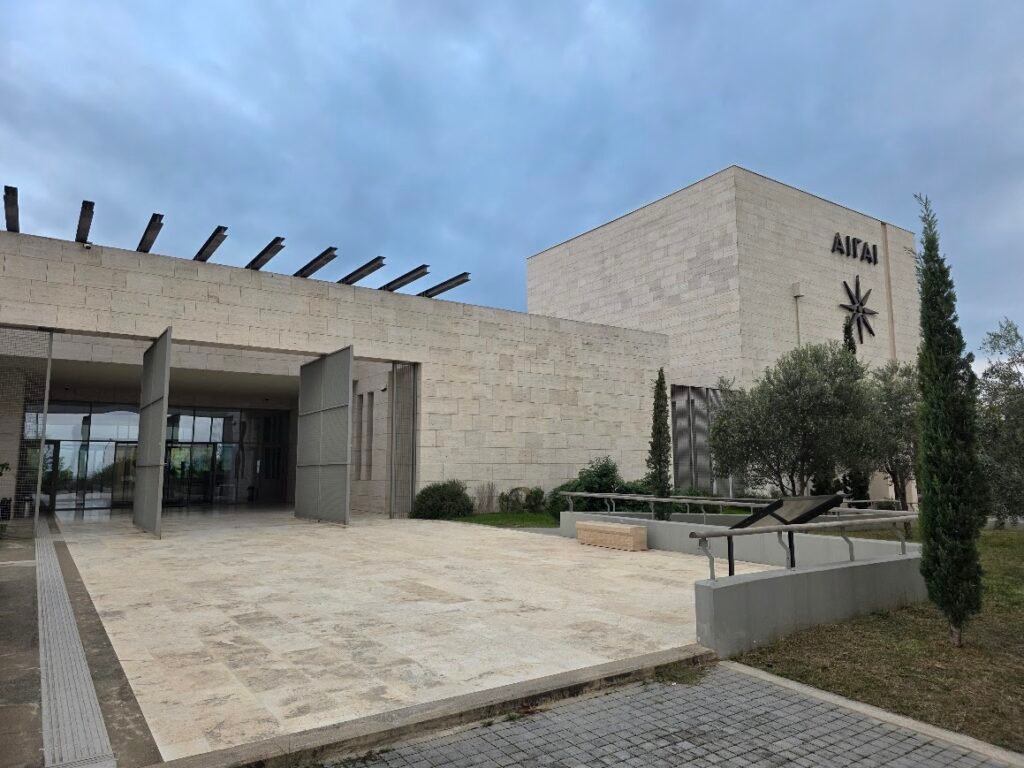
The Central Museum Building: an ingeniously curated complex with 7,000 sq. m of exhibition space. Polycentric Museum of Aigai / Royal Tombs – Display of Treasures — photo credit: Xpat.gr.
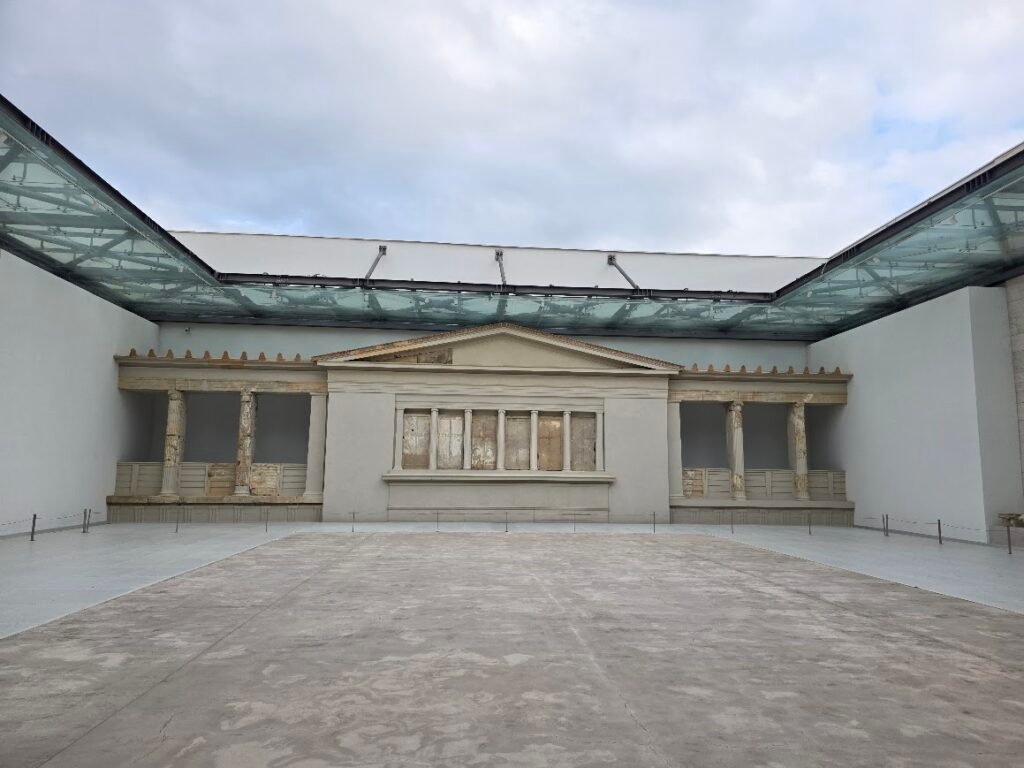
The glass-roofed atrium of the new museum features a 30-metre-long by 7-metre-tall reconstruction of the upper floor of Philip’s Palace, built largely with original materials (the lower floor is currently being reconstructed in situ). It was the largest building of classical Greece, covering around 15,000 square metres, dating to the mid-4th century BCE, and representing the culmination of Philip’s vision to modernize and transform the royal capital of the Macedonians. The immense palace complex, with its double colonnade, became a model for monumental architecture far beyond Macedonia, influencing designs across mainland Greece and as far as Asia. Polycentric Museum of Aigai /Central Museum Building — photo credit: Xpat.gr.
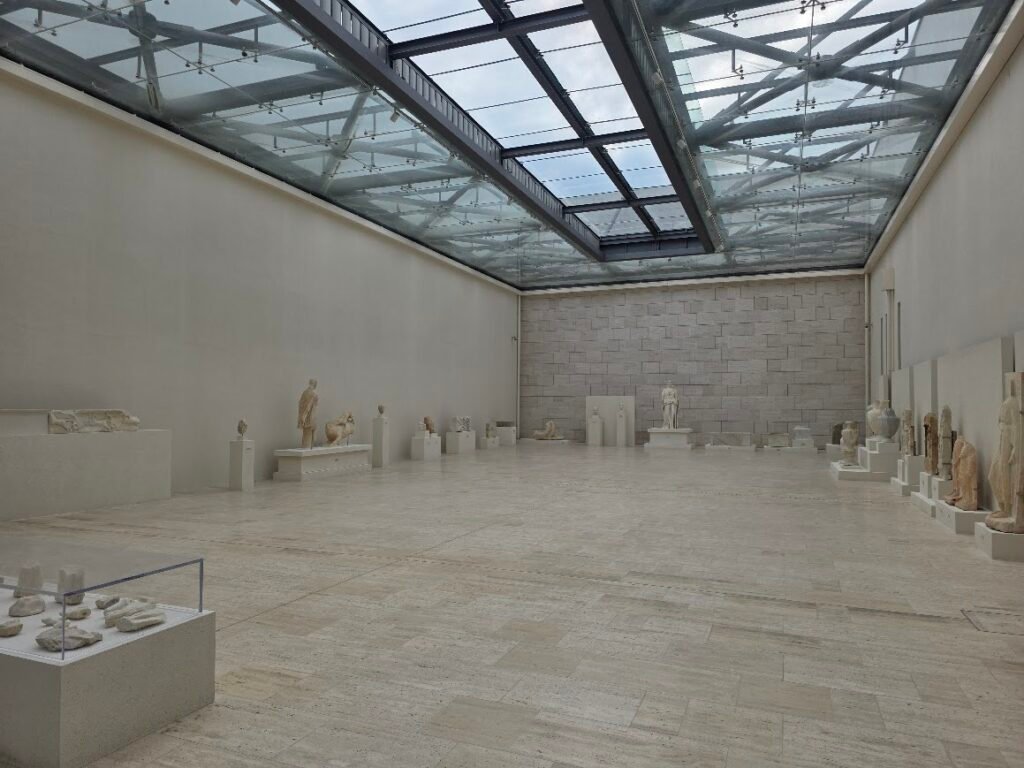
The Sculpture exhibition. The exhibition features statuary, reliefs, significant inscriptions mostly from the 4th century BCE, royal dedications, and votive offerings, including finds from the extensive excavations across the wider archaeological site of Aigai. Polycentric Museum of Aigai /Central Museum Building — photo credit: Xpat.gr.
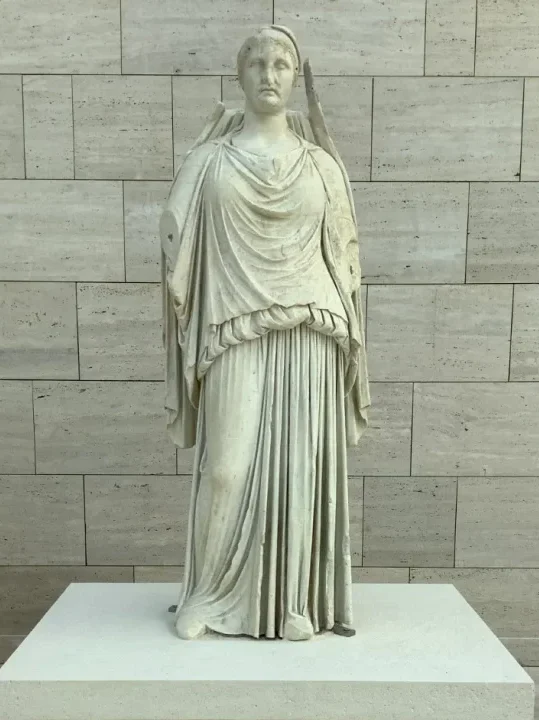
Statue of Queen Eurydice, wife of King Amyntas III of Macedon and a powerful political figure. Eurydice was the mother of three Macedonian kings—Alexander II, Perdiccas III, and Philip II, the father of Alexander the Great. Slightly larger than life-size, the statue was a votive offering by the queen in the Sanctuary of the goddess Eukleia, dating to the 3rd quarter of the 4th century BCE.
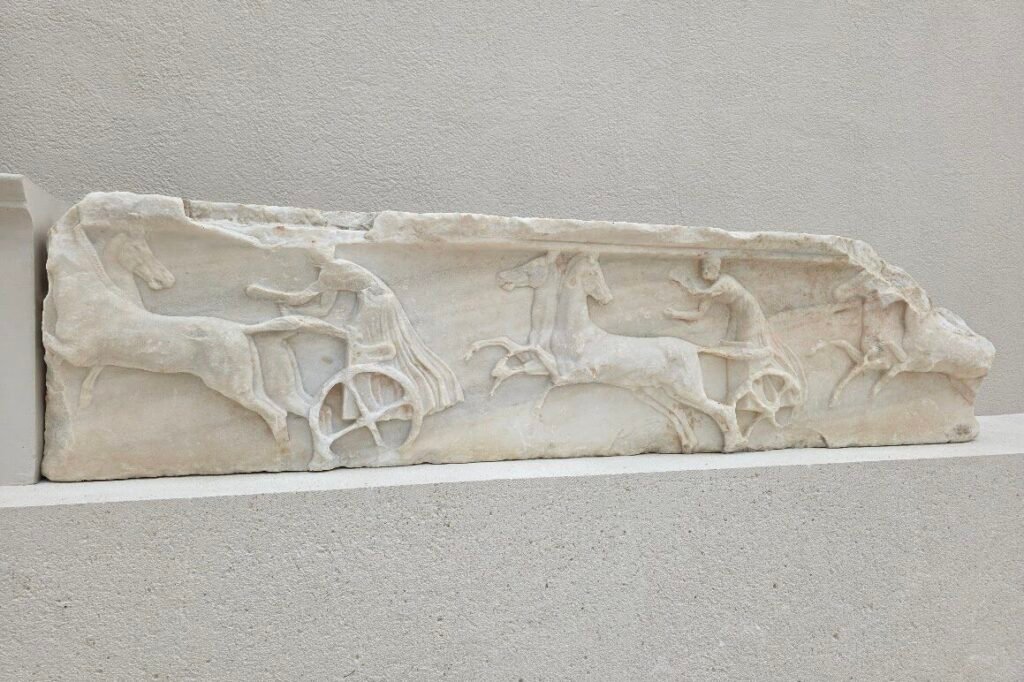
Relief frieze depicting a chariot race. The scene closely parallels the painted frieze decorating the antechamber of Alexander IV and is thought to represent funeral games (last quarter of the 4th century BCE). Polycentric Museum of Aigai /Central Museum Building — photo credit: Xpat.gr.

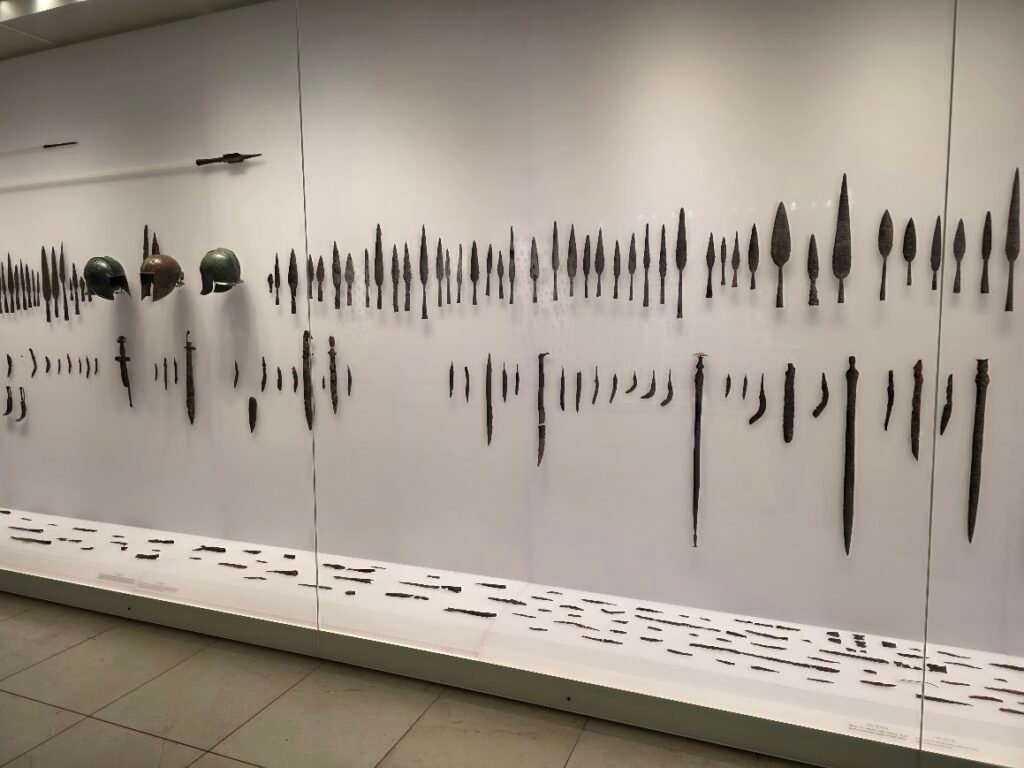
Arms and armour of the ancient Macedonians, arranged in chronological sequence. The display begins with long swords, spears, and javelins, while later periods—marked by the rise of cavalry warfare—show shorter swords. Knives, spear and javelin heads, helmets, shields, and the era’s ultimate weapon, the famed sarissa, reaching up to six metres in length, are also presented, with surviving fragments given pride of place. Polycentric Museum of Aigai /Central Museum Building — photo credit: Xpat.gr.
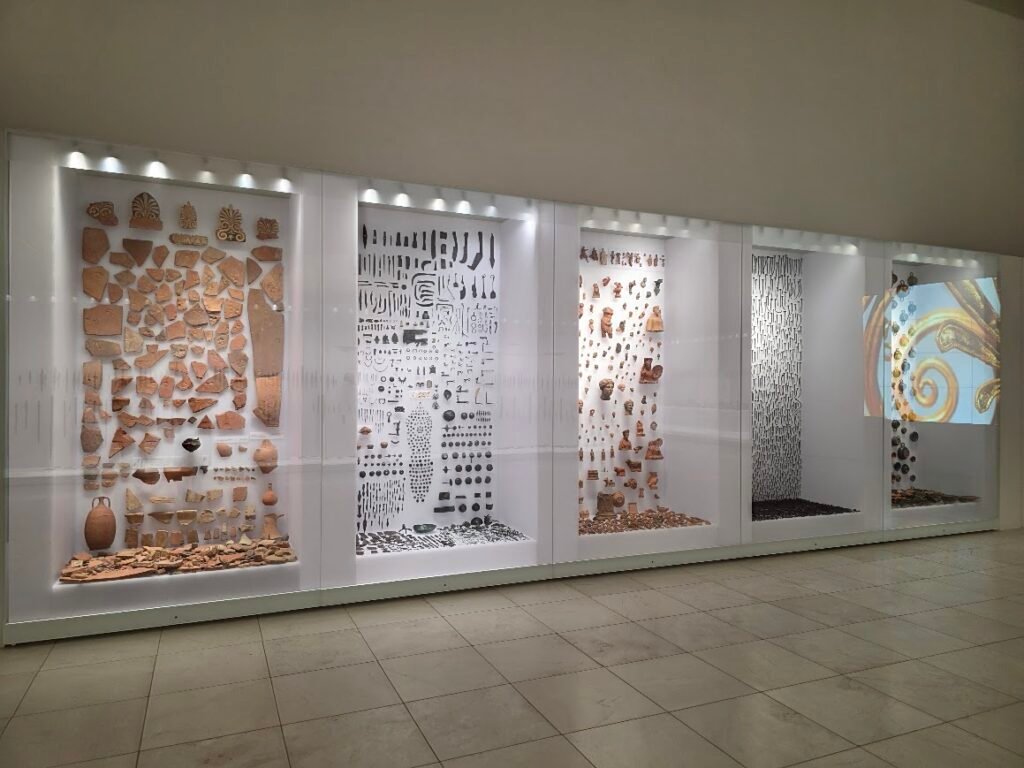
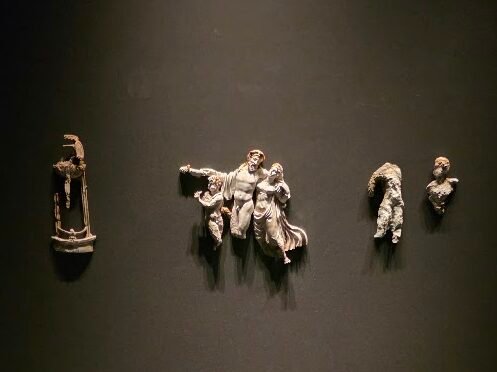
The central exhibition, “Aigai Memory,” presents its finds in thematic sections and with a distinctly minimalist approach, exploring the many dimensions of Macedonian life. Objects range from iron keys, terracotta figures, and oil lamps to the iron nails from the Palace of Aigai, all treated with equal significance. Carefully crafted interpretive texts—some expansive, others concise—guide visitors through what they are seeing, situating each object in both place and time. Under the heading “Resurrecting a City,” one text asks: What remains when a city is lost, when even its name is forgotten? What endures are its foundations, the successive layers of destruction that emerge from the soil at the archaeologist’s touch—chaotic and shapeless at first glance, yet filled with the work of human hands: fragments, traces, and messages, waiting patiently to be read, transformed into memory and knowledge. Polycentric Museum of Aigai /Central Museum Building — photo credit: Xpat.gr.
In this display case, attention shifts from the elaborate anthemion roof finials to a roof-tile fragment stamped with a goat’s head, identifying it with Aigai, whose name means “goats” in Greek, and then to humbler objects: terracotta shards bearing a human handprint and the tracks of dogs, cats, and roosters. Together, they remind us that every object deserves to be seen.
Iron keys, crafted by hands long gone, stand as quiet witnesses to doors once opened and lives lived centuries ago (4th century BCE–1st century AD)
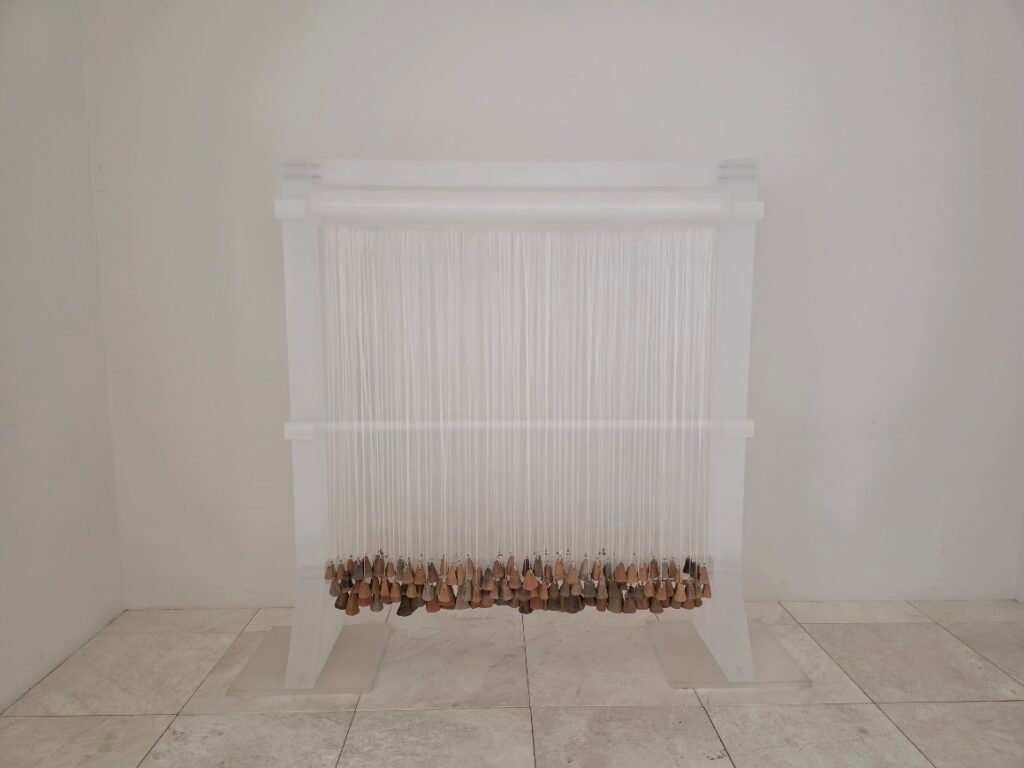
A loom reconstructed on a modern frame, strung with dozens of terracotta weights. Queens, noblewomen, and ordinary women alike—married women and maidens—would have spent countless hours moving back and forth at the loom. Polycentric Museum of Aigai /Central Museum Building — photo credit: Xpat.gr.
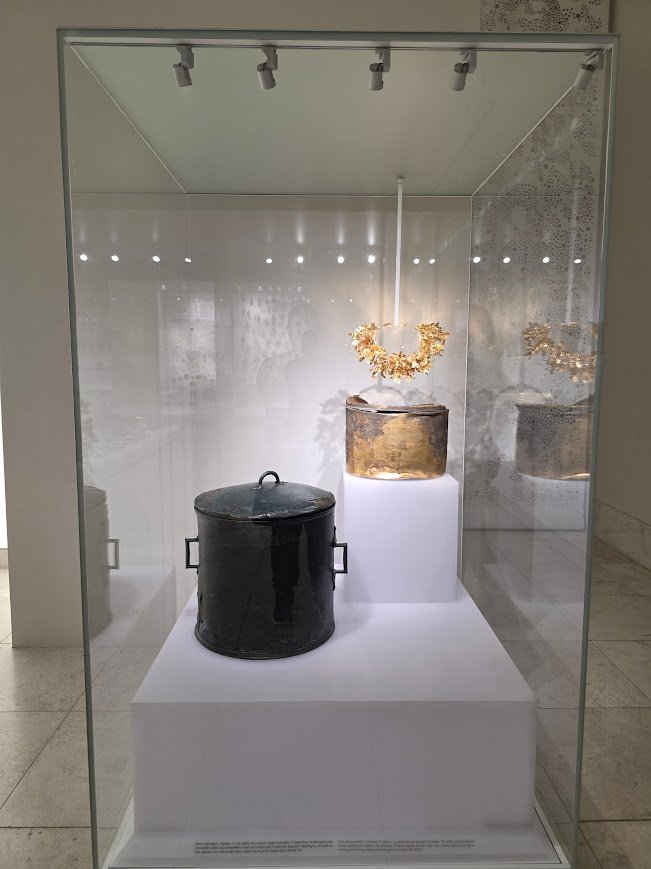
Golden cremation urn containing the bones of a teenager and a gold oak wreath. The urn, placed inside a bronze cauldron, was deposited in the sanctuary of Eukleia (325–300 BCE). Polycentric Museum of Aigai /Central Museum Building — photo credit: Xpat.gr.
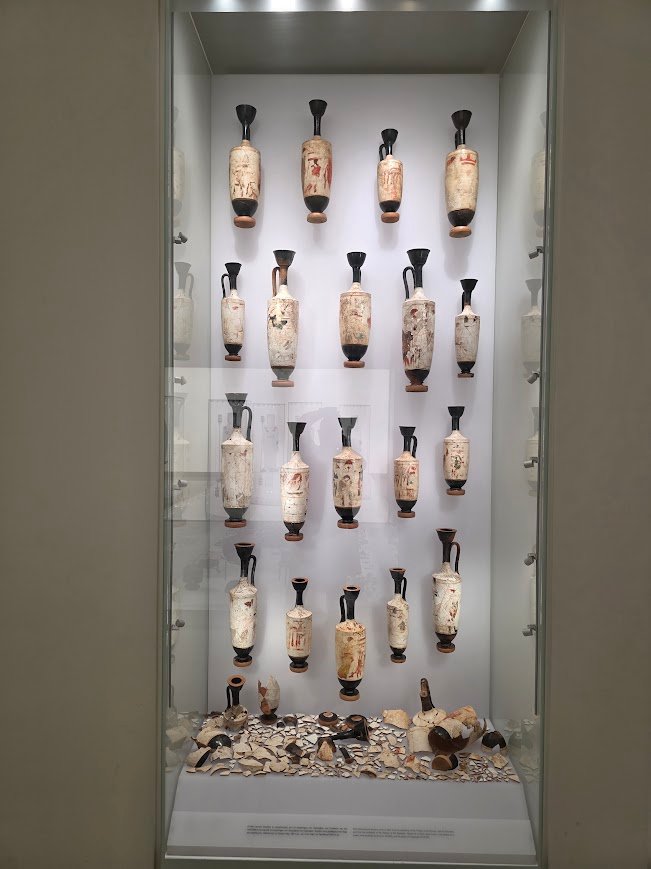
Attic polychromatic white-ground lekythoi by known painters from the excavation at the Royal Necropolis of Aigai. Polycentric Museum of Aigai / Central Museum Building — photo credit: Xpat.gr.
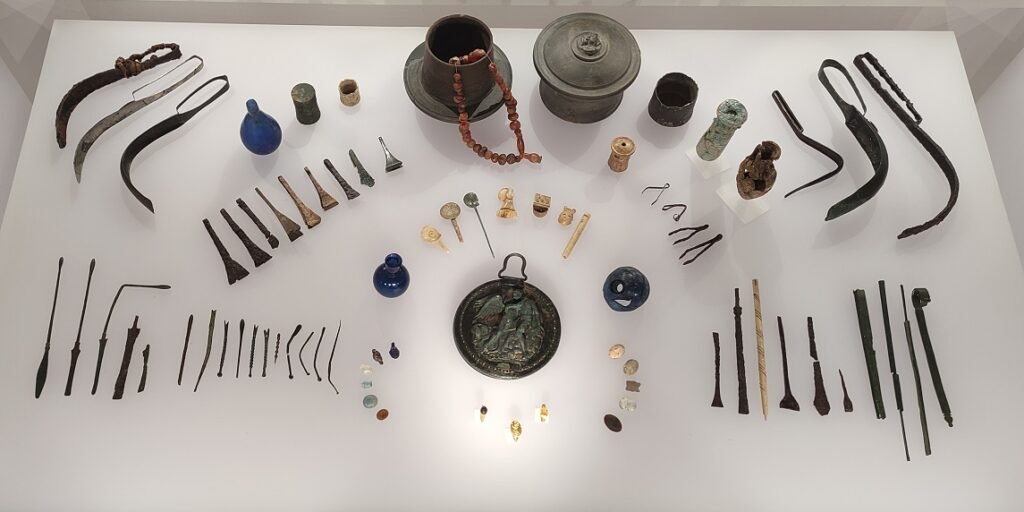
Makeup was known to the ladies of Aigai: tiny tweezers, delicate instruments, and toiletry boxes (pyxides) with lead-white facial powder were part of the female toilette and also indicated gender after death.
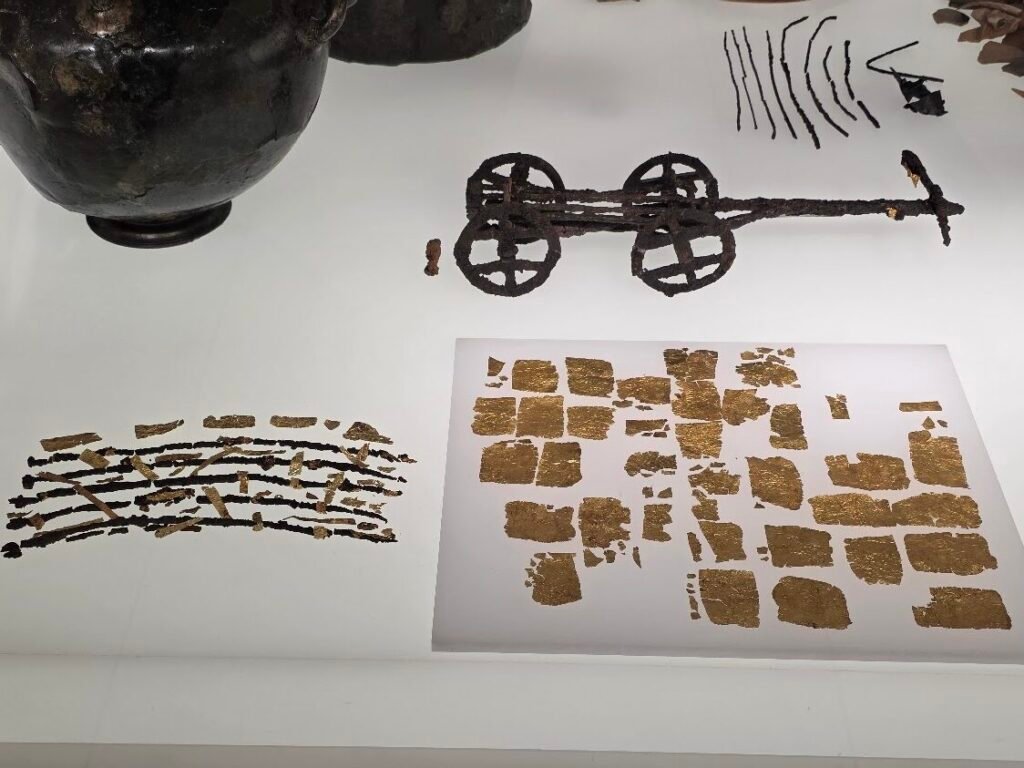
Iron four-wheeled cart, originally with gold-decorated pack animals attached, surviving only as gold bands, and several iron spits, found in the burial of the “Lady of Aigai” within the “Cluster of the Queens” necropolis, c. 500 BCE. Polycentric Museum of Aigai /Central Museum Building — photo credit: Xpat.gr.
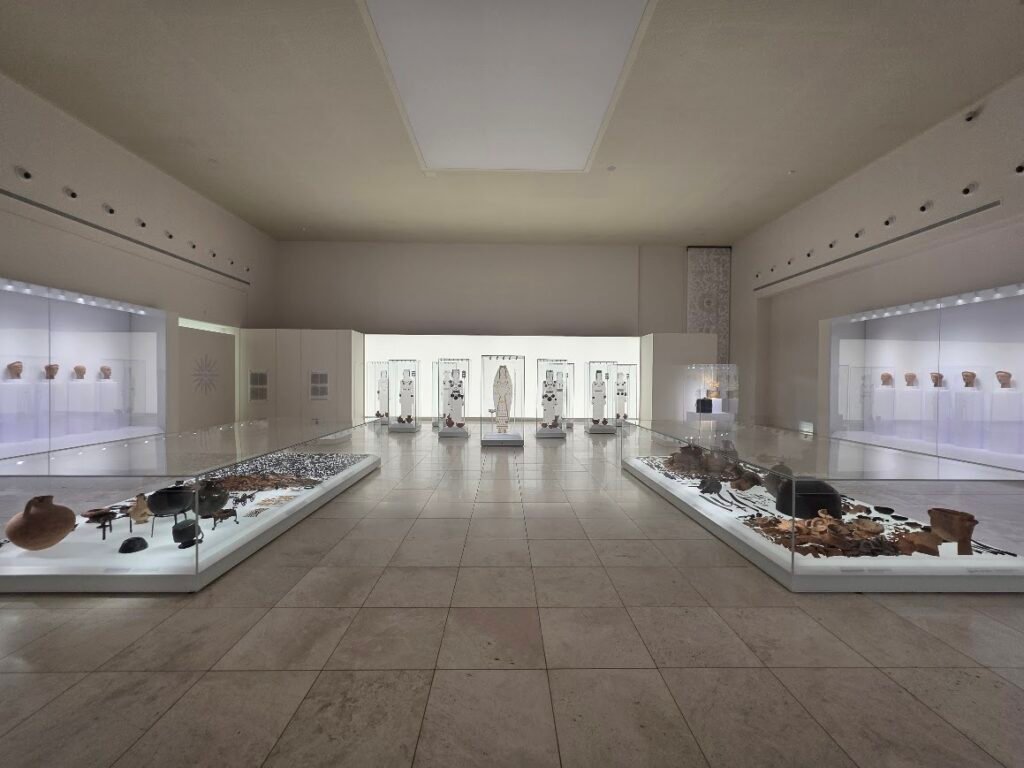
View of the exhibition: in the rear display cases on the right and left are heads of korai (maidens) and daemons (spirits). At the centre are remains from the monumental funeral pyres of the Temenids, including fragmented burial treasures and traces of royal power. From the background, nine Macedonian queens appear as if advancing toward the foreground. Polycentric Museum of Aigai /Central Museum Building — photo credit: Xpat.gr.
One of the most surprising and visually striking sections of the exhibition is the ingeniously curated display of the nine Queens of Macedon, led at the front by the so-called “Lady of Aigai” (c. 495 BCE), identified as the Lydian wife of King Amyntas I. These “queens” are, in fact, pre-Temenid noblewomen dating from the 10th to the 8th century BCE. They are presented through their rich funerary adornments, arranged on translucent, human-like standing figures, creating the powerful illusion that these women have re-emerged, almost as living presences, before the visitor. Mothers and wives, sisters and daughters, these women were not merely symbols of power but its active bearers. They claimed a role in authority and in shaping ideology, even identifying themselves in inscriptions by their father’s name rather than their husband’s—a striking assertion of lineage and status in the Macedonian world. Polycentric Museum of Aigai /Central Museum Building — photo credit: Xpat.gr.so

Sources: https://www.latsis-foundation.org/content/elib/book_20/aiges_en.pdf


Powered by GetYourGuide

Powered by GetYourGuide

Powered by GetYourGuide

Powered by GetYourGuide

Powered by GetYourGuide

Leave a Reply

Your email address will not be published. Required fields are marked *