
Updated: 15 August 2026
Every year on August 15, Greece marks Dekapentavgoustos, the Feast of the Dormition of the Virgin Mary. Often called the “summer Easter”, it is one of the most important celebrations in the Greek Orthodox calendar. The day also has a strong social significance, as many Greeks return to their family villages and islands during the main summer holiday period.
Religious services and processions take place across the country. In many communities, the observance is followed by a panigiri, where local residents, returning families and visitors gather for food, music and dancing.
August 15 is also one of Greece’s largest name-day celebrations. People call, visit or send messages to relatives and friends named Maria, Marios, Panagiotis, Panagiota, Despina and other names associated with the Virgin Mary.
Dekapentavgoustos at a glance
Date: 15 August
Religious feast: The Dormition of the Virgin Mary
Greek name: Κοίμηση της Θεοτόκου
Common description: The “summer Easter” or “summer Pascha”
Public holiday: August 15 is a compulsory public holiday in Greece, subject to the exceptions provided by Greek labour law
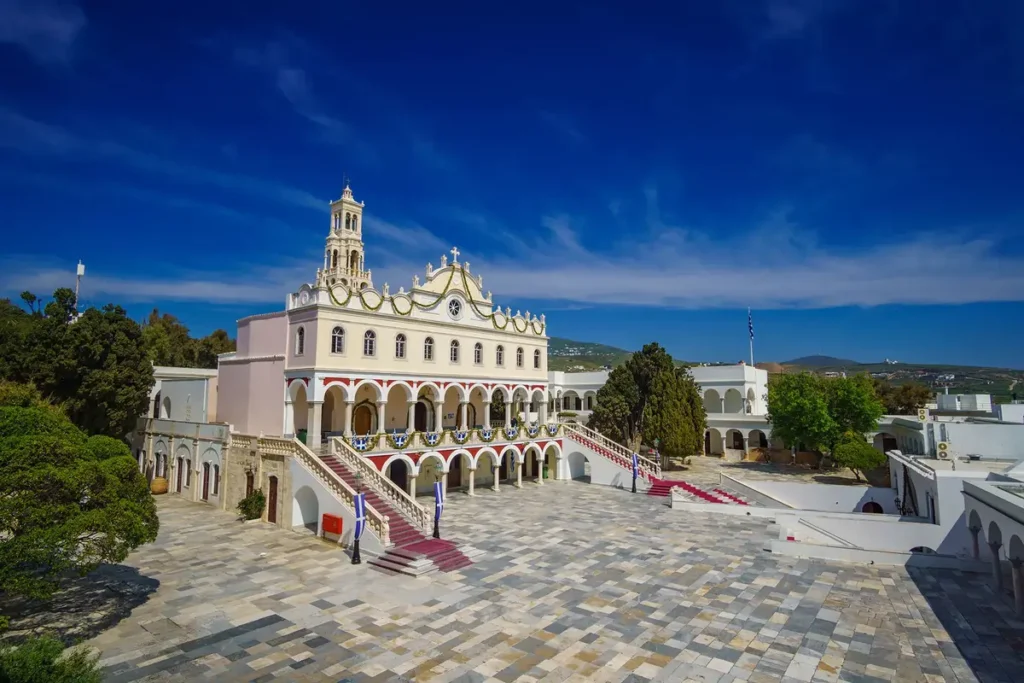
Panagia Evangelistria in Tinos
Navigate this guide to August 15 in Greece
What does Dekapentavgoustos mean?
What does the Dormition commemorate?
How the faithful prepare for August 15
What does Dekapentavgoustos mean?
Dekapentavgoustos (Δεκαπενταύγουστος) literally means “the fifteenth of August”. In everyday Greek, the word refers both to the date and to the religious and cultural season surrounding it.
The formal Greek name of the feast is the Koimisi tis Theotokou (Κοίμηση της Θεοτόκου), the Dormition of the Theotokos. Koimisi means “falling asleep”, while Theotokos means “God-bearer” or “Mother of God”.
In Greece, the Virgin Mary is more commonly called the Panagia (Παναγία), meaning the “All-Holy One”. This is why so many churches, monasteries and religious festivals dedicated to her begin with the name Panagia.
English-language calendars and travel information may call August 15 the Assumption of the Virgin Mary. Although the words are sometimes used interchangeably in general English, Dormition is the standard name of the Orthodox feast and places particular emphasis on Mary’s repose, described as her falling asleep.
What does the Dormition commemorate?
The New Testament does not describe the end of the Virgin Mary’s earthly life. The account commemorated on August 15 comes from the tradition of the Church.
According to that tradition, the Apostles were gathered at Mary’s side in Jerusalem as the end of her earthly life approached. After her repose, her body was carried in procession and placed in a tomb near Gethsemane. When the Apostle Thomas later asked to see her, the tomb was found empty.
Orthodox tradition therefore commemorates Mary’s death, described as her “falling asleep”, and her translation into heavenly life. The day is solemn, but its message is one of hope rather than despair. Death is understood as a passage and not the end of life.
Why is it called the “summer Easter”?
Dekapentavgoustos is popularly known as the “summer Easter” or “summer Pascha” because of its religious importance and its message of life beyond death. It also falls at the height of summer, when many Greeks return to their family villages and islands.
How the faithful prepare for August 15
For observant Orthodox Christians, preparation begins on 1 August with the Dormition Fast, which continues until 14 August.
Traditional fasting practice excludes meat and dairy products and is stricter on certain days. Fish is permitted on 6 August for the Feast of the Transfiguration. The degree to which the fast is followed varies according to health, personal circumstances and spiritual guidance.
During this period, the Small and Great Paraklisis, services of supplication to the Virgin Mary, are traditionally chanted on weekday evenings in Orthodox churches.
Great Vespers is celebrated on the eve of the feast. Matins and the Divine Liturgy are celebrated on August 15. The precise timetable and any local processions vary by parish, church and pilgrimage site.
How Greece celebrates Dekapentavgoustos
August 15 brings together religious devotion, family reunion and local identity. The balance differs from place to place. At a major pilgrimage centre, the emphasis may fall on the liturgy and procession. In a mountain village or on an island, the church observance may be followed by a communal meal and traditional festival.
Church services and processions
Churches dedicated to the Dormition or to a locally venerated icon of the Panagia become the centre of the celebration. Worshippers attend services, light candles, bring offerings and, where a procession is held, follow an icon through the surrounding streets.
Names such as Panagia Evangelistria, Panagia Ekatontapyliani, Panagia Soumela, Panagia Spiliani and Panagia Portaitissa refer to particular churches, monasteries, icons, places or titles of the Virgin Mary. They reflect the close relationship between devotion to the Panagia and the identity of individual Greek communities.
Returning to the family village
August is the principal holiday month in Greece, and Dekapentavgoustos is closely associated with returning to family homes, ancestral villages and islands. Relatives who live in Athens, Thessaloniki or abroad may meet again in the place from which their family comes.
For communities whose permanent populations have declined, the feast can briefly restore the village to its former scale. Houses reopen, church bells sound and several generations gather in the square.
From religious observance to panigiri
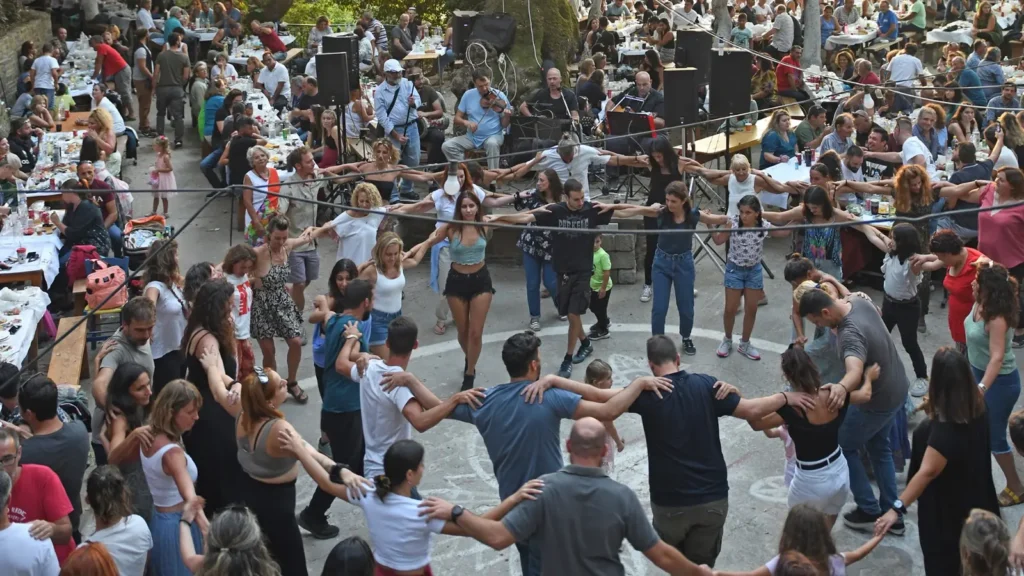
In many communities, the religious observance is followed by a panigiri, a traditional Greek village festival and local community celebration. Food, wine, live music and regional dances bring residents, returning families and visitors together.
The character of each celebration is different. Some gatherings are small and centred on a chapel. Others attract large crowds and continue into the early hours.
For dates, destinations and local traditions, explore our complete August panigyria calendar and Greek village festival guide.
Tinos: Greece’s great August 15 pilgrimage
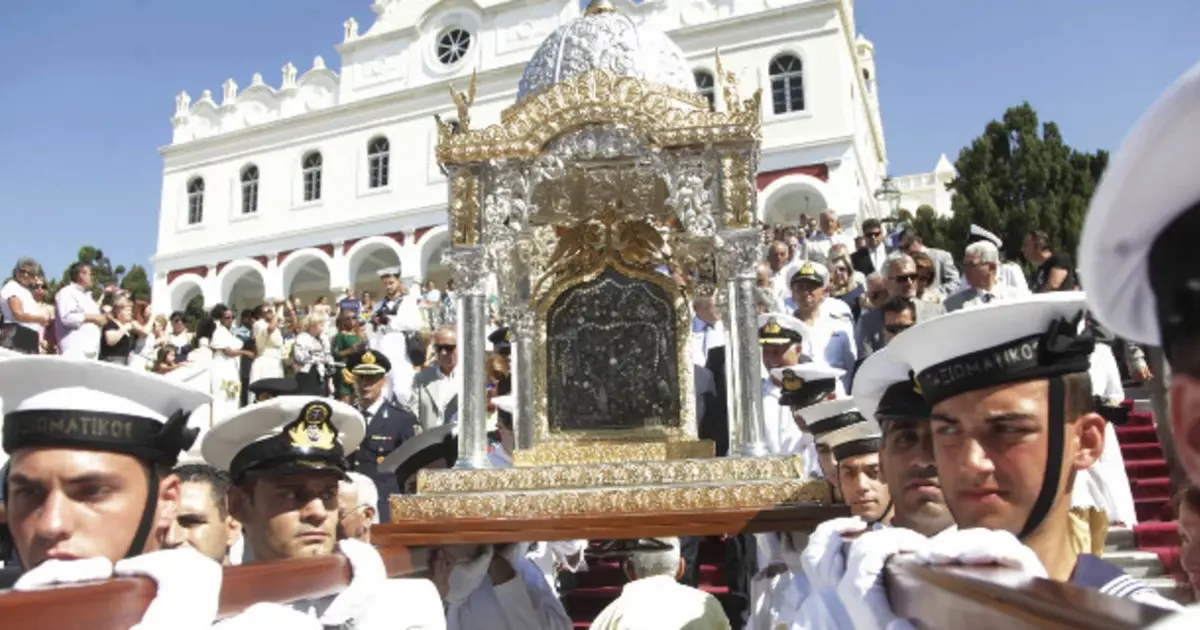
The island of Tinos is Greece’s best-known centre of pilgrimage on August 15. Thousands of worshippers travel to the Church of Panagia Evangelistria, widely known as the Megalochari, to venerate its holy icon.
According to the official website of Panagia Tinou, the nun Pelagia experienced a series of visions in July 1822 in which the Virgin Mary directed her to the place where the icon would be found.
Excavations uncovered the remains of an earlier church but initially failed to locate the icon. Work later resumed, and on 31 January 1823 the icon of the Annunciation was discovered. The Church of Evangelistria was built on the site and became one of the most important pilgrimage destinations in Greece.
From the port of Tinos, the avenue rises towards the church. Some pilgrims make their way uphill on their knees as an expression of faith, gratitude or the fulfilment of a vow. Visitors should avoid obstructing them or treating the practice as a spectacle.
On August 15, the holy icon is carried through Tinos town with religious and official honours. The day also carries a national historical memory. The Greek cruiser Elli was torpedoed by the Italian submarine Delfino outside the port on 15 August 1940, while the ship was present for the religious celebrations.
The sinking occurred before Greece formally entered the Second World War. It is commemorated as part of the official observances on Tinos. The incident and the reason for the ship’s presence are documented by the Hellenic Navy.
Anyone planning to visit Tinos at this time should arrange ferry tickets and accommodation well in advance. The island receives very large numbers of pilgrims and visitors around the feast.
Celebrations across Greece
Tinos may be the country’s most famous pilgrimage, but Dekapentavgoustos belongs to communities throughout Greece. Each place gives the feast its own sound, food, movement and local story.
Paros and Panagia Ekatontapyliani
In Parikia on Paros, Panagia Ekatontapyliani becomes the centre of the island’s observance. According to Visit Greece, the afternoon procession of the icon and decorated bier is followed in the evening by a harbour celebration with music, dancing, fireworks and illuminated fishing boats.
Island traditions
On Nisyros, the observance is associated with Panagia Spiliani. In Olympos on Karpathos, the feast is marked by traditional dress and ceremonial dancing. Ikaria is known for large panigyria where music, food and dancing bring together residents, returning islanders and visitors.
These are living community traditions. Their meaning comes from the relationship between religious observance, local families and the place itself.
Mountain communities reunited
Dekapentavgoustos is equally important on the mainland. In Vlasti in Western Macedonia and Syrrako in Epirus, August 15 traditions historically marked a reunion of pastoral communities before livestock farmers moved towards their winter pastures.
Today, the festivities continue to reunite people whose families have moved away from the villages. The Tranos Choros, or Grand Dance, of Vlasti and the Syrrako festival were inscribed together on UNESCO’s Representative List of the Intangible Cultural Heritage of Humanity in 2022.
In Vlasti, dancers of different ages form a large open circle and move to a slow rhythm while singing without instrumental accompaniment. In Syrrako, musicians and singers accompany the dance. UNESCO describes both festivities as expressions of village identity and opportunities for younger generations to reconnect with their cultural heritage.
These traditions are examples of intangible cultural heritage: living knowledge, practices and expressions transmitted between generations. Learn more about the concept and the way Greece records and safeguards its living traditions in our guide to intangible cultural heritage in Greece.
Who celebrates a name day on August 15?
Dekapentavgoustos is one of the busiest name days in Greece. Names associated with the Virgin Mary are widely celebrated, although the date observed can vary according to family or regional custom.
Names commonly celebrated on August 15 include:
Maria and familiar forms including Mario, Marika and Marigo
Marios
Panagiotis and familiar forms including Panos, Panagis and Panagos
Panagiota
Despina and Despo
A list published by Βυζαντινές Αγιογραφίες includes these names and several familiar forms. Name-day lists are not always identical, and individuals may follow a different family tradition.
An older custom, often associated with Crete, places the name day of unmarried women named Maria on 21 November, the Feast of the Entry of the Theotokos into the Temple, while married Marias celebrate on August 15. The custom is now followed by relatively few people and should not be treated as a universal rule. Family practice remains the best guide.
If you know someone personally, the safest approach is to ask when they observe their name day. For more on the way names and name days shape everyday social life, read our guide to Greek names and name-day traditions.
What should you say?
The standard greeting is:
Χρόνια Πολλά!
Pronunciation: Chronia polla
A warm equivalent of “many happy returns” or “best wishes”
You can say it in person, make a phone call or send it in a message. A simple Chronia polla is entirely appropriate, even if you do not speak Greek.
You may also hear:
Να χαίρεσαι το όνομά σου!
Na chaíresai to ónomá sou!
Best wishes for your name day.
People may receive name-day visitors without issuing the kind of formal invitation expected for a birthday. This depends on the person and family, so a call or message is always a considerate first gesture.
Is August 15 a public holiday in Greece?
Yes. August 15 is designated as a compulsory public holiday under Article 60 of Law 4808/2021. The rule applies to businesses, undertakings and work that normally cease operating on Sundays and public holidays. Greek law provides exceptions for activities permitted to operate on such days.
Government offices, banks and many shops are normally closed. Hotels, restaurants, cafés, transport providers and many tourism-related businesses may continue to operate. Opening hours can vary, particularly in resorts, airports, ports and other busy visitor destinations.
Public transport may follow a holiday timetable. Because August 15 falls during Greece’s busiest holiday period, ferries, flights, intercity buses and roads can be particularly busy before and after the feast. Travellers should check schedules directly with operators and reserve transport and accommodation early.
For the complete national calendar, see our guide to public holidays in Greece from 2026 to 2030.
How visitors can take part respectfully
You do not need to be Orthodox to attend a public procession or appreciate the cultural importance of Dekapentavgoustos. Visitors are generally welcome at services and community celebrations, provided they respect the religious character of the occasion.
For broader advice on social customs and everyday behaviour, read our guide to Greek etiquette for expats.
Inside a church: Wear clothing suitable for a place of worship, speak quietly and avoid obstructing worshippers.
Photography: Check whether photographs are permitted. Avoid photographing people at close range while they are praying.
During a procession: Stand to the side, follow local directions and allow the icon, clergy and worshippers to pass.
At a panigiri: Visitors can join the celebration, but should remember that it grows from a religious feast and belongs first to the local community.
When greeting someone: A warm “Chronia polla” is enough.
A feast of faith, place and belonging
Dekapentavgoustos has both religious and social significance. It brings people back to their family communities and keeps local traditions connected to the feast from which they developed.
For Orthodox Christians, August 15 is a feast of hope and devotion to the Panagia. More broadly, it is a day of reunion that shows how closely faith, family memory and local identity remain connected in Greece.
To everyone celebrating, Χρόνια Πολλά.
Continue exploring Greek traditions and etiquette
Find celebrations across the country in our August panigyria calendar and Greek village festival guide.
Learn how name days shape everyday social life in our guide to Greek names and name-day traditions.
Understand local customs and social expectations with Navigating Greek Etiquette: A Comprehensive Guide for Expats.
Discover how traditions, rituals, dances and inherited knowledge form part of Greece’s intangible cultural heritage.
Plan ahead with our complete guide to public holidays in Greece from 2026 to 2030.
Sources and further reading
- Official Foundation of Panagia Evangelistria of Tinos: History of the church and icon
- Visit Greece: Church of Panagia Evangelistria
- Visit Greece: August religious festivals on the Greek islands
- Visit Greece: Panagia Ekatontapyliani
- UNESCO: August 15 festivities in Vlasti and Syrrako
- Hellenic Navy: History of the cruiser Elli
- Βυζαντινές Αγιογραφίες: Names celebrated on Dekapentavgoustos