

Why Read Modern Greek Literature in Translation Today
Greece is often associated with ancient epics, philosophers, and tragedies. Yet the story of its people continues in the pages of modern Greek literature, where poets and novelists from the nineteenth century to today explore everyday life, social change, exile, faith, and identity with depth, wit, and enduring insight.
Today, a growing number of works of modern Greek literature in English translation allow international readers to discover these voices beyond Greece.
If you would like a broader cultural context first, you may also read our guide Greek History Explained: A Clear Timeline for Expats & Foreign Residents, which outlines the historical background that shaped modern Greek society and culture: https://xpat.gr/a-quick-guide-to-greek-history-for-foreign-residents-in-greece/
This guide presents twenty recommended books by major Greek writers available in English translation, including both poets and prose authors. From Nobel Prize–winning poets such as Odysseas Elytis and Giorgos Seferis, to internationally known novelists like Nikos Kazantzakis, and influential contemporary voices, these works offer a rich entry point into Greek literary culture.
This list is intended as a starting point for international readers and xpat.gr audiences rather than a comprehensive academic reference. Translation availability remains uneven: some important works are out of print, and many significant authors of modern Greek literature have yet to be translated. Organized chronologically and thematically, this guide offers a curated pathway into Greek literature—one writer and one book at a time.
📚 Table of Contents
20 Essential Books of Modern Greek Literature in English Translation
Late 19th-Century Foundations
- Emmanuel Roïdes — Pope Joan
- Alexandros Papadiamantis — The Murderess
- Andreas Karkavitsas — The Archaeologist and Selected Sea Stories
Major Voices of 20th-Century Greek Fiction
- Nikos Kazantzakis — Zorba the Greek
- Stratis Myrivilis — Life in the Tomb
- Ilias Venezis — Land of Aeolia
- M. Karagatsis — The Great Chimera
- Dido Sotiriou — Farewell Anatolia
- Antonis Samarakis — The Flaw
- Costas Tachtsis — The Third Wedding Wreath
- Pavlos Matesis — The Daughter
- Vassilis Vassilikos — Z
Contemporary Greek Fiction
- Ersi Sotiropoulos — What’s Left of the Night
- Amanda Michalopoulou — Why I Killed My Best Friend
- Christos Chomenidis — Niki
- Christos Ikonomou — Something Will Happen, You’ll See
Poetry
Late 19th-Century Foundations of Modern Greek Literature
Emmanuel Roïdes (1836-1904)
Emmanuel Roïdes was a leading figure of the New Athenian School, a literary movement that promoted Demotic Greek—the everyday spoken language of Greece, later its official language—over Katharevousa, a formal, purist variety. Roïdes was born in Syros in 1836 into a wealthy family and spent much of his youth in Europe, an experience that shaped his worldview. In 1841, his family settled in Genoa, where the liberal revolutions of 1848–49 influenced his political thinking. He later returned to Ermoupoli to study at the Greek-American Lyceum and continued his education in Berlin, attending philosophy courses, before traveling to Romania, reflecting the cosmopolitan life that would inform his writing. From 1864, he lived permanently in Athens. In 1866, he published Pope Joan (Papissa Ioanna), a novel condemned by the Orthodox Church and subjected to legal proceedings, cementing his reputation as one of modern Greek literature’s most provocative voices.
📚 Recommended: Pope Joan (1866)
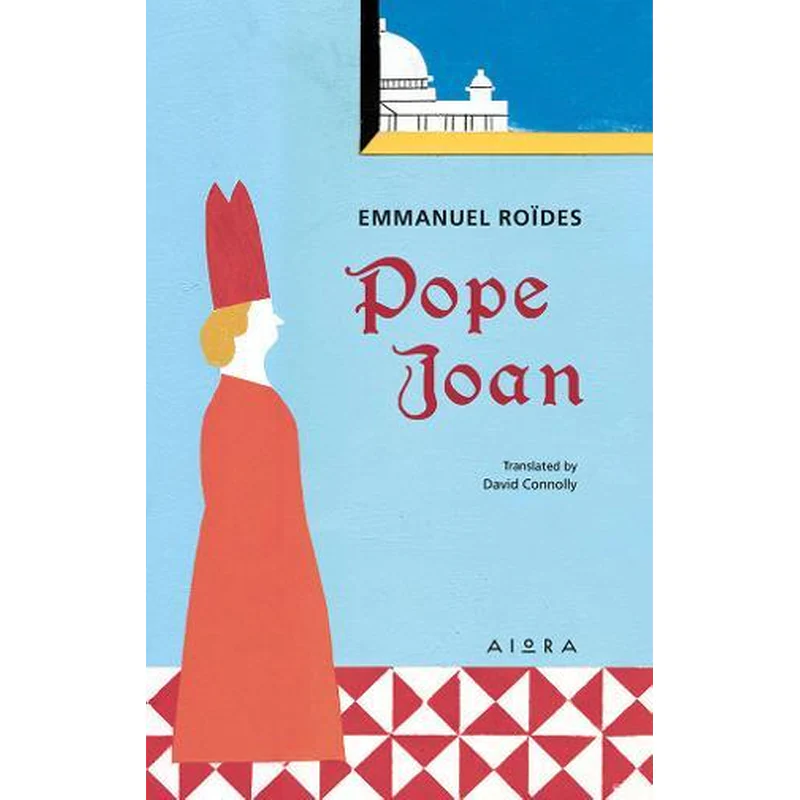
Pope Joan, Roïdes’ irreverent, witty, and satirical novel, tells the story of Joan, who, according to a popular medieval legend, ascended the Papal Throne as Pope John VIII. The historical truth of the legend is ultimately of little importance, as Pope Joan is far more than a historical novel. Instead, it parodies the popular historical romances of its time, blending meticulous research with sharp satire. Originally banned by the Church, the novel remains a landmark of Greek literature and an excellent introduction to Greek authors in English.
✨ Why read it: A fearless satire that skewers power and piety with such intelligence that it still feels subversive.
Alexandros Papadiamantis (1851–1911)
Known as the “Saint of Greek Letters,” Alexandros Papadiamantis was the most important representative of ethnographic literature, a form of Greek writing from the late 19th to early 20th century, influenced by folklore and representing the Greek version of realism.
Born in Skiathos to a poor Orthodox priest, he received his early education on the island before attending secondary schools intermittently in Chalkida, Piraeus, and Athens. At 23, he enrolled in the Faculty of Philosophy while teaching himself foreign languages, but financial hardship forced him to abandon his studies and earn a living, primarily as a newspaper translator.
Leading a modest, deeply religious, and solitary life, he began his literary career with historical, adventurous, and romantic novels before turning to the short story, eventually becoming the leading representative of the New Athenian School. His work reflects profound faith, devotion to tradition, compassion for human weakness, and a keen sensitivity to nature and everyday life. Remarkably, he did not live to see any of his works published in book form.
📚 Recommended: The Murderess (1903)
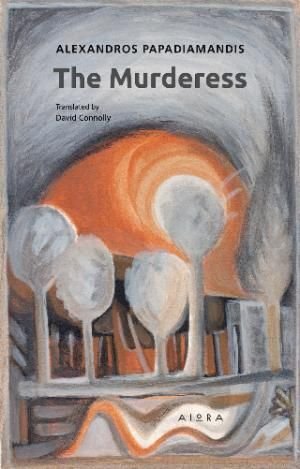
The Murderess is widely considered one of Alexandros Papadiamantis’s most important works. A bone-chilling novella of crime and punishment novella, it was first published in serialized form in Panathinaia magazine in 1903, with the subtitle “A Social Novel.” The story centres on Hadoula, or Frangoyannou, a woman shaped by poverty and social constraints, whose troubled reasoning leads her to commit a series of murders of young girls.
Dark, unsettling, and deeply psychological, The Murderess explores themes of guilt, morality, and social injustice, marking a departure from Papadiamantis’s more gently observed island characters. The work is often compared to Dostoevsky’s Crime and Punishment for its intense focus on inner conflict and moral responsibility, and remains one of the most powerful texts in modern Greek literature.
✨ Why read it: A dark, psychologically gripping portrait of poverty and moral collapse that reads like Greek realism at its most brutal.
Andreas Karkavitsas (1865–1922)
Andreas Karkavitsas was one of the leading figures of the New Athenian School and, after Papadiamantis, the most important representative of ethnographic prose in modern Greek literature. As a representative of the naturalist literary movement, he portrayed the everyday realities of individuals and society, standing in contrast to Romanticism. Born in Lechaina, Elis, he studied medicine and worked as a doctor in the merchant navy and the army, experiences that allowed him to travel widely across Greece and encounter the lives of sailors, villagers, and the rural poor—worlds vividly reflected in his writing.
His prose evolved from idyllic ethnography rich in folklore to a realist and socially critical style, with Lygeri (1890) marking the transition, while The Beggar (1896) is regarded as the most naturalist-influenced work of Greek prose.
A committed supporter of Demotic Greek, Karkavitsas combined social observation with moral concern, addressing poverty, exploitation, and the tensions between tradition and modern life. He died in 1922, leaving a body of work central to understanding Greek society at the turn of the 20th century.
📚 Recommended: The Archeologist and Selected Sea Stories (1904)
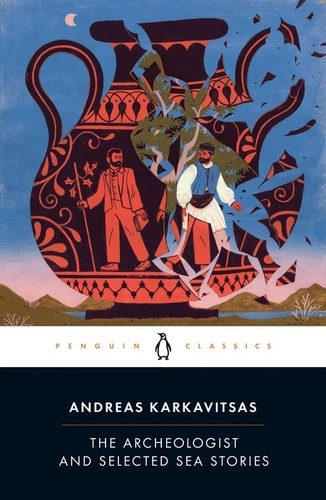
by Andreas Karkavitsas (trans. Johanna Hanink)
Written in 1903 and published the following year, The Archaeologist is a powerful allegory of the turmoil in Greek national consciousness following the Greco-Turkish War of 1897. The novel expresses faith in the present and hope for a future renewal grounded in the nation’s genuine strengths, while warning against blind devotion to a glorious past. It follows the Eumorphopoulos family, stripped of their ancestral lands and marginalized by rivals. Two brothers, Aristodemus and Dimitrakis, attempt to restore their family’s ancient glory, clashing over whether revival should come from the ancient past or the modern world.
This edition also includes Sea Tales, folk stories Karkavitsas gathered from sailors, fishermen, and sponge divers across the Mediterranean, offering vivid insights into Greece’s seafaring communities and oral traditions.
✨ Why read it: A sharp mirror of modern Greek self-image—plus sea tales that bring sailors’ voices and island life vividly to the surface.
Major Voices of 20th-Century Greek Fiction
Nikos Kazantzakis (1883–1957)
Nikos Kazantzakis was the most internationally renowned modern Greek writer, a restless intellectual whose work bridges philosophy, spirituality, and raw human passion. Born in Heraklion, Crete, in 1883, he studied law in Athens before continuing his studies in Paris, where he attended philosophy lectures by Henri Bergson, an influence that shaped his lifelong quest for spiritual and existential meaning.
A tireless traveler, Kazantzakis journeyed across Europe, Russia, Asia, and the Middle East, experiences that deeply informed both his fiction and his travel writing. He volunteered in the Balkan Wars, worked in public service, and later settled in France. In 1946 he was proposed for the Nobel Prize in Literature, and although nominated multiple times, he never received it.
His most famous novel, Zorba the Greek (1946), brought him global recognition. The story of the intellectual narrator and the exuberant Alexis Zorba explores the tension between contemplation and action, restraint and vitality. The novel was adapted into the iconic 1964 film directed by Michael Cacoyannis, with music by Mikis Theodorakis, winning three Academy Awards and popularizing the syrtaki dance worldwide.
Other major works include The Last Temptation of Christ, Captain Michalis, Christ Recrucified, and the epic poetic Odyssey. His final autobiographical work, Report to Greco, was published posthumously.
Kazantzakis died in 1957 in Freiburg, Germany, and was buried in Heraklion, overlooking his native city. Bold, controversial, and profoundly searching, he remains one of the most powerful and globally influential voices of modern Greek literature.
📚 Recommended: Zorba the Greek (1946)
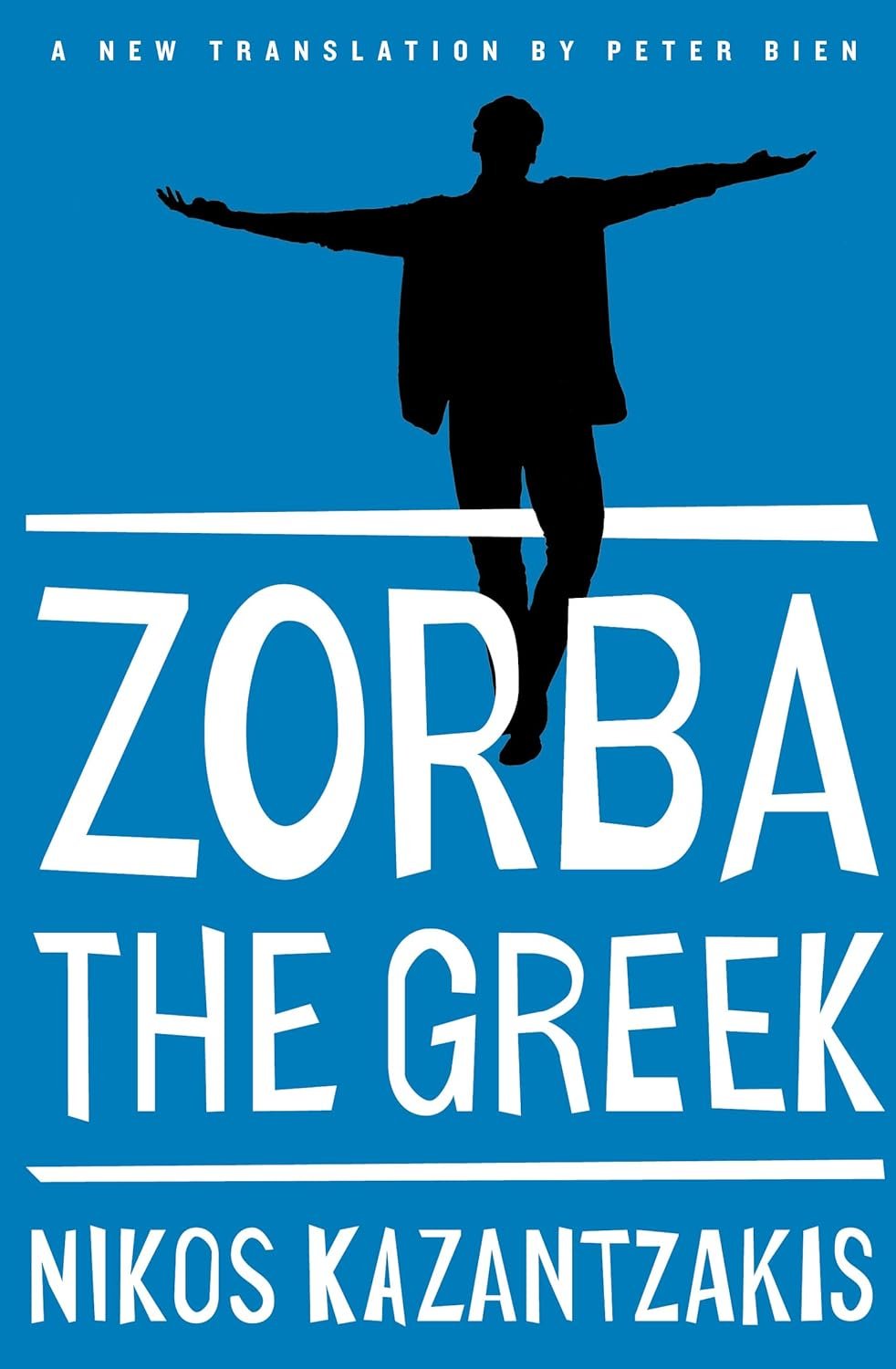
Nikos Kazantzakis’ Zorba the Greek tells the story of a young intellectual who meets Alexis Zorba, a larger-than-life Cretan worker, at the port of Piraeus. Together, they travel to a village in Crete to open a lignite mine. The two men are complete opposites: the narrator is thoughtful and scholarly, while Zorba is passionate, impulsive, and full of life. Through their conversations on love, work, faith, and human nature, Kazantzakis explores the contrasts between restraint and exuberance.
Their adventures culminate in the famous beach dance, a moment of pure joy and friendship. Zorba’s zest for life teaches the narrator—and the reader—to embrace life fully, face fear and death with courage, and find meaning in everyday moments. First published in 1946, Zorba the Greek is a modern classic of Greek literature, celebrated internationally for its rich storytelling, philosophical depth, and unforgettable characters.
✨ Why read it: For the unforgettable clash between intellect and appetite—one of literature’s great lessons in how to live.
Stratis Myrivilis (1890–1969)
One of Greece’s most acclaimed anti-war writers, Stratis Myrivilis was born in Sycamia, Lesbos. He interrupted his studies in Philosophy and Law at the University of Athens to volunteer in the Balkan Wars, later serving in World War I and the Asia Minor Campaign. After the destruction of Smyrna, he settled in Lesbos and later moved to Athens, contributing widely to newspapers and magazines.
Myrivilis’ literary debut came with Red Stories (1915), but his masterpiece Life in the Tomb (1924) established him as a leading voice in modern Greek anti-war literature. Later works, such as The Schoolmistress with the Golden Eyes (1932) and Panagia the Mermaid, explore nostalgia, childhood, and the human condition. His post-1949 collections—The Green Book, The Blue Book, The Red Book, and The Burgundy Book—demonstrate a mastery of themes and styles.
Known for his rich, lyrical language that blends realism with poetic tones, Myrivilis remains a central figure in 20th-century Greek literature, influencing generations of writers and readers alike.
📚 Recommended: Life in the Tomb (1924)
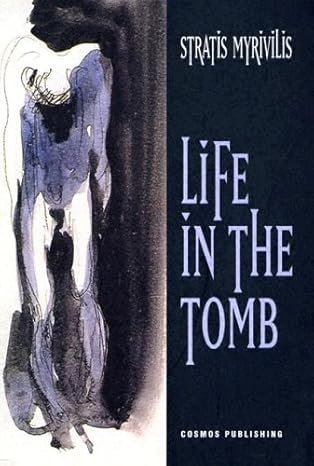
Life in the Tomb is a widely read war novel by Stratis Myrivilis, translated into nearly a dozen languages. Based on the author’s experience on the Macedonian Front during the First World War, it is written as a series of letters and diary-like entries by Sergeant Antonis Kostoulas, imagined as found after his death.
Set in 1917–1918, the novel rejects heroic myths of war, offering a stark portrayal of trench life that captures fear, exhaustion, and the fragile humanity of soldiers. By giving voice to the ordinary combatant, Myrivilis exposes the brutality of warfare while reflecting on the value of life.
The title Life in the Tomb, translated into Greek as Η Ζωή εν Τάφω (I zoi en táfo), alludes to a phrase from the Orthodox Holy Week liturgy and reinforces the novel’s reflection on existence, survival, and human dignity in the shadow of death. The novel stands as a foundational work of modern Greek prose and a landmark of European anti-war literature.
✨ Why read it: A raw, intimate anti-war classic that strips conflict of heroism and leaves only the human voice in the trenches.
Elias Venezis (1908–1979)
Ilias Venezis was one of the most important Greek writers of the Generation of the ’30s, drawing much of his fiction from the upheavals experienced by the Greek population in Asia Minor. Born in Ayvalık (then Kydonies), he endured displacement and imprisonment in the infamous forced labor battalions, experiences he recounted in his landmark novel Number 31328 (1931) — a powerful testament to survival and human dignity.
After resettling in Greece, Venezis worked for the Bank of Greece while participating in the literary circles of Mytilene and Athens. His later novels, including Calm (1939) and Aeolian Land (1943), explore the struggles of refugees, coexistence, and the lost world of Asia Minor through both adult and child perspectives. His writing combines realism with deep humanism, portraying both the horrors of war and exile and the resilience of ordinary people.
A member of the Academy of Athens and recipient of numerous literary honors, Venezis’s works have been widely translated and remain central to understanding modern Greek literature and the experiences of Asia Minor Greeks.
📚 Recommended: Land of Aeolia (1943)
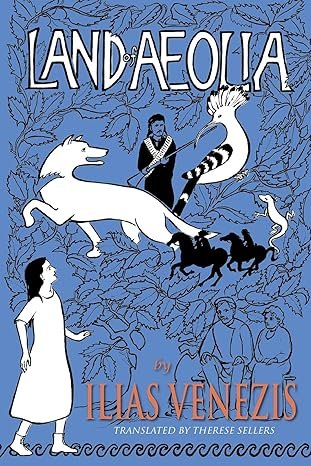
Land of Aeolia is a deeply moving novel about the lost world of the Greek communities of Asia Minor, seen through childhood summers in Ayvalik, Anatolia, where Ilias Venezis spent his early years before the upheavals of the early 20th century — World War I, the Greco-Turkish War, the genocide of Greek populations of Asia Minor, and the 1922 population exchange. Told through the eyes of the young boy Petros, it portrays a life shaped by family, nature, and enduring values long before war and forced displacement would erase it.
Rather than following a conventional plot, the novel unfolds as a tapestry of memories, legends, and everyday moments, bringing to life a peaceful world on the edge of disappearance. When exile comes, the narrative conveys the pain of separation with quiet dignity. Both nostalgic and deeply moving, Land of Aeolia stands as one of the most affecting introductions to modern Greek literature available in English.
✨ Why read it: A luminous book of memory that recreates a vanished world with tenderness—then lets loss arrive quietly, like weather.
M. Karagatsis (1908–1960)
M. Karagatsis (the literary pseudonym of Dimitris Rodopoulos) was one of the most dynamic prose writers of the “Generation of the ’30s.” Born in Athens in 1908 and raised partly in Thessaly, a landscape that profoundly shaped his fiction, he studied law in France and at the University of Athens before devoting himself to literature.
He first appeared in 1927 with the short story Mrs. Nitsa, but established his reputation with major novels such as Colonel Liapkin (1933), The Great Chimera (1936), and Junkermann (1938). His writing is characterized by psychological intensity, erotic tension, dramatic vitality, and bold realism.
Karagatsis’ protagonists are typically restless, ambitious, and driven by desire, often caught between personal longing and rigid social structures. Provincial Greece — especially Thessaly and the Aegean islands — becomes in his fiction a charged setting where passion collides with convention and identity is tested.
He died in Athens in 1960, leaving behind a body of work that remains vivid, provocative, and central to modern Greek prose.
📚 Recommended: The Great Chimera (1953)
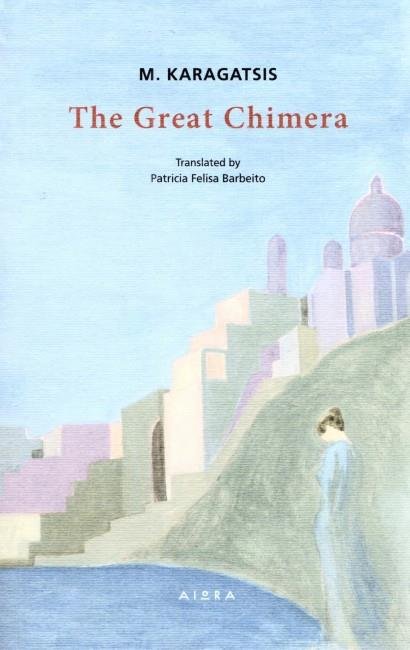
The Great Chimera is widely regarded as Karagatsis’ masterpiece and one of the most psychologically penetrating novels of modern Greek literature.
Set primarily in Syros, the novel follows Marina, a young French woman who marries a Greek shipowner and relocates to the island. What begins as a romantic new life gradually becomes a story of cultural alienation and emotional disintegration.
Marina’s passionate, uncompromising nature clashes with the island’s conservative, patriarchal society. Her longing for absolute love and fulfillment turns into obsession and self-destruction.
The “chimera” symbolizes the illusion of perfect happiness — a dream that cannot exist in reality. Through Marina’s tragic path, Karagatsis explores foreignness, female desire, fantasy versus reality, and the destructive pursuit of the unattainable.
Intense, unsettling, and emotionally charged, The Great Chimera remains one of the most powerful explorations of identity and desire in twentieth-century Greek fiction.
✨ Why read it: A feverish psychological novel about desire and belonging, where “foreignness” becomes a private catastrophe.
Dido Sotiriou (1909–2004)
Dido Sotiriou (1909–2004) was a prominent Greek novelist and journalist, best known for her powerful works on Asia Minor Hellenism, war, and displacement. She was born in Aydın, Asia Minor, and fled to Greece with her family after the 1922 Catastrophe, an experience that profoundly shaped her writing.
She studied French literature and later devoted herself to journalism and fiction, while actively participating in the social and political movements of her time. Her most celebrated novel, Farewell Anatolia (Matomena Chomata, 1962), became a landmark of modern Greek literature for its realistic and deeply human portrayal of the Asia Minor tragedy.
Her writing is characterized by realism, emotional depth, and autobiographical elements, focusing on themes of exile, memory, and human dignity. Widely translated and honored with numerous awards, Dido Sotiriou remains one of the most influential voices in 20th-century Greek prose.
📚 Recommended: Farewell Anatolia (1962)
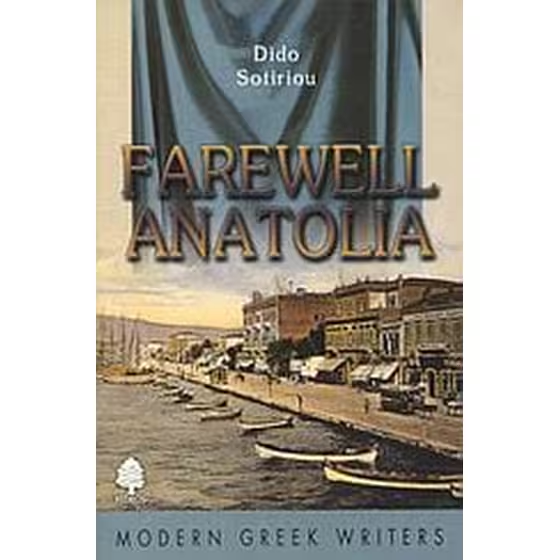
Farewell Anatolia (Matomena Chomata) by Dido Sotiriou is a monumental work of modern Greek literature, often called the “Bible of the modern exodus of Asia Minor Hellenism.” First published in 1962, it has sold over 400,000 copies and been translated into English, French, German, Italian, Spanish, Russian, Romanian, Bulgarian, Dutch, Hungarian, Estonian, Serbian, Turkish, and Breton.
The novel tells the story of Manolis Axiotis, a poor but resourceful villager from near the ruins of Ephesus, who witnesses firsthand the horrors of Greece’s Asia Minor Catastrophe in 1922—the forced death or expulsion of two million Greeks by the revolutionary forces of Kemal Atatürk. Through Axiotis’ eyes, Sotiriou paints a vivid, tragic fresco of a lost paradise and a shattered Hellenism, capturing both personal endurance and the collective suffering of a people uprooted.
Tender, tragic, and unflinching, Farewell Anatolia explores themes of betrayal, resilience, and the human cost of war and politics, while revealing the intertwined fates of Greece and Turkey in one of the darkest chapters of their shared history.
✨ Why read it: A humane, unforgettable witness to uprooting and survival—essential for understanding the emotional afterlife of 1922.
Antonis Samarakis (1919–2003)
Antonis Samarakis was one of the most widely translated Greek prose writers of the 20th century and a leading representative of socially engaged literature. Born in Athens in 1919, he studied law and worked for many years at the Ministry of Labour, resigning during the Metaxas dictatorship and returning after 1945. His professional and international activity — including work connected to UNESCO — reflected his enduring concern with human rights and social responsibility.
He first appeared in print as a poet in the early 1930s, but gained recognition with his short story collection Ziteitai Elpis (Hope Wanted, 1954), which introduced his characteristic style: clear, restrained language combined with moral intensity.
His most celebrated work, The Flaw (1965), established his international reputation. Set in an unnamed authoritarian regime, the novel unfolds as a psychological confrontation between a state agent and a suspected dissident, exposing the mechanisms of fear, surveillance, and manipulation. Beneath its political framework lies a deeper exploration of conscience, freedom, and the vulnerability of the individual within oppressive systems.
Awarded major distinctions abroad — including the Grand Prix de Littérature Policière in France — Samarakis remains a central voice of modern Greek prose. He died in 2003, leaving behind work that continues to resonate in times of political and moral uncertainty.
📚 Recommended: The Flaw (1965)
The Flaw is the most widely known work of Antonis Samarakis and one of the most influential political novels of modern Greek literature.
A man is abruptly taken from his afternoon drink at the Café Sport by two agents of the Regime. The reason for his arrest remains unclear — not only to the reader, but seemingly to the man himself. What follows is a tense car journey toward Special Branch Headquarters, where an interrogation awaits. As they move closer to their destination, the relationship between detainee and agents shifts in subtle and unsettling ways. Oppressor and oppressed confront not only one another, but also their own buried instincts, caught in a psychological contest where certainty begins to erode.
Blending elements of thriller and political satire, The Flaw by Antonis Samarakis remains as striking today as when it first appeared in 1965. Its portrayal of authoritarian logic proved uncannily prescient, anticipating the military dictatorship that would seize power in Greece just two years later. Widely regarded as Samarakis’ most internationally recognized work, the novel has been translated into more than thirty languages and was awarded the prestigious Grand Prix de Littérature Policière in France in 1970. A later English edition marked the fiftieth anniversary of its original publication in translation.
✨ Why read it: A tense, compact political thriller that turns interrogation into philosophy—and fear into a system.
Costas Taktsis (1927–1988)
Costas Tachtsis was one of the most unconventional and provocative figures of postwar Greek literature. Born in Thessaloniki in 1927, he moved to Athens as a child and later briefly studied law before dedicating himself to writing. He first emerged as a poet in the 1950s, publishing several collections and forming close connections with leading literary figures such as Odysseas Elytis, Nikos Gatsos, and Andreas Embirikos.
Restless by temperament, Tachtsis traveled extensively across Europe — famously embarking on a Vespa journey — and later spent time in Australia. These travels broadened both his cultural outlook and his literary voice, reinforcing his sharp observational style. Known for gritty realism and dark humour, he captured the raw texture of post-war urban life with an unfiltered honesty that set him apart from many of his contemporaries.
During the dictatorship of 1967–1974, he publicly opposed the regime and faced persecution. In his later years, he increasingly withdrew from literary life. Openly gay and defiantly opposed to social convention, Tachtsis lived a complex and often precarious existence. In August 1988, at the age of sixty-one, he was brutally murdered in his Athens apartment under circumstances that remain unsolved. Bold, controversial, and stylistically fearless, Tachtsis remains a singular presence in modern Greek prose.
📚 Recommended: The Third Wedding Wreath (1962)
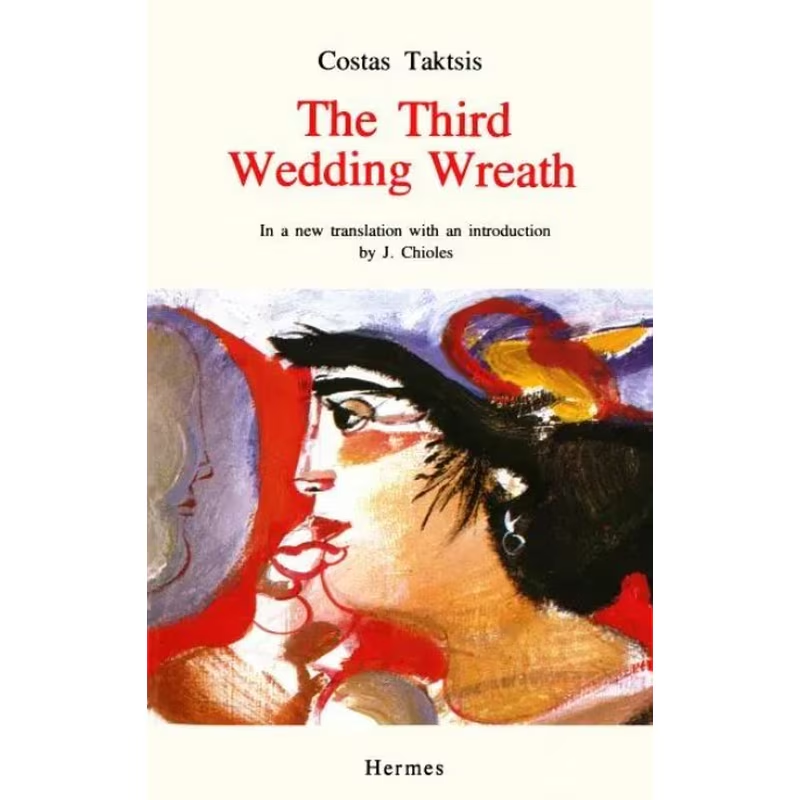
The Third Wedding Wreath is the novel that established Costas Taktsis as a major voice in postwar Greek prose. Written during his travels abroad in the late 1950s and early 1960s, the manuscript was rejected by three publishers before Taktsis published it at his own expense in 1962. The first edition passed largely unnoticed. However, when it was republished in 1970, it achieved significant commercial and critical success, securing his place among the most important prose writers of his generation. In 1995–1996, the novel was adapted for television, introducing it to a new audience.
The story unfolds mainly during the interwar period and the German Occupation, and is narrated by two women, Nina and Ekavi. Through their intertwined lives, the novel recreates the social atmosphere of early 20th-century urban Greece with remarkable psychological depth. Nina’s three marriages — from which the novel takes its title — provide the structural framework of the narrative.
The work contains strong autobiographical elements. Tachtsis himself acknowledged that the character of Ekavi was largely based on his grandmother, who raised him. Combining gritty realism, dark humour, and lyrical sensitivity, The Third Wedding Wreath remains one of the most vivid literary portraits of modern Greek society.
✨ Why read it: Two razor-sharp female voices carry you through love, class, and catastrophe—Athens in all its cruelty and comedy.
Pavlos Matesis (1933–2013)
Pavlos Matesis (1933–2013) was a prominent Greek novelist, playwright, and translator whose work often drew on myth, memory, and moral reckoning to reflect on modern Greek society. Born in Divri in the Peloponnese, he first worked as a bank employee in Athens before turning fully to literature. His career encompassed novels, theatre, television writing, and major literary translations, securing his place among the leading Greek writers of his generation.
His international breakthrough came with the novel The Daughter (1990), a powerful first-person account of a village woman’s wartime relationship and its aftermath. The book sold 150,000 copies in Greece, was translated into several European languages, and received the Greek Critics’ Award, earning praise for its emotional depth. Other important novels include Always Well and Sylvan Substances, which further explore memory, trauma, and historical experience.
In theatre, Matesis wrote significant works such as The Ceremony (National Theatre Award winner), Nman (recipient of the Karolos Koun Award), Guardian Angel for Rent, Roar, and Towards Eleusis. Between 1971 and 1973, he served as drama teacher and assistant director at the National Theatre of Greece. Alongside his original writing, he translated major classical and modern dramatists—including Aristophanes, Shakespeare, Molière, Brecht, Pinter, and Tennessee Williams—bringing world theatre to Greek audiences.
He died in Athens in 2013, at the age of eighty, leaving behind a body of work that bridges myth, modernity, and social critique.
📚 Recommended: The Daughter (1990)
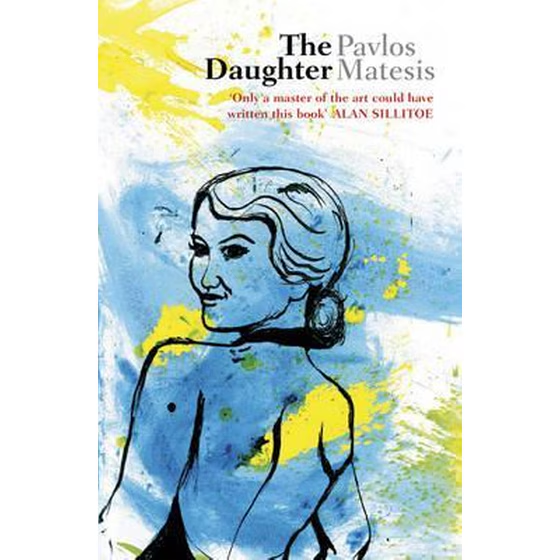
Matesis’s debut novel was first published in Greek in 1990 under the title Η μητέρα του σκύλου (The Mother of the Dog). It was later translated into English in 2002 by Fred A. Reed under the title The Daughter.
Set during the Axis occupation of Greece and its turbulent aftermath, the novel is narrated by Roubini, a young girl growing up amid hunger, social stigma, and moral ambiguity. Through her sharp and often ironic voice, Matesis explores war, survival, gender roles, collaboration, shame, and the long shadow of inherited trauma.
Widely translated and internationally acclaimed, the novel was included in Quintet Publishing’s list of “1001 Books You Must Read Before You Die.” It remains one of the most powerful modern Greek narratives about memory, hypocrisy, and resilience.
✨ Why read it: A bold, darkly funny wartime coming-of-age story that exposes hypocrisy with a voice you won’t forget.
Vassilis Vassilikos (1934–2023)
Vassilis Vassilikos was one of the most prolific Greek writers of the postwar period. Born in Kavala, he studied Law at the Aristotle University of Thessaloniki and later television direction in New York. He worked in journalism, cinema, and publishing before dedicating himself fully to literature.
He first appeared in print in 1949 with published poems and in 1953 released the novella The Narrative of Jason. His early trilogy — The Leaf, The Well, and The Angel’s Embrace — introduced innovative narrative techniques and a dense, modern style. He achieved national and international fame with Z (1966), a political novel based on the assassination of Grigoris Lambrakis, later adapted into the acclaimed film directed by Costa-Gavras.
Following the 1967 military dictatorship, Vassilikos went into exile in Europe and the United States, where he continued his anti-junta activity. After the restoration of democracy, he returned to Greece and remained active in public and cultural life. In 1978, he received the Mediterraneo Prize for his overall literary contribution. His work is characterized by strong political and social reflection, autobiographical elements, irony, and the use of journalistic and cinematic techniques that challenge traditional narrative structure.
📚 Recommended: Z (1966)
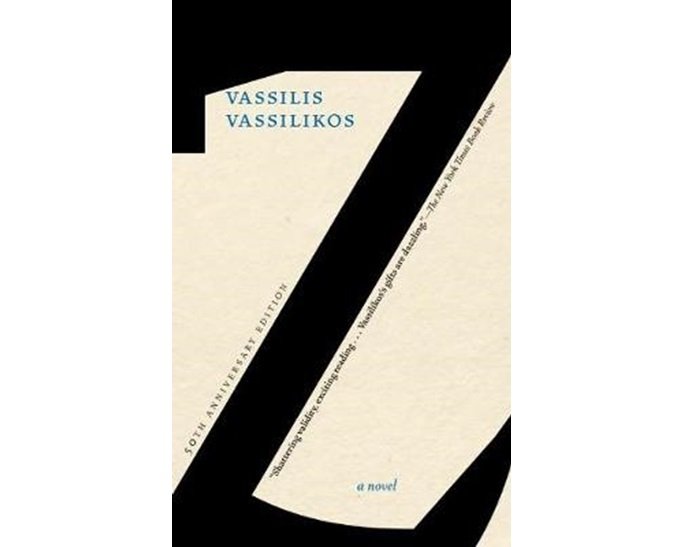
Published in 1966, Z by Vassilis Vassilikos is one of the most influential political novels in modern Greek literature. The story begins with a progressive parliamentary deputy preparing to speak at a political rally, while local political bosses secretly organize his assassination. Thugs are recruited to provoke violence and spread confusion. What follows is the unfolding of a crime in which individuals—and an entire society—are transformed by events.
The novel is based on the 1963 assassination of Greek parliamentarian Grigoris Lambrakis in Thessaloniki, a socialist deputy and outspoken critic of the government. Lambrakis’s death triggered a massive public reaction. His funeral turned into a powerful political demonstration, and as the procession reached Athens, hundreds of thousands of people followed the coffin in silence.
Soon afterward, the letter “Z” began appearing across Greece—on walls, sidewalks, and posters. The letter stands for the Greek word zei (“he lives”), becoming a symbol of resistance and political memory.
Written in the style of a “fictional documentary,” the novel combines investigative detail with fragmented narrative voices to expose the networks of power and violence behind the crime. It was banned in Greece after the military dictatorship of 1967, but gained international recognition and was adapted into the acclaimed 1969 film Z by Costa-Gavras, which won Academy Awards for Best Foreign Language Film and Best Editing.
✨ Why read it: A propulsive “fictional documentary” that shows how a political crime metastasizes—into institutions, streets, and memory.
Contemporary fiction
Ersi Sotiropoulos (b. 1953)
Ersi Sotiropoulos is a Greek poet, novelist, and short-story writer, widely regarded as one of the most original voices in contemporary Greek literature. Born in Patras, she studied Philosophy and Cultural Anthropology in Florence and worked as a cultural adviser at the Greek Embassy in Rome before devoting herself fully to writing.
Since her literary debut in 1980, she has published novels, short-story collections, and poetry, with her work translated into many languages and appearing in international literary journals such as the Harvard Review. Her novel Zigzag Through the Bitter-Orange Trees received both the Greek National Prize for Literature and the Diavazo Critics’ Award, while Eva and the short-story collection Feel Blue, Dress in Red were also widely acclaimed.
Her novel What’s Left of the Night, which follows the young Constantine P. Cavafy during a formative stay in Paris, won the Prix Méditerranée Étranger (2017). Alongside her fiction, Sotiropoulos has written screenplays, newspaper columns, and experimental visual poetry, and has participated in international writing programs and residencies. She lives in Athens.
📚 Recommended: What’s Left of the Night (2015)
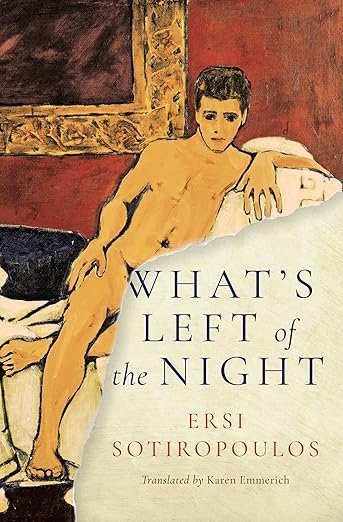
Published in 2015, What’s Left of the Night by Ersi Sotiropoulos imagines three formative days in the life of the young Constantine P. Cavafy during a visit to Paris in June 1897. At the end of a long European journey, the still-unknown poet confronts artistic doubt, personal desire, and the question of what kind of writer he might become.
Set against the turbulent atmosphere of fin-de-siècle Europe—with the aftermath of the Greco-Turkish War of 1897 and the tensions of the Dreyfus Affair—the novel portrays Cavafy wandering through Paris while wrestling with his homosexuality, at times both exhilarated and troubled by it, alongside his ambition and creative insecurity. Through lyrical and introspective prose, Sotiropoulos depicts the emotional and erotic impulses that shape the young writer’s imagination.
Blending historical detail with psychological fiction, the novel offers a portrait of the poet before he became one of the most important voices of modern Greek poetry, exploring the complex relationship between art, memory, and desire. The book received international acclaim, winning the Prix Méditerranée Étranger (2017) and the ALTA National Translation Award (2019).
✨ Why read it: A sensual, restless portrait of Cavafy becoming Cavafy—where art, secrecy, and ambition collide in a few electric days.
Amanda Michalopoulou (b. 1966)
Amanda Michalopoulou is the author of eight novels, three short story collections, a theatre play, and a novella. A contributing editor at Kathimerini in Greece and Tagesspiegel in Berlin, Michalopoulou has also published stories in international journals including Harvard Review, Guernica, PEN Magazine, World Literature Today, Words Without Borders, Asymptote, The Guardian, and Brooklyn Rail.
Among numerous distinctions, Michalopoulou has received the Revmata Award (1994), the Diavazo Award for the novel Jantes (1996), and the Academy of Athens Prize for the short story collection Bright Day (2013). The American translation of I’d Like won the International Literature Prize of the National Endowment for the Arts (NEA) in the United States (2008) and the Liberis Liber Prize of the Independent Catalan Publishers (2012). Michalopoulou’s stories and essays have been translated into twenty languages, while the novels Why I Killed My Best Friend and God’s Wife were shortlisted for the ALTA National Translation Award in the United States. The short story “Mesopotamia” was also selected for Best European Fiction 2018 (Dalkey Archive Press).
Michalopoulou has received literary fellowships and grants from institutions including DAAD and LCB in Berlin, the Shanghai Writers Association, the Edward Albee Foundation, the Ledig-Rowohlt Foundation, and the Bellagio Rockefeller Foundation. Participation in the International Writing Program at the University of Iowa further expanded this international presence.
Amanda Michalopoulou lives in Athens, where creative writing forms an important part of ongoing literary activity.
📚 Recommended: Why I Killed My Best Friend (2003)
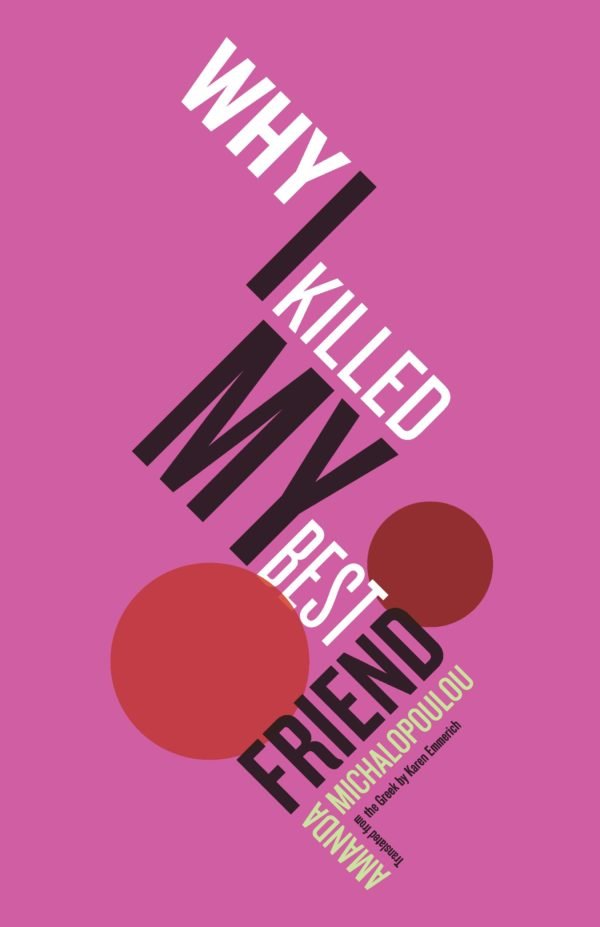
In Amanda Michalopoulou’s Why I Killed My Best Friend, a young girl named Maria is lifted from her beloved Africa and relocated to her native Greece. She struggles with the transition, hating everything about Athens: the food, the air, the school, her classmates, and the language. Just as she resigns herself to misery, Anna arrives. Though Anna’s refined, Parisian upbringing is the exact opposite of Maria’s, the two girls instantly bond over their shared sense of foreignness, becoming inseparable as both best friends and fierce competitors—whether over boys, talents, future aspirations, or political beliefs.
From Maria and Anna’s school days in 1970s post-dictatorship Greece to their adult lives in the present, Michalopoulou traces the ups and downs of a powerful and sometimes self-destructive friendship. Beautifully written, Why I Killed My Best Friend explores how friendship can mirror a political system, oscillating between totalitarianism and democracy.
✨ Why read it: A fierce, funny, unsettling study of friendship as power—intimate, political, and painfully recognizable.
Christos Chomenidis (b. 1966)
Christos Chomenidis is a contemporary Greek novelist. He was born in Athens in 1966 and studied law at the University of Athens, graduating in 1990. He later pursued further legal studies in the Soviet Union and studied communications in the United Kingdom. Early in his career he worked in a law firm in Athens.
Chomenidis first appeared as a writer in 1988, when one of his short stories was published in the magazine Playboy. In 1993, he published his first novel, The Wise Child (Το σοφό παιδί), which drew considerable attention for its bold style and subject matter and was later translated into French, Italian, and Hebrew. Since then he has published numerous novels and short story collections and collaborated with several newspapers and magazines, including Ta Nea and Capital.
His work explores a wide range of themes—from contemporary Greek society and the world of popular culture to imaginative historical settings reaching as far back as pre-Homeric Greece. His novel Niki (2014), a sweeping family chronicle set against the turbulent history of twentieth-century Greece, received the Greek State Literature Prize, the Anagnostis Magazine Award, and the Public Readers’ Award, and in 2021 it was awarded the Prix du Livre Européen (European Book Prize).
Chomenidis has also translated the play The Rope by Patrick Hamilton, written screenplays for film and television, and worked as a radio producer. For a short period he was involved in politics as a member of the Central Committee of the Democratic Left (DIMAR). Chomenidis remains one of the most widely read contemporary Greek novelists and continues to write and live in Athens.
📚 Recommended: Niki (2014)
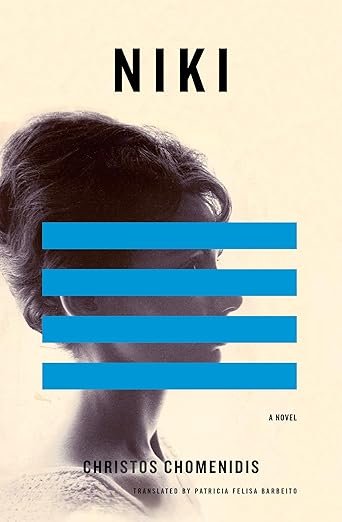
In Christos Chomenidis’s Niki, a resilient Greek woman recounts her life and family history against the backdrop of the dramatic events that shaped twentieth-century Greece. Born in 1938, the daughter of a senior member of the Greek Communist Party, Niki is drawn into political turmoil from infancy when her parents are arrested and she is sent into exile with her mother on an island near Santorini.
Through her memories and the stories of relatives scattered across the Aegean world, the novel traces decades marked by war, occupation, civil conflict, and ideological division. Blending personal narrative with national history, Niki offers a vivid portrait of modern Greece while celebrating the resilience, humor, and endurance of those who lived through its most turbulent years.
✨ Why read it: A big, humane life-story that makes modern Greek history feel personal—told with warmth, bite, and momentum.
Christos Ikonomou (b. 1970)
Christos Ikonomou was born in Athens in 1970 and is a Greek short story writer, playwright, translator, and creative writing teacher. He first appeared in Greek prose in 2003 with the short story collection The Woman on the Rail (Η γυναίκα στα κάγκελα).
He gained international recognition with his second collection, Something Will Happen, You’ll See (Κάτι θα γίνει, θα δεις, 2010), which received the Greek National Prize for Literature and the Prix Littéraire des Jeunes Européens. The book has been widely translated and introduced his work to international readers.
His later collection Good Will Come from the Sea (Το καλό θα ’ρθει από τη θάλασσα, 2014) further established his reputation and was translated into several languages, while the French edition received Le Point Magazine’s Coup de Cœur Award. His work has appeared in international anthologies such as Best European Fiction (Dalkey Archive Press) and has been adapted for theatre and film.
In 2022, Ikonomou received the USC Dornsife Chowdhury Prize in Literature, an international award recognizing outstanding contemporary writers.
📚 Recommended: Something Will Happen, You’ll See (2010)
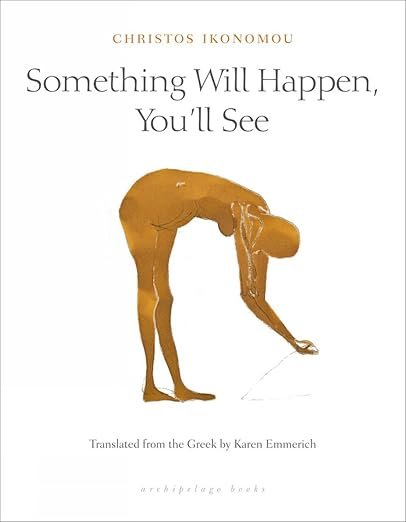
In Christos Ikonomou’s Something Will Happen, You’ll See, a powerful collection of short stories captures the hopes, fears, and daily struggles of working-class Greeks during the economic crisis. Set in the urban neighborhoods between Athens and Piraeus, the stories follow laid-off workers, struggling families, and people searching for dignity in a harsh social landscape.
While many dream of escape—from poverty, social pressure, or the indifference of the powerful—Ikonomou’s characters continue to act with resilience and solidarity. Through stark realism and compassionate insight, the collection offers a striking portrait of contemporary Greek society at the edge of hardship.
✨ Why read it: Crisis-era Athens and Piraeus in compassionate close-up—ordinary lives, small decencies, and quiet resilience.
Poetry: Greece’s Most International Literary Language
Constantine P. Cavafy (1863–1933)
Constantine P. Cavafy was born Konstantínos Pétrou Kaváfis in Alexandria, Egypt, on April 29, 1863, the ninth child of a Greek family from Constantinople. After the death of his father in 1870, the family moved to England, where Cavafy spent several formative years and became fluent in English, even composing some of his earliest poems in that language. He later lived briefly in Constantinople before returning permanently to Alexandria.
At the age of twenty-nine he began working as a clerk in the Irrigation Service of the Egyptian Ministry of Public Works, a position he held for nearly thirty years, while quietly developing his literary work. Cavafy lived a largely private life and rarely sought public recognition.
Writing in Greek while living far from Greece, Cavafy became a cosmopolitan “Hellenic” poet of the diaspora. His work draws frequently on Homeric, Hellenistic, and Byzantine history, using historical figures and imagined voices to explore themes of memory, identity, decline, desire, and the passage of time, while also addressing homosexuality and personal longing with remarkable openness for his time. His oeuvre includes the 154 poems of the canonical collection, as well as several unpublished, unfinished, and early poems discovered after his death.
Cavafy never published a full commercial volume of his poetry, instead circulating privately printed pamphlets among friends and admirers. Recognition during his lifetime remained limited, though in 1926 he received the Order of the Phoenix from the Greek state. He died in Alexandria on April 29, 1933, his seventieth birthday. The first collected edition of his poems appeared in 1935, and his international reputation has grown steadily ever since. Today he is widely regarded as one of the most original and influential poets of the twentieth century, and his work occupies a central place in both modern Greek and world literature.
Selected Poems to Start With (Read Online)
Readers discovering C. P. Cavafy often begin with a few of his most celebrated poems, which illustrate the historical depth, irony, and philosophical reflection that define his work:
- “Ithaka” (Ιθάκη) – A meditation on the meaning of journeys and the wisdom gained through experience.
- “Waiting for the Barbarians” (Περιμένοντας τους Βαρβάρους) – A powerful allegory on political paralysis and societal decline.
- “The God Abandons Antony” (Απολείπειν ο Θεός Αντώνιον) – A stoic reflection on dignity in the face of loss.
- “Days of 1903” (Μέρες του 1903) – One of Cavafy’s most intimate poems exploring memory, desire, and the passage of time.
Together, these poems demonstrate how Cavafy blends history, personal reflection, and subtle irony, creating a poetic voice that remains distinctive and widely influential in modern world literature.
📚 Recommended: Selected Poems by C.P. Cavafy
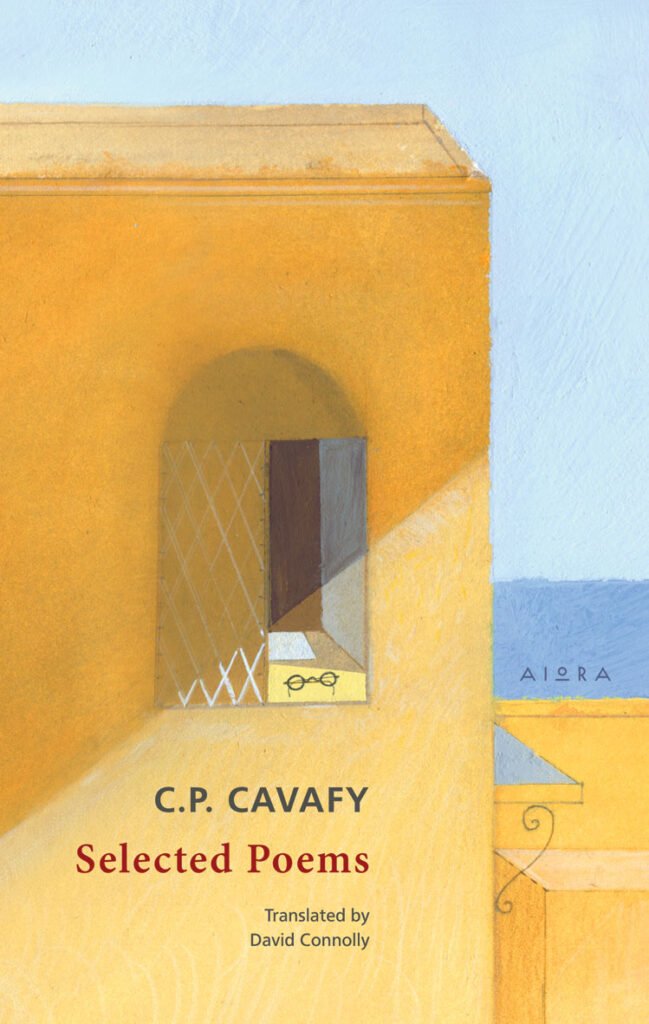
✨ Why read it: For poems that turn history into intimacy—ironic, devastating, and strangely modern in how they speak about desire and time.
George Seferis (1900–1971)
George Seferis, the literary pseudonym of Georgios Seferiadis, was born in 1900 in Smyrna, then a major center of Greek culture in Asia Minor. His family moved to Athens in 1914, where he completed his secondary education before continuing his law studies in Paris (1918–1924). These formative years coincided with the emergence of new literary and intellectual movements in Europe after the First World War, influences that played an important role in shaping his poetic voice. During this same period he experienced the shock of the Asia Minor Catastrophe and the destruction of Smyrna, events that remained deeply rooted in his memory and later influenced much of his poetry.
Seferis pursued a career in the Greek diplomatic service, serving in various posts abroad as attaché, consul, ambassador, and director of press offices in Greek embassies. In 1963 he was awarded the Nobel Prize in Literature, becoming the first Greek writer to receive the distinction, and he was later named honorary doctor by several universities abroad. In 1969 he publicly denounced the military dictatorship in Greece, issuing a statement that circulated widely in Greece and internationally.
Seferis’s poetry is not always easy, but it is never obscure. Its language can be demanding, yet his voice remains clear, restrained, and deeply personal, often achieving an expression that feels both precise and intimate. His work is generally melancholic and reflective, shaped by the historical experiences of the twentieth century and by meditation on exile, memory, and the burdens of Greek history. Yet beneath this tone lies a persistent sense of faith and resilience, suggesting that beyond darkness there remains the possibility of light. George Seferis died in September 1971 in Athens.
Selected Poems to Start With (Read Online)
Readers discovering George Seferis often begin with a few of his most celebrated poems, which illustrate his themes of history, exile, memory, and Greek identity:
- “The King of Asine” (Ο βασιλιάς της Ασίνης) – A meditation on history, absence, and the traces left by the past.
- “Helen” (Ελένη) – A reinterpretation of the myth of Helen that reflects on illusion, war, and historical truth.
- “The Last Stop” (Τελευταίος Σταθμός) – Written during the Second World War, expressing uncertainty and reflection on Greece’s fate.
- “Denial” (Άρνηση) – Often identified by its opening line “On the secret seashore” (Στο περιγιάλι το κρυφό), one of Seferis’s best-known poems, reflecting themes of disillusionment, memory, and loss.
📚 Recommended: Novel and Other Poems by George Seferis
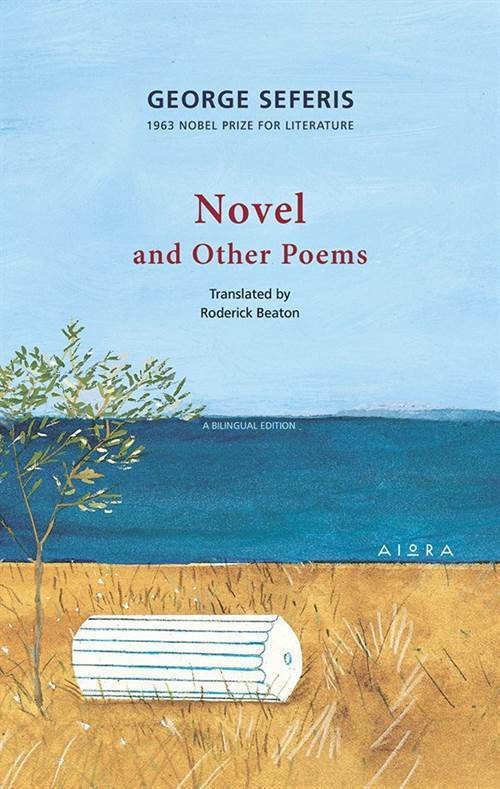
✨ Why read it: A Nobel voice of exile and inheritance—spare poems where Greece’s past feels heavy, and still luminous.
Yannis Ritsos (1909–1990)
Yannis Ritsos was one of the most important and prolific poets of modern Greece. Born in Monemvasia in 1909, his life was marked by profound personal and political upheavals that deeply influenced his poetry. His family suffered financial ruin during his childhood, and several members faced illness or institutionalization. Ritsos himself battled tuberculosis, spending several years in a sanatorium in Athens, where he began writing poetry.
Closely associated with the Greek left, Ritsos frequently faced censorship and persecution for his political views. His celebrated poem Epitaphios (1936)—inspired by the killing of a worker during a strike in Thessaloniki—was publicly burned by the Metaxas dictatorship. During the Greek Civil War and later under the military dictatorship of 1967–1974, he was imprisoned, exiled to islands such as Makronisos and Agios Efstratios, and placed under house arrest. Despite these hardships, he continued writing with remarkable productivity.
Ritsos’s poetry ranges from politically engaged works to intimate lyrical reflections. He often reinterpreted figures from Greek mythology, creating modern dramatic monologues such as those collected in The Fourth Dimension, where characters like Persephone, Orestes, Ajax, and Helen reflect on memory, power, and human vulnerability.
Twice nominated for the Nobel Prize in Literature, Ritsos received numerous international honors, including the Lenin Peace Prize. Today he is widely regarded as one of the central voices of twentieth-century Greek poetry, admired for his lyrical intensity, moral courage, and deep human compassion.
Selected Poems to Start With (Read Online)
Readers discovering Yannis Ritsos often begin with a few of his most celebrated poems, which illustrate the emotional depth, historical awareness, and lyrical clarity that characterize his work:
📚 Recommended: Yiannis Ritsos — Selected Poems 1938–1988
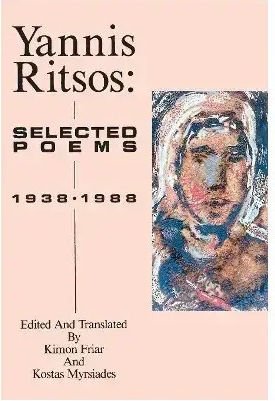
✨ Why read it: A vast, humane imagination—myth and daily life braided together, with tenderness that survives persecution.
Odysseas Elytis (1911–1996)
Odysseas Elytis, whose real name was Odysseas Alepoudelis, was born in Heraklion, Crete, on November 2, 1911, although his family originated from the island of Lesbos. In 1914 his family moved to Athens, where he spent most of his childhood and completed his secondary education. His origins in Lesbos, his birth in Crete, and the summers of his youth spent on islands such as Spetses and the Cyclades helped shape a deeply island-rooted sensibility that later became central to his poetry. Combined with the influence of modern artistic movements—especially Surrealism—these experiences contributed to the development of a distinctive poetic voice rich in lyrical imagery, spiritual intensity, and universal human values. With light as a central motif, Elytis’s poetry explores the spiritual dimension of nature and the senses, seeking to decipher the mystery of human existence.
After finishing school in Athens, Elytis began studying law at the University of Athens, although he did not complete his studies. In 1935 he first appeared in Greek letters, publishing poems in the literary journal Ta Nea Grammata, which gathered many of the writers associated with the influential Generation of the 30’s. His acquaintance with the poet Andreas Embirikos that same year strengthened his interest in surrealism, which would play a significant role in shaping his poetic style.
During the Italian invasion of Greece in 1940, Elytis served as a second lieutenant on the Albanian front, an experience that inspired later works such as Heroic and Elegiac Song for the Lost Second Lieutenant of Albania (1945). During the German occupation of Athens he wrote The First Sun and some of his earliest prose writings.
Between 1948 and 1951 Elytis traveled extensively in Western Europe, often based in Paris, where he encountered leading figures of twentieth-century art and literature, including Pablo Picasso, Henri Matisse, André Breton, and Marc Chagall. He returned to Paris again between 1969 and 1971, during the years of the Greek military dictatorship, a period that also saw the creation of important works such as The Phototree, The Monogram, The Sun the Sovereign, and The Rs of Love.
Among his most celebrated works are The Axion Esti (1959), one of the major poetic compositions of modern Greek literature, and Maria Nefeli (1978), a “scenic poem” blending poetry and dramatic dialogue. Elytis also wrote essays on major Greek artists and writers, including The Painter Theophilos (1973), The Magic of Papadiamantis (1974), and Report on Andreas Embirikos (1979).
In 1979 he was awarded the Nobel Prize in Literature, becoming one of the most internationally recognized Greek poets of the twentieth century. He also received honorary doctorates from several universities, including Thessaloniki, the Sorbonne, and London, and his works have been translated into numerous languages.
Odysseas Elytis remained devoted to poetry throughout his life and died in Athens on March 18, 1996, at the age of eighty-five.
Selected Poems to Start With (Read Online)
Readers discovering Odysseas Elytis often begin with a few of his most celebrated poems, which illustrate his themes of light, the Greek landscape, freedom, and spiritual renewal:
- “Monogram” (Το Μονόγραμμα) – One of Elytis’s most lyrical works, exploring love, memory, and the enduring power of emotional experience.
- Excerpt from “The Axion Esti” (To Άξιον Εστί) – A monumental poetic composition blending history, faith, and the Greek landscape, widely regarded as one of the most important works of modern Greek poetry.
- “The Mad Pomegranate Tree” (Η Τρελή Ροδιά) – A vivid poem celebrating nature, rebirth, and the energy of life, filled with characteristic surreal imagery.
- “Body of Summer” (Το Σώμα του Καλοκαιριού) – A poem that captures Elytis’s signature vision of light, sea, and sensual presence in the Greek summer landscape.
📚 Recommended: Odysseas Elytis — Selected Poems 1940–1979
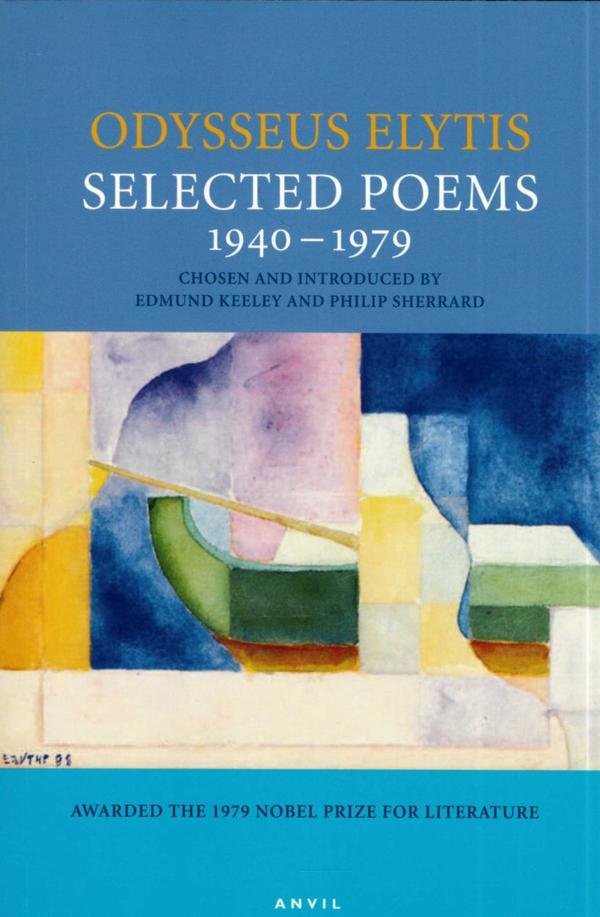
Chosen and introduced by Edmund Keeley and Philip Sherrard
✨ Why read it: For a Greece made of light, sea, and moral clarity—surreal, sensuous poems that feel like weather and revelation at once.
For a comprehensive overview of Greek authors from the 19th to the 21st century available to English-language readers, see The CENSUS of Modern Greek Literature: A Bibliography of Modern Greek Literature for Speakers of English.