
Updated: 18 August 2026
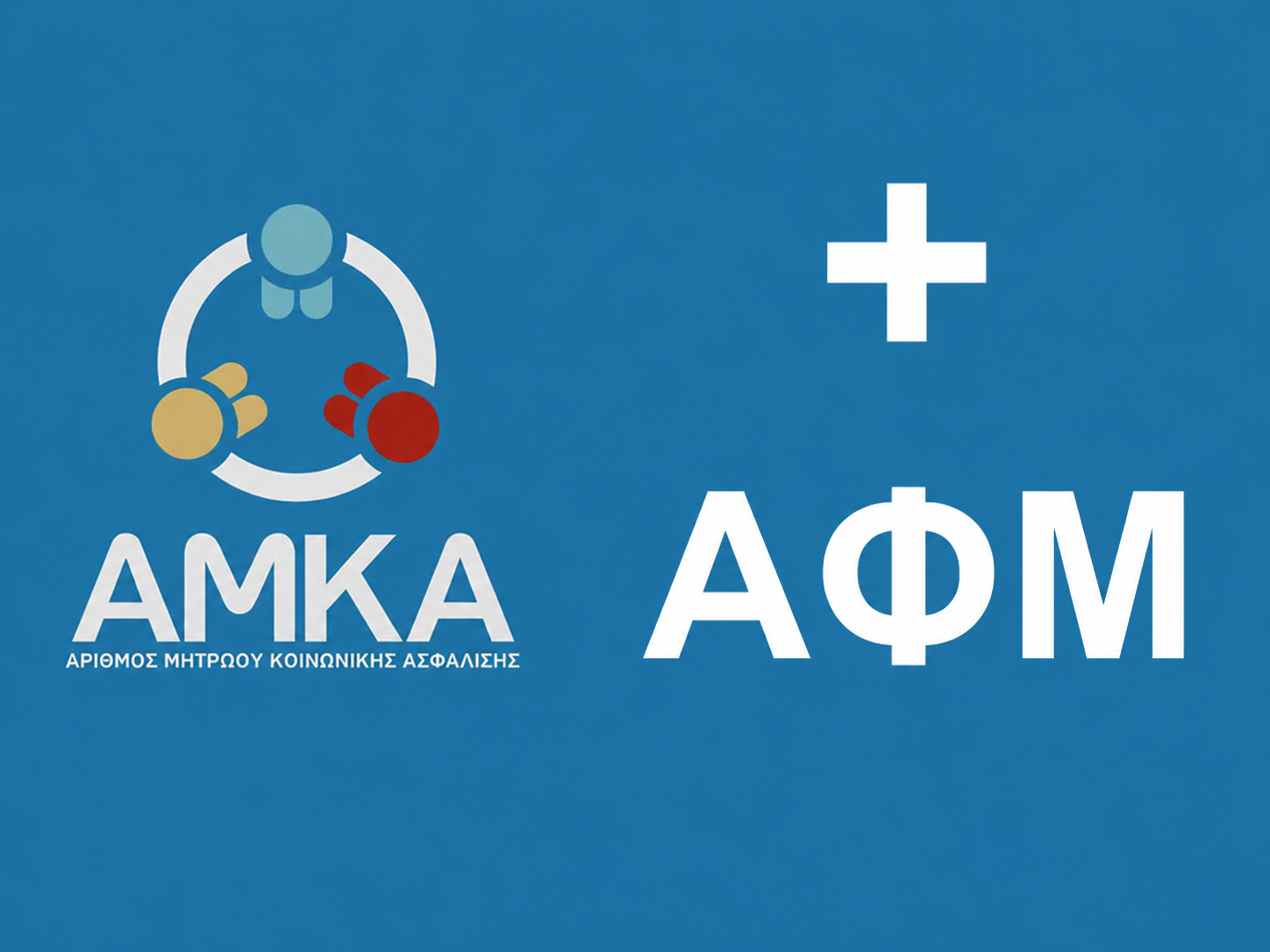
Getting an AFM and an AMKA is one of the first practical steps towards establishing everyday life in Greece. The two numbers serve different purposes: the AFM identifies you within the Greek tax system, while the AMKA identifies you within the country’s employment and social-security system.
You may need them when starting work, renting or buying property, dealing with a bank, registering with e-EFKA, using electronic prescriptions or completing other public-service procedures. Having the numbers, however, does not by itself establish tax residence, legal residence or healthcare entitlement.
This guide explains what each number does, who can obtain it, where to apply and which documents foreign residents are commonly asked to provide in 2026.
In this guide
- AFM and AMKA at a glance
- What is an AFM?
- How to get an AFM in 2026
- Documents for an AFM application
- AFM, Taxisnet and the kleidarithmos
- What is an AMKA?
- What is e-EFKA?
- AMKA issuance and activation
- How to get an AMKA
- Documents for an AMKA application
- AMKA, health insurance and healthcare
- What is PAAYPA?
- Common problems and how to avoid them
- Frequently asked questions
AFM and AMKA at a glance
| AFM | AMKA | |
|---|---|---|
| Full name | Tax Identification Number | Social Security Registration Number |
| Main purpose | Tax and financial identification | Employment and social-security identification |
| Responsible system | AADE | Social-security registry under the Ministry of Labour |
| Application | Electronic application, followed by identification | In person at a KEP or e-EFKA office |
| Cost | No government fee | No government fee |
| Important distinction | An AFM does not make you a Greek tax resident | An AMKA does not by itself provide insurance coverage |
What is an AFM in Greece?
AFM stands for Arithmos Forologikou Mitroou (Αριθμός Φορολογικού Μητρώου). It is the unique number used to identify a person or organisation in the Greek tax registry.
Foreign nationals may obtain an AFM whether they are tax residents of Greece or residents of another country. You may need one to:
- Start employment or self-employment in Greece
- File a Greek tax return or pay Greek taxes
- Rent, purchase, sell or inherit property
- Purchase and register a vehicle
- Open or operate certain Greek banking products
- Set up utilities, telephone or internet contracts
- Obtain Taxisnet credentials and use many digital public services
- Complete residence, investment or business procedures that request tax identification
Obtaining an AFM is an administrative registration. Your tax residence is determined separately under Greek tax law, based on factors including residence, centre of vital interests and time spent in Greece. For more detail, see our Greek Tax Guide for Expats 2026.
How to get an AFM in Greece in 2026
The current application for an individual’s AFM and kleidarithmos begins electronically through AADE’s dedicated AFM & Kleidarithmos service. The older approach of simply arriving at a local tax office with an M1 form is no longer the standard route.
- Open the AADE AFM & Kleidarithmos application. The applicant, a legal representative, a tax representative or another authorised person can submit the appropriate electronic request.
- Enter the applicant’s details. These include identity, birth and contact information.
- Upload the required documents. The documents depend on nationality, residence status, age and who is submitting the application.
- Choose an identification method. A person applying for themselves can generally be identified through an immediate or scheduled myAADElive video call, or through an appointment with physical presence at a tax office.
- Receive the AFM and access details. Following approval, AADE sends the AFM certificate and the information needed to activate digital access through the contact details registered in the application.
Start with AADE’s official AFM and kleidarithmos service.
Can you get an AFM before moving to Greece?
Yes. A person living outside Greece can apply electronically and complete identification through myAADElive where eligible. An authorised representative can also submit an application on the applicant’s behalf, provided the authorisation and supporting documents meet AADE’s requirements.
A foreign tax resident may appoint a tax representative in Greece. The representative acts as a contact for tax administration and does not become liable for the taxpayer’s obligations merely because of the appointment.
Documents commonly required for an AFM application
The exact list is generated by the applicant’s circumstances. Common requirements include:
- A valid passport or national identity card
- A valid Greek residence permit or other evidence of lawful stay, where required
- A birth certificate or other civil-status evidence if essential details are not shown clearly on the identity document
- Contact information, including an email address
- Documents establishing the authority of a legal or authorised representative
- Acceptance documentation if a tax representative is being appointed
- Parental consent and supporting civil documents for a minor
Foreign public documents may require an apostille or other legalisation and an officially acceptable Greek translation. Check this before the appointment rather than assuming that an English document will be accepted without further formalities.
AFM, Taxisnet and the kleidarithmos
These terms are related but not interchangeable:
- AFM is your tax identification number.
- Taxisnet credentials are the username and password used to enter AADE and many gov.gr services.
- Kleidarithmos is the security key used during the activation or management of your digital tax access.
The AFM application is now designed to issue an AFM and kleidarithmos together. Keep the information sent by AADE secure. Once your account is active, you can use myAADE for tax records, requests, notifications and other services.
What is an AMKA?
AMKA stands for Arithmos Mitroou Koinonikis Asfalisis (Αριθμός Μητρώου Κοινωνικής Ασφάλισης). It is the personal registration number used for employment and social security in Greece.
An AMKA is generally required for people who work, are insured or intend to work in Greece. It is used for:
- Employment and registration with the social-security system
- Transactions with e-EFKA
- Insurance contributions, pensions and eligible social-security benefits
- Electronic prescriptions
- Healthcare procedures when the holder also meets the relevant entitlement conditions
An AMKA is not the same as insurance capacity (asfalistiki ikanotita). The number identifies you in the system; insurance capacity determines whether you currently have access to healthcare benefits through Greek social insurance.
What is e-EFKA?
e-EFKA is Greece’s Electronic National Social Security Entity. It administers the country’s main social-insurance system and keeps records connected with employment, insurance contributions, insurance history, pensions and insurance capacity.
For an expat, e-EFKA may become relevant when you start salaried work, register as self-employed, need to confirm your social-security record, add an eligible dependent family member, check insurance capacity or deal with pension and benefit matters. Your employer normally reports salaried employment and contributions, while self-employed people have separate registration and contribution obligations.
AMKA issuance and activation: why both matter
Under the current framework, the creation of an AMKA number and its activation are distinct administrative steps.
Issuance
Issuance creates the individual number in the social-security registry. The official procedure is completed in person at a KEP or local e-EFKA office.
Activation
Activation allows the number to function fully within the relevant systems. Foreign citizens must demonstrate actual residence in Greece, together with the documents required for their nationality and status. Activation is also handled in person at a KEP or e-EFKA office.
The official administrative register describes both issuance and activation as free services. Its published estimate is 15 to 30 minutes for processing at the service point when the application is complete. This is not a guarantee of appointment availability or same-day resolution where documents need further checks.
How to get an AMKA in 2026
- Identify the correct category. The checklist differs for Greek citizens, EU/EEA citizens, third-country citizens, minors, dependent family members and people covered by the EU–UK Withdrawal Agreement.
- Gather documents for both issuance and activation. Bring original documents and copies.
- Visit a KEP or e-EFKA office. The general adult procedures are not provided fully online.
- Check the spelling of your details. Confirm the name, birth date and identity-document number before leaving.
- Confirm that the AMKA is active. If only the number has been issued, ask what further evidence is needed for activation.
You can find a nearby KEP Citizens’ Service Centre, use the official e-EFKA website or contact the Ministry of Labour and e-EFKA information line on 1555.
Documents commonly required for AMKA
The official register contains separate procedures for different groups, so use the list below as preparation rather than a universal checklist.
EU and EEA citizens
- A valid national identity card or passport
- Your AFM
- Evidence supporting the reason for social-security registration, such as employment, self-employment or coverage as a dependent member
- Evidence of actual residence in Greece for activation
- Additional civil-status documents where applying through a family relationship
Third-country citizens
- A valid passport or recognised travel document
- Your AFM
- A valid residence permit or another document establishing lawful residence under the applicable category
- Evidence supporting employment, insurance or dependent-member status
- Evidence of actual residence in Greece for activation
- Translated and legalised civil-status documents where relevant
Children and dependent family members
Separate procedures apply to minors and adults insured indirectly through another person. Common supporting documents include a birth or marriage certificate, the sponsor’s AMKA and proof of the family relationship. The person providing the insurance coverage must meet the applicable insurance-capacity conditions.
Documents accepted as evidence of actual residence depend on the applicant’s situation. Use the relevant procedure in the National Registry of Administrative Procedures and confirm the list with the KEP or e-EFKA office before attending.
AMKA, health insurance and healthcare in Greece
AMKA is used to identify you in Greece’s health and social-security systems. It is commonly requested for electronic prescriptions, diagnostic referrals, medical records and transactions involving e-EFKA or the National Organisation for Healthcare Services Provision (EOPYY). It is an identification number—not a health-insurance policy.
What is insurance capacity?
Insurance capacity is the recognised right to healthcare benefits through the Greek social-insurance system. According to e-EFKA, it concerns access to medical and pharmaceutical care, including healthcare providers, pharmacies and doctors contracted with EOPYY.
Eligibility can arise through insured employment, self-employment and the required contributions, pensioner status, registration as an eligible dependent family member or applicable European social-security coordination rules. The conditions are different for each category and can change over time.
Does an AMKA give you free healthcare?
No—not by itself. Receiving or activating an AMKA does not automatically establish insurance capacity or make every service free. Coverage, referrals, co-payments and access conditions depend on your insurance status and the service being used. Newly arrived residents should keep any required private health insurance, European Health Insurance Card or other valid coverage until their position in Greece has been confirmed.
You can check your insurance capacity online through gov.gr. For questions about contributions or an incorrect insurance record, contact e-EFKA. Healthcare benefits and contracted providers are administered through EOPYY.
What is PAAYPA?
PAAYPA is the Temporary Insurance and Healthcare Number for Foreigners. It is issued within the international-protection system to applicants for asylum so that they can access the rights provided during the examination of their claim.
PAAYPA is not the standard temporary number for non-EU citizens waiting for an ordinary work, investment, family or other residence permit. People granted international protection follow the applicable process for transition from PAAYPA to AMKA.
Common problems and how to avoid them
- Mismatched names: use the same spelling and order shown on your principal identity document.
- Missing legalisation or translation: check foreign public documents before the appointment.
- Confusing issuance with activation: ask whether the AMKA has been both issued and activated.
- Assuming AMKA equals healthcare coverage: verify your insurance capacity separately.
- Using an old AFM form or office address: begin with AADE’s current electronic application.
- Submitting the wrong residence document: use the checklist for your exact nationality and status.
- Leaving without checking the record: confirm all personal details before the transaction is closed.
What can you do after receiving both numbers?
Depending on your legal and insurance status, an AFM and active AMKA can help you progress with:
- Employment and e-EFKA registration
- Tax and myAADE procedures
- Banking and financial verification
- Rental, property and utility arrangements
- Electronic prescriptions and eligible healthcare services
- Access to a wider range of gov.gr services
They form part of a wider administrative setup that may also include a residence document, Taxisnet credentials, registration in the National Communication Registry and proof of insurance capacity. Our guide to Greek bureaucracy for expats explains how the main systems connect.
Frequently asked questions
Do I need a residence permit to get an AFM?
Not in every case. Foreign residents abroad can obtain an AFM for legitimate tax or financial reasons. A third-country national applying as a lawful resident of Greece may be asked for a valid residence permit or another document proving lawful stay.
Is an AFM the same as a VAT number?
The AFM identifies the taxpayer. If a person or business is registered for intra-EU VAT transactions, the VAT identification is generally formed using the Greek prefix EL followed by the AFM. Having an AFM alone does not mean that you are registered for VAT or have opened a business activity.
Does getting an AFM make me a Greek tax resident?
No. AFM registration and tax residence are separate matters. Your residence, days in Greece and personal and economic connections determine your tax position under the applicable rules.
Can someone apply for my AFM for me?
Yes. A legal representative, tax representative or properly authorised third party can submit the electronic application when the required authority and supporting documentation are provided.
Is AMKA permanent?
The number identifies the same person in the registry, but its operational status can change. Foreign citizens may need to maintain the conditions connected to lawful and actual residence, and insurance capacity is assessed separately.
Can I use public healthcare as soon as I receive AMKA?
AMKA is necessary for many healthcare and prescription procedures, but the number alone does not establish insurance capacity. Your employment, contributions, dependent-member status, EU coordination rights or another legal basis determine coverage.
How long does the process take?
The AMKA administrative register estimates 15 to 30 minutes for a complete in-person transaction. The overall process can take longer if an appointment is required, documents need translation, identity records do not match or the authority must verify residence or immigration status. AFM timing depends on document approval and the chosen identification method.
You may also like
- Moving to Greece in 2026 — the complete relocation guide
- Greece Visa and Residence Permit Guide 2026 — choosing the correct residence route
- Greek Tax Guide for Expats 2026 — tax residence, income and filing
- How to Open a Bank Account in Greece — documents and practical steps
- Greek Bureaucracy for Expats — navigating the main public systems
Official sources
- AADE: AFM and kleidarithmos for individuals
- AADE: AFM, kleidarithmos and tax representatives for foreign residents
- Ministry of Labour and Social Security: AMKA
- e-EFKA: Electronic National Social Security Entity
- e-EFKA: insurance capacity and healthcare
- EOPYY: National Organisation for Healthcare Services Provision
- National Registry: AMKA issuance for adult EU citizens
- National Registry: AMKA activation for adult EU citizens
- National Registry: AMKA issuance for adult third-country citizens
- National Registry: AMKA activation for adult third-country citizens
- Gov.gr: check insurance capacity
Administrative requirements depend on nationality, residence status, employment and family circumstances. Confirm the current checklist for your category before attending an appointment. This guide provides general information and is not legal, tax or social-security advice.