

Are you an EU or non-EU citizen?
The answer could substantially change the cost and timing of buying property in Greece if the announced 15% property-transfer tax for non-EU purchasers takes effect in 2027. The change has not yet been enacted, and the detailed rules have not been published.
Greece has announced plans to increase the property-transfer tax paid by purchasers from outside the European Union from 3% to 15%.
Prime Minister Kyriakos Mitsotakis announced the fivefold increase on 6 September 2026, during his address at the Thessaloniki International Fair. He presented it as a measure intended to reduce pressure on the housing market in areas where international demand has made buying a home more difficult for Greek residents.
The higher rate is not yet in force. Legislation setting out who will be affected, when the change will begin and whether exemptions or transitional arrangements will apply has not been published.
For the complete purchasing process, including legal and technical checks, deposits, contracts and additional expenses, see our step-by-step guide to buying property in Greece.
What Has Greece Announced?
In his official speech, the Prime Minister said that the government had decided to raise the property-transfer tax from 3% to 15% when buyers come from “third countries outside the European Union”.
He referred specifically to buying interest from countries including China, Turkey and Israel. While describing such interest as welcome to a degree, he said it had contributed to conditions that made buying a home more difficult for Greeks in several parts of the country.
The tax would be paid by the buyer, rather than deducted from the seller’s proceeds. By substantially increasing the cost of buying, the measure is intended to reduce demand from non-EU purchasers and ease pressure on property prices.
The Prime Minister’s wording indicates that the higher rate is intended for buyers connected with countries outside the EU. However, the speech did not define whether the test will be based on citizenship, residence, tax residence or another legal status. That distinction will need to be established by the legislation.
When Could the 15% Tax Begin?
The measure was announced as part of a broader economic programme focused largely on 2027. However, the Prime Minister did not specify an exact starting date for the higher property-transfer tax.
The effective date will remain uncertain until the legislation is published.
How Much Could the New Tax Add to a Purchase?
Property-transfer tax in Greece is paid by the purchaser, normally before the final notarial deed is signed.
Under the present system, property-transfer tax is generally charged at 3% on the higher of the agreed purchase price and the property’s official taxable value.
The following examples compare the current 3% rate with the announced 15% rate. They exclude all other purchasing expenses.
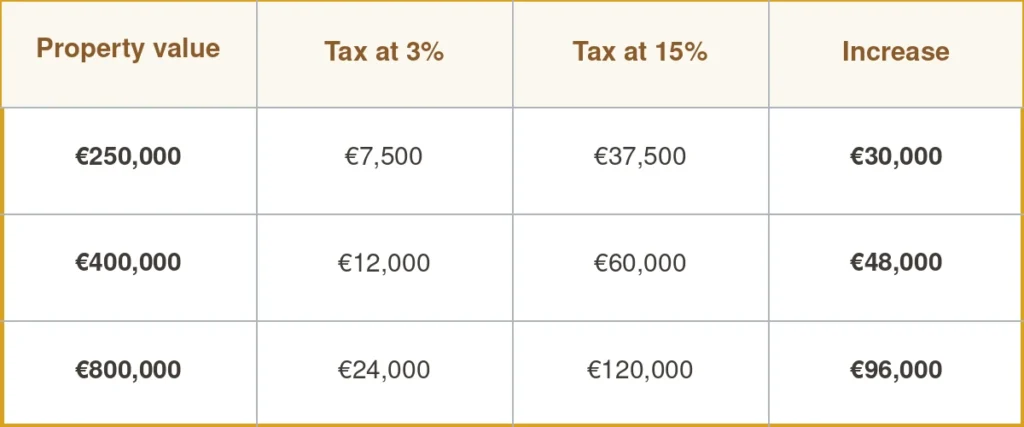
For example, on a €400,000 property, the buyer’s basic transfer-tax bill could rise from €12,000 to €60,000. The buyer would therefore need an additional €48,000 to complete the purchase.
These figures do not include notary fees, registration costs, legal fees, estate-agent charges or other expenses connected with buying property in Greece.
What Could It Mean for the Greek Golden Visa?
The announcement could significantly change the cost of obtaining a Greek Golden Visa through property investment.
The programme is available to third-country nationals, the same broad group referred to in the Prime Minister’s announcement. Unless the forthcoming legislation provides an exemption, the higher tax could affect purchases under all three principal property thresholds:
- €800,000 in high-demand areas, including much of Attica and Thessaloniki, as well as Mykonos, Santorini and islands with more than 3,100 residents
- €400,000 in other parts of Greece
- €250,000 for qualifying conversions of commercial property into residential use and certain listed-building restoration projects
On an €800,000 qualifying purchase, the basic transfer-tax calculation would rise from €24,000 to €120,000 if the 15% rate applied without an exemption. The resulting €96,000 increase would be payable in addition to the qualifying property investment and the other costs of completing the purchase.
Who Else Could Be Affected?
The change is not limited to Golden Visa investors. It could also affect non-EU citizens buying property in Greece as:
- A permanent or part-time home
- A retirement property
- A home while living in Greece under a work, family or digital-nomad residence permit
- An investment without applying for a Golden Visa
Buyers from EU member states do not appear to be included in the announced increase. The position of citizens of the European Economic Area and Switzerland, however, has not yet been confirmed.
What Is Still Unclear?
Questions the legislation must answer
- What will be the exact starting date?
- Will the test be based on citizenship, residence, tax residence or another legal definition?
- Will non-EU citizens who already hold Greek residence permits be included?
- How will dual nationals and non-EU family members of EU citizens be treated?
- Will EEA and Swiss citizens receive the same treatment as EU citizens?
- What will happen when an EU citizen and a non-EU citizen buy jointly?
- Will preliminary agreements or transactions already underway receive transitional protection?
- How will purchases through Greek, EU or non-EU companies be treated?
- Will any Golden Visa property category receive an exemption?
What Should Prospective Buyers Do Now?
Anyone considering a purchase should avoid treating either the 15% rate or its timing as settled law until the bill is published.
Non-EU buyers with a transaction already in progress should ask an independent Greek lawyer and notary how the timing of the preliminary agreement, property-transfer tax declaration and final notarial deed could affect them. A reservation payment or private agreement may not necessarily provide protection from a later tax change.
Prospective buyers should also avoid rushing into a purchase solely because of the announcement. The final legislation may contain exemptions, transitional arrangements or definitions that materially change how the measure applies.
Final note: The announcement could add tens of thousands of euros to the cost of a property purchase, but it is not yet law. Buyers should calculate the possible higher cost while waiting for the legislation to confirm who will be covered, when the measure will begin and whether any exemptions or transitional arrangements will apply.
This article provides general information and does not constitute legal, tax or investment advice. Xpat.gr will update it when the legislation and implementation rules are published.
You May Also Find This Xpat.gr Guide Useful
Buying Property in Greece in 2026: A Step-by-Step Guide for Foreign Buyers