

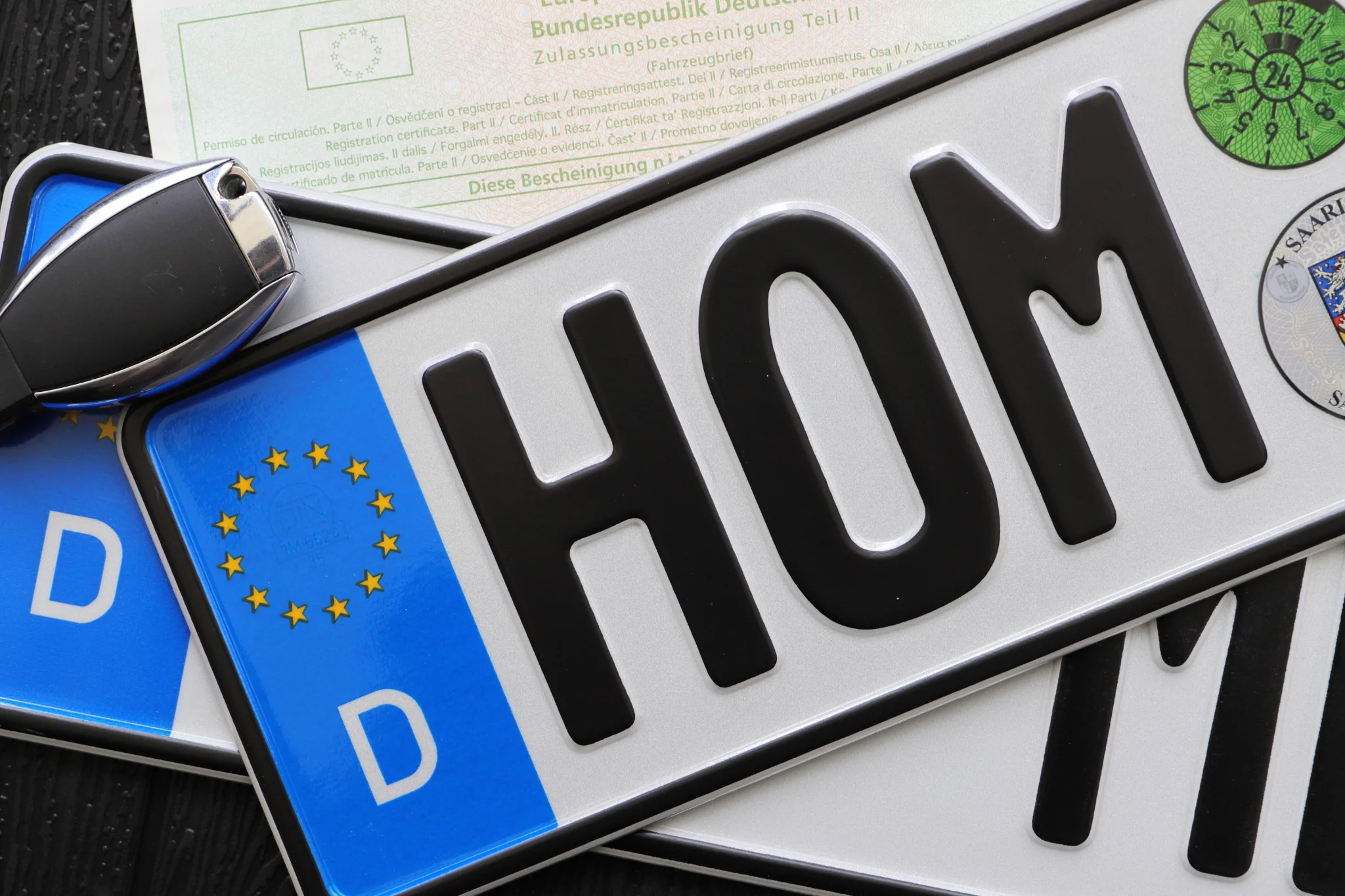
Greece’s Independent Authority for Public Revenue (AADE) is stepping up checks on foreign-registered cars, according to reporting published on 15 September 2026. For people who divide their time between Greece and another country, the questions are where they normally live, how long the vehicle stays in Greece and who drives it.
According to To Vima, investigators are using toll-road information, customs records and digital risk analysis to select vehicles for examination. The report also refers to April’s “Supercars” operation, in which 229 luxury vehicles were detained, with an estimated combined value exceeding €10 million. These figures concern the earlier operation, rather than a new September seizure.
For foreign residents, understanding the conditions attached to temporary vehicle use can prevent an expensive mistake. A car’s registration abroad is only one part of the picture.
In this guide
Who qualifies to use foreign plates?
AADE’s guidance on temporary vehicle use covers people whose habitual residence is abroad, who visit Greece temporarily and use the vehicle privately. It generally allows six months, consecutive or split across visits, within a twelve-month period. Customs may grant up to 15 additional days in exceptional circumstances.
The residence threshold is 185 days. Article 135 of the National Customs Code defines habitual residence through personal and occupational ties and at least 185 days, consecutive or otherwise, per twelve months. Where work and personal ties lie in different countries, regular returns to the place of personal ties can affect the assessment. University attendance does not itself transfer habitual residence.
For EU vehicles, Article 150(2) provides for temporary circulation and use under conditions analogous to those governing temporary importation of third-country vehicles. AADE’s guidance groups these arrangements under the heading “temporary importation–use”.
This matters for someone who keeps a home abroad while spending extended periods in Greece. The assessment requires a fuller account of their circumstances than the address on the vehicle’s registration.
How does the six-month rule work?
Separate visits count towards the same allowance. Three months in Greece followed by another three months within the relevant twelve-month period would use the ordinary entitlement. A short border crossing does not automatically start a fresh allowance.
Keep a dated record of the car’s arrivals and departures. Ferry tickets, transport documents and other travel evidence can help reconstruct its movements if questions arise. Ask the supervising customs office to confirm the applicable deadline where your visits overlap or your circumstances change.
What if you move to Greece permanently?
For people moving permanently between EU countries, the European Commission’s Your Europe guidance says the car should generally be registered and the relevant vehicle taxes paid in the new country. Any relocation exemption depends on that country’s conditions and deadlines.
Someone bringing their existing car to a new permanent home in Greece should contact customs about registration and any applicable transfer-of-residence relief. Ask about the procedure before relying on a visitor’s allowance, particularly if the vehicle arrives after your move.
Are there exceptions for students and workers?
AADE lists specific categories, including overseas residents coming exclusively for university studies, certain temporary teaching or specialist public-sector contracts, and qualifying people living and working abroad. Conditions and permitted periods differ. Its foreign EU company-car provision also carries employment, use and insurance requirements.
A fixed-term job, foreign employer or overseas company registration should prompt a check of the relevant category. Send customs your contract and details of how the vehicle will be used, and request a written response identifying the conditions that apply.
Can a partner or friend drive the car?
Under AADE’s driving restrictions, other eligible drivers generally need customs approval. Spouses, children and parents are exempt from that approval requirement if they have the same entitlement to temporary vehicle use.
Insurance permission and customs eligibility are separate checks. Before handing over the keys, establish whether the other driver qualifies under the Greek rules.
Can you leave the car parked in Greece?
Under AADE’s Special Uses FAQs (version 2.0), passenger vehicles brought temporarily into Greece by people habitually resident abroad who do not conduct professional activity in Greece must undergo formal customs immobilisation if they are not taken out of the country when the six-month period expires. The beneficiary must apply to the competent customs authority. Parking the car in a garage alone does not satisfy this requirement.
The vehicle must remain immobilised for at least six months and no more than 24 months. Parking, guarantee and release conditions apply. To return it to circulation, the beneficiary must prove at least 185 days abroad after immobilisation within the twelve months preceding release. After 24 months, the vehicle is declared unclaimed and subsequently passes into state ownership.
Leaving Greece without the car does not extend its permitted stay. Ensure it is taken out of Greece by the applicable deadline or complete the required customs procedure for keeping it here beyond that deadline. Keep the resulting documents with your vehicle records.
What penalties can apply?
Article 154 of the National Customs Code (Law 5222/2025), as amended by Article 12 of Law 5313/2026 and in force, sets the following fines for specified unlawful possession or circulation of EU passenger cars by people established in Greece who fail to meet the exemption conditions and required formalities.
| Engine capacity | Fine |
|---|---|
| Up to 1,400 cc | €2,500 |
| 1,401–1,600 cc | €3,000 |
| 1,601–2,000 cc | €5,000 |
| 2,001–3,000 cc | €8,000 |
| Above 3,000 cc | €10,000 |
The same amounts appear in AADE’s Special Uses FAQs (version 2.0) in the context of an EU vehicle being driven by a non-entitled person when the beneficiary was outside Greece. If the beneficiary was in Greece, the FAQs specify a €700 fine.
Separate scales cover electric vehicles. Overstays can attract daily fines, while non-EU vehicles fall under separate provisions that can involve smuggling offences. Consequently, €10,000 is not a universal maximum for every foreign-plate violation.
What documents should you keep available?
Your Europe recommends carrying registration, ownership and normal-residence evidence when using a car temporarily in another EU country. It also identifies valid roadworthiness documentation as relevant to avoiding penalties.
Alongside these, keep your insurance documents, driving licence, travel records and any customs authorisation or paperwork supporting a special category.
Before an extended stay, give customs the registration country, arrival date, intended departure, residence circumstances and names of proposed drivers. A written answer based on those details provides a useful reference throughout your stay.
Sources
- AADE: Temporary Importation of Private Vehicles and Personal Items to Greece
- National Customs Code, Law 5222/2025, particularly Articles 135, 150 and 154, read with subsequent amendments
- AADE: Special Uses FAQs, 23 April 2026, version 2.0, including temporary vehicle use, immobilisation and fines
- AADE Circular E.2036/2026, reproduced by Taxheaven: amendments under Law 5313/2026, including Article 154
- European Commission, Your Europe: Car registration in another EU country
- To Vima: Greek Tax Authorities Step Up Checks on Foreign-Registered Cars, 15 September 2026
You May Also Like
- Buying Property in Greece? What the Proposed 15% Tax Means for Non-EU Buyers
- Greek Tax Guide for Expats 2026
- Moving to Greece in 2026: The Complete Expat Guide
- Golden Visa Greece 2026: New Data, New Rules and Who Holds It
- Moving Your Whole Home to or from Greece? What to Ask Before Choosing an International Moving Company