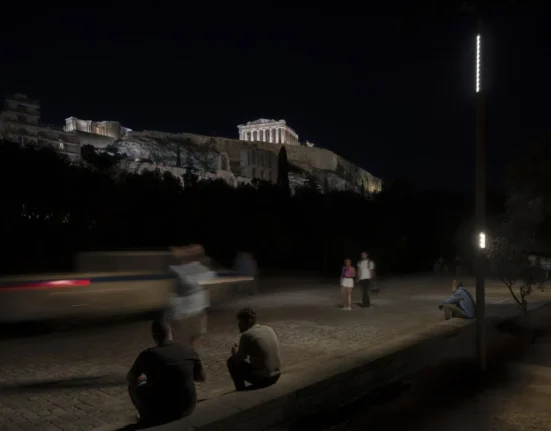

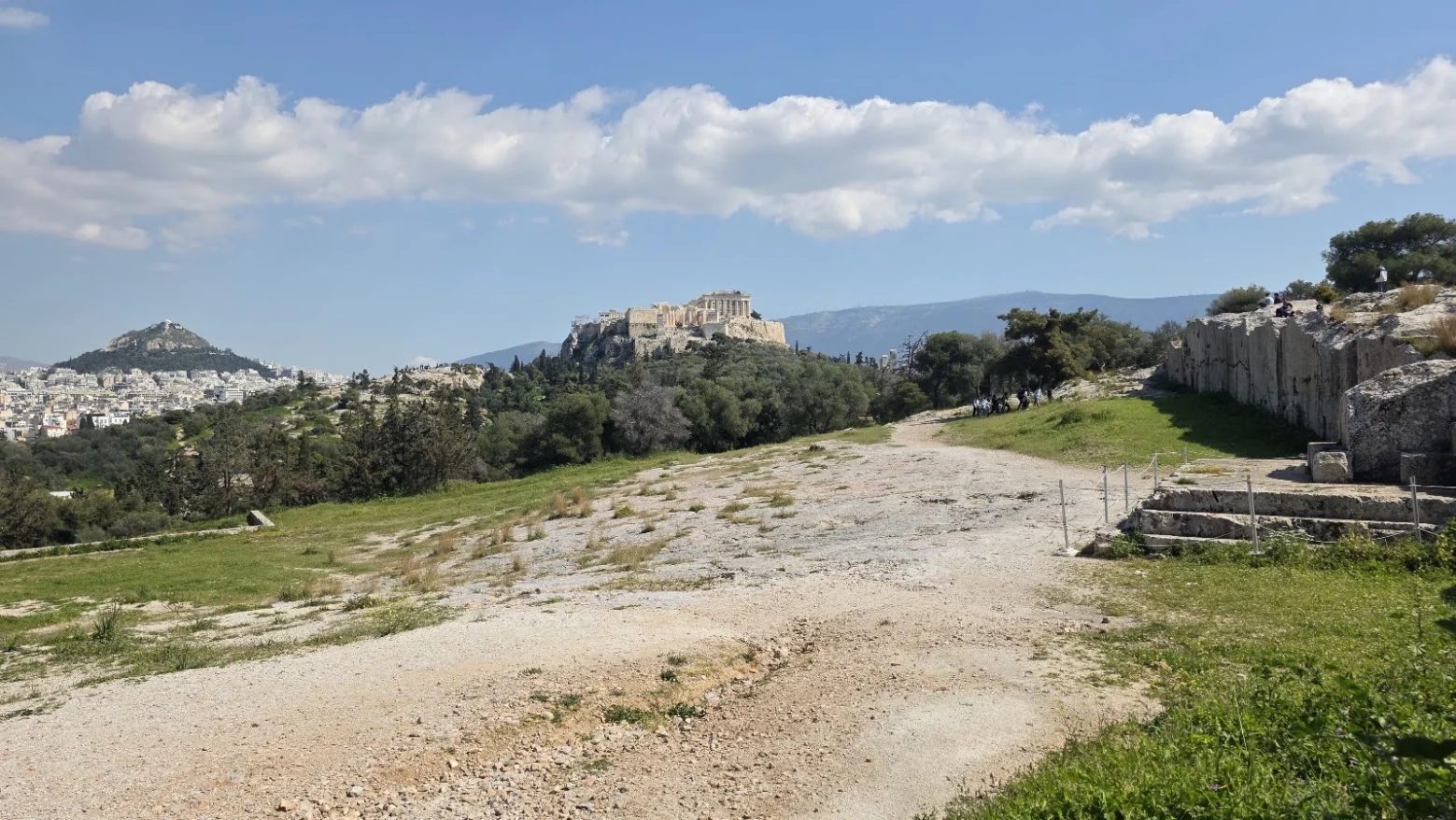
US Secretary of State Marco Rubio spoke at the Pnyx in Athens on 7 October 2026, joining a succession of political figures who have chosen the birthplace of Athenian democracy as a setting for their speeches, drawing on its historical significance and democratic symbolism to give their words greater resonance. In antiquity, the Pnyx was the principal meeting place of the Athenian Assembly, where renowned statesmen and orators such as Themistocles, Aristides, Pericles, Alcibiades and Demosthenes addressed their fellow citizens. Questions of war, peace, alliances and the future of the city were debated here, with eligible citizens exercising political authority through their votes.
Over the past two centuries, the Pnyx has acquired a second political life. Theodoros Kolokotronis, the leading military commander of the Greek War of Independence, addressed students here in 1838 on education and the future of the newly independent Greek state. André Malraux, France’s Minister of Cultural Affairs, invoked culture, freedom and human dignity in 1959, while French President Emmanuel Macron appealed for democratic renewal and European sovereignty in 2017. US President Barack Obama was also expected to speak at the Pnyx during his 2016 visit to Athens, but security concerns moved his address on citizenship and political accountability to the Stavros Niarchos Foundation Cultural Center.
Yet the democratic significance of the Pnyx does not legitimise the political agendas promoted from its historic ground. The authority of the ancient Assembly cannot be transferred to modern leaders simply because they choose to speak there. There is a distinction between drawing on history for inspiration, as Kolokotronis did, and appropriating it to lend authority to a contemporary political programme, as Rubio’s speech illustrates. The political ideas, policies and actions of modern leaders must be judged independently of the symbolism of the setting, particularly against the democratic principles of public participation, accountability and the scrutiny of power.
At a glance: Explore the Pnyx
Discover the modern political speeches, how democracy worked in ancient Athens, what survives at the Pnyx and how to visit it.
| Modern political speeches |
Kolokotronis (1838), Malraux (1959), Obama (2016), Macron (2017), Rubio (2026) |
| The Pnyx in antiquity | The Athenian Assembly and direct democracy |
| The bema and great orators | Pericles, Demosthenes and their contemporaries |
| The archaeological site | Construction phases and surviving remains |
| Ancient sanctuaries | Religious history and archaeological discoveries |
| Where and how to visit | Location, nearby hills, paths and Metro |
The Pnyx as a political backdrop — From Kolokotronis to Rubio
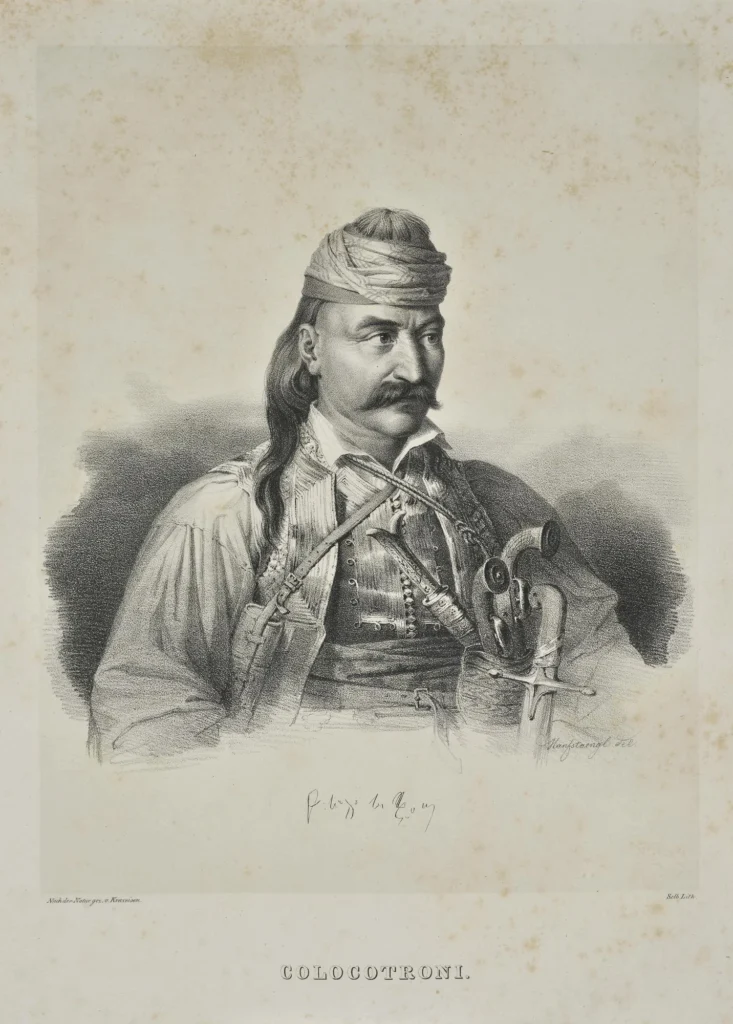
Theodoros Kolokotronis, 1838
On 8 October 1838, Theodoros Kolokotronis, one of the principal military commanders of the Greek War of Independence against Ottoman rule, addressed students of the Athens Gymnasium on the Pnyx. Greece had become an independent kingdom under King Otto, and Kolokotronis was speaking to a generation growing up after the revolution.
He began by recalling the men who had once spoken on the same hill.
«Παιδιά μου! Εἰς τὸν τόπο τοῦτο, ὁποὺ ἐγὼ πατῶ σήμερα, ἐπατοῦσαν καὶ ἐδημηγοροῦσαν τὸν παλαιὸ καιρὸ ἄνδρες σοφοί…»
“My children! On this ground where I tread today, wise men walked and made speeches in ancient times.”
Theodoros Kolokotronis, 8 October 1838. Translated from the Greek.
Kolokotronis recalled the achievements of the ancient Greeks before discussing the struggle for independence and the divisions that had weakened the revolutionary movement. He encouraged his young audience to pursue education, preserve unity and accept responsibility for their country’s future. The Pnyx connected ancient civic life with the challenges of establishing a modern Greek state.
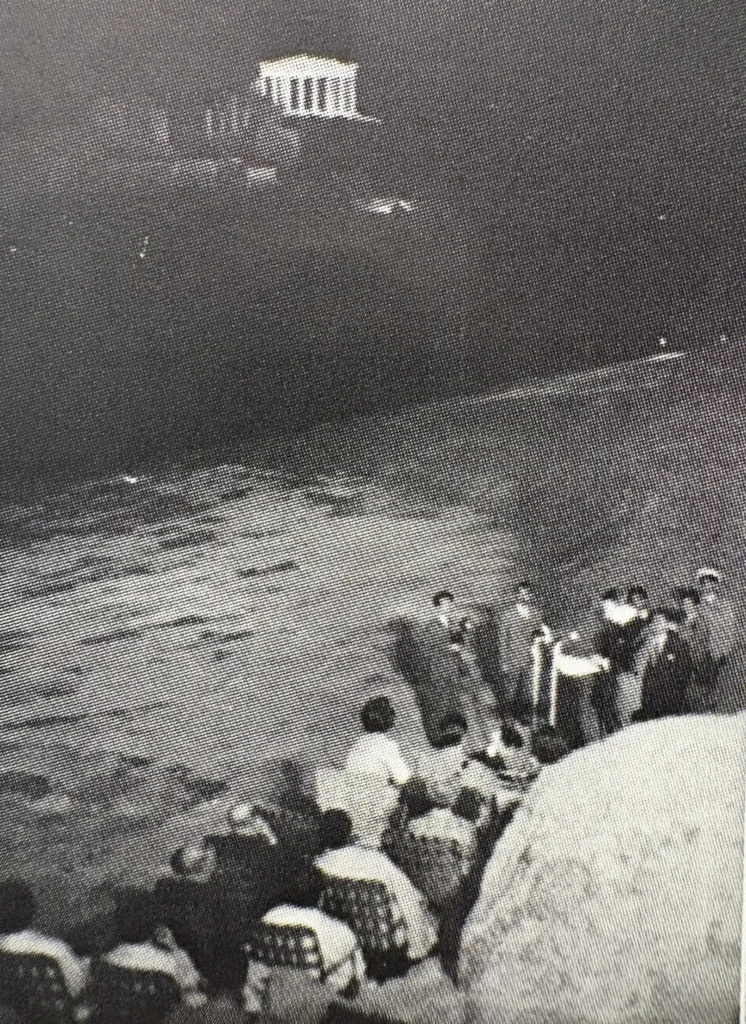
André Malraux, 1959
On 28 May 1959, André Malraux, the French novelist, former Resistance fighter and Minister of Cultural Affairs under President Charles de Gaulle, addressed an audience from the Pnyx during the inauguration of the Acropolis sound-and-light spectacle. He celebrated ancient Greece as a civilisation that had placed questioning, artistic creation and intellectual freedom at the centre of human achievement.
His speech also reflected the cultural ambitions of post-war France. Malraux called for wider access to art and intellectual achievement, linking the Greek inheritance with freedom, resistance to oppression and solidarity between nations.
“The major political challenge of our time is to reconcile social justice and freedom. The major cultural challenge is to make the greatest works accessible to the greatest number of people.”
André Malraux, Pnyx, 28 May 1959. Translated from the French.
The Pnyx and the illuminated Acropolis gave this agenda a powerful historical setting. Malraux presented the Greek inheritance as an inspiration for cultural access, intellectual independence and solidarity between peoples, while strengthening the cultural relationship between France and Greece.
Barack Obama, 2016
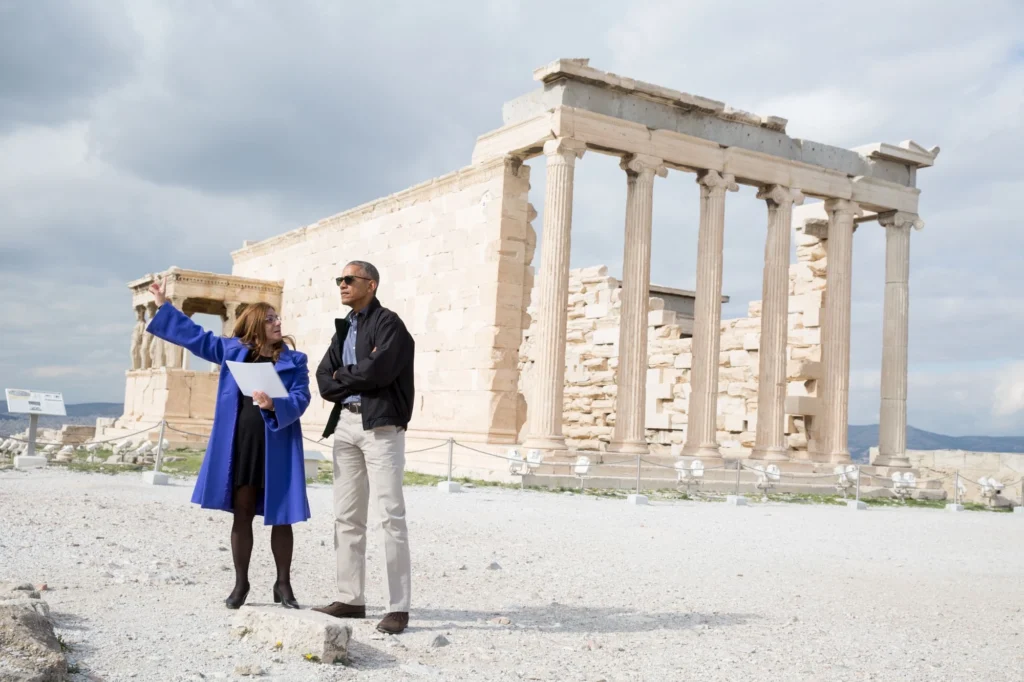
In November 2016, the Pnyx was considered as the setting for an address by Barack Obama, the outgoing 44th President of the United States, during his final overseas tour. Security concerns reportedly led to the abandonment of the outdoor venue, and Obama ultimately delivered his speech at the Stavros Niarchos Foundation Cultural Center in Athens on 16 November, shortly after Donald Trump’s first presidential election victory.
Despite the venue change, Obama evoked the democratic history of Athens, making the origins of citizenship and self-government central to his address. In his opening remarks, he recalled the emergence of democracy in the city’s rocky hills.
“These are all concepts that grew out of this rocky soil.”
Barack Obama, Athens, 16 November 2016.
Drawing on the Athenian Assembly, Obama highlighted citizenship, freedom of speech, equality before the law and self-government. He used this history to argue for broader economic opportunity and stronger democratic institutions amid increasing political polarisation.
He acknowledged the exclusions of ancient Athenian democracy, particularly the denial of political rights to women and enslaved people, while emphasising the subsequent expansion of citizenship and political participation. He defended a free press, the rule of law, checks on executive authority and the peaceful transition of power. His argument rested on the ability of citizens to challenge their governments and hold political leaders accountable.
Obama also addressed the consequences of economic inequality and praised the generosity Greeks had shown towards refugees arriving during the European migration crisis. His interpretation of the democratic inheritance of Athens placed particular emphasis on individual rights, inclusion and international cooperation. His speech at the Stavros Niarchos Foundation Cultural Center retained the Athenian Assembly as a central historical reference.
Emmanuel Macron, 2017
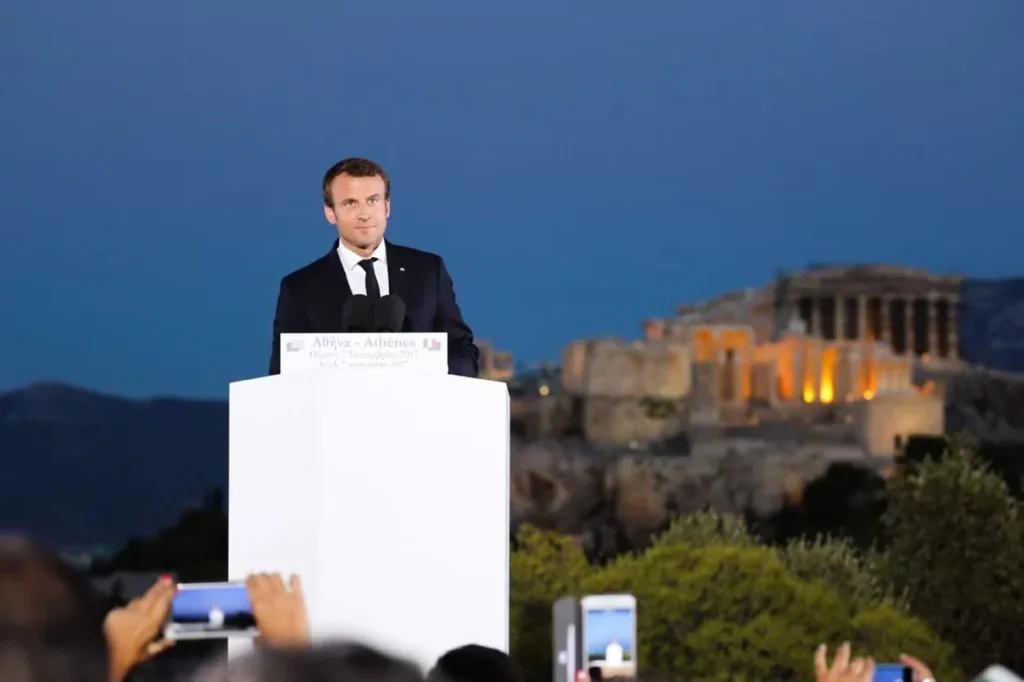
On 7 September 2017, Emmanuel Macron, who had become President of France four months earlier, addressed an audience at the Pnyx during an official visit hosted by Greek Prime Minister Alexis Tsipras. Europe was still confronting the consequences of the financial crisis, Britain’s decision to leave the European Union and growing public distrust of European institutions.
Macron used the birthplace of Athenian democracy to deliver a warning about Europe’s political future.
“On the Pnyx, free speech, debate and even controversy prevailed. So tonight, I want to speak frankly and without equivocation: in Europe today, sovereignty, democracy and trust are in danger. You know this better than anyone, because what became known as ‘the Greek crisis’ exposed this for all to see.”
Emmanuel Macron, 7 September 2017. Translated from the French.
He described the Greek financial crisis as a failure of Europe, acknowledging the hardship imposed on Greek citizens and criticising the mistrust and divisions that had shaped the response. He argued that European institutions had become increasingly remote from the people whose lives they governed.
His answer was a programme of European renewal built around sovereignty, democracy and trust. Macron proposed stronger common institutions, greater democratic accountability and public consultations across member states. He argued that European countries could protect their interests more effectively by exercising sovereignty together, rather than retreating behind national borders.
The Pnyx was integral to this argument. Macron explicitly invoked the ancient Assembly’s tradition of free speech, disagreement and citizen participation as a model for the democratic debate he wanted to revive across Europe. He also recalled André Malraux’s 1959 address from the same hill, connecting his proposals for European reform with a broader cultural inheritance.
His programme sought greater European integration alongside stronger democratic accountability, with public trust central to both aims.
Marco Rubio, 2026
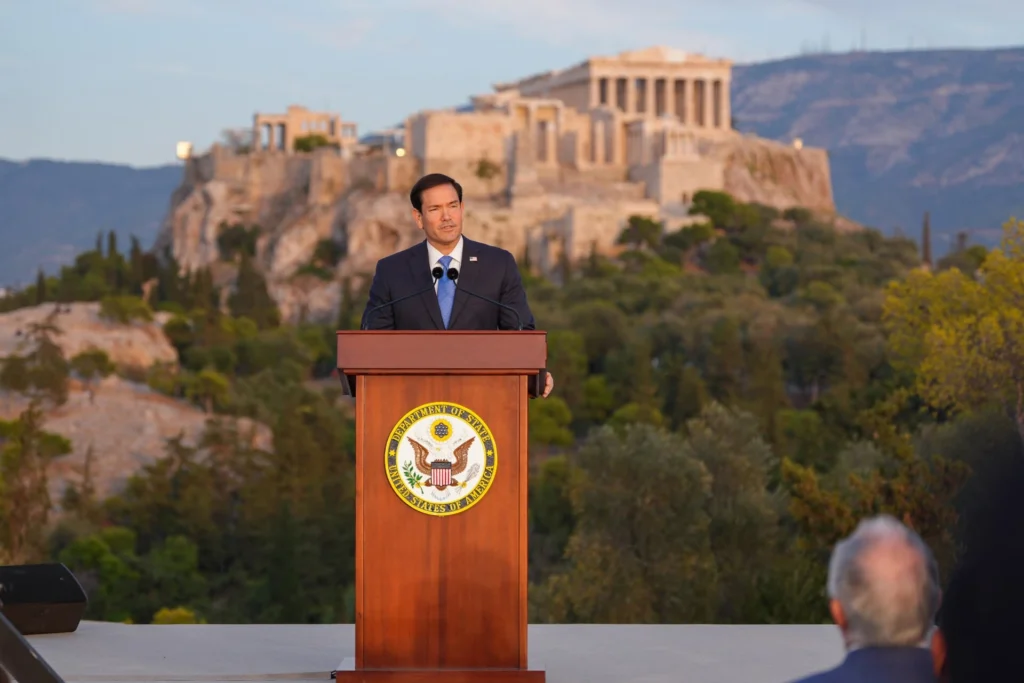
On 7 October 2026, Marco Rubio, the United States Secretary of State under President Donald Trump, stood on the Pnyx and invoked the achievements of ancient Greece and their influence on Western civilisation. His address moved from a tribute to Greece into a defence of the Trump administration’s America First agenda.
Rubio identified ambition, courage, curiosity and the pursuit of excellence as qualities that had shaped ancient Greek civilisation. He urged Western nations to rediscover these values, strengthen their industries and armed forces, and recover confidence in their national identities. He called for stronger alliances to confront contemporary threats, but framed those partnerships around the sovereignty and interests of individual nations.
“We choose the unapologetic pursuit of national power.”
Marco Rubio, Pnyx, 7 October 2026.
Rubio drew selectively on ancient Greece to support the Trump administration’s political programme. Ancient Greece contained competing traditions. Athens developed direct democracy while exercising imperial power over its allies, Sparta followed a different political system, and Greek cities frequently fought one another. The historical record offers examples of civic participation, military ambition, philosophical enquiry and struggles for supremacy. Rubio chose the qualities that supported his argument for national power.
This is where historical interpretation becomes political appropriation. Rubio presented the achievements of ancient Greece as part of America’s civilisational inheritance, drawing on their prestige to support an agenda centred on national strength and strategic dominance. The particular significance of the Pnyx lies in the political institution that once occupied it, an Assembly where eligible citizens debated proposals, challenged speakers and exercised authority directly. That history receded as the speech turned towards America First.
Earlier speakers also selected from the Greek inheritance to advance their own agendas. Kolokotronis spoke of education and national unity, Malraux of culture and freedom, Obama of citizenship and accountability, and Macron of European sovereignty and democratic renewal. Rubio’s speech illustrates how the same historical setting can be enlisted in a different political project. The Acropolis provided the backdrop, the Pnyx supplied the democratic symbolism, and the political argument belonged to the Trump administration.
Ancient Athens — How democracy worked on the Pnyx
The Pnyx became the principal meeting place of the Athenian Assembly in the early fifth century BC, following the reforms of Cleisthenes in 508/507 BC. These reforms reorganised the citizen body and helped establish the institutions of classical Athenian democracy. Earlier assemblies had gathered in the Ancient Agora, the city’s commercial and civic centre. The hillside west of the Acropolis provided a dedicated space for public decision-making.
The name Pnyx is traditionally associated with the Greek word pyknos, meaning dense or closely packed, an interpretation linked to the crowds that gathered there. The Assembly of the People, or Ekklesia tou Demou (Εκκλησία του Δήμου), exercised authority over major questions concerning war, peace, alliances, military campaigns and public finances. The Council of Five Hundred, whose members were chosen annually by lot, prepared the Assembly’s agenda and administered much of the daily business of government.
Athenian democracy was direct. Eligible citizens debated proposals and voted on decisions themselves. Participation was restricted to adult male Athenian citizens, excluding women, enslaved people and resident foreigners, known as metics. The institution gave political authority to a defined citizen body rather than to the population as a whole.
Two principles helped define the system: isegoria (ἰσηγορία), the equal right of citizens to address the Assembly, and isonomia (ἰσονομία), equality before the law. These rights were fundamental to political participation, although wealth, education, reputation and rhetorical skill influenced who could exercise the greatest practical influence.
Meetings included a call traditionally expressed as Tis agoreuein bouletai? (Τίς ἀγορεύειν βούλεται;), meaning “Who wishes to address the Assembly?” Any eligible citizen could come forward to speak. Established political figures and accomplished orators frequently dominated discussion, but their proposals remained subject to the approval of the citizen audience.
The Pnyx accommodated several thousand citizens, although its capacity changed as the auditorium was enlarged and remodelled. By the fourth century BC, the Assembly normally met four times during each of the ten administrative periods of the Athenian year. Voting commonly took place by a show of hands, known as cheirotonia (χειροτονία).
The proceedings could be lively and contentious. Citizens applauded, shouted objections and interrupted speakers, while collective reactions known as thorubos (θόρυβος) could influence the course of debate. Orators needed to hold the attention of large crowds gathered outdoors, often speaking on questions that directly affected the city’s future.
The comic playwright Aristophanes captured another aspect of Athenian political life in The Acharnians, first performed in 425 BC. He describes citizens lingering in the Agora while public slaves used a rope stained with red pigment to encourage reluctant participants to attend the Assembly. Anyone caught by the rope risked having their clothing marked with red dye. The episode belongs to political comedy, but it suggests the practical tensions between public duty and everyday life.
Athenian democracy also experienced serious interruptions. Oligarchic governments replaced democratic institutions in 411 BC and again in 404 BC during the Peloponnesian War. Democracy was restored in 403 BC, and the Assembly resumed its central place in civic life.
The bema and the great orators
The bema (βῆμα), the speakers’ platform, was the focal point of the Assembly. The surviving rock-cut platform dates from the site’s final major construction phase, around 330–326 BC. Earlier statesmen, including Pericles, spoke from different positions within the older arrangements of the hillside.
Themistocles, the Athenian politician and general, helped establish the naval strategy that proved decisive in the Persian Wars. He persuaded Athens to expand its fleet, which contributed to the Greek victory over the Persians at Salamis in 480 BC. Aristides, known as “the Just”, played an important role in organising the Delian League and assessing the contributions paid by Athens’ allies.
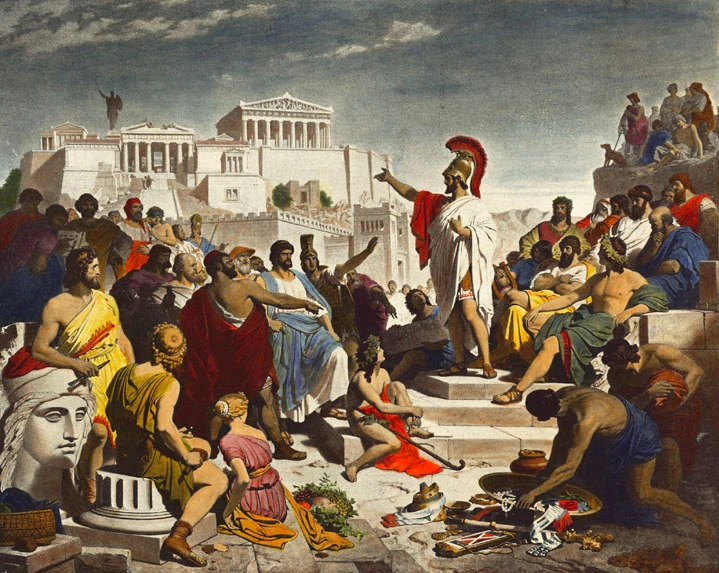
Pericles dominated Athenian political life during much of the fifth century BC. His leadership coincided with the construction of the Parthenon, the development of Athens as a major cultural centre and the expansion of its influence across the Aegean. He addressed the Assembly on military policy, diplomacy and public affairs.
His celebrated Funeral Oration, preserved in the history of Thucydides, remains one of the most influential ancient reflections on civic duty and democratic government. The speech was delivered during a public funeral ceremony associated with the Kerameikos. The surviving version is Thucydides’ literary reconstruction.
Alcibiades, an Athenian statesman and military commander whose shifting allegiances marked the Peloponnesian War, became a leading advocate of the Sicilian Expedition in 415 BC. The campaign against Syracuse ended in a devastating defeat for Athens. His career demonstrated how powerful political personalities could influence collective decisions with consequences extending far beyond the Assembly itself.
In the fourth century BC, Demosthenes emerged as one of Athens’ most celebrated political orators. His Philippics warned against the expansion of Macedonian power under Philip II, the father of Alexander the Great. The speeches combined political argument with appeals to Athenian independence and public responsibility, illustrating the continuing importance of persuasion in the city’s democratic institutions.
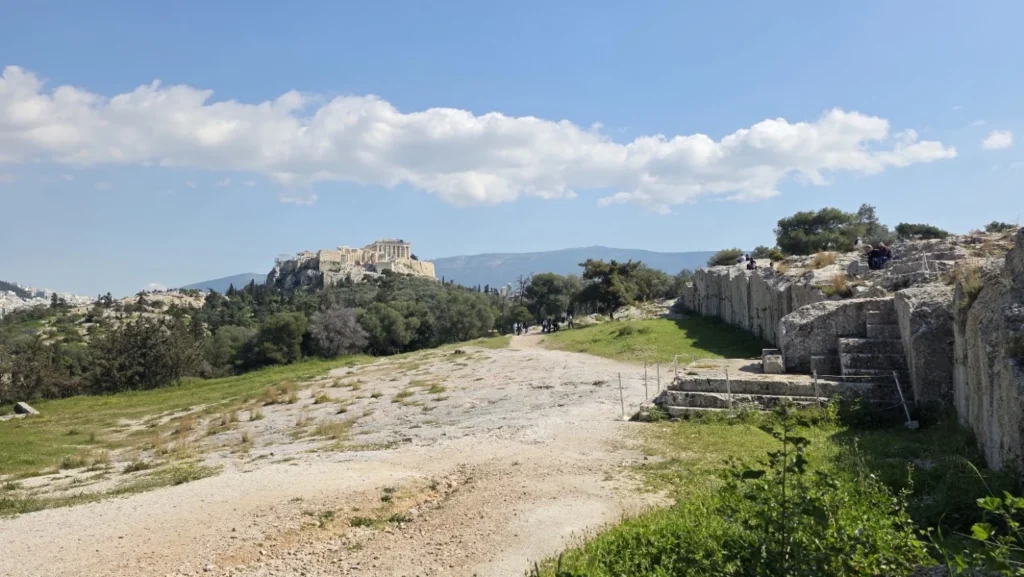
The Pnyx was a place where political leadership operated through public argument. Orators could propose policies and seek influence, while citizens exercised their authority through collective decisions. The consequences of those decisions could be profound, from military campaigns and alliances to questions concerning the future of the democracy itself.
The archaeological site — How the Pnyx was built and rebuilt
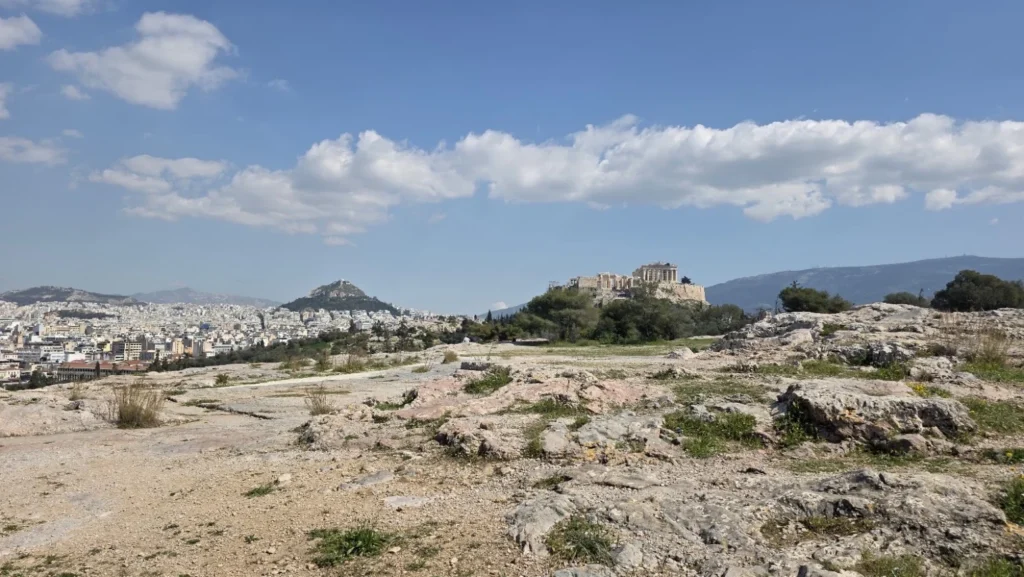
The photographs of the Pnyx archaeological site and its surrounding hills in this guide were taken by Xpat.gr.
The Pnyx underwent three major phases of construction as the Athenians adapted and enlarged the meeting place of their Assembly. Its carved limestone, monumental retaining walls and surviving foundations reveal how a natural hillside developed into a substantial civic space.
In the first phase, during the early fifth century BC, the Assembly used the natural slope of the hill as an open-air auditorium. The Athenians levelled sections of limestone and constructed a straight retaining wall along the northern edge. Citizens assembled on the sloping ground, facing a speakers’ area to the north.
The second phase, generally dated to the late fifth century BC, involved a substantial reorganisation. The orientation of the auditorium was reversed, with a semicircular retaining wall constructed on the northern side. The enclosed area was filled to create a slope descending towards the south, while two stairways, each approximately 3.90 metres wide, provided access.
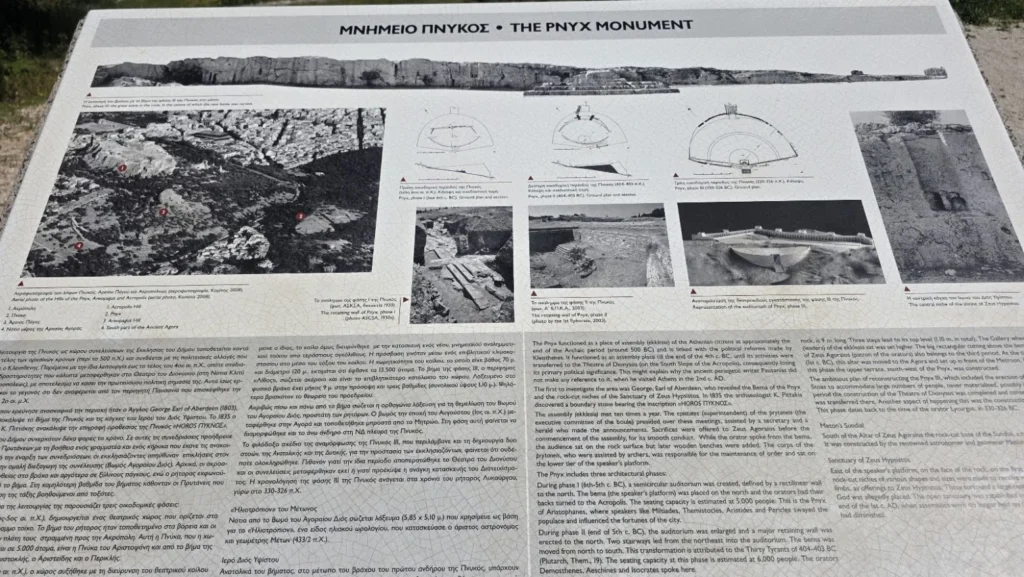
The third and most ambitious phase, around 330–326 BC, substantially enlarged the site. The Athenians constructed a massive retaining wall using limestone quarried from the hillside and cut a new bema into the rock on the southern side. This is the speakers’ platform visitors can still see today.
The programme is associated with Lycurgus, a fourth-century BC Athenian statesman who oversaw public finances and important civic building projects. Plans included two substantial stoas, or covered colonnades, on the terrace above the speakers’ platform. Between them, a rectangular foundation measuring approximately 19 by 13 metres was prepared for a monumental entrance, or Propylaea.
Archaeological investigations revealed the scale of the proposed development. The western stoa was planned to extend approximately 148 metres along a broad terrace overlooking Athens and the Attic plain. Both stoas and the entrance remained unfinished. By the end of the fourth century BC, a defensive wall known as the diateichisma (διατείχισμα) had been constructed across the hill, incorporating parts of the abandoned foundations.
Sanctuaries and archaeological discoveries
The Pnyx also preserves evidence of religious activity. Above the bema, a rectangular cutting in the limestone marks the original position of the Altar of Zeus Agoraios. During the reign of Augustus, the first Roman emperor, the altar was moved to the Ancient Agora and re-erected near the Metroon, the building associated with the city’s public records.
Close to the speakers’ platform lie the remains of the Sanctuary of Zeus Hypsistos, or Zeus Most High. The sanctuary came to light in 1803 during excavations by Lord Aberdeen, a Scottish nobleman and antiquarian. Steps, inscribed votive plaques and niches cut into the limestone provide evidence of its religious use. Some offerings depict human body parts, including eyes and breasts, suggesting that worshippers sought healing or gave thanks for recovery.
Excavations by the Greek Archaeological Society in 1910 helped establish the identification of the ancient assembly ground. Between 1930 and 1937, the American archaeologist Homer A. Thompson worked with the Greek archaeologist Konstantinos Kourouniotes and later Robert L. Scranton to investigate the site. Their findings clarified the principal stages of its architectural development, including the changing orientation of the auditorium and the unfinished fourth-century BC building programme.
Visiting the Pnyx today
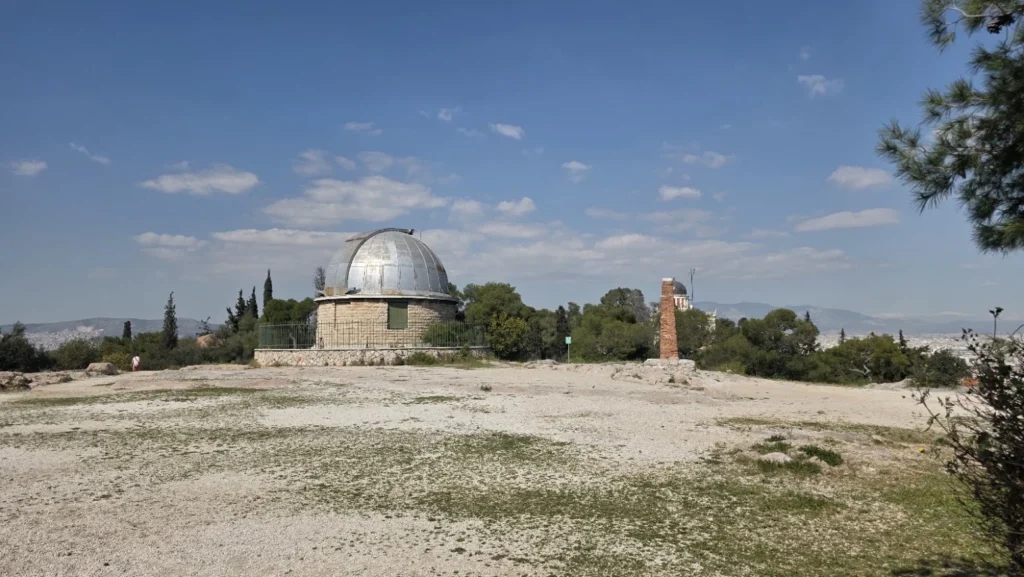
The Pnyx lies among three historic hills west of the Acropolis. To the north rises the Hill of the Nymphs, crowned by the National Observatory of Athens. To the south stands the Hill of the Muses, better known as Philopappos Hill, named after the second-century AD Roman consul and prince of Commagene whose marble funerary monument survives near the summit.
The archaeological site lies within walking distance of the Acropolis, with paths crossing the surrounding hills. One approach begins near the junction of Dionysiou Areopagitou and Roberto Galli streets, close to the Church of Agios Dimitrios Loumbardiaris. The nearest Metro stations are Thissio and Acropoli. Visitors should check current access arrangements, particularly when official events are taking place.
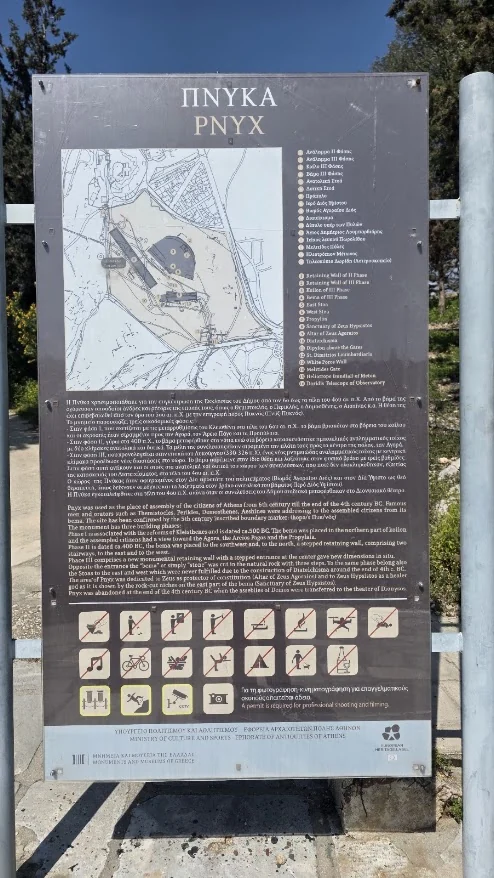
The principal surviving features include the great retaining wall, the open auditorium and the rock-cut speakers’ platform dating from the final building phase. Archaeological information panels explain the construction periods, while cuttings in the limestone and surviving foundations indicate the positions of ancient buildings and sanctuaries.
Standing within the assembly ground offers a remarkable sense of physical continuity with the past. Thousands of Athenian citizens once occupied this hillside, listening to arguments, interrupting speakers and voting on decisions that could determine their city’s future. The Acropolis rises to the east, and the surviving stonework makes it possible to recognise the place where public debate shaped political authority.
The surrounding hills also preserve traces of Athens’ scientific history. Meton of Athens, a fifth-century BC astronomer and mathematician known for his work on the relationship between lunar months and solar years, is associated with a solar observation instrument, or heliotrope, on the Pnyx. His studies helped establish the nineteen-year astronomical cycle known as the Metonic cycle.
On the neighbouring Hill of the Nymphs stands the National Observatory of Athens, founded in 1842 with the support of Georgios Sinas, a Greek banker and benefactor based in Vienna. The neoclassical building, designed by Danish architect Theophil Hansen, was completed in 1846.
The Pnyx has outlived the institution for which it was built by more than two thousand years. Its continuing attraction to political leaders demonstrates the enduring power of ancient Athens in modern political imagination. Yet the most significant feature of the hillside remains the ancient assembly ground itself, where citizens once gathered to hear competing proposals, debate public affairs and decide how they would be governed.
Sources
Hellenic Ministry of Culture – Odysseus: The Pnyx, Athens
Theodoros Kolokotronis: Speech at the Pnyx, 8 October 1838
André Malraux: Speech in Athens, 28 May 1959
Kathimerini: Obama will not speak on Pnyx Hill because of security concerns
White House Archives: Barack Obama’s Athens address, 16 November 2016
Office of the Greek Prime Minister: Alexis Tsipras at the Pnyx, 7 September 2017
Élysée: Emmanuel Macron’s Pnyx address, 7 September 2017
US Department of State: Marco Rubio’s remarks at the Pnyx, 7 October 2026