


Greek culture can be full of surprises for newcomers, but few catch expatriates off guard as quickly as Greek communication.
An American friend of mine discovered this shortly after moving to Athens. While visiting a public office to sort out some paperwork, she approached the counter, smiled politely, and waited to be greeted. The employee looked up, smiled back warmly, and said, «Πείτε μου» (PEE-teh moo), a phrase that literally translates as “Tell me.”
My friend froze for a moment. Later, over coffee, she recounted the story with genuine bewilderment.
“Why was she so rude?” she asked. “She just looked at me and said, ‘Tell me.'”
To an American or British ear, the phrase sounded surprisingly abrupt, almost like a command. In the United States, Britain, and many other English-speaking countries, customer-service interactions are usually wrapped in softer formulas such as “How can I help you today?” or “What can I do for you?” The words themselves are designed to cushion the interaction before any business is conducted.
Yet the Greek employee would probably have been equally surprised by my friend’s reaction. From her perspective, she had been perfectly courteous and welcoming. She had smiled, acknowledged the visitor immediately, and invited her to explain what she needed. In natural English, «Πείτε μου» is often much closer to “How can I help you?” or “Please tell me what you need” than to the bare command “Tell me.”
That brief exchange captures one of the most common cultural misunderstandings experienced by expats in Greece. Many foreigners arrive expecting politeness to look and sound the same as it does in their home countries. Instead, they encounter neighbours who ask personal questions, colleagues who speak with startling frankness, shopkeepers who get straight to the point, and strangers who seem unusually comfortable crossing conversational boundaries.
To someone raised in Britain, Germany, Scandinavia, the United States, Japan, or China, these behaviours can initially feel abrupt, intrusive, or even rude. Yet the reality is often far more complex.
In many cases, what foreigners perceive as Greek directness is not directness at all. It is politeness that has become invisible through translation, cultural assumptions, and differing ideas about what respect actually looks like.
Understanding this difference is one of the keys to understanding Greek culture, Greek customs, and everyday life in Greece. Beneath the apparent directness lies a sophisticated system of courtesy that is expressed differently from the forms many foreigners are accustomed to. Some of the very behaviours that outsiders interpret as impolite are often intended as signs of warmth, openness, hospitality, and genuine human connection.
To understand why, we need to look beyond the words themselves and examine how different cultures define politeness. As we shall see, the issue is not that Greeks are less polite than Britons, Germans, Japanese, Chinese, or Americans. Rather, they are often operating according to a different set of cultural rules. Linguists refer to these as positive politeness and negative politeness strategies, and understanding the distinction helps explain why the same interaction can sound perfectly courteous to one person and surprisingly rude to another.
Before we explore those contrasting approaches to politeness, however, we need to return to the phrase that started it all, because hidden inside «Πείτε μου» is one of the most revealing lessons about Greek etiquette, Greek communication, and the subtle ways in which politeness can get lost in translation.

The Courtesy Hidden Inside «Πείτε μου»
To understand why «Πείτε μου» (PEE-teh moo, “Tell me”) can sound so different to Greeks and foreigners, we need to look at something that is largely invisible in translation.
Most foreigners focus on the literal meaning of the phrase. They hear “Tell me” and naturally interpret it as a command. What they do not realise is that a significant part of the politeness is hidden inside the grammar itself.
The verb «Πείτε» is not singular but plural. The speaker is addressing the customer using the traditional plural of politeness. Greek distinguishes between εσύ (eh-SEE), the informal singular “you” used with friends and family, and εσείς (eh-SEES), the respectful form used with strangers, customers, professionals, and older people. Similar distinctions exist in French (vous), Italian (Lei), and Spanish (usted). English, however, lost this distinction centuries ago and now has only one “you.”
This difference matters more than many people realise. To a Greek speaker, «Πείτε μου» does not simply mean “Tell me.” It also carries an implicit message of respect and is often understood more along the lines of “How can I help you?” or “Please tell me what you need.” In other words, part of the courtesy is already built into the sentence itself.
A Greek shopkeeper who says «Πείτε μου» is not snapping at the customer or trying to be abrupt. Quite the opposite. The phrase is often intended as a welcoming invitation, encouraging the other person to explain what they need. By dispensing with excessive formality, the speaker signals that the conversation can begin immediately, without unnecessary barriers or social distance.
The problem arises when Greeks switch to English. When they translate their thoughts directly, one of the language’s most important politeness markers disappears. The respectful plural embedded in «Πείτε» has no equivalent in modern English, meaning that the foreigner hears a simple imperative while the Greek speaker hears an imperative softened by a built-in marker of respect. Much of the intended courtesy is therefore lost in translation.
The same phenomenon occurs in countless everyday interactions. Consider another common example: «Τι θα θέλατε;» (tee tha THEH-lah-teh, “What would you like?”). The phrase combines the respectful plural with the softening effect of θα, creating a courteous invitation for the customer to express their needs. To a Greek speaker, the sentence sounds perfectly polite. Yet when Greeks speak English, they sometimes translate similar expressions more directly than native English speakers would, unintentionally creating the impression of abruptness where none was intended.
Another phrase foreigners frequently hear is «Περιμένετε ένα λεπτάκι» (peh-ree-MEH-neh-teh EH-na lep-TA-kee, “Please wait a little moment”). Here, two politeness mechanisms are operating simultaneously. The plural of politeness conveys respect, while the diminutive λεπτάκι softens the request by making the wait sound smaller and less burdensome. To Greek ears, the phrase sounds reassuring, friendly, and considerate. To someone hearing only a literal translation, however, much of that subtle politeness may disappear.
This is one reason why newcomers sometimes conclude that Greeks use fewer politeness markers than English speakers. In reality, the opposite may be true. Greek often distributes politeness across grammar, syntax, vocabulary, and social conventions rather than relying exclusively on highly visible words such as παρακαλώ (pa-ra-ka-LO, “please” / “you’re welcome”) and ευχαριστώ (ef-ha-ri-STO, “thank you”). The politeness is there; it is simply located in a different place.
As we shall see, this difference becomes even more striking when we examine how different societies understand politeness itself. Some cultures tend to show respect by maintaining distance and avoiding imposition. Others, including Greece, often show respect by reducing distance and creating a sense of warmth and human connection.
That distinction lies at the heart of what linguists call positive politeness and negative politeness—two very different routes to the same destination: making other people feel respected.

Two Different Routes to Respect
The differences we have seen so far are not unique to Greece. In fact, they reflect a much broader question that has fascinated linguists for decades: What does it actually mean to be polite?
Most people think they know politeness when they see it. We recognise good manners, courteous behaviour, and respectful language almost instinctively. Yet what one culture considers polite may strike another as distant, overly formal, intrusive, or even unfriendly.
The challenge is that politeness is not simply a collection of universal rules. It is a cultural system shaped by different ideas about how human relationships should work.
One of the most influential attempts to explain these differences was developed by linguists Penelope Brown and Stephen Levinson. Their Politeness Theory revolves around the concept of face, meaning the public image, dignity, and self esteem that individuals seek to maintain during social interactions.
According to their framework, people generally possess two related social needs. The first is positive face, the desire to be liked, appreciated, accepted, and included. The second is negative face, the desire to have one’s independence, autonomy, and freedom of action respected.
From these two needs emerge two broad approaches to politeness: positive politeness and negative politeness. Despite their names, neither is more polite than the other, nor does either represent “good” or “bad” politeness. They simply reflect different ways of showing consideration for others.
Negative politeness seeks to minimise imposition and protect personal autonomy. It recognises that requests, interruptions, and demands on another person’s time can potentially threaten their independence. Speakers therefore tend to soften requests, apologise for inconveniences, and maintain a degree of social distance. In this approach, respect is communicated through restraint and consideration of boundaries.
Positive politeness, by contrast, seeks to satisfy the human desire for connection and belonging. Speakers emphasise friendliness, warmth, common ground, and involvement. Rather than protecting distance, they seek to reduce it. In this approach, respect is communicated through engagement, solidarity, and the creation of a sense of shared humanity.
Broadly speaking, countries such as Britain, Germany, Scandinavia, and Japan are often associated with stronger negative politeness tendencies. In these societies, respect is frequently demonstrated by avoiding imposition, protecting privacy, and acknowledging the other person’s right to make their own choices.
Greece, Italy, Spain, and many Latin American societies, by contrast, are often associated with stronger positive politeness tendencies. Here, friendliness, personal involvement, emotional expressiveness, and conversational warmth are more likely to be interpreted as signs of goodwill rather than intrusions.
Of course, these are broad cultural tendencies rather than rigid rules. Not every Greek is outgoing, and not every Briton is reserved. Human beings are far more complex than national stereotypes. Nevertheless, these differing expectations profoundly influence how people interpret everyday interactions.
The same behaviour can generate completely different reactions depending on the cultural lens through which it is viewed. A direct question may sound friendly to one person and intrusive to another. A carefully hedged request may sound respectful to one person and cold to another. A display of familiarity may feel welcoming to one person and inappropriate to another.
Neither interpretation is necessarily wrong. Both reflect deeply rooted assumptions about how respect should be expressed.
These contrasting approaches help explain why foreigners living in Greece sometimes feel that ordinary interactions operate according to unfamiliar rules. The issue is rarely the words themselves. More often, it is the cultural meaning attached to them.
These contrasting approaches became the starting point for the work of Greek sociolinguist Maria Sifianou, whose pioneering research explored how politeness operates in England and Greece. Her findings help explain why behaviours that seem perfectly natural in one country can sometimes appear puzzling or even impolite in another.
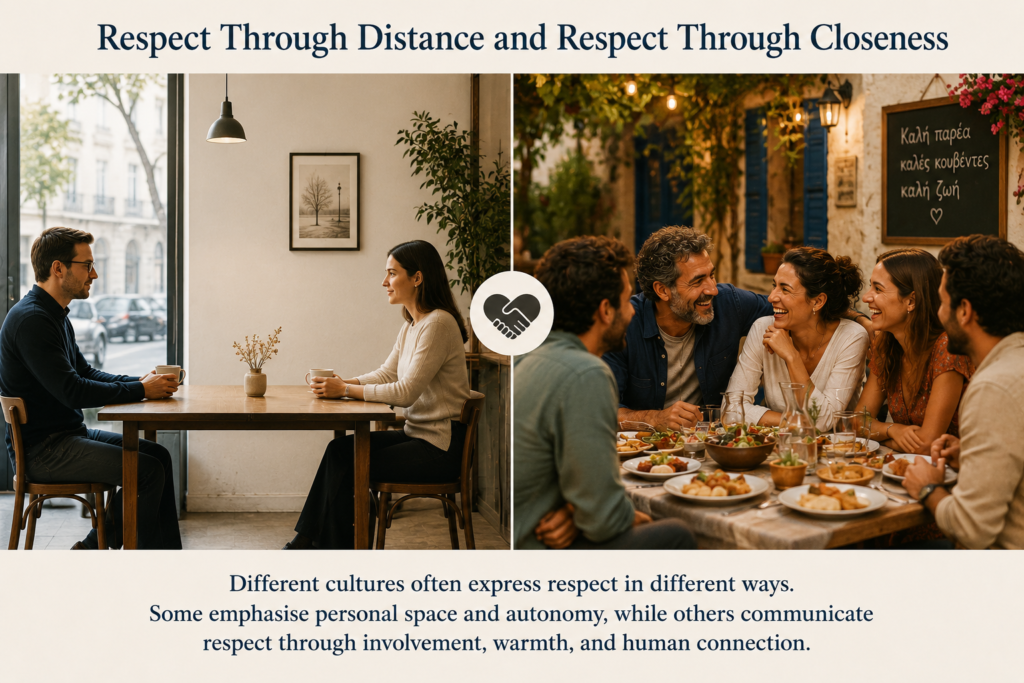
Respect Through Distance and Respect Through Closeness
In her landmark book Politeness Phenomena in England and Greece: A Cross Cultural Perspective, Greek sociolinguist Maria Sifianou applied these ideas to everyday communication in England and Greece.
Her conclusion was both simple and profound. The issue is not that one culture is more polite than another. Rather, different cultures often pursue the same goal of showing respect, but they do so through very different strategies.
In England, politeness frequently revolves around what has been described as an idiom of independence. People are expected to respect one another’s privacy, autonomy, and personal space. The underlying assumption is that every request imposes, at least slightly, on another person’s freedom. As a result, speakers often go to considerable lengths to soften requests, avoid appearing demanding, and give others room to decline. In this context, respect is demonstrated by acknowledging boundaries.
This is why English conversations are often filled with expressions such as “perhaps,” “possibly,” “would you mind,” “if it’s not too much trouble,” and “sorry.” To outsiders, these phrases may sometimes seem unnecessarily indirect or even excessive. To English speakers, however, they perform an important social function because they signal awareness that another person has the right to choose and the right not to be inconvenienced.
Greek communication often follows a different logic. Rather than prioritising independence, Greek politeness tends to emphasise involvement rather than distance. The focus is not primarily on protecting boundaries but on creating connection. Speakers frequently seek to establish common ground, demonstrate interest, and show that they are personally engaged in the interaction. Rather than treating another person as a stranger whose boundaries must be carefully protected, the conversation often proceeds from the assumption that human beings are meant to connect.
In this context, warmth, familiarity, engagement, and personal interest are frequently interpreted as signs of goodwill. Respect is often communicated not by stepping back but by stepping closer. Asking questions, offering advice, showing curiosity, or becoming personally involved in another person’s situation may therefore be intended as demonstrations of care rather than intrusions.
This helps explain why interactions that seem perfectly normal to Greeks can sometimes feel surprising to foreigners. A British visitor may interpret a Greek neighbour’s curiosity as nosiness, while a Greek may sometimes interpret British reserve as a lack of interest. A Briton may view social distance as respectful, whereas a Greek may perceive the same distance as coldness.
Neither interpretation is necessarily wrong. Both reflect different cultural expectations about how respect should be expressed.
Seen through this lens, many behaviours that initially surprise expatriates begin to make more sense. What appears to be directness may actually be openness. What appears to be intrusion may actually be interest. What appears to be informality may actually be an effort to make another person feel welcome.
Understanding this distinction is one of the keys to understanding Greek culture. Once you realise that Greeks often communicate respect through involvement rather than distance, many everyday interactions become easier to interpret and considerably easier to enjoy.

Why Greeks Ask Personal Questions
One of the first cultural surprises many expatriates encounter while living in Greece is how quickly conversations can become personal.
You may have known someone for only a few minutes before they ask where you are from, whether you are married, whether you have children, what brought you to Greece, or how long you intend to stay. In some cases, questions about work, housing, family circumstances, or future plans may arise far earlier than they would in many Northern European countries.
For newcomers, particularly those from cultures that place a strong emphasis on privacy, these questions can feel unexpectedly intrusive. The instinctive reaction is often to wonder whether the speaker is being nosy or crossing a social boundary. In many cases, however, that is not the intention at all.
Within cultures that lean towards positive politeness, personal questions frequently serve a different purpose. Rather than gathering information for its own sake, they help establish common ground, identify shared experiences, and transform an anonymous interaction into a human relationship. At a deeper level, they are often an attempt to answer a simple question: Who are you? Not in an administrative sense, but in a human one. Where do you come from? What is your story? How did you end up here? Do we share experiences, acquaintances, interests, or challenges?
In cultures that emphasise negative politeness, respect is often demonstrated by avoiding topics that might make another person uncomfortable. In cultures that favour positive politeness, respect is often demonstrated by showing genuine interest in another person’s life.
This difference helps explain why questions that may feel intrusive to some foreigners can sound perfectly normal to many Greeks. Asking someone where they are from, whether they have children, or what brought them to Greece is often intended as an invitation to conversation rather than an invasion of privacy. The purpose is frequently to discover common ground and establish a personal connection.
The same behaviour can therefore carry very different meanings depending on the cultural context. It also helps explain why conversations in Greece can develop with remarkable speed. A discussion that begins with practical matters may quickly move into family, work, travel, education, or personal experiences. Many Greeks see this not as an invasion of privacy but as the beginning of rapport, because the goal is often not distance but connection.
Of course, not every Greek behaves in the same way, and younger generations are sometimes more cautious about personal questions than their parents or grandparents. Nevertheless, many expatriates eventually discover that the curiosity they initially interpreted as nosiness often stems from a genuine desire to understand the person standing in front of them.
Once this becomes clear, the questions tend to feel very different. What first appeared intrusive may gradually come to feel welcoming.
The same principle applies to language. Just as personal questions often serve a social purpose that may not be immediately obvious to foreigners, many forms of Greek politeness are embedded in the language itself. Native speakers hear them automatically, but they often disappear when translated into English.
This helps explain why Greek communication can sometimes sound more direct to foreigners than it does to Greeks. Much of the politeness is still there. It is simply being expressed in ways that outsiders do not always recognise.
One of the clearest examples can be found in the Greek equivalents of “please” and “thank you.”

When “Please” Is Already Built Into the Sentence
One of the most persistent myths among foreigners is that Greeks simply use “please” and “thank you” less often than English speakers. The reality is considerably more nuanced.
Greeks certainly use παρακαλώ (pa-ra-ka-LO, “please” / “you’re welcome”) and ευχαριστώ (ef-ha-ri-STO, “thank you”), often and sincerely. The issue is not that Greeks do not use these words, but that Greek possesses a remarkably rich range of additional linguistic tools for expressing courtesy, warmth, respect, friendliness, and consideration. As a result, words such as “please” and “thank you” do not always carry the entire burden of politeness in Greek in the way they often do in English.
Greek often works differently. The language has multiple ways of softening requests, expressing respect, and creating goodwill without necessarily relying on explicit verbal formulas. Some of these mechanisms are grammatical, while others are embedded in tone, vocabulary, and word formation. Native speakers hear them automatically, but foreigners often do not. This is one of the main reasons why Greek politeness can disappear during translation.
One example is the widespread use of the conditional. Consider the phrase «Θα μπορούσατε να μου δώσετε εκείνο το έγγραφο;» (tha boo-ROO-sa-teh na moo THEH-seh-teh e-KEE-no to EH-ghra-fo — “Could you give me that document?”). Here, several politeness mechanisms are operating simultaneously. The conditional θα μπορούσατε softens the request by acknowledging the other person’s freedom to comply or refuse, while the verb form itself incorporates the traditional plural of politeness used when addressing strangers, customers, professionals, and older people. Much of the courtesy is therefore embedded directly into the structure of the sentence itself.
Another important feature is the use of diminutives. Greek speakers frequently transform ordinary words into smaller, softer versions of themselves. Rather than asking someone to wait, they may say «Περιμένετε ένα λεπτάκι» (peh-ree-MEH-neh-teh EH-na lep-TA-kee — “Please wait a little moment”). Instead of requesting a signature, they may ask «Θα ήθελα μια υπογραφούλα εδώ» (tha EE-the-la mia i-po-ghra-FOO-la e-THO — “I’d like a little signature here”). Friends may suggest «Να πιούμε ένα κρασάκι;» (na PEE-ou-me EH-na kra-SA-kee? — “Shall we have a little wine?”), while others might invite someone for «ένα καφεδάκι» (EH-na ka-fe-DA-kee — “a little coffee”).
These expressions do not simply indicate size. They often function as social cushions, making requests, invitations, and suggestions sound friendlier, less imposing, and more collaborative. By linguistically shrinking the object of the request, speakers also reduce its emotional weight. Asking for «μια υπογραφούλα» often feels less demanding than asking for a signature, while suggesting «ένα κρασάκι» creates a sense of warmth, friendliness, and sociability rather than referring to a small quantity of wine.
Greek also makes extensive use of possessive forms such as μου (“my”), not primarily to indicate ownership but to express familiarity, affection, and social closeness. Expressions such as «Μαρία μου» (“my Maria”), «φίλε μου» (“my friend”), or «παιδί μου» (“my child”) often sound far warmer in Greek than their literal English translations suggest. Once again, part of the emotional meaning is embedded in the language itself rather than in explicit words such as “please.”
This linguistic richness is one reason why Greek politeness often disappears during translation. When Greeks switch to English, they frequently translate the words but not the cultural and grammatical mechanisms carrying the politeness. What remains is the literal sentence stripped of many of the signals that originally conveyed respect, friendliness, and consideration.
The foreigner hears the words, while the Greek speaker hears the words together with all the layers surrounding them. As a result, what may sound direct in translation often sounds considerably warmer, softer, and more courteous to a native Greek speaker.

Talking Over Each Other Isn’t Always Rude
For many expatriates, one of the most bewildering aspects of Greek culture has nothing to do with grammar. It has to do with conversation itself.
A group of Greeks sitting around a table can sometimes sound as though they are arguing. Voices rise, people interrupt one another, several conversations appear to be taking place simultaneously, and someone may begin speaking before another person has finished. To visitors from Britain, Germany, Scandinavia, Japan, or other cultures where careful turn taking is considered an important sign of respect, the scene can appear chaotic.
Yet appearances can be deceiving. In many cases, what sounds like interruption is actually cooperative overlap. Rather than signalling impatience or disrespect, it often reflects enthusiasm, engagement, and active participation. People are not trying to silence the speaker; they are showing that they are listening and eager to contribute.
Within a culture that values positive politeness, involvement itself can be a sign of respect. Remaining completely silent may sometimes create the impression of emotional distance, whereas active participation signals interest and engagement.
The same principle often applies to volume and body language. Foreigners sometimes assume that Greeks are angry because they are speaking loudly. In reality, increased volume frequently reflects excitement, enthusiasm, or emotional involvement rather than conflict. Direct eye contact, expressive hand gestures, and closer physical proximity often communicate sincerity, attention, and engagement rather than aggression.
One particularly confusing habit for foreigners is the Greek gesture for “no”. Instead of shaking the head from side to side, Greeks often make a small upward movement of the head, sometimes accompanied by a slight tongue click. Many newcomers initially interpret the gesture as irritation or disapproval when it simply means “no.”
The same interaction can therefore generate very different impressions. A Greek may leave a conversation feeling that both parties were engaged, friendly, and animated, while a foreigner may leave the same conversation feeling interrupted or overwhelmed.
Neither interpretation is necessarily wrong. Each reflects a different cultural understanding of what respectful communication looks like.
Once expatriates become familiar with these conversational patterns, many discover that what initially felt chaotic begins to feel energetic and welcoming. The conversation has not changed. What has changed is the listener’s cultural lens.
And that lens becomes even more important when we consider a question that lies at the heart of recent research on politeness: Is being polite simply a matter of good manners, or is it something deeper?

Beyond Good Manners: What Greeks Mean by Politeness Today
Throughout this article, we have seen that what counts as polite behaviour often depends on cultural expectations.
Recent research suggests that many Greeks understand politeness in broader terms than etiquette alone.
In her 2023 study On Understandings of Politeness in Greek, Again!, Maria Sifianou explored how contemporary Greeks define politeness. Participants were asked to describe the qualities of a polite person and to provide examples of behaviour they considered polite.
The results were revealing. The qualities most frequently associated with politeness were respect, kindness, helpfulness, and good manners. Yet politeness was often understood as something more than simply observing social conventions or using the correct expressions.
Many respondents associated politeness with genuine concern for other people. Respect was often understood not merely as deference to authority but as respect for fellow human beings. Helpfulness, generosity, consideration, and willingness to assist others emerged as recurring themes.
One particularly interesting aspect of the study concerns sincerity. Some respondents appeared to distinguish between what might be called “politeness of manners” and “politeness of the heart.” The first refers to outward forms such as etiquette, conventional expressions, and correct social behaviour. The second refers to genuine concern for others, kindness, helpfulness, and sincerity. In this view, politeness is not simply a matter of appearing courteous. It should also reflect authentic feelings and come from the heart.
This helps explain why foreigners can sometimes find Greece confusing. A person may follow every rule of etiquette, use all the expected polite expressions, and still be perceived as cold, distant, or insincere. Conversely, someone may occasionally ignore formal conventions while displaying genuine warmth, generosity, and concern for others. Many Greeks would regard the second person as the more polite of the two.
In other words, politeness is not always judged solely by language. It is also judged by behaviour and character.
This perspective sheds light on many everyday experiences familiar to expatriates. The neighbour who brings food when you are ill, the shopkeeper who spends extra time helping you solve a problem, the stranger who insists on walking you to your destination rather than merely pointing the way, or the public servant who goes out of their way to help despite an initially brusque manner may all be demonstrating forms of courtesy that extend far beyond conventional etiquette.
The emphasis is often placed not merely on saying the right thing but on treating others with kindness, respect, and consideration.
At the same time, understandings of politeness are not static. Like all social values, they continue to evolve. Yet the study suggests that respect, kindness, helpfulness, generosity, and genuine concern for others remain at the heart of how many Greeks understand politeness today.
Seen from this perspective, Greek politeness is not simply a collection of phrases or social rules. At its heart lies a broader concern for human relationships and the way people treat one another in everyday life.
Looking Beyond the Words
For many expatriates, understanding Greece involves learning a new language, navigating unfamiliar bureaucracy, and adapting to different social customs. Yet some of the most important cultural lessons emerge through everyday interactions.
As we have seen, what appears rude, abrupt, intrusive, or overly familiar through one cultural lens may carry a very different meaning through another. Much of Greek politeness is easy to miss because it is often embedded in places where foreigners are not accustomed to looking for it. It may be hidden in grammar, softened through diminutives, expressed through warmth and involvement, or revealed through acts of kindness that extend beyond conventional etiquette.
When translated literally into English, many of these signals disappear. The politeness was there all along. The translation simply made it invisible.
Ultimately, Greek etiquette is not simply about following rules or saying the right words. At its best, it reflects a belief that human relationships matter; that strangers can become acquaintances, and acquaintances can become friends.
For many people who choose to make Greece their home, that may prove to be one of the country’s most enduring and appealing qualities.
While this article has focused primarily on communication styles and politeness, newcomers may also find it helpful to read our Navigating Greek Etiquette: A Comprehensive Guide for Expats, which covers greetings, hospitality, dining customs, family values, and other aspects of everyday life in Greece.