
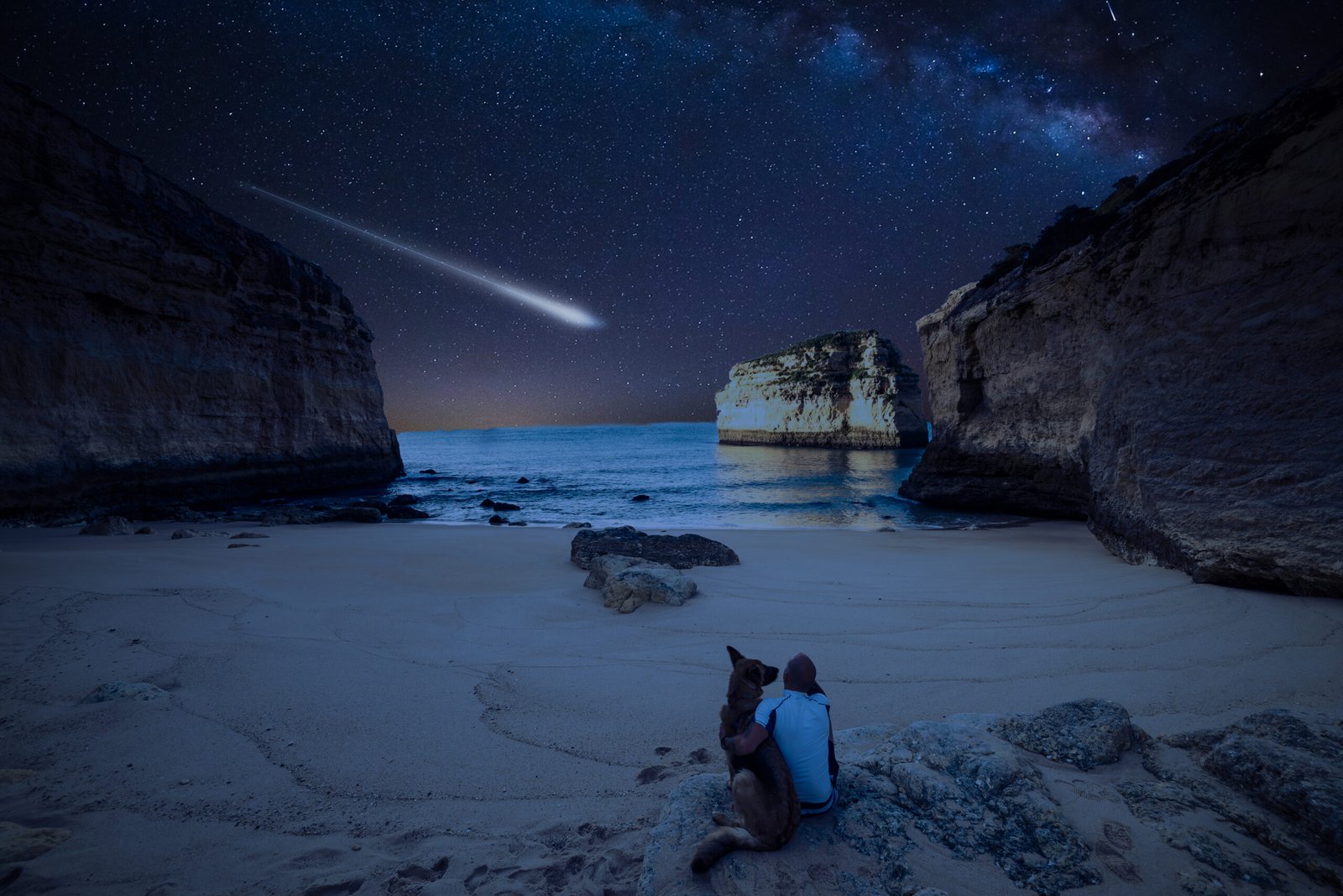
A New Moon, warm August nights and Greece’s mountains, islands and open coastlines will create excellent conditions for watching the Perseid meteor shower in 2026. Here is when to look up, where to go and what you can realistically expect to see.
Every August, bright streaks of light appear across the summer sky as the Perseid meteor shower reaches its annual peak. Known in Greek as peftasteria—πεφταστέρια, literally “falling stars”—the Perseids are among the year’s most eagerly awaited displays of “shooting stars.”
They are particularly well suited to casual observation. You do not need a telescope, binoculars or specialist knowledge. A dark location, an open view of the sky and a little patience are enough.
In 2026, the main display will coincide almost perfectly with a New Moon, leaving the sky free from disruptive moonlight. For observers in Greece, the night of Wednesday 12 August into Thursday 13 August should therefore offer some of the best Perseid conditions in years.
In This Guide
The navigation below is clickable. Select any section to jump directly to it.
Perseids 2026 in Greece: Essential Information
Will You Really See 100 Meteors an Hour?
What Is the Best Time to Watch?
Where to Watch the Perseids in Greece
How to Choose a Good Observation Site
Do You Need a Telescope or Binoculars?
What Else Can You See That Night?
How to Photograph the Perseids
Perseids 2026 in Greece: The Essential Information
AT A GLANCE
Best night: Wednesday 12 August into Thursday 13 August 2026
Best practical viewing period: After midnight until the first signs of dawn
Predicted principal maximum: Approximately 05:00–07:00 EEST on 13 August, partly overlapping with morning twilight
Moon conditions: New Moon, with virtually no moonlight interference
Equipment required: None
Best setting: A safe, dark location away from artificial light
Important: The predicted maximum occurs partly during morning twilight in Greece. Begin watching well before 05:00 rather than waiting for the official maximum.
According to the International Meteor Organization’s 2026 Meteor Shower Calendar, the Perseids remain active from 17 July to 24 August 2026. Meteors may therefore be visible for several weeks around the main event, although the highest activity is concentrated around the annual maximum.
The predicted principal maximum falls between 02:00 and 04:00 Universal Time on 13 August, corresponding to approximately 05:00–07:00 in Greece.
This is a prediction rather than an appointment with the sky. Meteor-shower maxima can vary, and the Perseids have a relatively broad peak. Morning twilight will already be developing during part of the predicted maximum, so observers in Greece should not wait until 05:00 to begin watching.
The practical plan: Begin before midnight and remain outside for as long as possible after midnight, when the radiant rises higher and the number of visible meteors generally increases.
The nights immediately before and after the main maximum may also be rewarding, particularly if clouds interfere on 12–13 August. The International Meteor Organization recommends observing around the peak because additional activity has occasionally appeared outside the principal maximum.
What Are the Perseids?
They are produced by tiny pieces of interplanetary dust and rock called meteoroids. When these particles enter Earth’s atmosphere at extremely high speed, they heat the surrounding air and create the brief trails of light that we see as meteors.
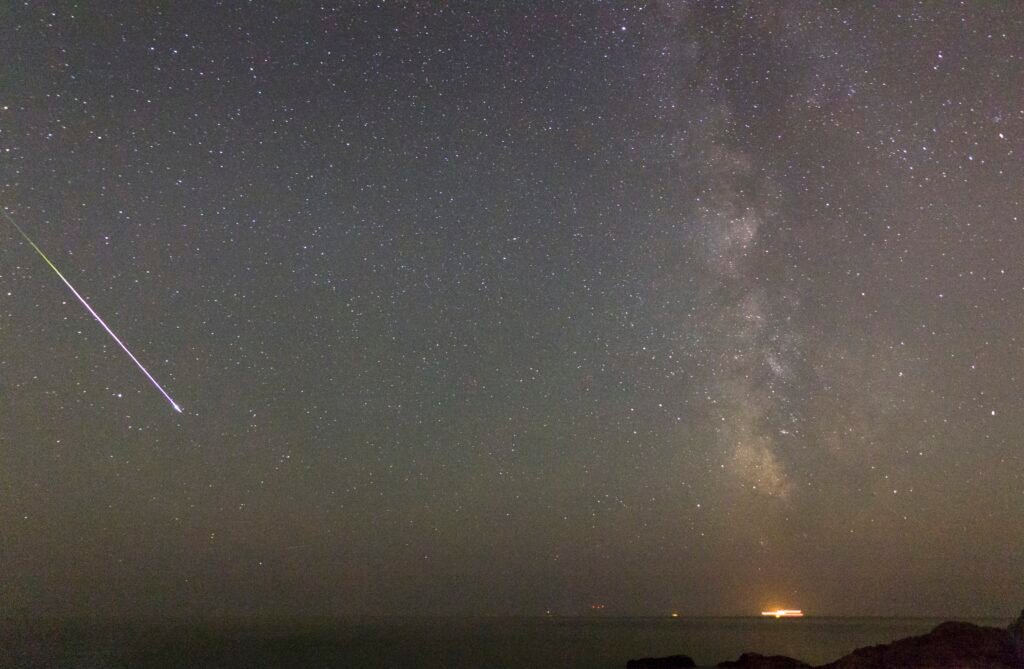
Most meteors are faint and remain visible for less than a second. Exceptionally bright examples, known as fireballs, can illuminate a large section of the sky and may leave glowing trails that remain visible for several seconds.
The material responsible for the Perseids was left behind by Comet 109P/Swift–Tuttle. Each summer, Earth passes through the broad stream of dust and debris distributed along the comet’s orbit.
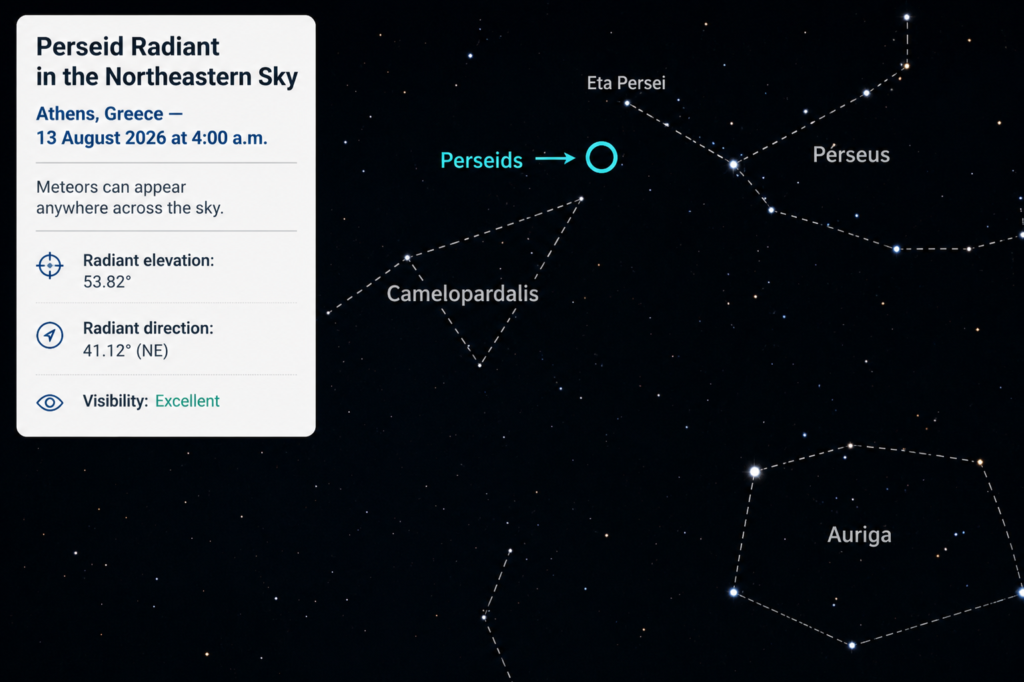
The meteors appear to travel outwards from the direction of the constellation Perseus, which is why the shower is called the Perseids. Perseus is the shower’s radiant—the point from which the meteors appear to originate because of perspective. The constellation itself is not their physical source.
According to NASA Science, Perseid meteoroids enter the atmosphere at approximately 59 kilometres per second. This high velocity helps produce the swift, bright and sharply defined streaks for which the shower is known.
Why 2026 Is an Excellent Year for Watching
Moonlight is one of the greatest natural obstacles to observing meteors. A bright Moon can illuminate the sky sufficiently to hide all but the most brilliant streaks.
In 2026, however, the Perseid maximum coincides with the New Moon. According to the United States Naval Observatory’s lunar-phase calculations, the New Moon occurs on 12 August 2026 at 17:37 Universal Time, corresponding to 20:37 Greek summer time.
The Moon will therefore not brighten the sky during the main observing hours. The International Meteor Organization describes the lunar circumstances around the 2026 maximum as excellent for visual observation.
This does not guarantee a spectacular display. Cloud cover, haze, atmospheric transparency, light pollution and the observer’s precise location will still determine how much can be seen. Nevertheless, the absence of moonlight removes one of the most significant obstacles.
Will You Really See 100 Meteors an Hour?
The Perseids are often promoted as producing “up to 100 meteors per hour,” but that figure requires some explanation.
The 2026 Meteor Shower Calendar lists a zenithal hourly rate, or ZHR, of 100. This is a standardised theoretical figure calculated for ideal circumstances: a completely dark and transparent sky, an unobstructed view and the shower’s radiant positioned directly overhead.
Real observers rarely experience all those conditions simultaneously.
From a genuinely dark location in Greece, you may see dozens of meteors during a sustained viewing session. From a suburb, an illuminated coastal resort or a location close to a town, the number may be substantially lower because artificial light conceals the fainter streaks.
The International Meteor Organization also cautions that the underlying Perseid activity in 2026 may be lower than the traditionally quoted theoretical maximum. Model calculations indicate that a weak filament of cometary material could contribute some additional activity close to the main maximum, but its visible effect cannot be guaranteed in advance.
Manage expectations: Think of the ZHR as a scientific comparison figure, not as a promise that you will personally count 100 meteors within sixty minutes.
What Is the Best Time to Watch from Greece?
You can begin observing from approximately 22:30 or 23:00, when the Perseid radiant has reached a useful elevation above the northeastern horizon at Greece’s latitude.
During the earlier part of the night, you may see a smaller number of meteors, including occasional earthgrazers. These enter the atmosphere at a shallow angle and may produce long trails close to the horizon.
Conditions usually improve after midnight. As Earth rotates, the observer’s location turns increasingly towards the direction from which the meteoroids are arriving. At the same time, Perseus climbs higher in the sky.
For most observers, the most rewarding period will be after midnight and before morning twilight becomes strong. Those unable to remain outside throughout the night should aim for a viewing session of at least one hour during this period.
Meteors do not arrive at regular intervals. Several quiet minutes may pass before two or three appear within a short period. The longer you remain outside, the greater your chances of witnessing a particularly bright fireball.
Where Should You Look?
The Perseids appear to radiate from Perseus, which rises in the northeastern part of the sky and climbs higher as the night progresses.
However, you should not stare directly at Perseus throughout the night. Meteors can appear almost anywhere, and those farther from the radiant frequently produce the longest visible trails.
Choose a position with the widest possible view of the sky. Lie back on a reclining chair, beach mat or blanket and look roughly halfway between the horizon and the point directly overhead.
A broad view towards the north, northeast or east can be helpful, but an unobstructed dark sky is more important than identifying one precise constellation.
An astronomy application such as Stellarium can help you locate Perseus before the observing session begins. Once your eyes have adjusted to the darkness, reduce the screen brightness, select a red-light mode where available and avoid checking your phone repeatedly.
Where to Watch the Perseids in Greece
The areas below are broad suggestions rather than formally designated observation sites. Conditions can vary considerably within the same region because of nearby towns, resorts, roads, ports and other sources of artificial lighting.
Always confirm that your chosen location is legally and publicly accessible after dark. Do not assume that archaeological sites, observatories, national parks, organised beaches or mountain facilities remain open overnight.
Athens and Attica
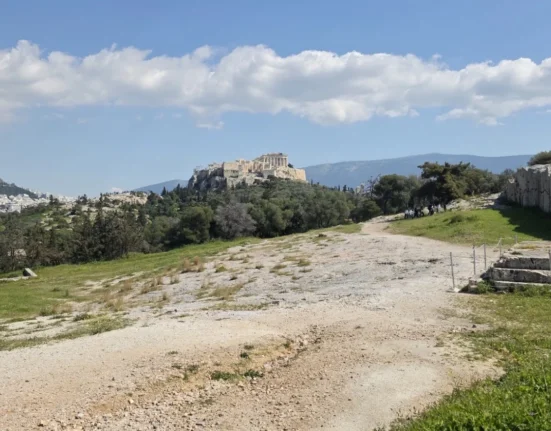
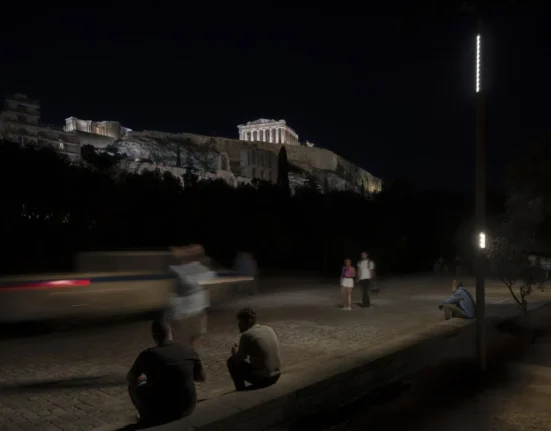
From central Athens, the brightest Perseids and occasional fireballs may still be visible, but urban light pollution will conceal many of the weaker meteors.
Better conditions can generally be found in the wider Lavreotiki and Sounio region, along quieter sections of the eastern Attica coastline and in less densely developed inland areas of eastern and southeastern Attica.
Thessaloniki and Northern Greece
Bright meteors may be seen from Thessaloniki, but travelling away from the metropolitan area should substantially improve the experience.
Broader areas worth considering include Epanomi, Chalkidiki, Holomontas, Prespa, Zagori, Pindus and rural Pieria, particularly locations protected from the glow of nearby towns and coastal resorts.
Central Greece and the Peloponnese
Mountainous and sparsely populated regions can provide excellent skies. Broader areas associated with dark-sky observation include Helmos and the Kalavryta region, Parnonas, Mainalo, rural Arcadia, Mani, Laconia and the foothills of Taygetos.
Quiet coastal locations facing away from nearby settlements may also work well, particularly where hills block some of the light from larger towns.
Crete
Crete’s mountainous interior can provide impressively dark summer skies. The broader Psiloritis and Skinakas region, together with rural parts of eastern and southern Crete, may offer good conditions away from the island’s cities and major resort areas.
Observatories are scientific facilities and are not necessarily open during the Perseid peak, so visitors should choose a safe and legally accessible location in the surrounding countryside.
The Greek Islands and Kefalonia
On a Greek island, move away from the main town, port, airport and heavily illuminated resort areas. A quiet beach, inland plateau or open hillside on the less developed side of the island can offer far darker conditions.
Quieter areas of islands such as Amorgos, Ikaria, Karpathos, Naxos and Kefalonia may provide impressive summer skies when local weather and lighting conditions permit.
Kefalonia has an additional distinction: Ainos National Park was designated Greece’s first International Dark Sky Park in 2023. The recognition reflects the darkness of its night sky, the protection of its nocturnal environment and efforts to reduce artificial light. The International Dark Sky Park of Mt. Aenos National Park also hosts summer astronomy evenings and educational activities, where visitors can observe planets, constellations, star clusters and the Milky Way through telescopes with guidance from OFYPEKA staff and amateur astronomers. Current schedules and access arrangements should be checked in advance.
How to Choose a Good Observation Site
A suitable site does not have to be completely remote, but it should meet several basic conditions.
Choose somewhere with as little direct artificial light as possible. A nearby streetlamp, car headlight or illuminated building can affect your night vision more severely than the distant glow of an entire town.
Look for a broad and unobstructed view. Trees, walls, buildings and steep mountain slopes reduce the amount of sky you can monitor.
Safety is equally important. Inspect the location during daylight where possible, park without obstructing the road and stay away from cliffs, unstable ground, isolated forest tracks and unfamiliar footpaths.
Tell someone where you are going when visiting a remote area and avoid travelling alone to an inaccessible location.
Give your eyes time: Allow at least 20 to 30 minutes for your vision to adapt to the darkness. Avoid bright phone screens, torches and car lights during this period. A dim red torch can help you move safely without completely losing your night vision.
Do You Need a Telescope or Binoculars?
No. A telescope is generally unsuitable for observing a meteor shower because it reveals only a very small section of the sky.
The naked eye provides the wide field of view needed to detect meteors appearing in different directions. Binoculars and telescopes are better reserved for observing planets, star clusters and nebulae during quieter intervals.
Bring a reclining chair or thick mat, drinking water, a light jacket and perhaps a small pillow. Even in August, exposed coastal and mountain locations can become unexpectedly cool during the hours before dawn.
Mosquito repellent may prove more useful than any piece of astronomical equipment.
What Else Can You See That Night?
The Perseids will not be the only objects worth observing.
Saturn should become visible in the eastern sky later in the evening, with its precise rising time depending on your location and the surrounding horizon. It can be seen with the naked eye as a bright, relatively steady point of light.
Through a small telescope, Saturn’s rings should be visible, although they will still appear relatively narrow in 2026 because Earth viewed the ring system almost edge-on in 2025 and the rings are only gradually opening again from our perspective.
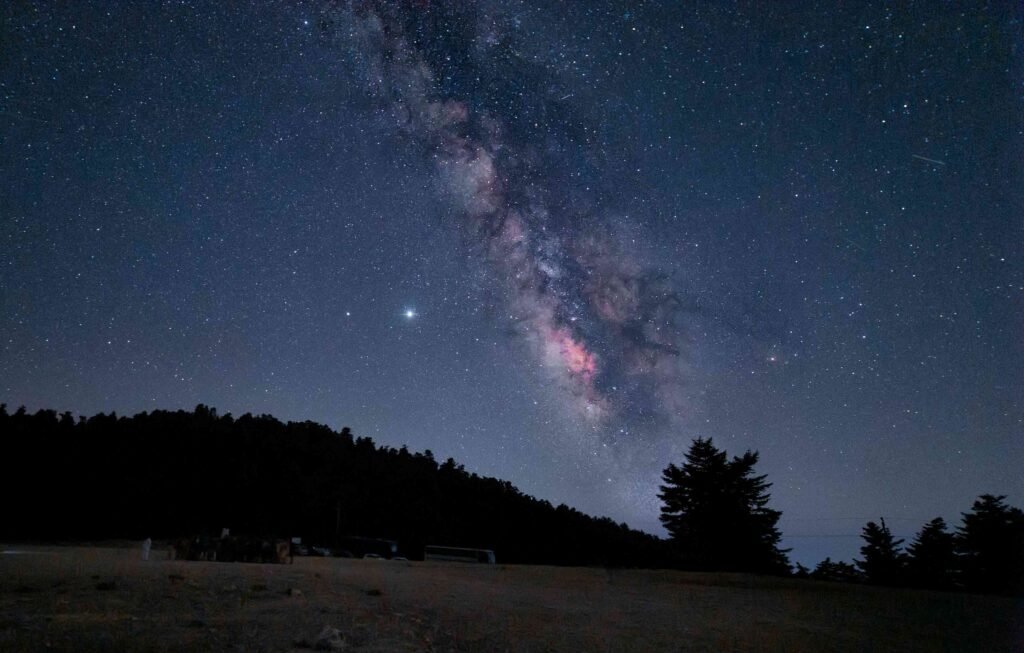
From a sufficiently dark location, you may also see the Milky Way extending across the summer sky. The bright stars Vega, Deneb and Altair form the easily recognised Summer Triangle.
Observers with binoculars or a small telescope can also search for:
- Albireo, a colourful double star in Cygnus
- M13, the Great Globular Cluster in Hercules
- M27, the Dumbbell Nebula
- M57, the Ring Nebula in Lyra
Because these objects require concentrated observation through equipment, it is better to explore them during quieter intervals rather than spending the entire Perseid display looking through a telescope.
How to Photograph the Perseids
A modern smartphone may record an exceptionally bright fireball, particularly when it is mounted securely and used in a night-photography mode. A camera offering full manual control, however, gives you a much better chance of capturing several meteors.
Mount the camera firmly on a tripod and use a wide-angle lens to include as much of the sky as possible.
Focus manually on a bright star and take several test photographs until the stars appear sharp. Autofocus often struggles in darkness and may leave the entire image blurred.
Suggested Starting Settings
Aperture: As wide as the lens permits
Exposure: Approximately 10–20 seconds
ISO: Approximately 1600–3200
Focus: Manual
Shooting method: Continuous interval shooting
The ideal settings depend on the camera, lens, sky brightness and surrounding landscape. Check several test images and adjust the exposure to prevent the sky from becoming excessively bright.
Including a recognisable element of the Greek landscape—a chapel, mountain ridge, tree or coastline—can create a much stronger composition. Keep artificial lights outside the frame unless they are deliberately included as part of the photograph.
Meteor photography depends heavily on chance. A continuous sequence taken over an hour is far more effective than attempting to press the shutter after seeing a meteor, because the streak will almost always have disappeared before you react.
Check Fire Risk and Access Restrictions
August falls in the middle of Greece’s official fire-prevention season. According to the Greek Ministry of Climate Crisis and Civil Protection, the 2026 fire-prevention period runs from 1 May to 31 October.
The General Secretariat for Civil Protection publishes a Daily Fire Risk Forecast Map throughout this period. The map is issued for the following day and indicates the level of fire risk across different regions of Greece.
High-risk conditions may result in temporary restrictions or prohibitions affecting forests, national parks, nature reserves and other vulnerable areas. Check the daily map and any regional announcements before travelling to a mountain or forest location.
Respect all barriers, closures and instructions issued by the police, the fire service, municipalities and protected-area authorities.
During Greece’s dry summer months:
- Never light a fire or barbecue near woodland or dry vegetation.
- Do not discard cigarettes or use equipment that may produce sparks.
- Do not leave glass bottles, litter or other potentially hazardous material behind.
- Respect signs prohibiting access during periods of high fire risk.
When access to a forest or mountain area is restricted, a legally accessible beach, open agricultural landscape or established public viewpoint may provide a safer alternative.
A Summer Night Worth Staying Awake For
Watching the Perseids is less about counting every meteor than about giving the night enough time to reveal itself.
Settle into a comfortable position, turn off unnecessary lights and allow your eyes to adapt. There may be periods when nothing appears. Then, without warning, a fast line of light may cross the sky, followed by another in a completely different direction.
Some will be faint and fleeting. Others may leave a brilliant trail that seems to remain suspended above the Greek landscape.
With a moonless sky and the Perseid radiant well placed for observers at Greece’s latitude, the night of 12–13 August 2026 presents an exceptional opportunity to leave the illuminated towns behind and rediscover how much of the universe remains visible to the naked eye.
Sources and Further Information
International Meteor Organization: 2026 Meteor Shower Calendar
NASA Science: Perseids Meteor Shower
United States Naval Observatory: Dates of Primary Phases of the Moon: 2026
DarkSky International: Aenos National Park
Greek Ministry of Climate Crisis and Civil Protection: Daily Fire Risk Forecast Map
Astronomical forecasts describe the most likely timing and intensity of the shower. Actual visibility will depend on weather, atmospheric conditions, local light pollution and the observer’s precise location.