
From flowing drapery and sculptural gold jewellery to braided hair and luminous beauty, Ancient Greece is shaping one of summer 2026’s most recognisable aesthetics.
Fashion has always been quick to register the mood of the moment. This summer, that mood is undoubtedly being shaped by Christopher Nolan’s The Odyssey.
The film has drawn audiences back to Homer, revived debate around the poem’s characters and themes, and prompted fresh comparisons between the ancient text and its modern interpretation. As we recently explored in our own return to Homer on Xpat.gr, The Odyssey continues to invite new readings and competing interpretations. Fashion has followed the same current.
The costumes created for the film, together with the carefully orchestrated looks worn by its stars during the press tour, have brought ivory drapery, metallic armour, ancient Greek-style sandals and braided hair into contemporary fashion.
As reported in Vogue’s “Zendaya Takes Athena From Mount Olympus to New York City”, Zendaya, who plays Athena in the film, began her The Odyssey press-tour appearances in New York and was photographed in Tribeca wearing a draped ivory Khaite ensemble with gold details and metallic sandals. At a later London photocall, she appeared in a custom ivory Jacquemus column gown. For the film’s London world premiere, she wore a Schiaparelli Haute Couture dress with a moulded porcelain-effect bodice and illuminated mirrored fringe. Together, the looks developed a distinctly classical vocabulary through drapery, column silhouettes and armour-like forms.
The New Yorker, in “The Divine Red-Carpet Looks of ‘The Odyssey’ Press Tour”, described the tour as a goddess-themed display of Method Dressing, with Zendaya, Anne Hathaway, Lupita Nyong’o and Charlize Theron using fashion to echo their characters or the visual world of the film. Zendaya and her longtime stylist, Law Roach, have made Method Dressing a recurring feature of her career, notably during the press tours for Dune, Challengers and now The Odyssey.
The appeal of antiquity to the commercial world is clear. It allows fashion, beauty and cinema to borrow the grandeur of the ancient past and reshape it into a modern image designed to command attention.
Zendaya and the Winged Victory
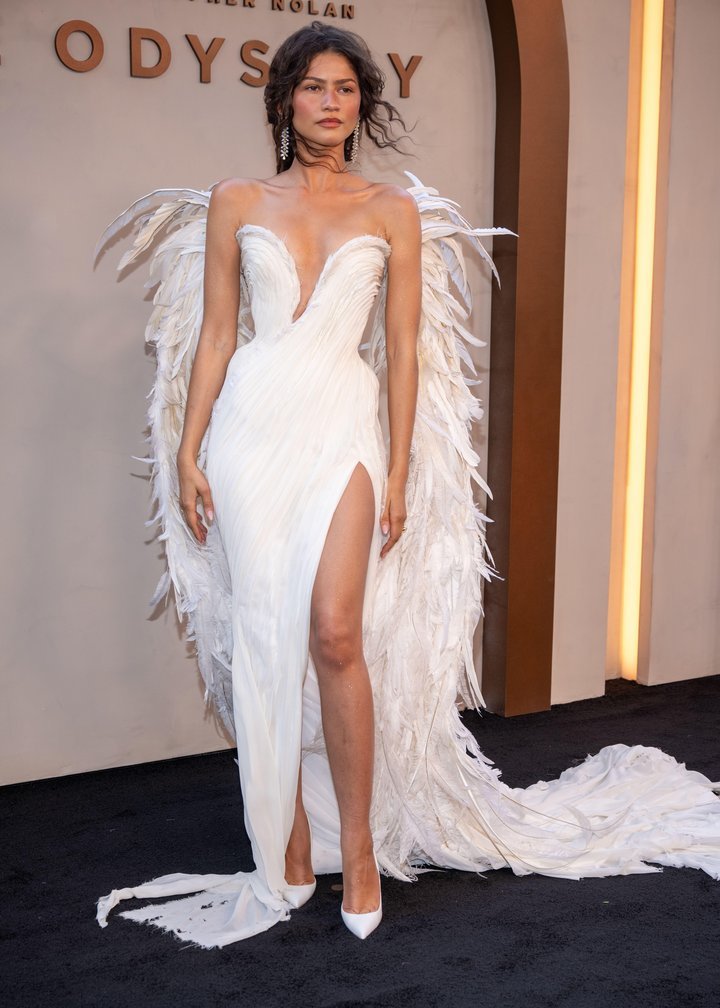
Among the many classical references seen throughout the press tour, Zendaya delivered its most dramatic expression at the New York premiere. She wore a white Matières Fécales gown with a sculptural bodice, a distressed train and large wings rising from the back.
WWD compared the look with the Winged Victory of Samothrace, the celebrated Hellenistic sculpture of Nike, the Greek personification of victory. Discovered in the Sanctuary of the Great Gods on the island of Samothrace, the statue is now displayed at the top of the Daru staircase in the Louvre Museum in Paris.
The comparison rests on the wings and the powerful impression of movement. The ancient Nike appears to have just landed on the prow of a ship, with the wind pressing her chiton against the body and carrying the heavier folds behind her. The spiralling fabric, long train and winged silhouette of Zendaya’s gown created a similarly commanding entrance.
Perhaps surprisingly, the association had been established before. In 2023, Zendaya was photographed beside the statue in the Louvre for the Lancôme x Louvre campaign, where her dark gown and extended fabric visually completed the sculpture’s fragmented form.
Placed together, the three images show how the same ancient masterpiece has moved from sacred monument to museum icon, beauty campaign and a work of haute couture created for film publicity.
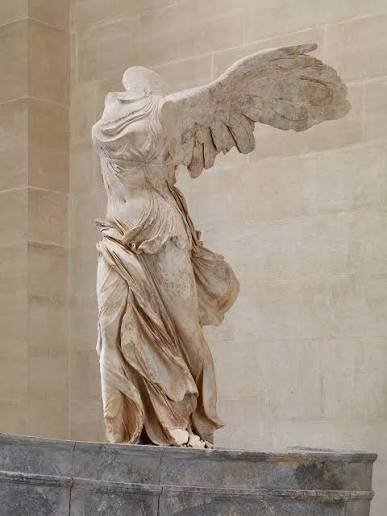
Image credit: Musée du Louvre
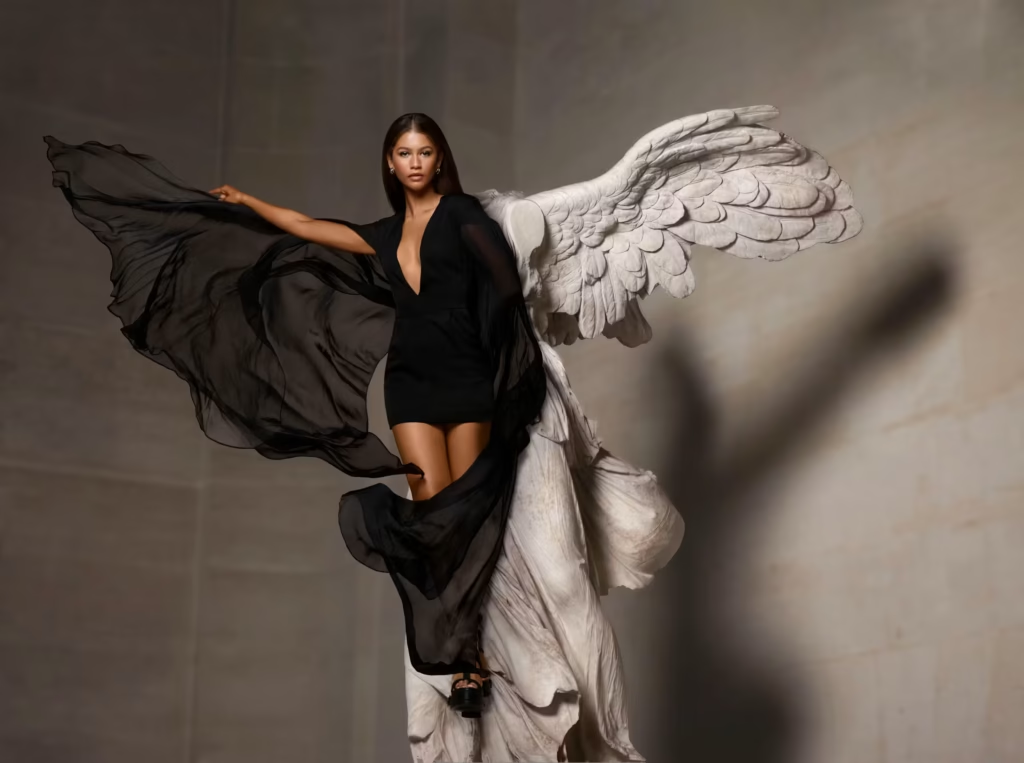
Image credit: Lancôme x Louvre / Musée du Louvre
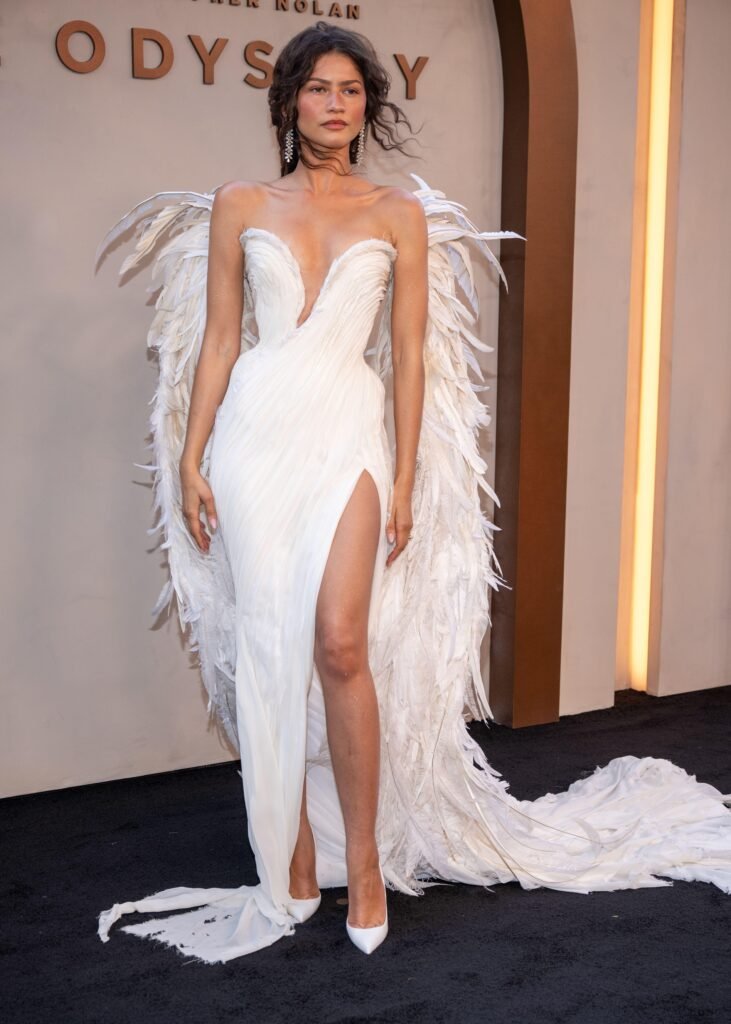
Image credit: Erik Pendzich / Alamy
But What Did Women in Ancient Greece Actually Wear?
The modern Greek-goddess look does not belong to one historical moment. It combines the Bronze Age world associated with Homer, the richly dressed korai of Archaic Athens, the controlled drapery of Classical sculpture and the theatrical movement of the Hellenistic period.
The result is not a reconstruction of a single ancient wardrobe, but antiquity filtered through archaeology, museums, cinema and luxury fashion. The objects behind this aesthetic can still be seen in the archaeological museums and sites of Greece.
Women’s dress changed across periods and regions, but three garments became especially important: the peplos, the chiton and the himation. Usually formed from rectangular lengths of wool or linen, they were folded, fastened and belted in different ways, producing a wide range of silhouettes. Linen was light and cool, while wool offered greater weight and warmth.
The Peplos, Chiton and Himation: Colour and Drapery
The peplos was made from a large rectangle of heavier cloth, usually wool. Its upper edge was folded down to create the apoptygma, an overfold extending across the torso, before the fabric was wrapped around the body and secured at the shoulders with pins or brooches. The open side could remain loose or be pinned or sewn closed. A belt was often added, although it was not essential.
When the garment was long enough to be drawn over the belt, the excess fabric formed a soft fold known as the kolpos. Depending on the weight, colour and arrangement of the cloth, the silhouette could appear restrained and column-like or richly layered.
The chiton, an ancient Greek tunic, was generally made from lighter material, most often linen. It was formed from a long, wide piece of fabric secured at the shoulders and usually sewn along the sides. In fuller versions, pins or buttons placed along the upper arms created a sleeve-like effect without conventional sleeves. Women’s chitons were commonly ankle or floor length and could also be gathered over a belt to form a kolpos.
Over either garment, women could wear the himation, a large rectangular mantle of wool or linen. It might be draped diagonally across one shoulder or arranged over both, adding warmth, modesty and another layer of movement. A lighter epiblema, or shawl, could also be worn around the shoulders.
None of these garments was necessarily white. Ancient textiles could be dyed red, yellow, green, blue, violet or purple, then decorated with checks, stripes, meanders, woven borders and more elaborate motifs. Strong colours and fine fabrics were costly, making them visible signs of wealth and status.
The ivory palette favoured by modern fashion reflects the present appearance of ancient marble more than the full colour of ancient Greek dress.
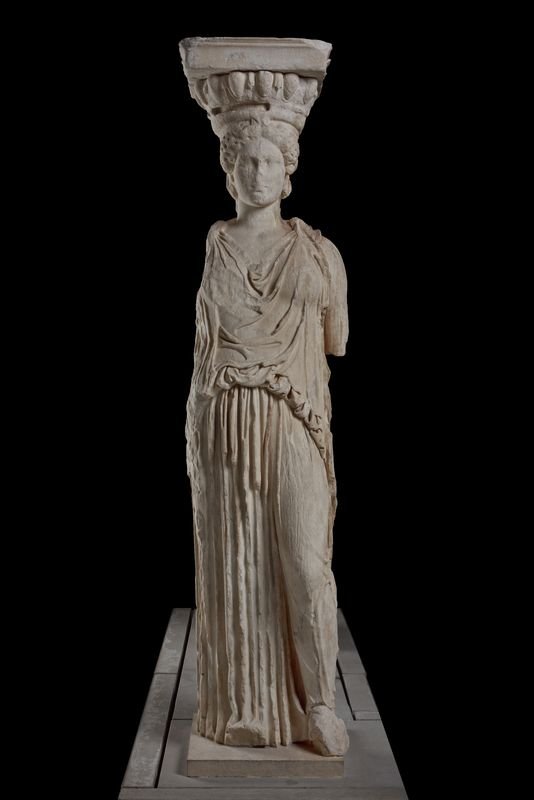
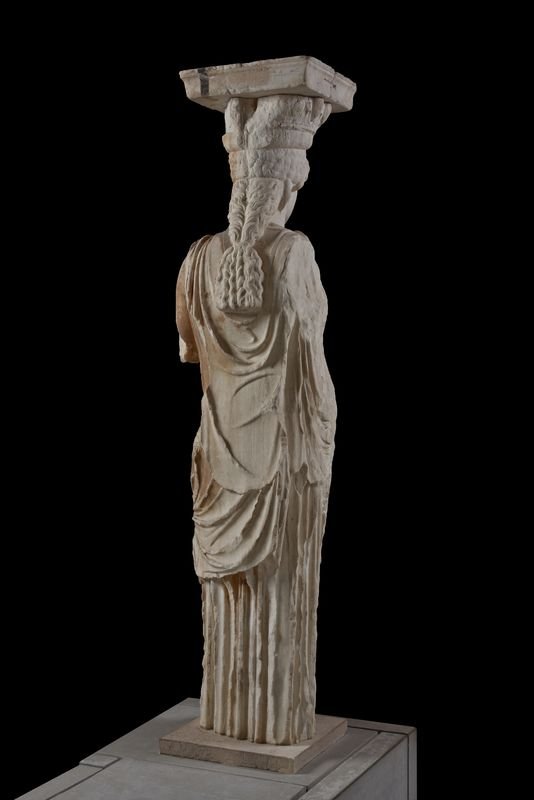
.
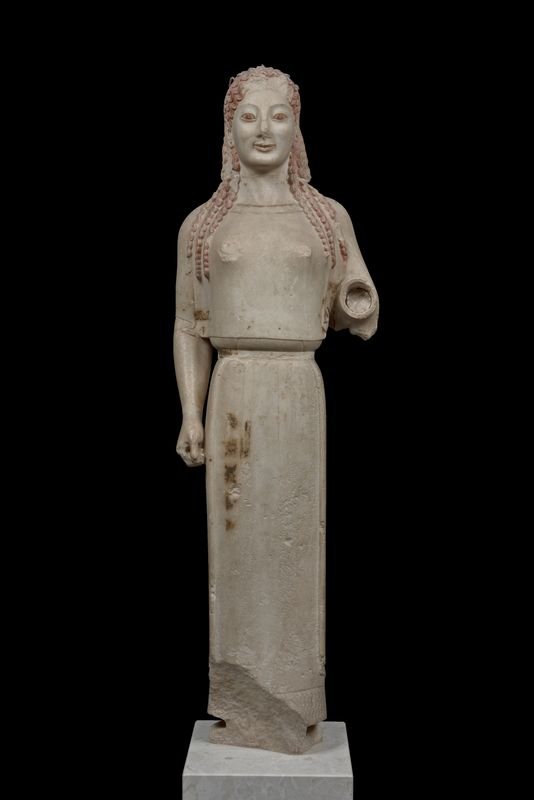
Image credit: Acropolis Museum
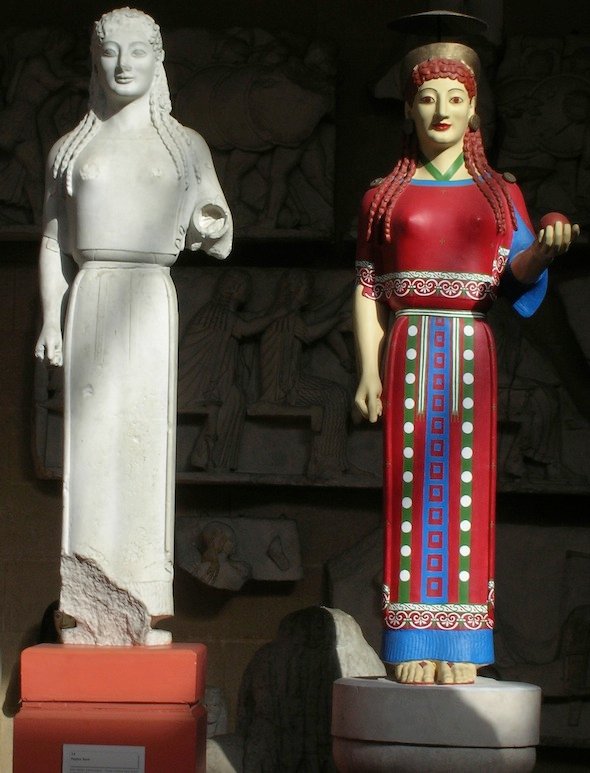
Image credit: Museum of Classical Archaeology, University of Cambridge
So What Happens When Antiquity Enters the Fashion Spectacle?
The answer is rarely simple. When ancient objects and monuments enter fashion, some see cultural pride and renewed visibility. Others see heritage converted into scenery, status or commercial image.
The promotional tour for Christopher Nolan’s The Odyssey captures that tension. Its visual world blends elements from the Bronze Age, Archaic dress, Classical drapery and Hellenistic drama into a broader image of ancient magnificence. The mixture also extended beyond Greece, drawing on the histories and material culture of other ancient civilisations.
At the London photocall, Zendaya wore earrings made from ancient Iranian gold discs attributed to the Ziwiyeh hoard and dating to the first millennium BC. Remounted with diamonds and 18-carat gold, the artefacts became contemporary red-carpet jewellery.
The gallery that owns them described the gesture as a tribute to ancient Iranian craftsmanship. Critics focused instead on provenance, the dispersal of the Ziwiyeh objects through the antiquities market and the decision to use original artefacts where replicas might have achieved the same effect.
A similar argument surrounded Dior’s 2021 Acropolis shoot for its Cruise 2022 project. Supporters welcomed the international exposure, the participation of Greek photographers and artisans, and the revenue generated for archaeological sites. Critics questioned whether the Acropolis should serve the image-making needs of a luxury brand.
The 2023 Lancôme x Louvre campaign, which placed Zendaya beside the Winged Victory of Samothrace, raised a comparable question. Admirers saw a striking way to bring museum collections into contemporary culture, while others questioned the use of an ancient masterpiece in luxury advertising.
The question remains unresolved, which may be precisely why fashion keeps returning to antiquity. It offers beauty, authority and instant grandeur, even when the borrowing becomes uncomfortable.
Fashionistas, meanwhile, will have plenty of inspo from drapery, gold, braids, sandals and just enough goddess energy to carry them through summer 2026.
Sources and Further Reading
Magazine and Media Sources
Euronews: Zendaya’s Ancient Iranian Earrings Stir Debate over Looted Artefacts
Greece Is: At the Acropolis with Dior: The Historic Photo Shoot Revival
The New Yorker: The Divine Red-Carpet Looks of The Odyssey Press Tour
Schiaparelli: Zendaya Wears Schiaparelli Haute Couture to the World Premiere of The Odyssey
Vogue: Long Before the Movie, Fashion Has Taken Its Cues from The Odyssey
Vogue: Zendaya Goes Pure Goddess Mode in Custom Jacquemus
Vogue: Zendaya Takes Athena From Mount Olympus to New York City
Museums and Institutional Sources
Acropolis Museum: Erechtheion, Karyatid Kore B
Acropolis Museum: Statue of a Kore, the “Peplos Kore”
The Metropolitan Museum of Art: Ancient Greek Dress
Musée du Louvre: The Winged Victory of Samothrace
Museum of Classical Archaeology, University of Cambridge: The Painted Peplos Kore