
We drove up from Athens to Feneos in late autumn, following the road into mountainous Corinthia towards Lake Doxa, Agios Fanourios, the Monastery of Agios Georgios and Goura. Feneos is rewarding throughout the year, but autumn gives the journey its own character, with colder air, changing colours and weather that can transform the mountains within an hour.
The road climbs steadily away from the coast and begins to wind through forest as it approaches the plateau. By the time Lake Doxa appears, the setting has changed completely. The drive from Athens takes roughly two and a half hours, depending on traffic and mountain-road conditions, and Lake Doxa was our first destination. The day soon expanded beyond the lake, taking us to a roadside stall on the plateau, along the path to Agios Fanourios, up to the Monastery of Agios Georgios and finally to Goura before the return journey through mist.
Lake Doxa
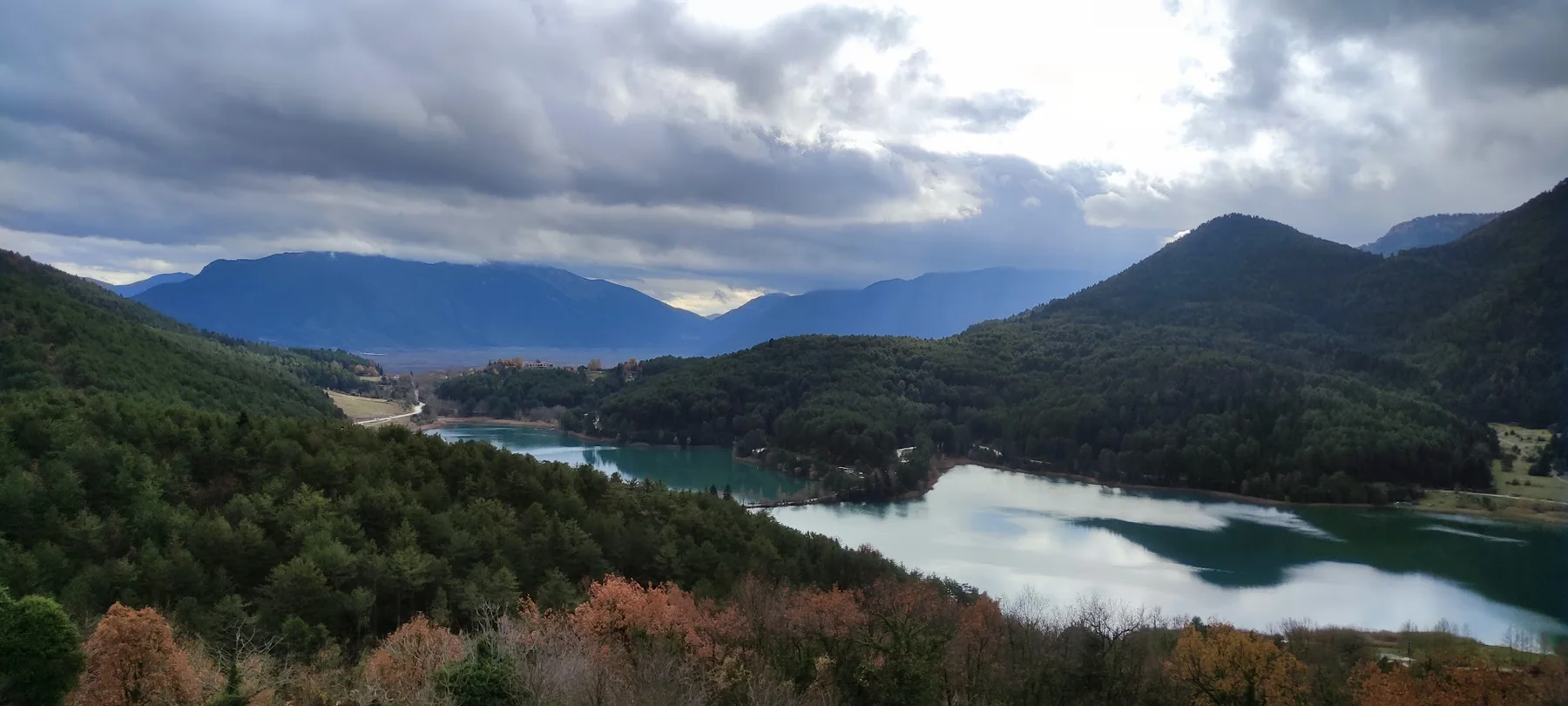
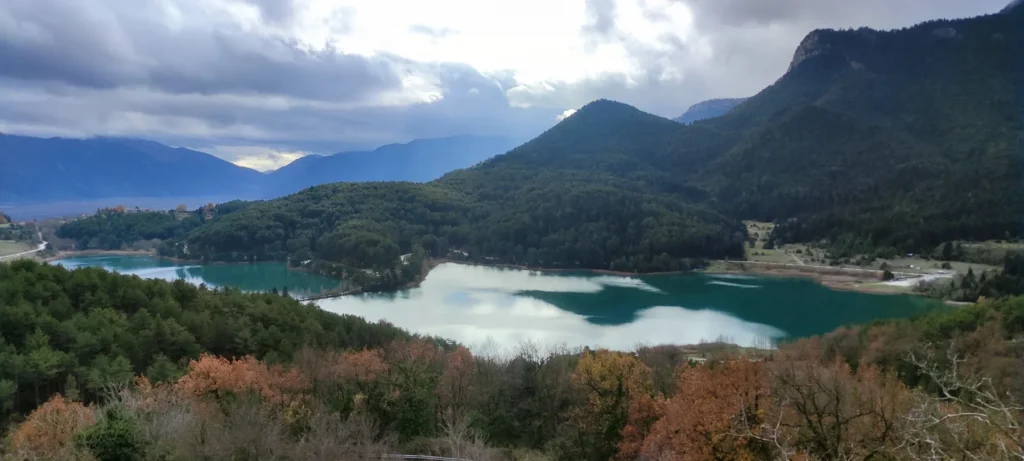
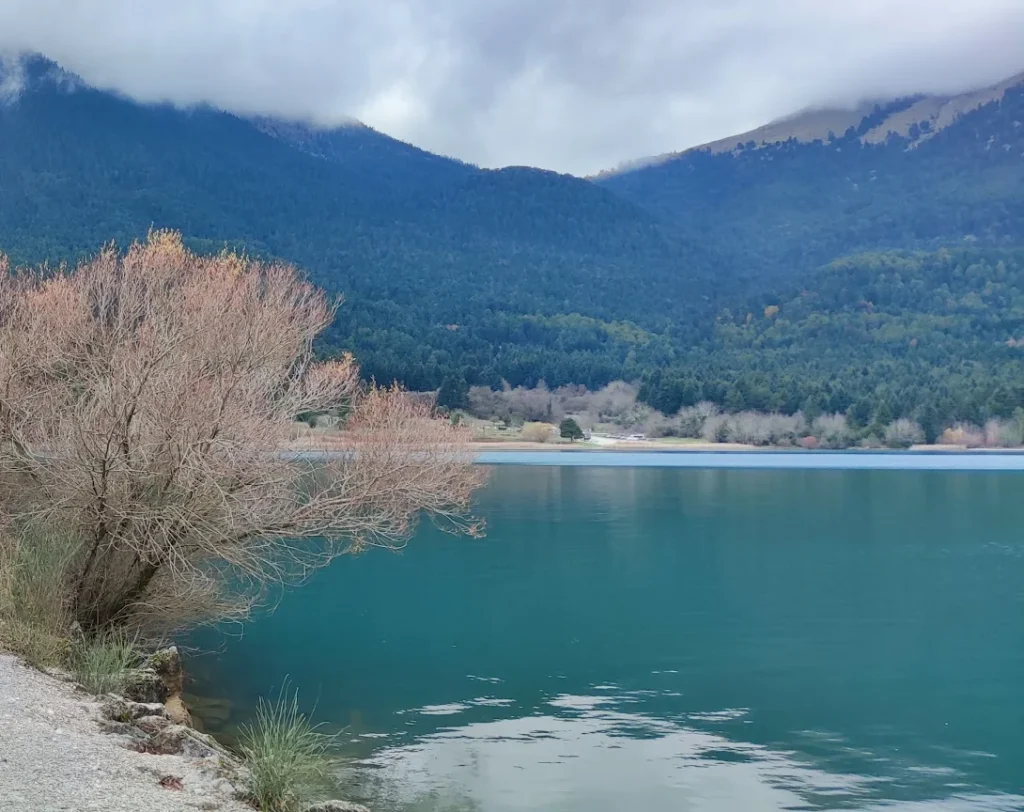
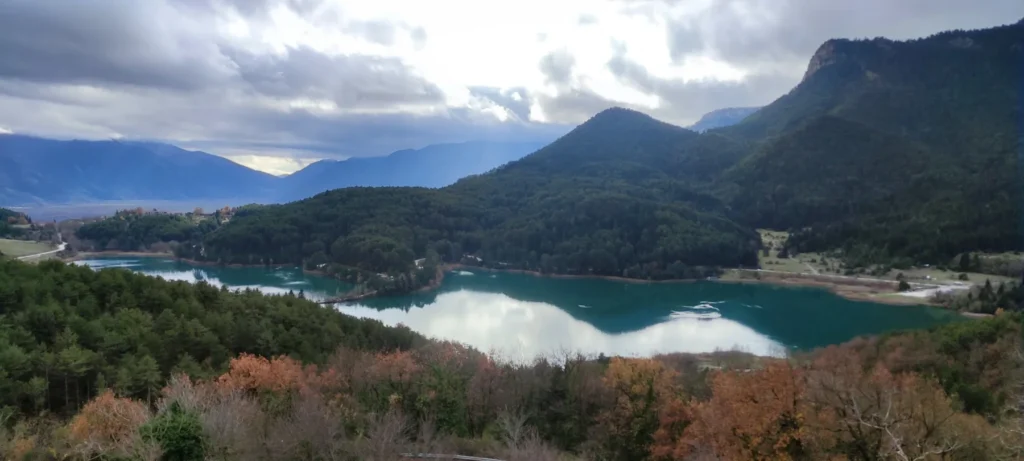
Lake Doxa lies at around 900 metres in mountainous Corinthia. It is an artificial lake, created in the late 1990s when the Doxa stream was dammed to improve irrigation and help protect the agricultural plain from flooding. Forest now reaches almost to the water, with fir, pine and oak covering the surrounding slopes. In autumn the lake changes colour with the sky. Under dense cloud it becomes slate blue, while breaks in the light bring out green and turquoise tones.
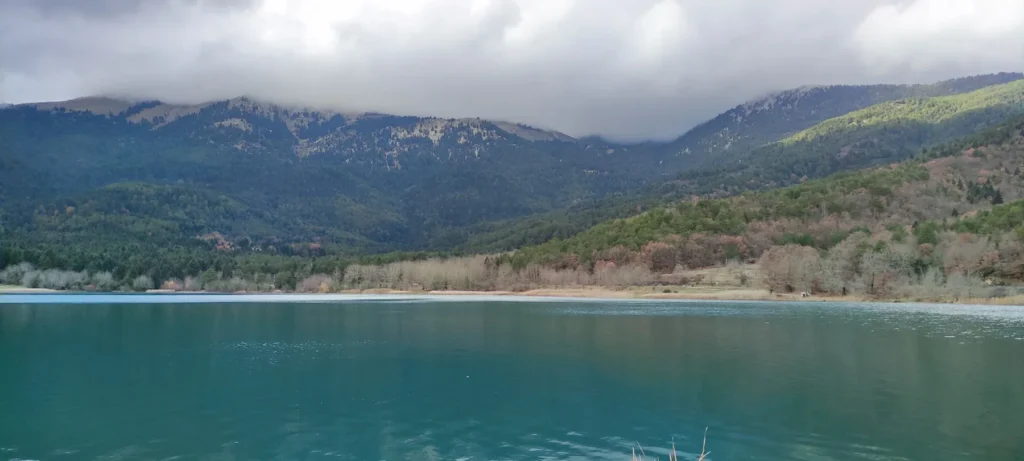
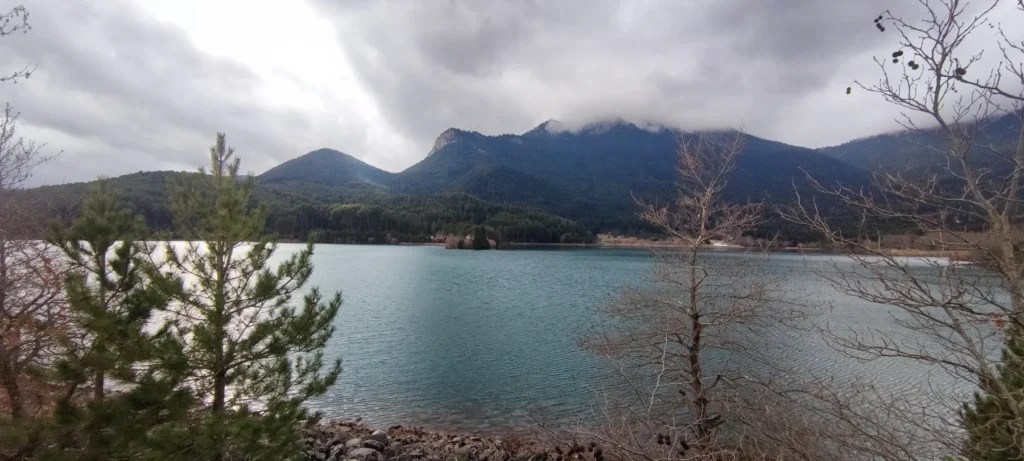
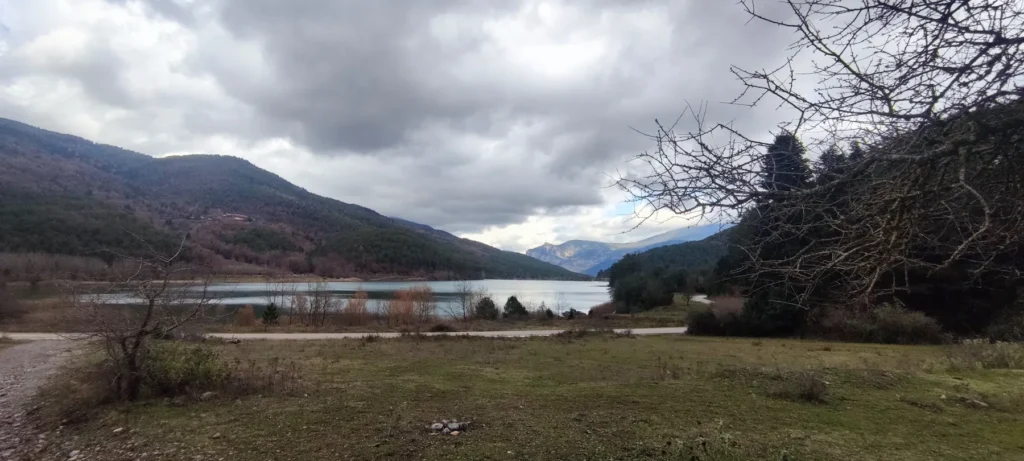
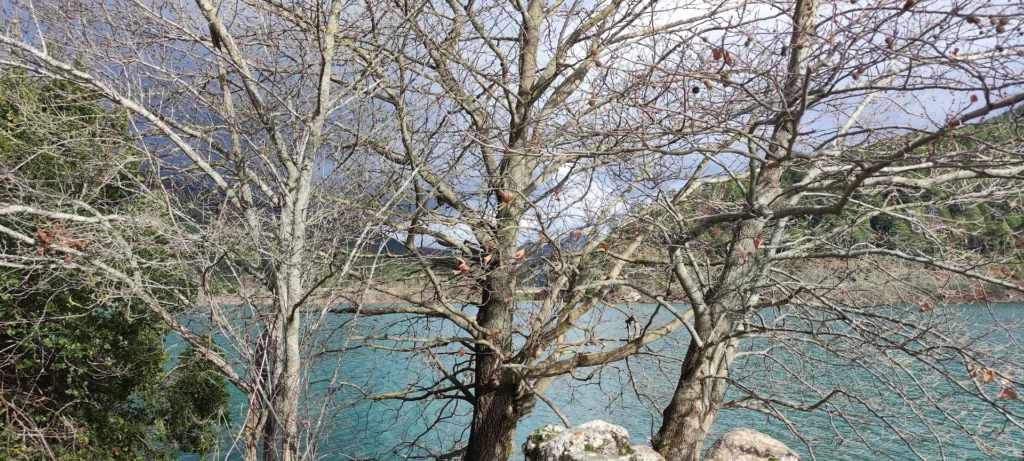
A road follows the shore and gives plenty of opportunities to stop, walk and look at the water from different angles. People come here to walk and cycle, while pedal boats operate when conditions allow. The lake never feels like a single viewpoint. One bend opens onto a broad sweep of water, another brings the trees close to the edge and a few minutes later the mountains seem to close in around the shore.
Before heading towards Agios Fanourios, we stopped at a small roadside stall on the Feneos plateau, where bags and crates of local produce were laid out beside the road. We bought Feneos fava and vanilla beans to take home. Fava Feneou has PDO status, while Fasolia Vanilies Feneou are protected as a PGI product.
Walking to Agios Fanourios
A gravel path runs along a narrow strip of land into the lake, with water close on either side. We walked towards the small chapel of Agios Fanourios beneath bare autumn branches, with low cloud pressed against the mountains opposite.
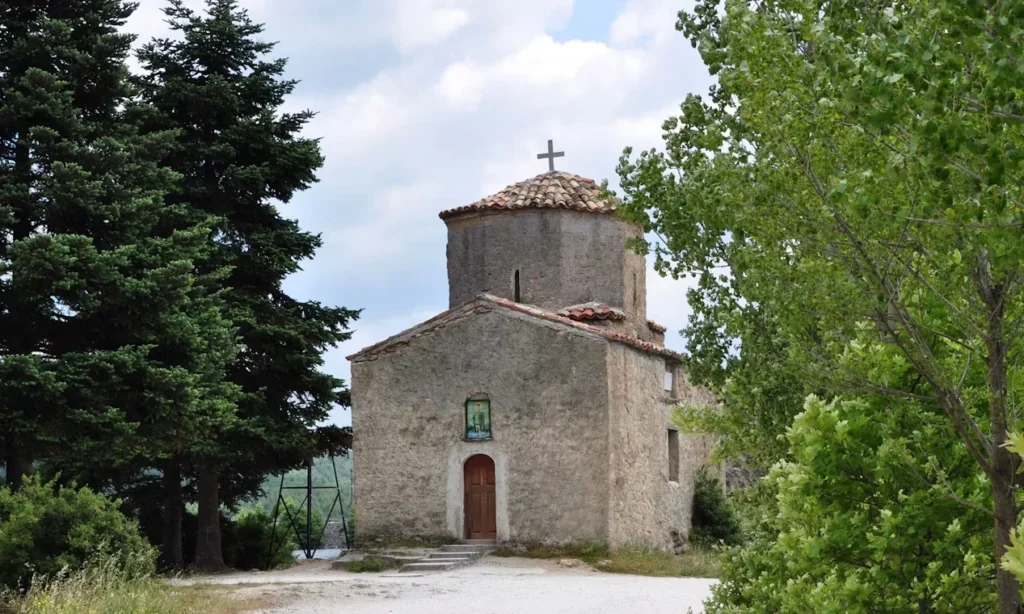
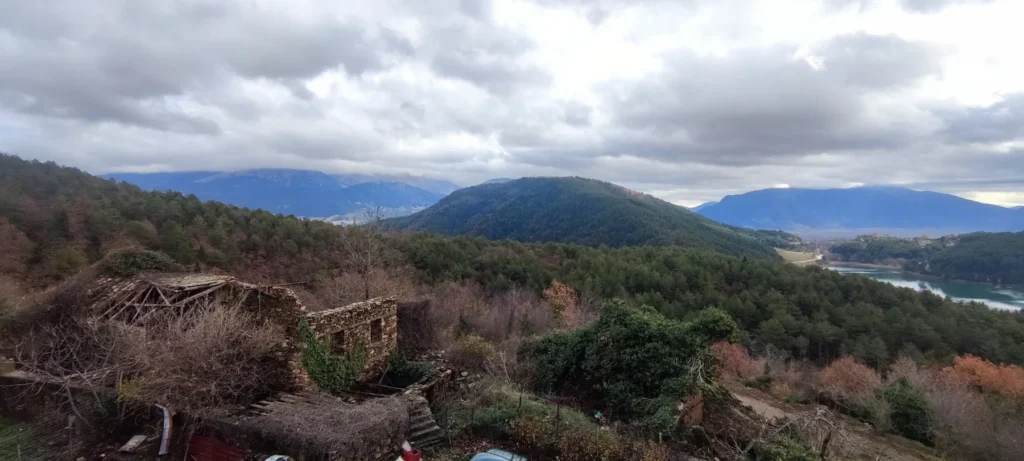
The chapel stands beside the site of the earlier Monastery of Agios Georgios, known as the Paliomonastiro. Repeated flooding led the community to abandon the lower site and move to higher ground in 1693. Stone remains still survive beside the water, including an arch close to lake level, and together with the chapel they show where the earlier monastery once stood.
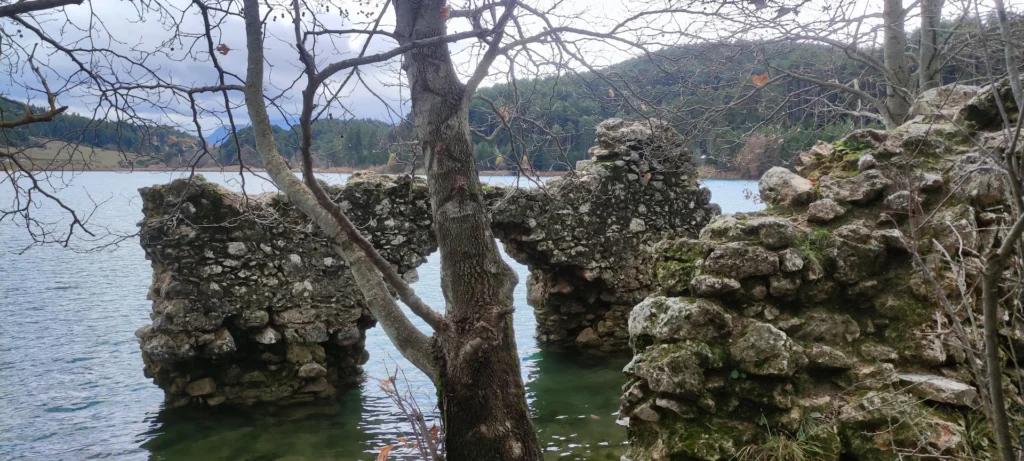
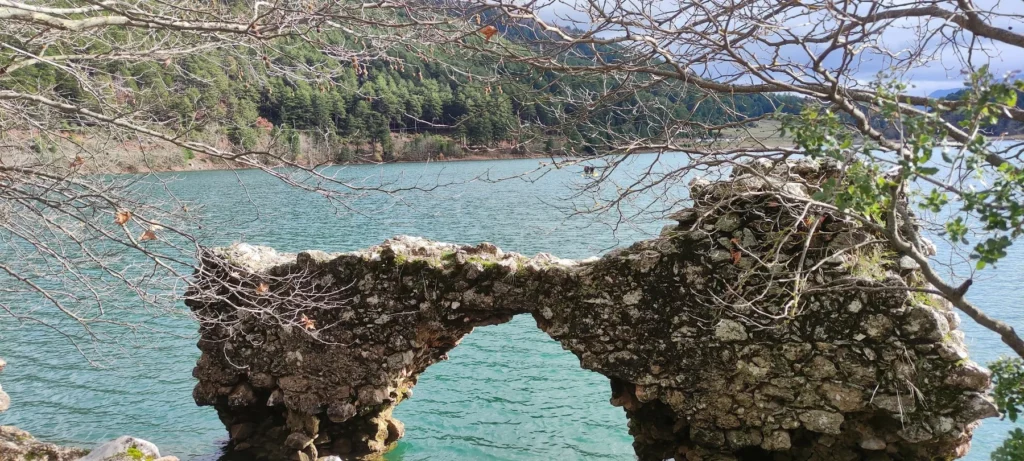
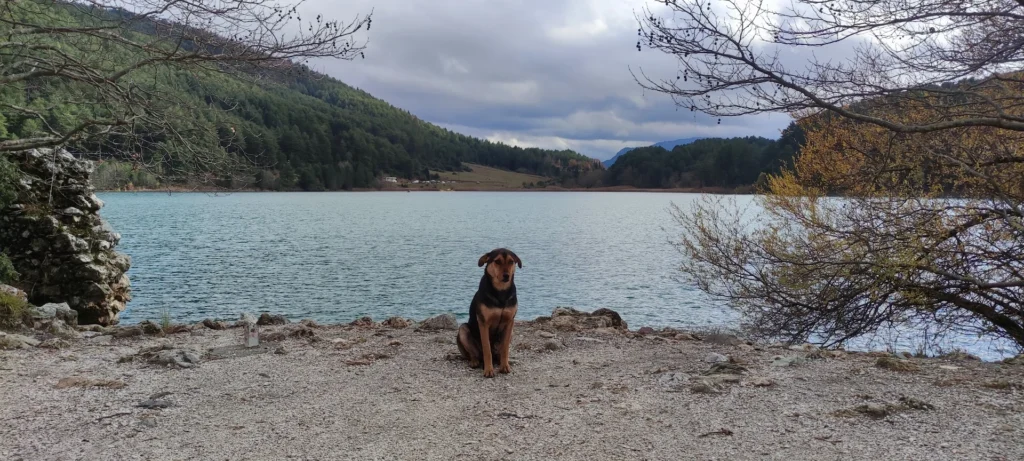
The walk takes only a few minutes and gives a clear sense of the relationship between the old monastery and the lake. From here, the later move uphill becomes easy to understand.
The Monastery of Agios Georgios
From the lake, the road climbs through forest to the Monastery of Agios Georgios, about 1.7 kilometres from the old monastic site. The present monastery dates from the community’s move in 1693, recorded by an inscription at its entrance. It later held Patriarchal and Stavropegic status, placing it directly under the Ecumenical Patriarchate.
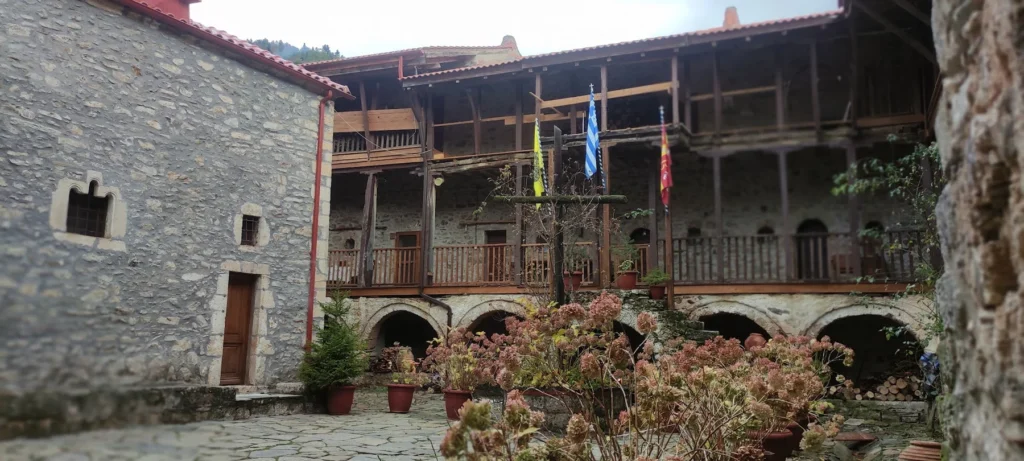
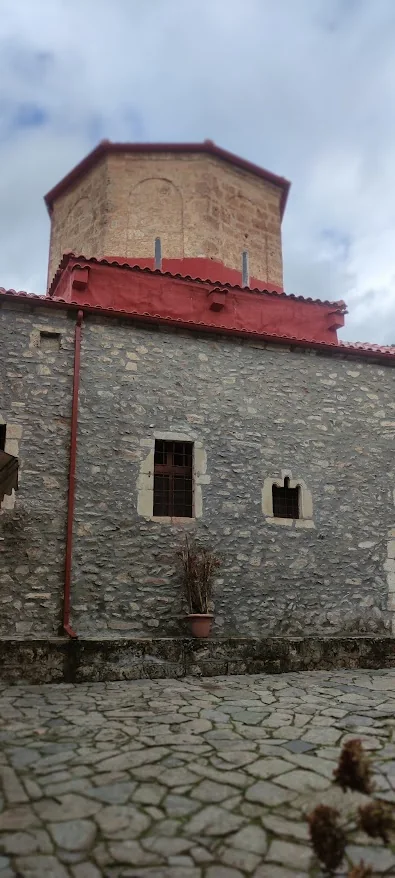
The complex has the enclosed character of a fortified mountain monastery. Stone buildings surround the courtyard, with cells, guest rooms and communal spaces arranged around the katholikon, the monastery’s main church. A major fire damaged the monastery around 1740, and the complex was rebuilt during the 18th century.
Inside the katholikon, frescoes cover the walls and rise into the dome, where Christ Pantocrator dominates the interior. A carved wooden chandelier hangs below, while the wooden iconostasis, the screen of icons separating the sanctuary from the main body of the church, dates from 1762 and carries a dense sequence of religious scenes. The decoration rewards a slower look, especially after the plain stone exterior and the open mountain light outside.
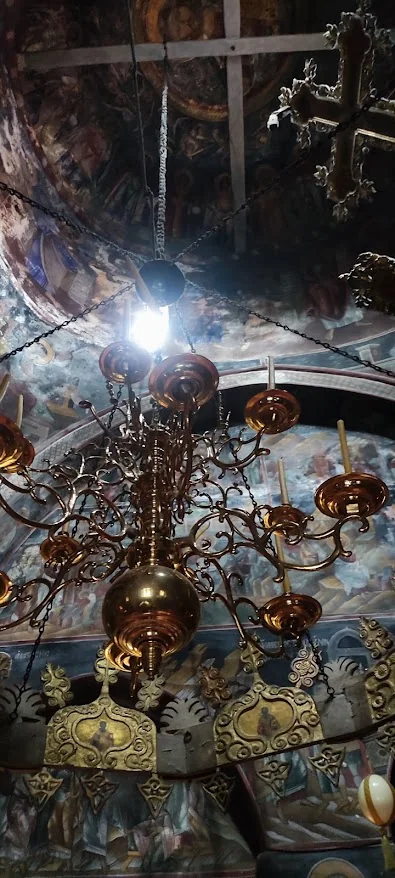
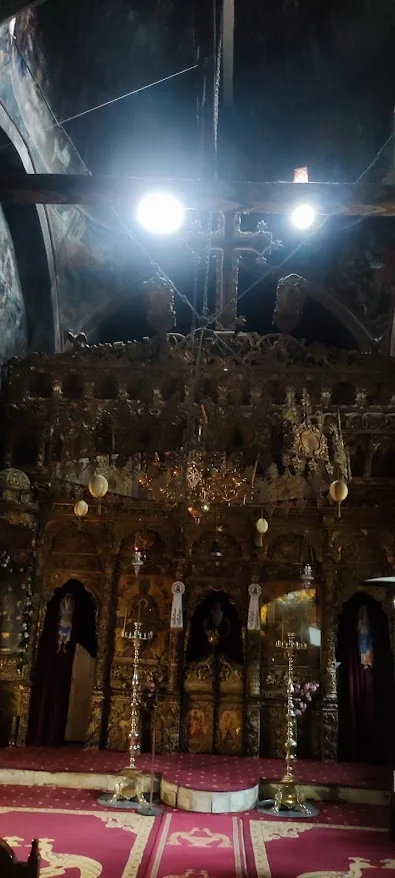
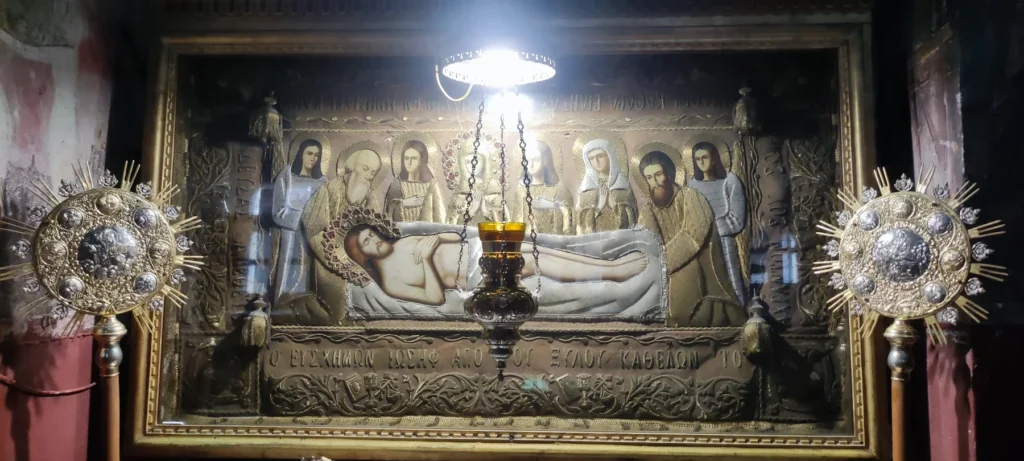
A narrow staircase leads to a small upper room traditionally known as the Kryfo Scholeio, or “Secret School”, associated with teaching during the Ottoman period. The monastery also played a role in the years leading up to and during the Greek War of Independence. Monks were connected with the Filiki Eteria, the monastery supported the revolutionary effort, and Theodoros Kolokotronis used it as a base.
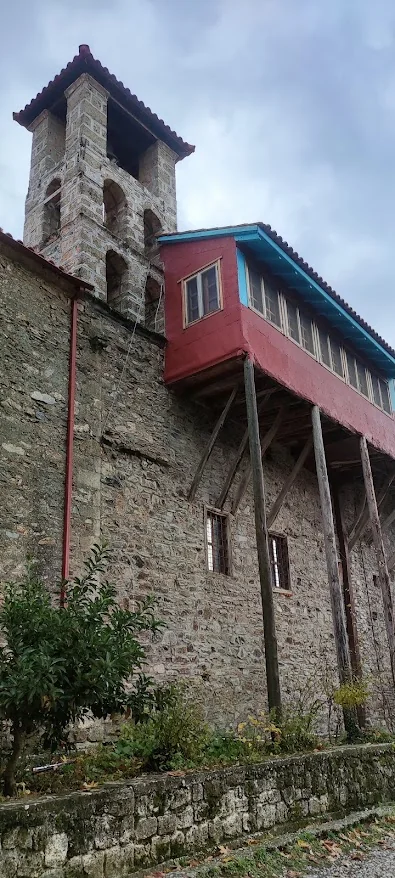
The covered wooden balcony above Feneos
The monastery’s long covered wooden balcony is one of its most distinctive features. From outside, it runs along the upper level of the stone building in deep red, supported by tall timber braces. From the balcony, the view opens over Lake Doxa and the Feneos basin.
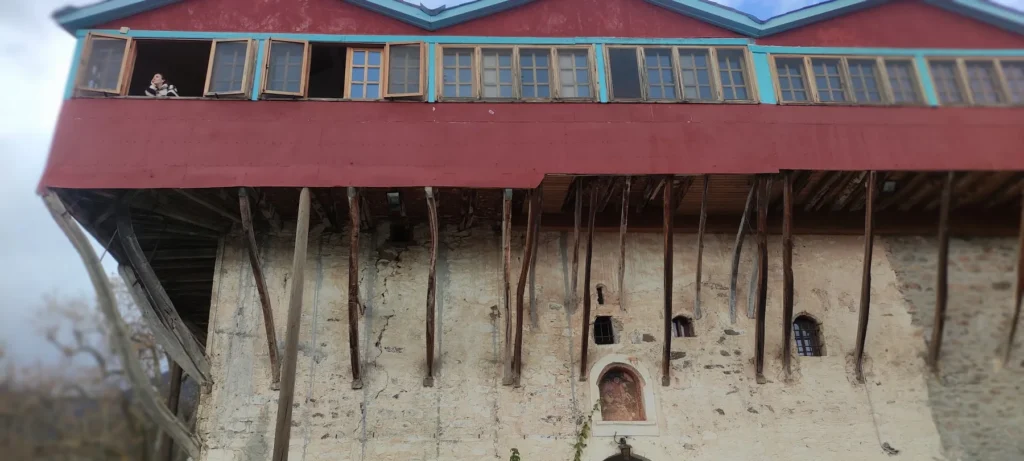
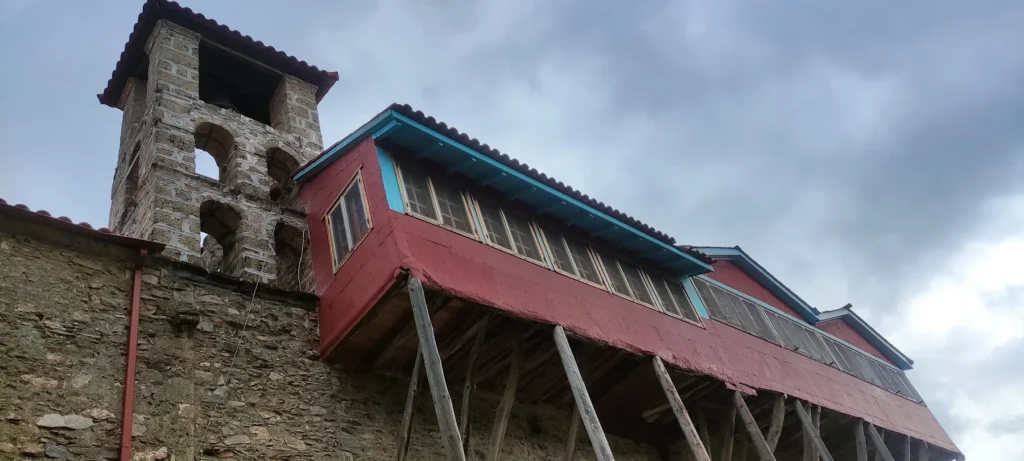
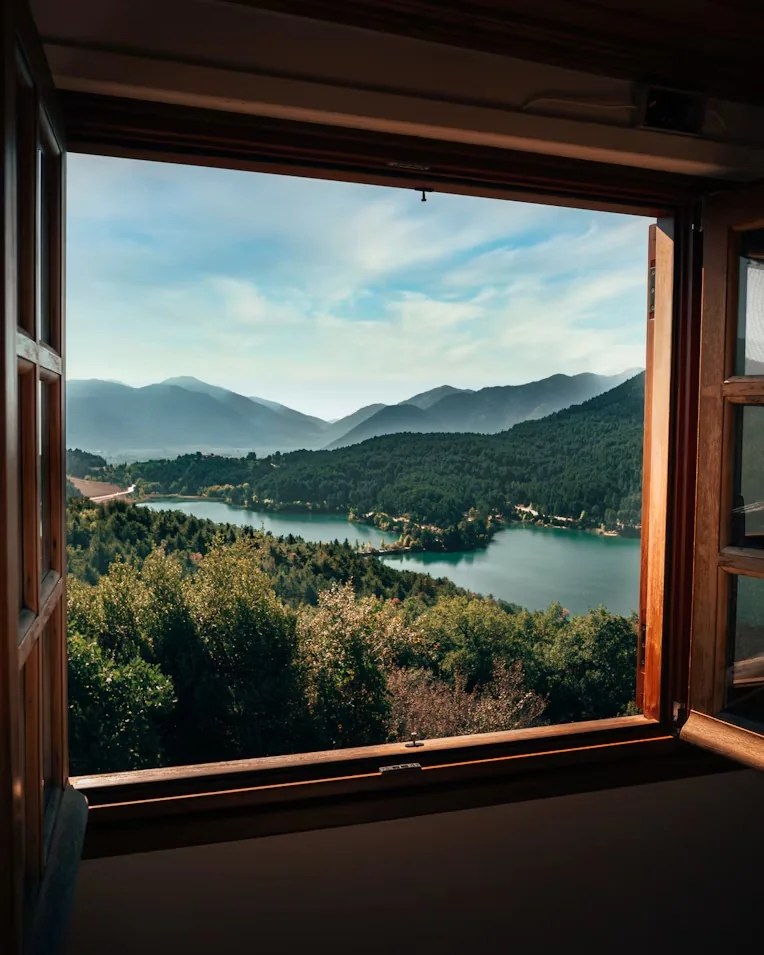
Agios Fanourios can be seen far below, close to the earlier monastic site, while forest fills the slope between the chapel and the later monastery. The wooden frame of the window gives the view a striking sense of depth, with the lake, forest and mountain held within one opening.
We were also offered the monastery’s rose-petal spoon sweet, a traditional treat associated with Agios Georgios. After visiting the church and the covered wooden balcony, we sat with it for a moment before continuing on.
The Feneos plateau
The plateau lies at roughly 850 metres and is surrounded by villages and mountains. Much of the flatter land remains agricultural, with beans, pulses and potatoes among the crops associated with the area. Agriculture and livestock farming are still visible in daily life, in the fields, roadside stalls and village shops.
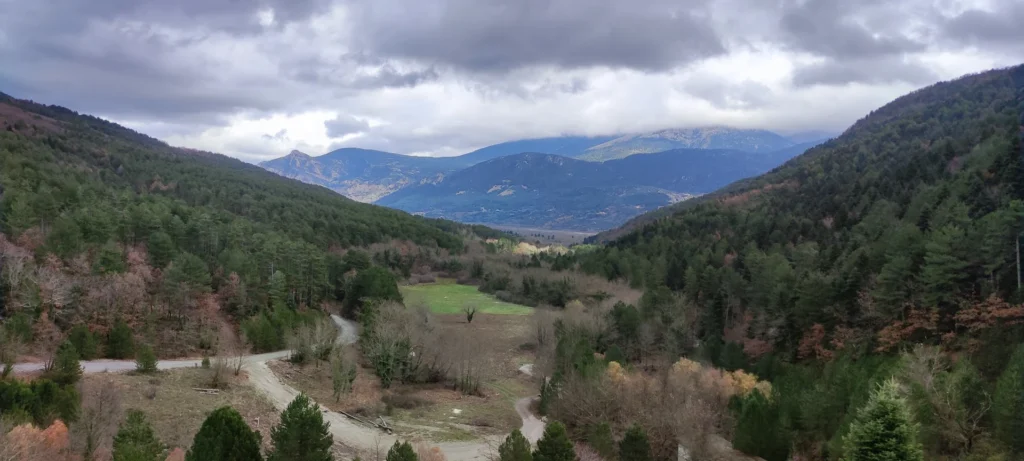
Ancient Feneos adds another layer to the valley. Archaeological excavations uncovered an Asklepieion, evidence of a settlement that flourished here long before the modern villages took shape. Today, the plateau is still defined first by its fields, forested slopes and scattered settlements.
Goura
From the monastery, we continued to Goura, which stands at about 950 metres on the slopes of Mount Ziria, overlooking the Feneos plateau. Its centre is a broad paved square surrounded by stone buildings, cafés and tavernas, with the Church of the Taxiarches, built in 1877, standing prominently along one side.
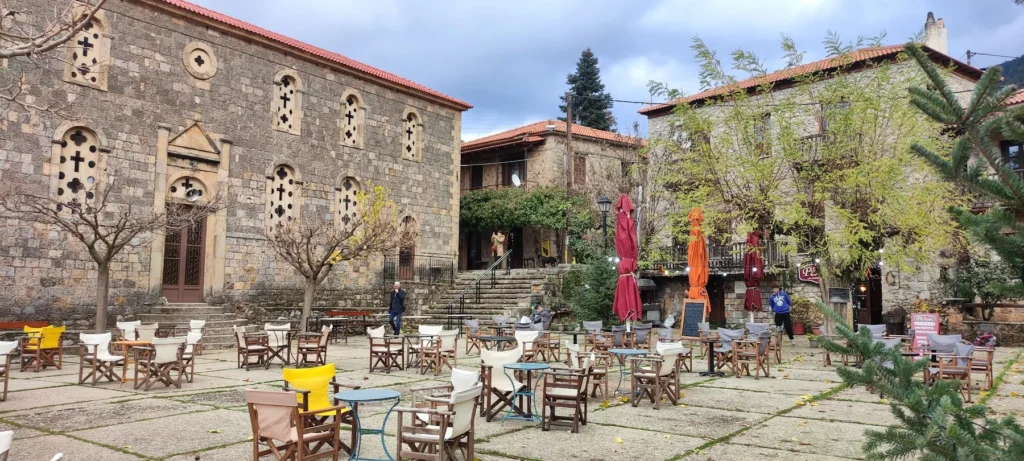
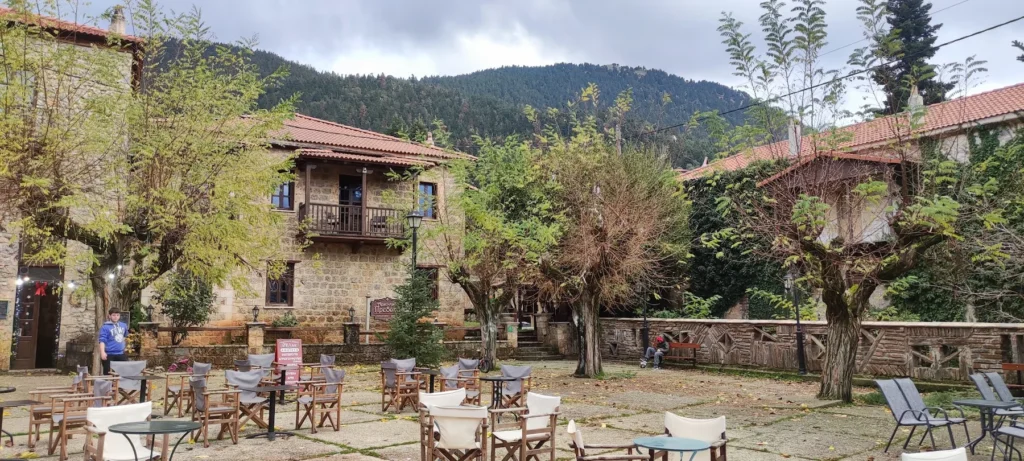
Nineteenth-century stone houses survive throughout the village, some now restored as guesthouses. Goura still combines tourism with farming and livestock raising, and local shops carry products from the surrounding plateau alongside handmade pasta, cheeses and meat.
By the time we arrived, the weather had turned colder. Tables were still set beneath the trees, but the square was quiet and cloud was dropping lower over the mountains. After the openness of Lake Doxa, Goura felt compact and sheltered. We stayed for a while before beginning the drive back.
The drive home
By the time we left Goura, cloud had moved into the valleys. The road disappeared into mist in places, and the mountains that had framed the lake earlier were reduced to dark shapes behind moving cloud.
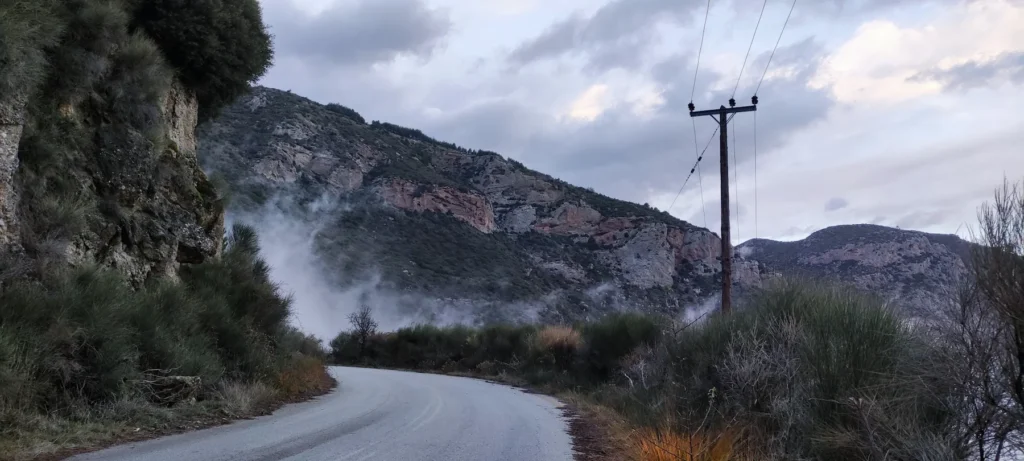
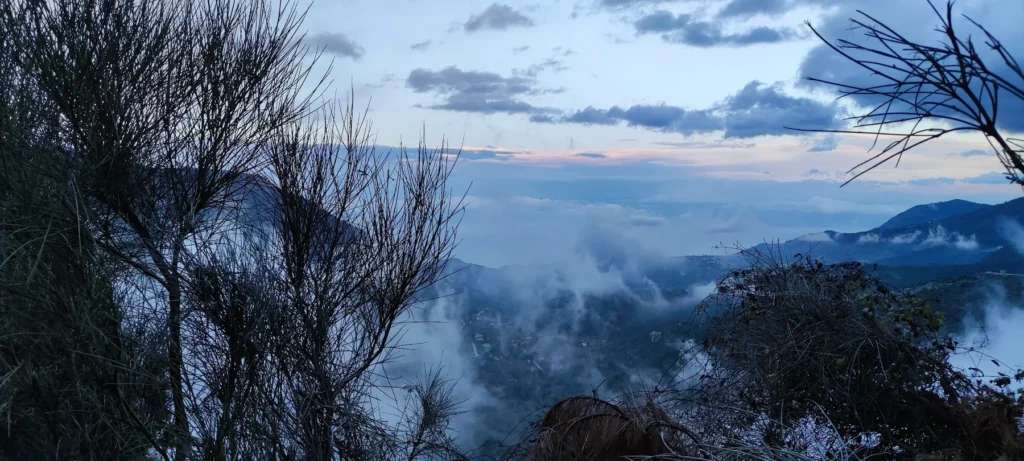
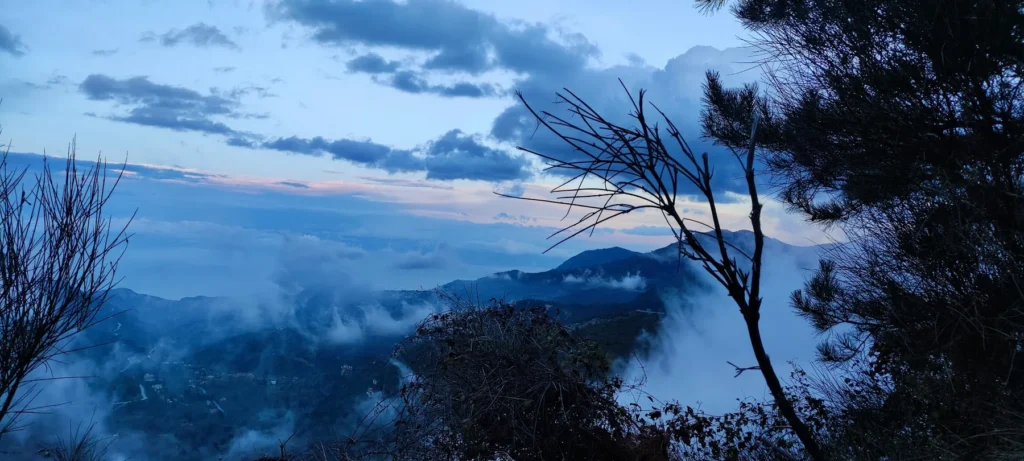
The journey home looked completely different from the drive in. Late autumn can change quickly at this altitude, and that shift in weather became part of the day itself. Lake Doxa in changing light, the path beside the water, the old monastic site, the covered wooden balcony above Feneos, Goura’s square and the mountain road disappearing into mist all belonged to the same journey.
Practical information
Lake Doxa is around 170 km from Athens, and the drive takes roughly two and a half hours depending on traffic and road conditions. Feneos can be visited throughout the year, with autumn bringing colour and rapidly changing weather, while winter can bring snow. The shore of Lake Doxa is suitable for walking and cycling, and Agios Fanourios is reached by a short walk beside the water.
The Monastery of Agios Georgios is an active monastery, so visitors should dress appropriately and check current opening times before travelling. Weather conditions change quickly at this altitude, so a jacket and suitable footwear are useful even when the morning forecast appears mild.
Our route worked well for a day trip: Lake Doxa, the roadside produce stalls, Agios Fanourios and Paliomonastiro, the Monastery of Agios Georgios and Goura. An overnight stay would give more time for the wider Feneos plateau and neighbouring villages.
Sources
Visit Greece, Lake Doxa
Visit Peloponnese, Lake Doxa and Goura Village
Monastiria.gr, Holy Monastery of Agios Georgios Feneos
RADIANT Project, Greece: A Policy Analysis of PDO UCs, Fava and Vanilla Beans of Feneos
You may also like
- Deep Mani: A Genetic Time Capsule in Mainland Greece
- Kalamata, the Magical City of Four Seasons and 1,000 Faces
- Where History Sleeps: An Evening at Kalamata’s Church of the Holy Apostles
- Kalamata’s Street Art: An Open-Air Gallery of History, Culture and Creativity
- Mystras: A Complete Guide to Byzantium’s Last Great City
- A Weekend Escape to Nafplio
- Vergina Royal Tombs & New Aigai Museum: A Full Journey Through Ancient Aigai
- Thessaloniki Explained: The History of Northern Greece’s Great Metropolis
- Edessa: Waterfalls, Water and the City Shaped by Them
- Greek History Explained: A Clear Timeline for Expats & Foreign Residents