

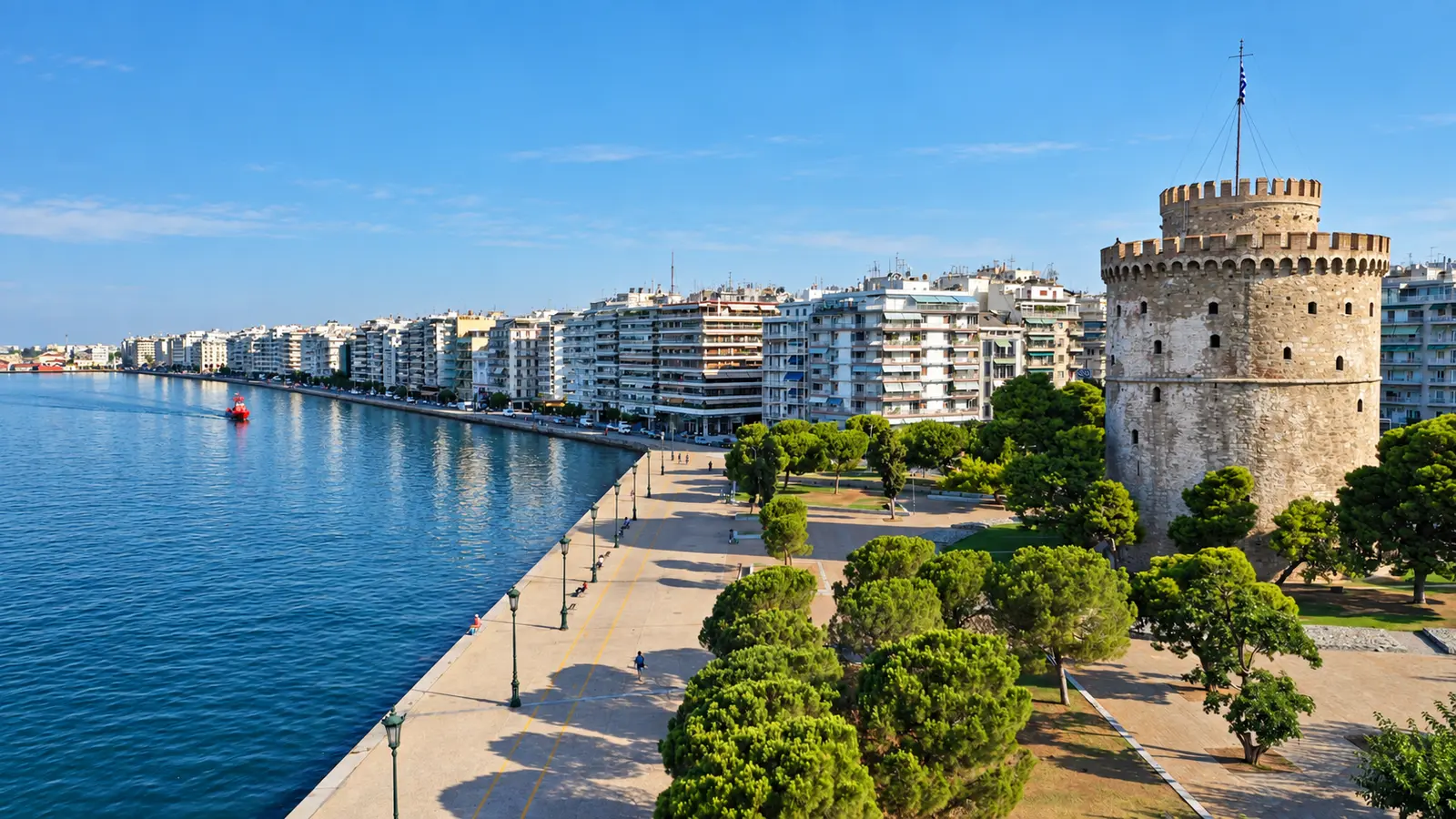
Few cities wear their history as openly as Thessaloniki. Roman streets run beneath busy avenues. Byzantine churches sit between apartment buildings. Ottoman baths stand around the corner from modern cafés, while the waterfront continues to shape the rhythm of daily life, much as it always has.
Founded in 315 BCE, Thessaloniki has spent more than 2,300 years at the meeting point of Europe and Asia, the Balkans and the Aegean. It grew into an important Macedonian port, a major crossroads of the Roman world and one of the great cities of the Byzantine Empire. Under Ottoman rule, it became a diverse metropolis, home to Greek Orthodox Christians, Sephardic Jews, Muslims and communities from across Europe.
Its history also carries immense loss. Fire destroyed much of the city centre in 1917. The population exchange between Greece and Turkey transformed entire neighbourhoods. During the German occupation, Thessaloniki’s centuries-old Jewish community, once one of the largest in Europe, was almost entirely destroyed in the Holocaust.
Knowing this history changes the way Thessaloniki is seen. The White Tower, the Rotunda, the old markets, Ano Poli and Aristotelous Square belong to different periods, yet all remain part of the same working city.
Thessaloniki at a Glance
315 BCE
Cassander of Macedon
319,045
802,392
1912
15 monuments
Port and Balkan crossroads
Saint Demetrius
The wider Thessaloniki Regional Unit has 1,092,919 residents, according to the 2021 census.
Why This Guide Matters
Thessaloniki is usually introduced as Greece’s second city, a description that says little about its historical reach. For centuries, it looked towards Constantinople, deep into the Balkans and across the Mediterranean. Its port carried people and goods between the Macedonian interior and the sea. Greek, Ladino, Ottoman Turkish, Bulgarian, French and many other languages were heard in its streets.
This guide follows the changes that produced the present city, from ancient Macedon and Rome to Byzantium, the Ottoman Empire and modern Greece. War, fire, forced migration and genocide altered both its population and its appearance, while monuments and street patterns preserved much of what came before.
In This Article
🧭 Click on any section to jump directly to that part of the guide.
- How Thessaloniki Was Founded
- Thessaloniki Under Rome
- The Arrival of Christianity
- The Byzantine Metropolis
- Thessaloniki Under Ottoman Rule
- Sephardic Salonica
- Thessaloniki Joins Modern Greece
- The Great Fire of 1917
- A City Reshaped by Refugees
- The German Occupation and the Holocaust
- Thessaloniki After the War and Today
How Thessaloniki Was Founded
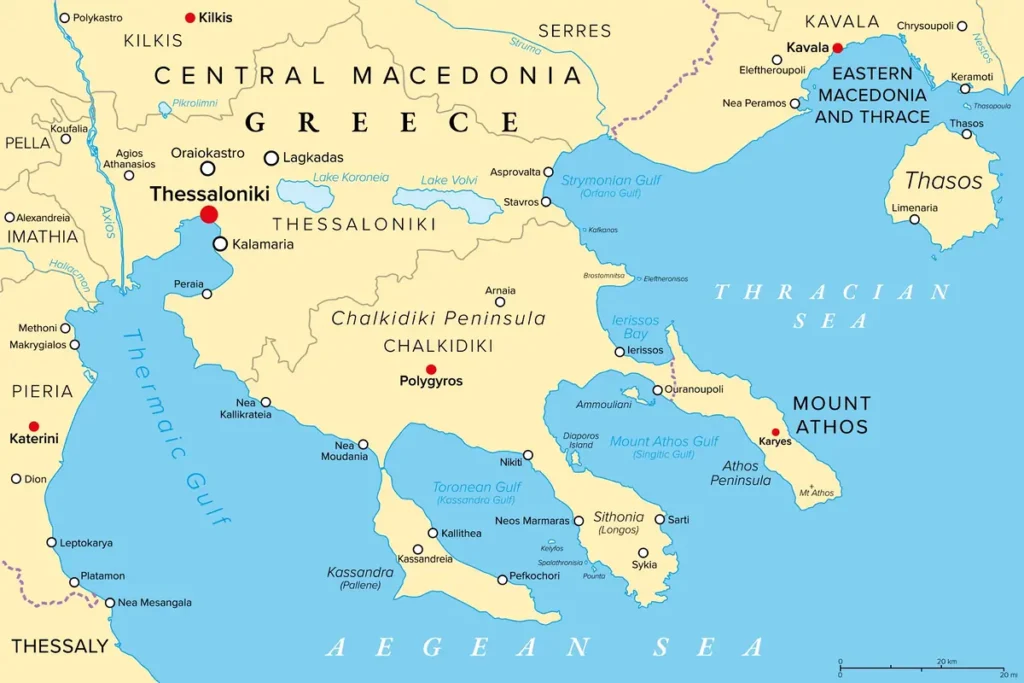
Thessaloniki (Θεσσαλονίκη, Thessaloníki) was founded in 315 BCE by Cassander, king of Macedon and one of the successors who fought for control of Alexander the Great’s empire. Cassander united 26 settlements around the Thermaic Gulf and established a new city beside a sheltered natural harbour.
He named it after his wife, Thessalonike of Macedon, daughter of Philip II and half-sister of Alexander the Great. Her name commemorated a Macedonian victory in Thessaly. The modern city therefore carries the name of a woman from the royal house of ancient Macedon.
The harbour gave Thessaloniki access to the Aegean. River valleys and land routes connected it with the Macedonian interior and the Balkans. Trade grew quickly, and the city developed its own civic institutions, including a council and popular assembly. Philip V, king of Macedon, granted Thessaloniki the right to mint coins, reflecting its commercial and political importance.
The Hellenistic city followed a grid of streets and large urban blocks. Its marketplace occupied the area later developed as the Roman Forum. Continuous habitation and repeated rebuilding buried most of this early city beneath the modern centre. Excavations have uncovered houses, roads, cemeteries and sections of its fortifications.
The Macedonian royal world from which Thessaloniki emerged survives most vividly at ancient Aigai. Our guide to the Vergina Royal Tombs and the New Aigai Museum covers the first capital of Macedon, the palace of Philip II and the royal burials.
Did You Know?
The name Thessalonike combines Thessaly with nikē, the Greek word for victory, commemorating a Macedonian victory in Thessaly. More than 23 centuries later, the city still bears the name Cassander gave it in honour of his wife.
Thessaloniki Under Rome
Thessaloniki’s next period began after Rome defeated King Perseus at the Battle of Pydna in 168 BCE and brought the Macedonian kingdom to an end. In the following century, the city became the capital of the Roman province of Macedonia. Its position on the Via Egnatia, the military and commercial road from the Adriatic to Byzantium, accelerated its growth.
Soldiers, officials, merchants and travellers moved through the city. Grain, wine, oil, timber, metals and manufactured goods passed through its markets and port. Thessaloniki received the status of a free city, retained civic privileges and issued its own coins. The Roman statesman and orator Cicero spent part of his exile there in 58 BCE, writing letters that reveal the city’s established place in Roman political life.
The line of the Roman road survives in Egnatia Street, still one of the main routes through central Thessaloniki. Excavations for buildings, roads and the metro have repeatedly exposed the older city below it.
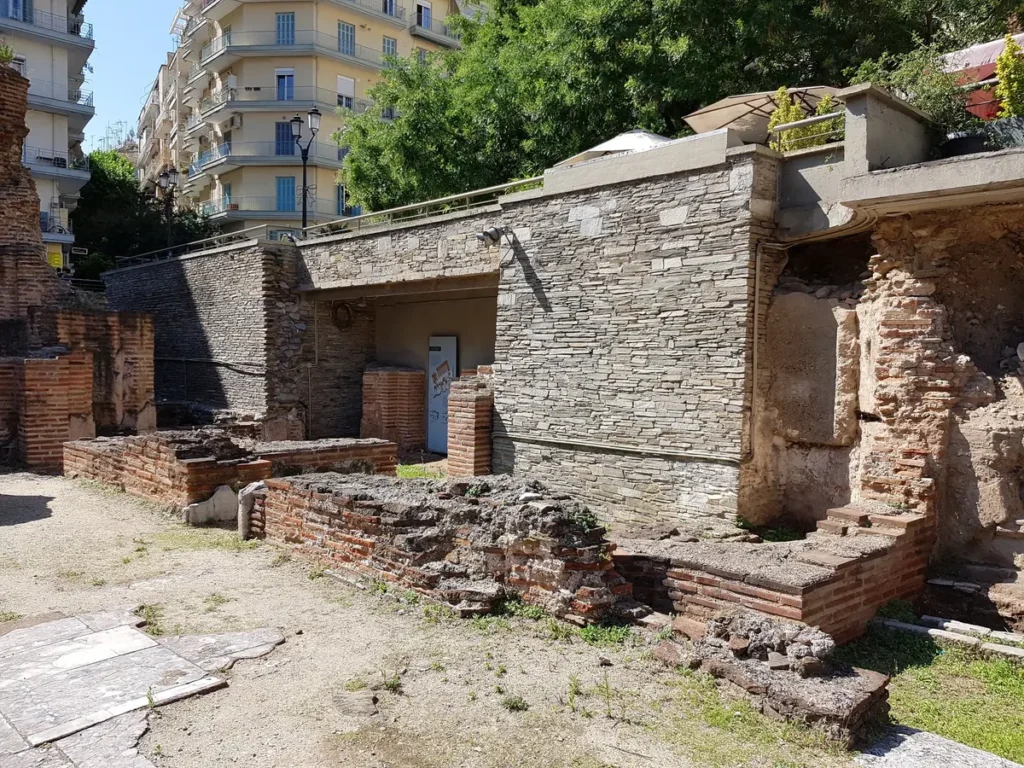
Thessaloniki acquired an imperial character at the beginning of the 4th century CE, when Galerius, one of the rulers of the Roman Tetrarchy, made it one of his seats of power. His vast complex extended across the eastern part of the Roman city. It included a palace, a hippodrome, an octagonal ceremonial hall, the Arch of Galerius and the Rotunda.
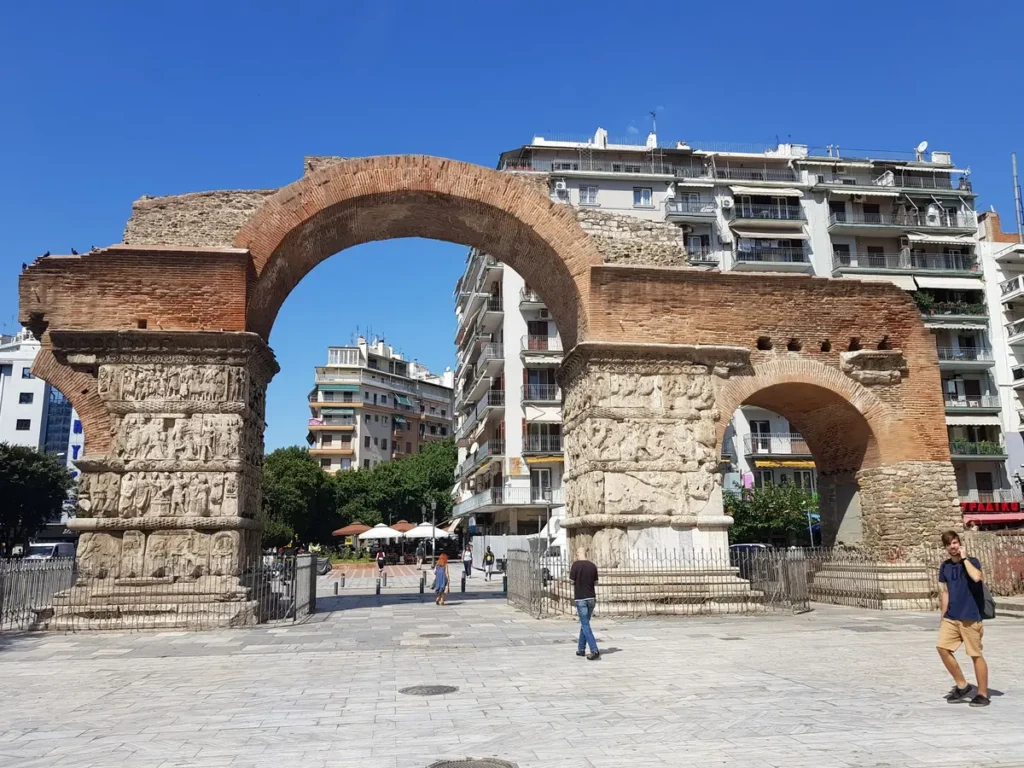
The arch, known as the Kamara, was completed in 305 CE after Galerius’s victory over the Persians. It stood above the ceremonial road linking the palace with the Rotunda. Its marble reliefs present battles, imperial ceremonies and the unity of the Tetrarchy. Two main piers and one smaller pier survive beside Egnatia Street, where the monument now serves as one of Thessaloniki’s best-known meeting points.
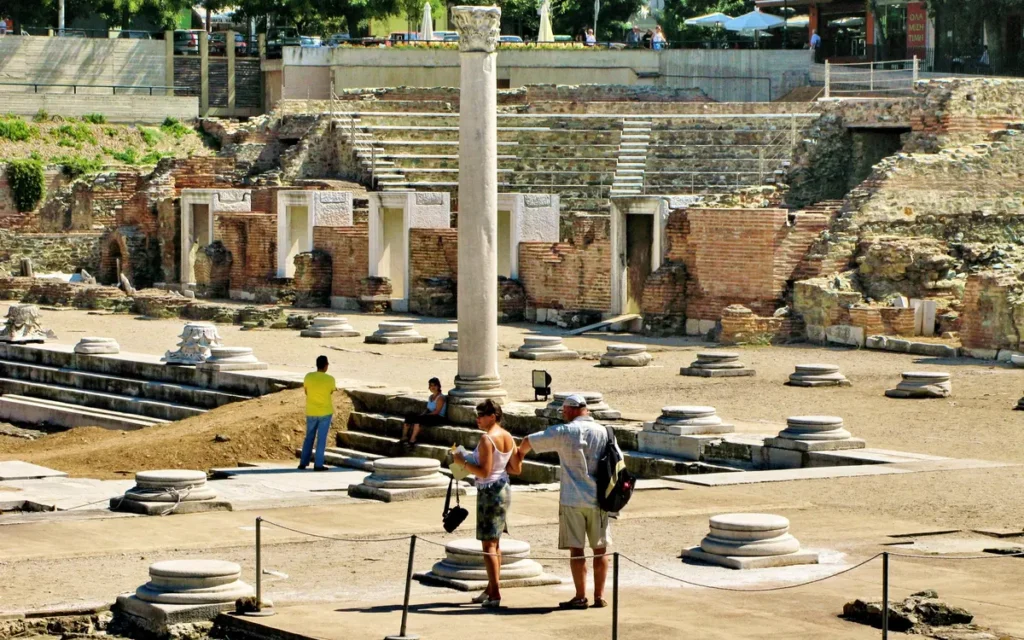
The Roman Forum formed the administrative and commercial centre. Its squares, colonnades, public buildings, odeon and underground shopping arcade occupied a large area between today’s Egnatia and Olympou streets. Elsewhere, archaeologists have uncovered baths, villas with mosaic floors, marble-paved avenues and the remains of the Galerian palace around Navarinou Square.
Roman investment also transformed the waterfront. In the early fourth century, the Roman emperor Constantine the Great built a new artificial harbour near today’s Ladadika and Eleftherias Square, strengthening Thessaloniki’s position as the principal maritime outlet for the Balkan interior.
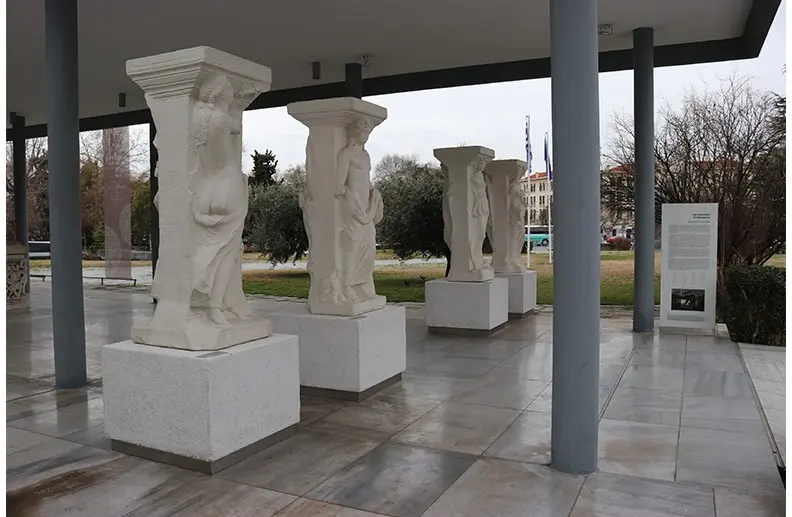
Las Incantadas of Salonica
A colonnade near the Roman Forum once carried eight sculpted mythological figures. Thessaloniki’s Ladino-speaking Jewish community called the monument Las Incantadas. Its Greek name was Μαγεμένες (Mageménes, “Enchanted Ones”). The sculptures were removed in 1864 and taken to France, and the originals are now held by the Louvre. Full-size replicas are displayed at the Archaeological Museum of Thessaloniki.
The Massacre of 390
In 390 CE, unrest in Thessaloniki led to the killing of a Roman military commander. Emperor Theodosius I ordered a savage reprisal. Imperial troops attacked a crowd gathered in the hippodrome and killed thousands of people.
Ambrose, Bishop of Milan, barred Theodosius from communion until the emperor performed public penance. The confrontation became a defining episode in the relationship between imperial power and Christian authority during late antiquity.
The Arrival of Christianity
Christianity reached Thessaloniki during the first century CE. The Apostle Paul visited during his second missionary journey around 50 CE and preached to the city’s Jewish community. His two letters to the Thessalonians entered the New Testament and placed Thessaloniki within the earliest written history of European Christianity.
Saint Demetrius, traditionally described as a Roman officer martyred in the early fourth century, became the central figure in the city’s Christian identity. He was honoured as Thessaloniki’s patron and protector. His feast on 26 October remains a major civic and religious celebration and coincides with the anniversary of the city’s entry into modern Greece in 1912.
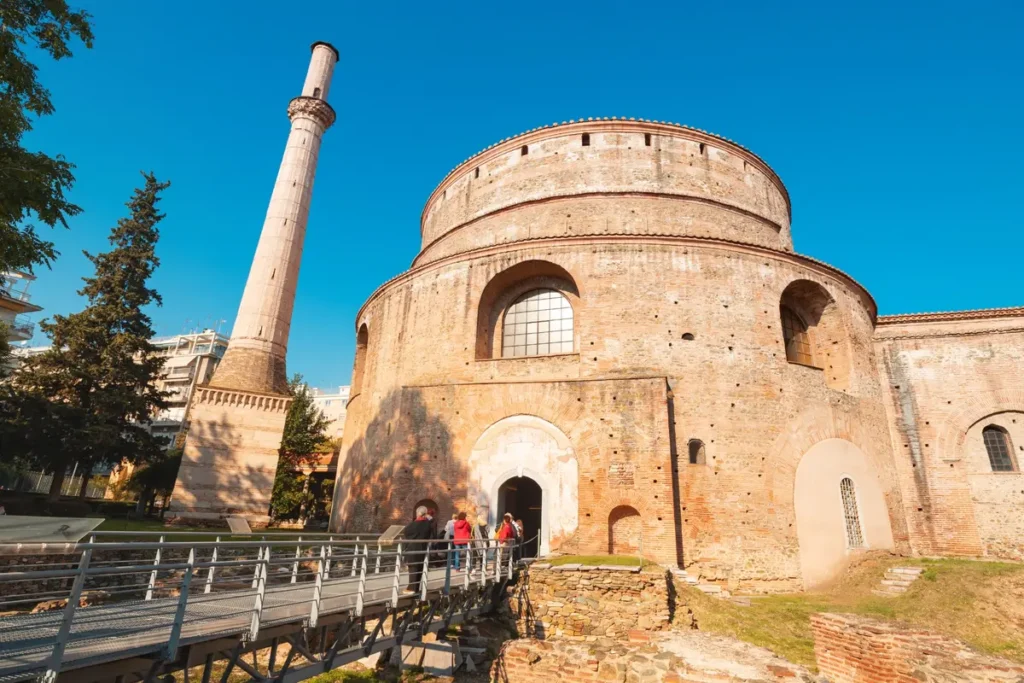
Imperial acceptance of Christianity reshaped the city. The Rotunda, built around 306 CE as part of the Galerian complex, became a church during the Early Christian period. A sanctuary was created at its eastern end and a covered aisle was added around the immense circular building.
The surviving mosaics transformed its brick interior into a vision of the Christian cosmos. Martyrs stand in prayer before richly coloured architectural settings. Angels, stars, fruit, birds and a phoenix appear in the upper compositions. Gold tesserae catch the changing light beneath a dome almost 30 metres high.
The Rotunda became a mosque in 1590 or 1591. Its minaret still rises beside it. Following the city’s incorporation into Greece, the building was dedicated to Saint George. Major restoration followed the earthquake of 1978.
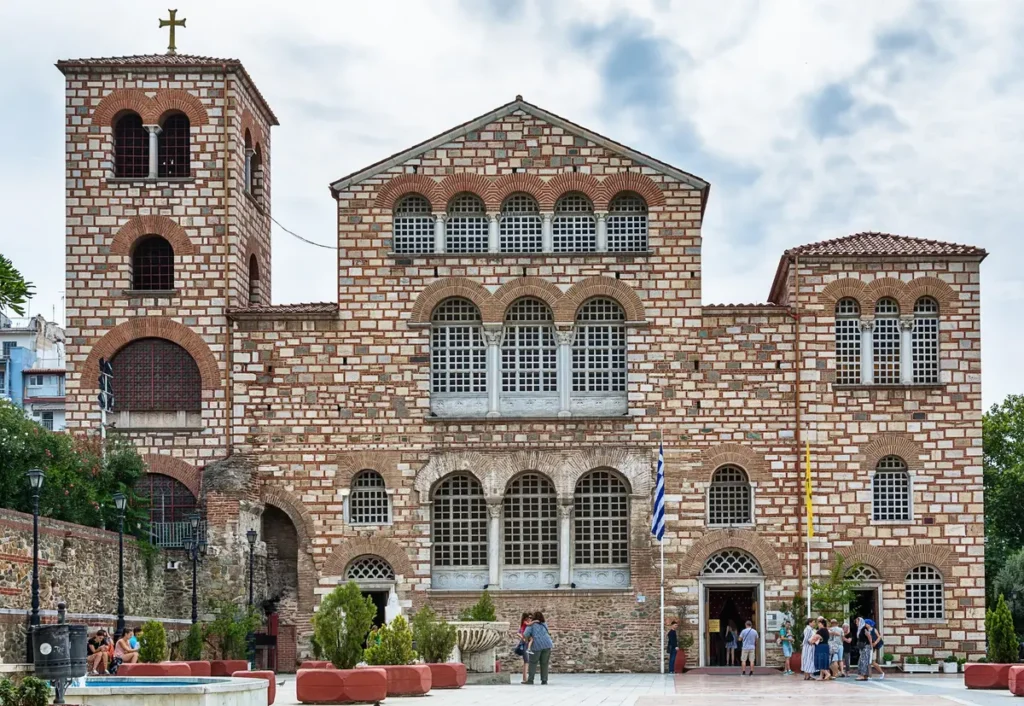
The Basilica of Saint Demetrius developed above a Roman bath complex associated with the saint’s imprisonment and martyrdom. Other major churches appeared throughout the city as pagan civic spaces gave way to a Christian urban order.
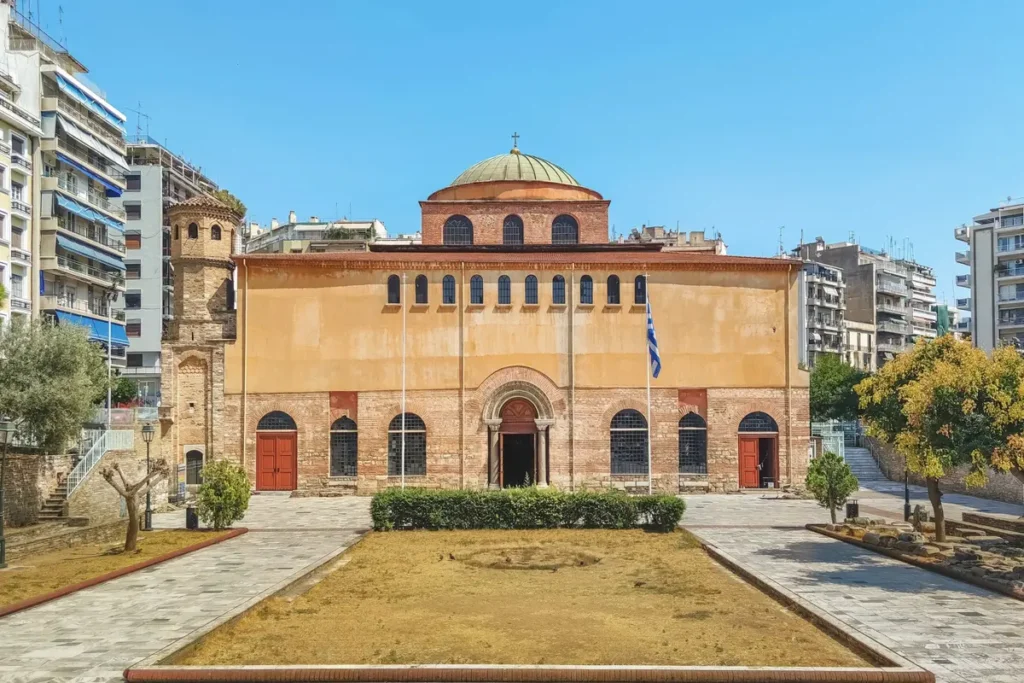
Fifteen Early Christian and Byzantine monuments of Thessaloniki entered the UNESCO World Heritage List in 1988. Together they preserve more than a thousand years of architecture, mosaics and wall painting within the living city.
The Byzantine Metropolis
As the Roman Empire in the east developed into the Byzantine Empire, Thessaloniki became its leading city after Constantinople. It guarded the Balkan routes, supplied armies and connected the interior with the Aegean. Its wealth was expressed in its walls, port, churches and intellectual life.
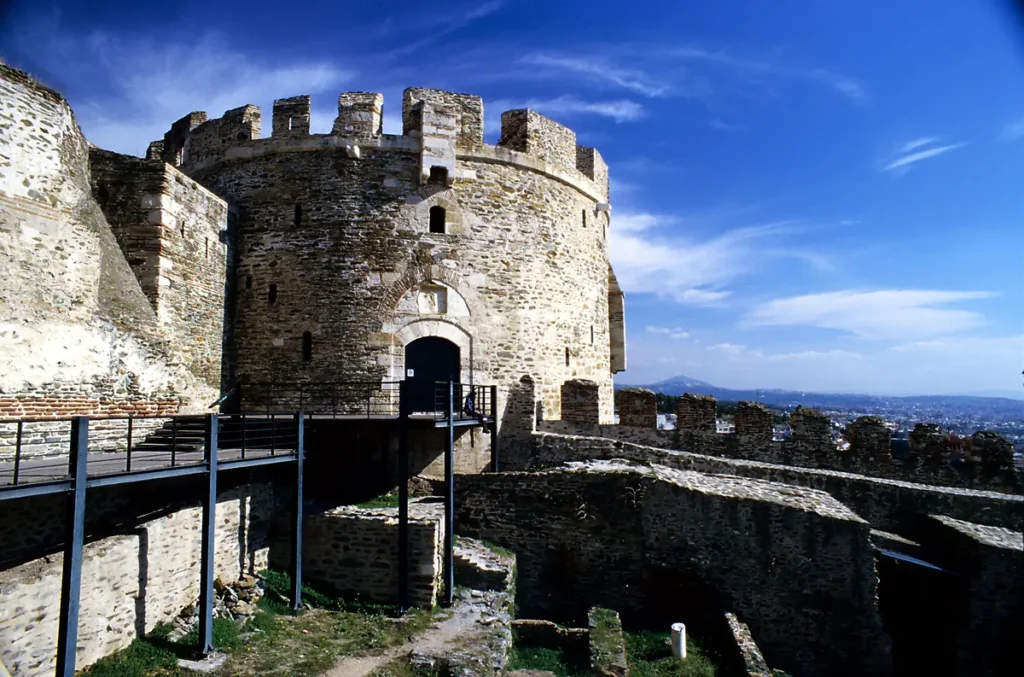
The walls enclosed the lower city and climbed towards the acropolis in today’s Ano Poli. Towers, gates and successive repairs record centuries of pressure from Goths, Avars, Slavs, Bulgarians, Saracens and Normans. The fortifications protected the population, controlled movement and defined the city’s outline until large sections were demolished in the late 19th century.
A powerful earthquake around 620 damaged the Roman Forum and many public buildings. The Christian city grew across and around the ruins. Churches occupied central positions, workshops spread into former civic spaces and new neighbourhoods emerged within the ancient street plan.
War brought two devastating sacks. Saracen raiders captured Thessaloniki in 904, looted it and carried thousands of residents into slavery. Norman forces from Sicily seized it in 1185 and subjected its population to another violent assault.
The Fourth Crusade created a Latin Kingdom of Thessalonica in 1204. The city returned to Greek rule in 1224 and entered the restored Byzantine Empire after the recovery of Constantinople. During the civil conflicts of the 14th century, the Zealots, an urban political movement opposed to the landed aristocracy, governed Thessaloniki from 1341 to 1350. They drew much of their support from merchants, artisans and poorer residents.
Byzantine Thessaloniki produced theologians, scholars, painters and churchmen whose influence travelled across the Orthodox world. The Byzantine missionary brothers Cyril and Methodius, born in the city in the 9th century, carried Christianity and a written liturgical tradition to the Slavs. Their pupils developed the Cyrillic script and extended that cultural mission across southeastern Europe.
The churches of Hagia Sophia, Panagia Acheiropoietos, Hosios David, Panagia Chalkeon and the Holy Apostles preserve successive phases of Byzantine architecture and art. Their domes, mosaics and frescoes reveal a city with the resources and artistic workshops to serve imperial and local patrons.
Commerce remained equally important. Each October, the Demetria joined the feast of Saint Demetrius with a major trading fair. Merchants arrived from the Balkans, the Mediterranean and central Europe. Religious celebration and international commerce met in the same annual gathering.
A Byzantine City Still in Use
Thessaloniki’s Byzantine monuments remain part of everyday life. Worship continues inside churches more than a thousand years old. Medieval walls overlook apartment blocks, football grounds and the port. The Byzantine city survives within the routes and routines of the modern one.
Thessaloniki Under Ottoman Rule
Byzantine control weakened during the late 14th and early 15th centuries. Ottoman forces first captured Thessaloniki in 1387, although Byzantine rule returned after the Ottoman defeat at Ankara in 1402. Under renewed Ottoman pressure and unable to defend the city, its Byzantine governor, Andronikos Palaiologos, placed Thessaloniki under the protection of the Republic of Venice in 1423. Venice governed it for seven years, until Sultan Murad II captured the city in 1430, beginning almost five centuries of Ottoman rule.
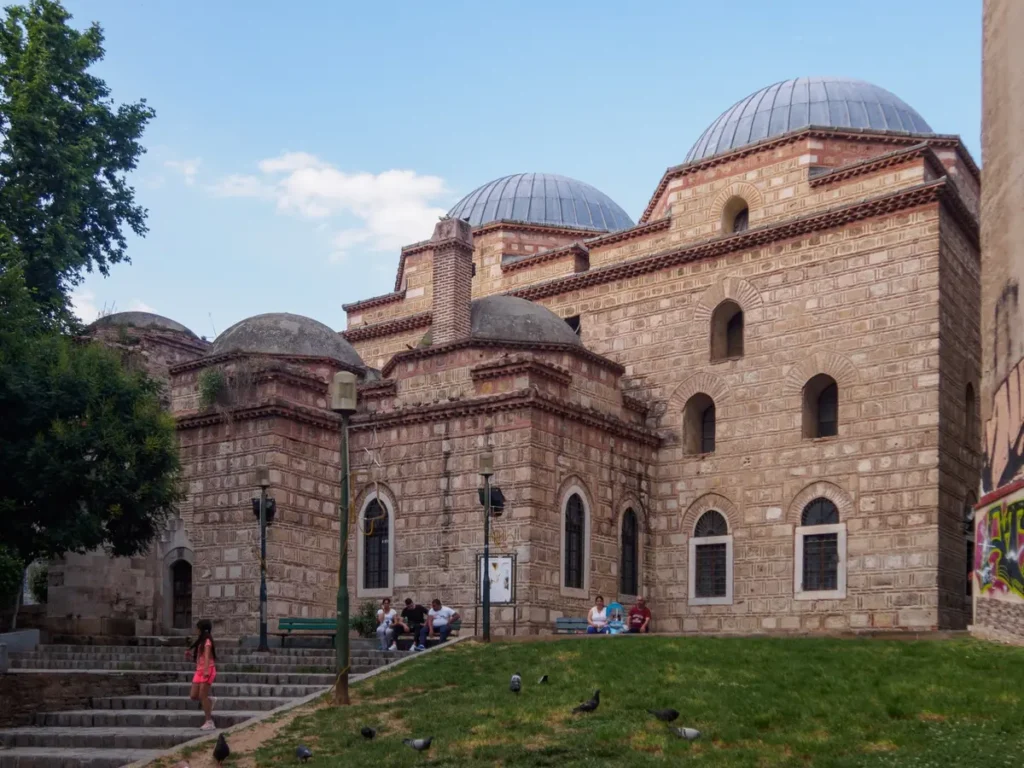
The conquest changed the city’s population, institutions and skyline. Major churches became mosques. Muslim neighbourhoods developed on the higher ground. Markets, workshops and caravan routes concentrated around the port and lower city. Religious foundations financed bathhouses, fountains, schools, kitchens and places of worship.
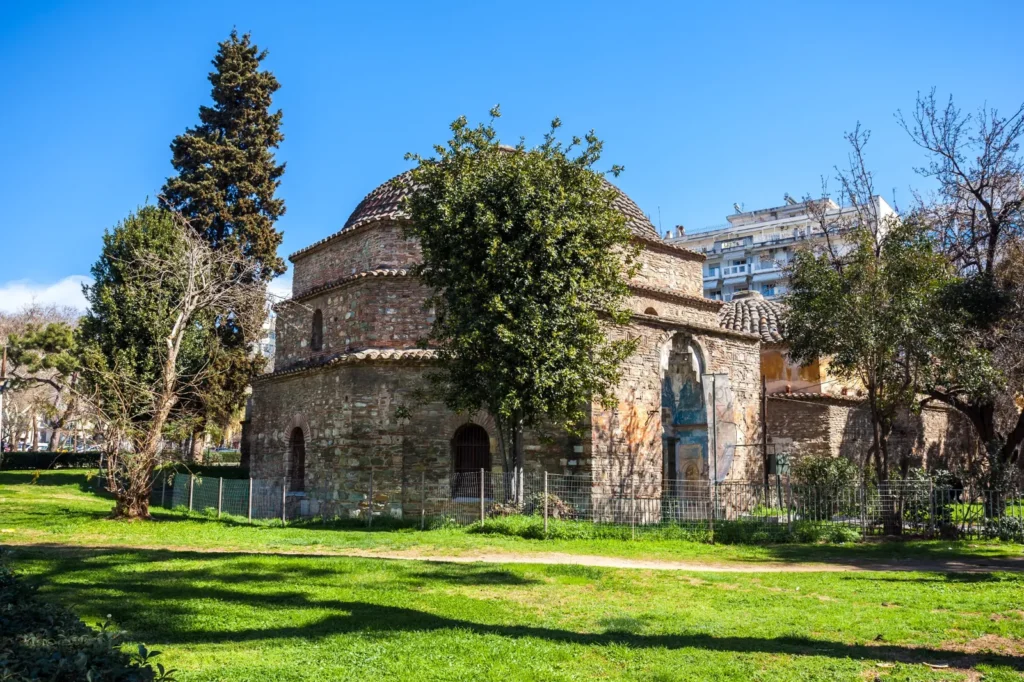
The Bey Hamam, built in 1444, is the oldest surviving Ottoman bath in Thessaloniki. The Alaca Imaret, Hamza Bey Mosque, Bezesteni and Yeni Mosque mark different stages of Ottoman urban life.
The White Tower
The most recognisable monument from Ottoman Thessaloniki is the White Tower (Λευκός Πύργος, Lefkos Pyrgos). The present cylindrical structure was built in the late 15th century, replacing an earlier Byzantine fortification at the eastern end of the waterfront walls. It guarded the coastal approach to the city and later served as a military garrison and prison.
Executions carried out there earned it the name Tower of Blood during the 19th century. After Thessaloniki became part of Greece in 1912, the tower was whitewashed and its present name became established. Today it houses an exhibition on the city’s history, while its rooftop offers views across the waterfront and the Thermaic Gulf. It remains the best-known symbol of Thessaloniki.
A City Beyond the Walls
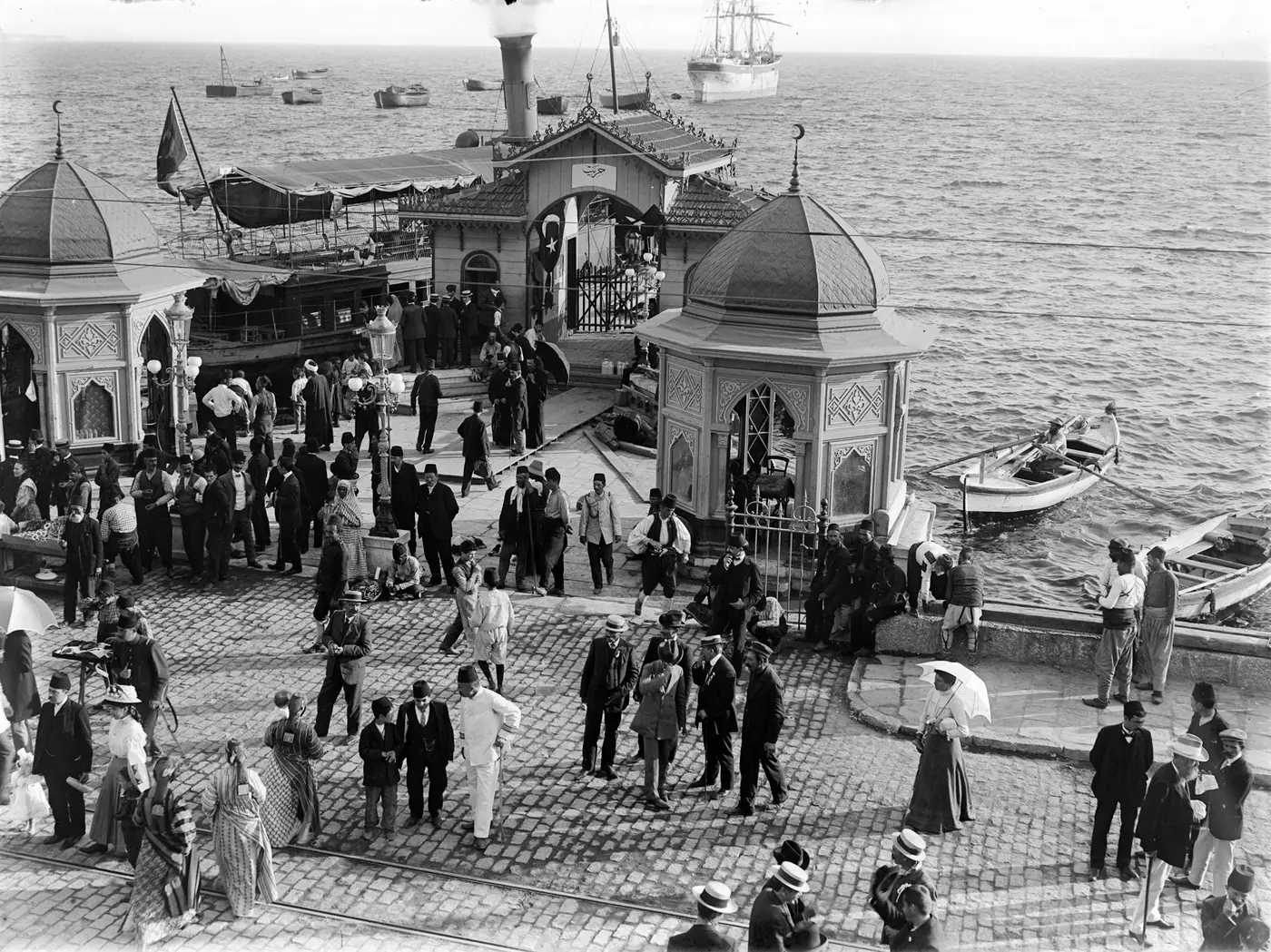
By the 19th century, railways, steamships, banks, factories and European consulates were binding Thessaloniki more closely to international markets. The seaward wall came down in 1874, opening the city towards the gulf and creating a modern waterfront. The removal of the eastern walls allowed expansion beyond the old fortified centre.
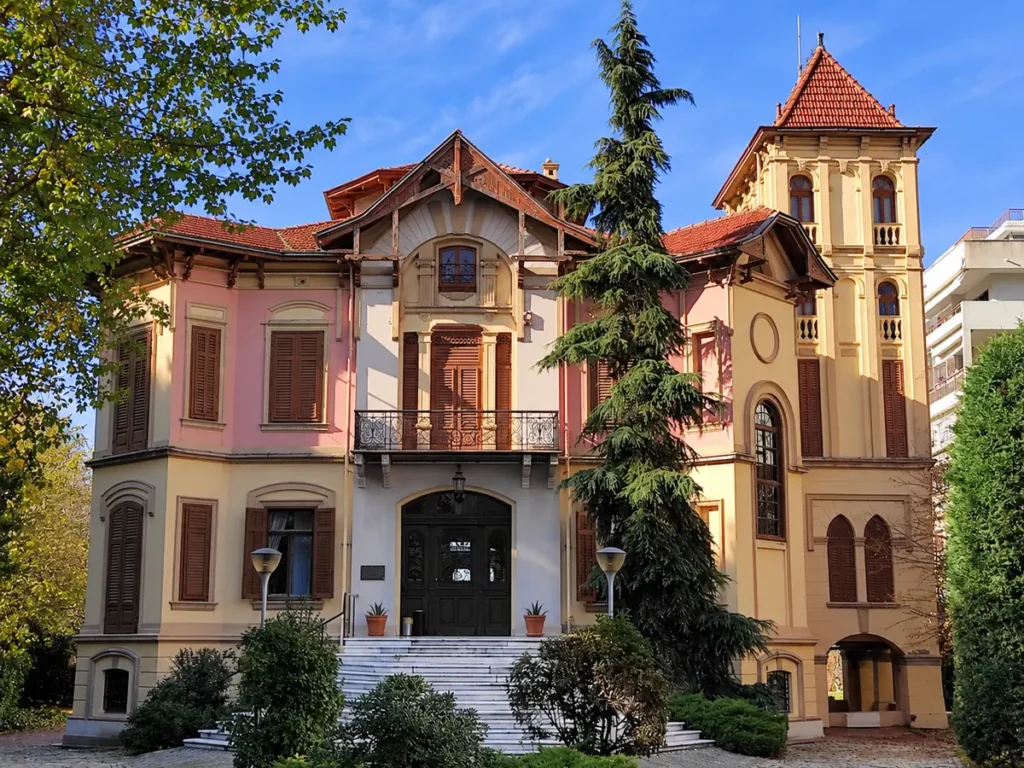
The southeastern suburb of Exoches grew along today’s Vasilissis Olgas Avenue. Wealthy Jewish, Muslim, Greek Orthodox and European families commissioned villas in neoclassical, Art Nouveau, eclectic and Ottoman styles. The surviving Villa Allatini, Villa Bianca and Casa Mordoch preserve the confidence and cosmopolitan taste of late Ottoman Salonica.
A Port of New Ideas
Newspapers appeared in Ladino, Greek, Ottoman Turkish, French and Bulgarian. Schools, theatres, cafés and political clubs circulated ideas about constitutional government, nationalism, socialism and labour rights.
The city became a centre of the Young Turk movement, which restored the Ottoman constitution in 1908. The deposed Ottoman ruler Sultan Abdul Hamid II was later held at Villa Allatini. Mustafa Kemal Atatürk, the founder and first president of modern Turkey, was born in Thessaloniki in 1881 and grew up in this restless political environment.
In 1909, Jewish socialist and labour organiser Avraam Benaroya helped establish the Socialist Workers’ Federation, known as the Federación. It organised workers through separate language sections joined in a common movement. Its structure reflected a city where dockworkers, railway employees, factory workers and artisans came from several communities.
Sephardic Salonica
The Ottoman city was transformed further by the arrival of Sephardic Jews, although Jewish life in Thessaloniki already reached back to antiquity. After the rulers of Spain expelled practising Jews in 1492, refugees settled across the Ottoman Empire and made Thessaloniki one of their most important centres.
The newcomers brought Ladino, or Judeo-Spanish, together with commercial networks, printing skills, crafts, scholarship and distinct religious traditions. Congregations took the names of places their members had left, including Castile, Aragon, Majorca, Lisbon and Italy. Over time, these communities formed the largest element of the city’s population.
Jewish merchants linked the Macedonian interior with Mediterranean and European markets. Jewish workers loaded ships, processed tobacco, spun wool, printed books, made textiles and ran shops. The port slowed for the Sabbath. Ladino newspapers reported local and international events. Thessaloniki became known as the Jerusalem of the Balkans and the Mother of Israel.
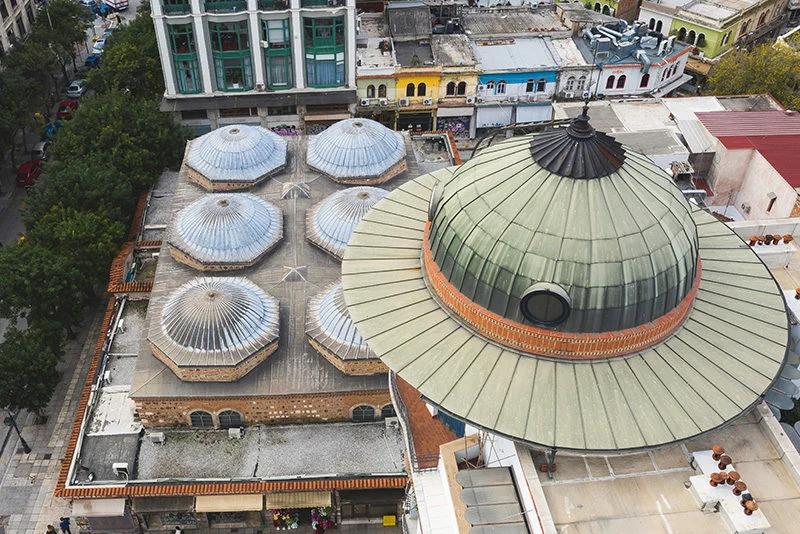
The city’s commercial geography reflected this presence. Markets, workshops, synagogues and homes filled the districts near the waterfront. The six-domed Bezesteni protected valuable goods at the centre of the bazaar. Modiano families became bankers, merchants, architects and public figures. Working-class Jewish neighbourhoods developed beside the railway and industrial zone.
Fire, political change and migration placed growing pressure on the community during the early 20th century. Jewish institutions nevertheless remained central to Thessaloniki until the German occupation. The Jewish Museum of Thessaloniki, surviving synagogues, memorials and family archives preserve the history of a community that shaped Salonica for more than four centuries.
Thessaloniki Joins Modern Greece
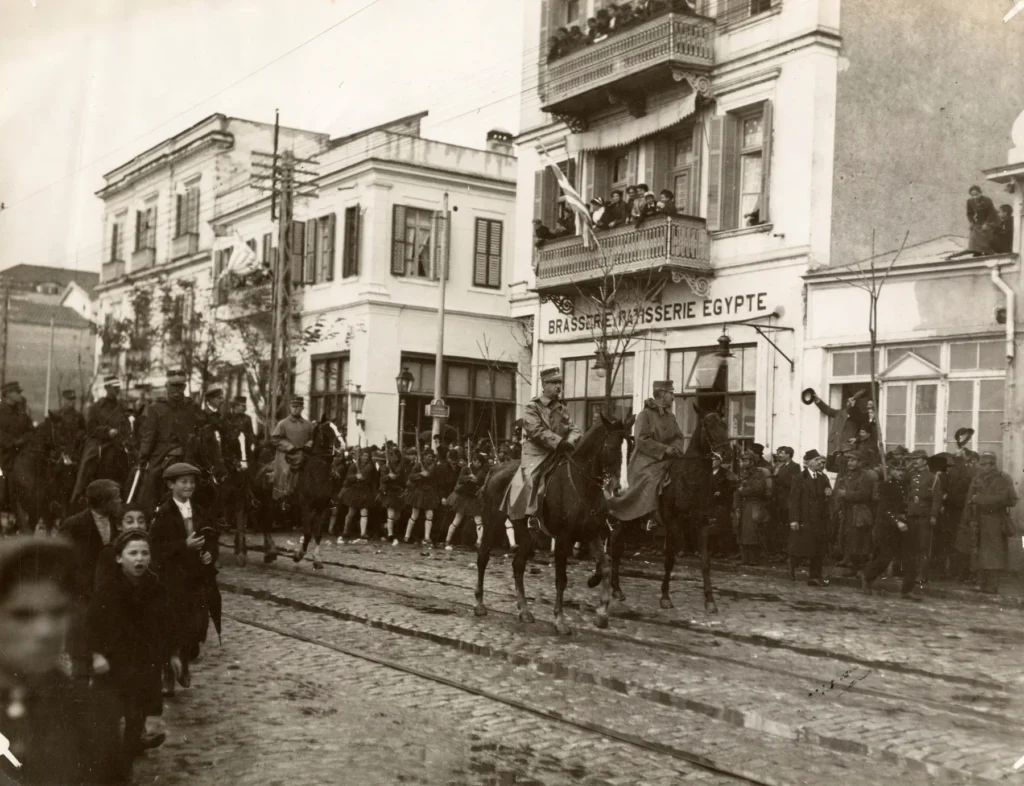
The First Balkan War brought Ottoman rule to an end. On 26 October 1912, the feast of Saint Demetrius, the Ottoman commander Hasan Tahsin Pasha surrendered Thessaloniki to Crown Prince Constantine, commander-in-chief of the Greek Army of Thessaly and heir to the Greek throne. Greek troops entered shortly afterwards, and the city became part of the modern Greek state.
The new border changed its political allegiance while the city remained visibly Ottoman and multicultural. Greek Orthodox Christians, Jews, Muslims and Europeans continued to share its streets. Osman Sait Bey remained mayor under Greek administration until 1916 and returned to the office from 1920 to 1922. Greek authorities gradually introduced a new administrative, legal and educational framework.
King George I of Greece, who had arrived in Thessaloniki soon after its incorporation into the country, was assassinated there in March 1913. Three years later, the First World War turned the city into the headquarters of the Allied Salonica Front. French, British, Serbian, Italian, Russian and colonial troops filled camps, hospitals and depots around it.
Thessaloniki also stood at the centre of Greece’s National Schism, the bitter division over whether the country should enter the First World War. In 1916, former prime minister Eleftherios Venizelos formed the Provisional Government of National Defence in the city with naval officer Admiral Pavlos Kountouriotis and army commander General Panagiotis Danglis. Their government supported the Entente and directly challenged King Constantine I, who favoured neutrality and retained control of the government in Athens.
Within five years, military occupation, political division and a catastrophic fire changed the city more profoundly than the transfer of sovereignty alone.
The Great Fire of 1917
The catastrophe came on 18 August 1917, when a domestic fire broke out in the densely built centre. Strong winds, dry conditions and a severe shortage of water drove the flames across the lower city. The fire burned for more than 30 hours, destroyed about one square kilometre and left more than 70,000 people homeless.
The destruction cut through the commercial and religious centre. Thousands of homes vanished along with shops, warehouses, schools, synagogues, churches and mosques. The Basilica of Saint Demetrius suffered extensive damage. Around 50,000 of the people made homeless were Jewish.
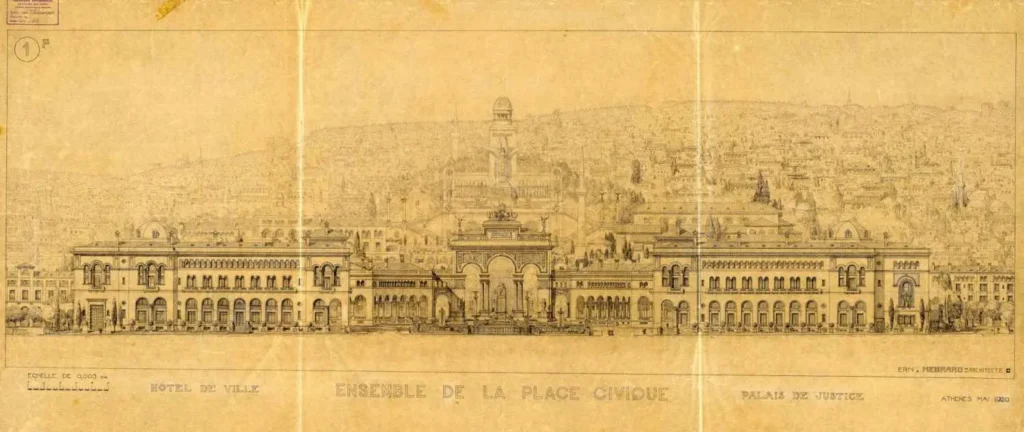
The government used the disaster to rebuild central Thessaloniki on a new plan. A commission led by French architect and urban planner Ernest Hébrard replaced the tight street pattern with avenues, civic squares and carefully framed views of the sea. The design drew on Byzantine forms and the architecture of Mediterranean port cities.
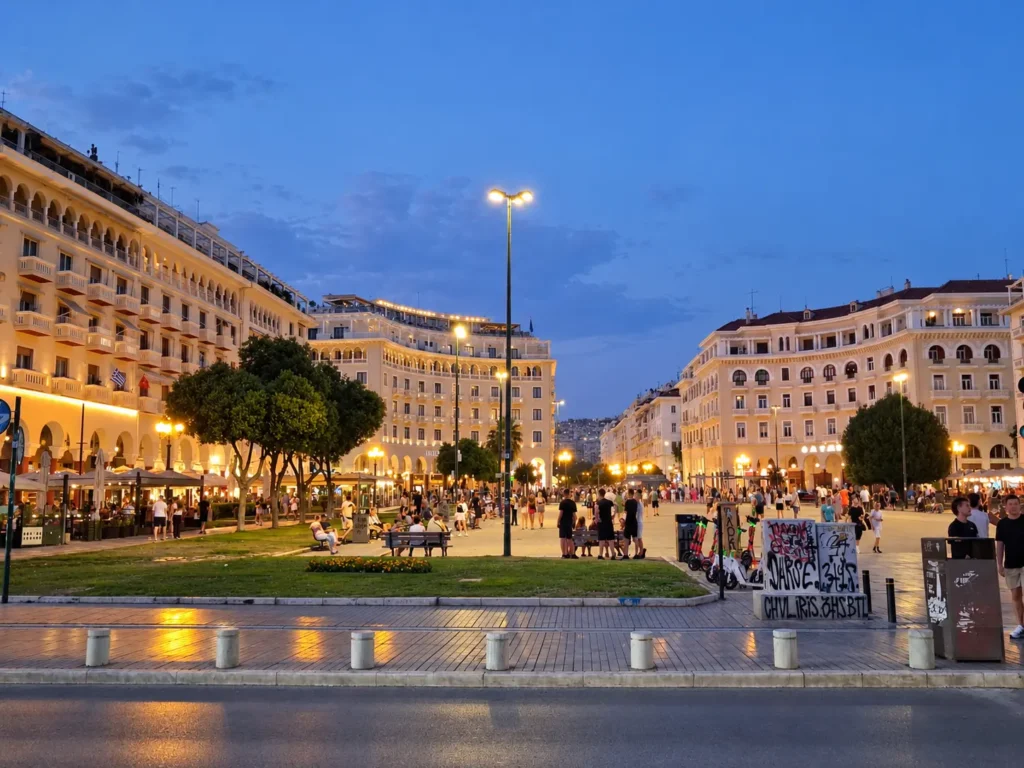
Aristotelous Square became the plan’s most recognisable achievement. Its curved façades create a formal route from the waterfront towards the hills, opening the dense centre to light and sea. Hébrard’s wider scheme was only partly realised, and the completed sections established the structure of the modern city centre.
The reconstruction also changed ownership and access to land. Many former residents were unable to return to their neighbourhoods. The old Jewish quarters lost homes, businesses, synagogues and communal networks. The fire therefore altered Thessaloniki’s social geography as decisively as its buildings.
Did You Know?
Aristotelous Square belongs to a larger civic axis conceived after the fire. Its architecture was designed to give Thessaloniki a monumental centre facing the Thermaic Gulf.
A City Reshaped by Refugees
Reconstruction was still under way when another demographic change remade Thessaloniki. Following the Greco-Turkish War and the compulsory population exchange agreed in 1923, Orthodox Christian refugees arrived in large numbers from Asia Minor, Pontus and Eastern Thrace. Most of the city’s Muslim population left for Turkey.
New settlements expanded around the old city. Kalamaria, Toumba, Neapoli and other districts absorbed displaced families, often under extremely difficult conditions. Refugees built homes, opened workshops, established associations and entered factories, markets and the port.
Their food and music became inseparable from the city’s culture. Recipes from Smyrna, Constantinople, Pontus and the Black Sea joined Macedonian, Sephardic, Balkan and Ottoman traditions. Thessaloniki’s celebrated cuisine grew directly from this history of movement and resettlement.
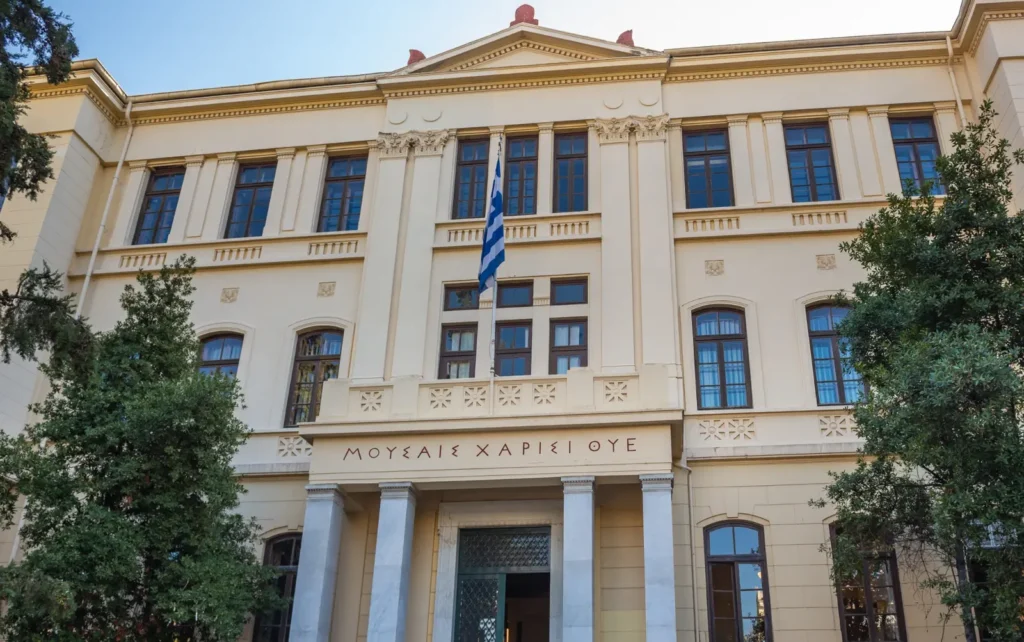
Aristotle University of Thessaloniki was founded in 1925. The new university strengthened the city’s role as the intellectual centre of northern Greece and eventually occupied land that included the historic Jewish cemetery.
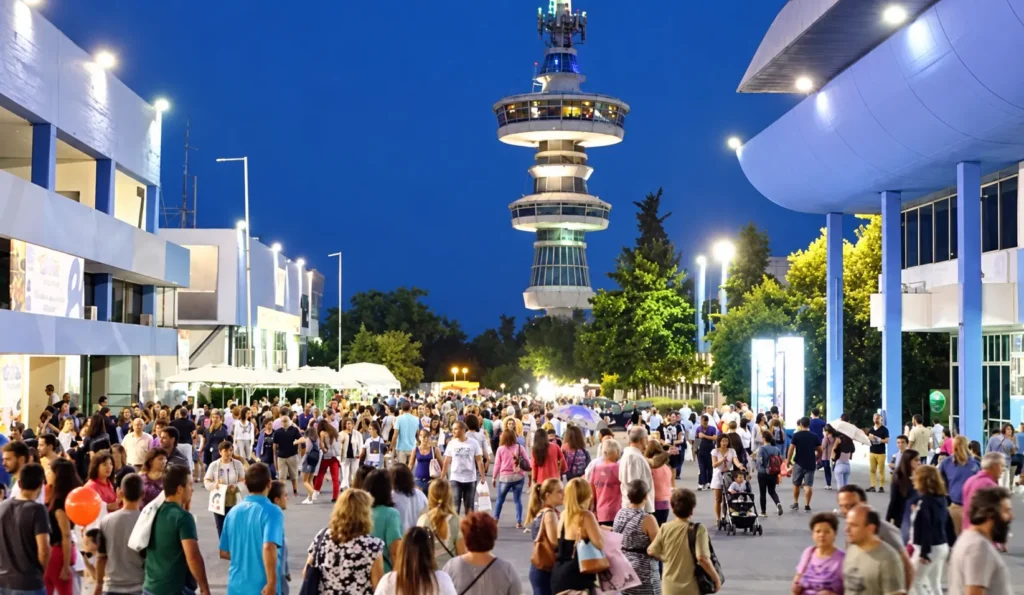
In the same year, Greek politician and zoologist Nikolaos Germanos proposed the Thessaloniki International Fair. The first fair opened on 3 October 1926 with more than 600 exhibitors. It moved to its present site in 1940, resumed after the wartime decade in 1951 and developed into Greece’s leading annual trade exhibition.
As the fair grew, it also became an important fixture in the national political calendar. Each September, the prime minister uses the event to present the government’s economic programme and announce measures affecting taxation, income, investment and social policy. The leaders of the main opposition parties respond with their own programmes and priorities. For several days, Thessaloniki becomes the centre of Greek political and economic debate.
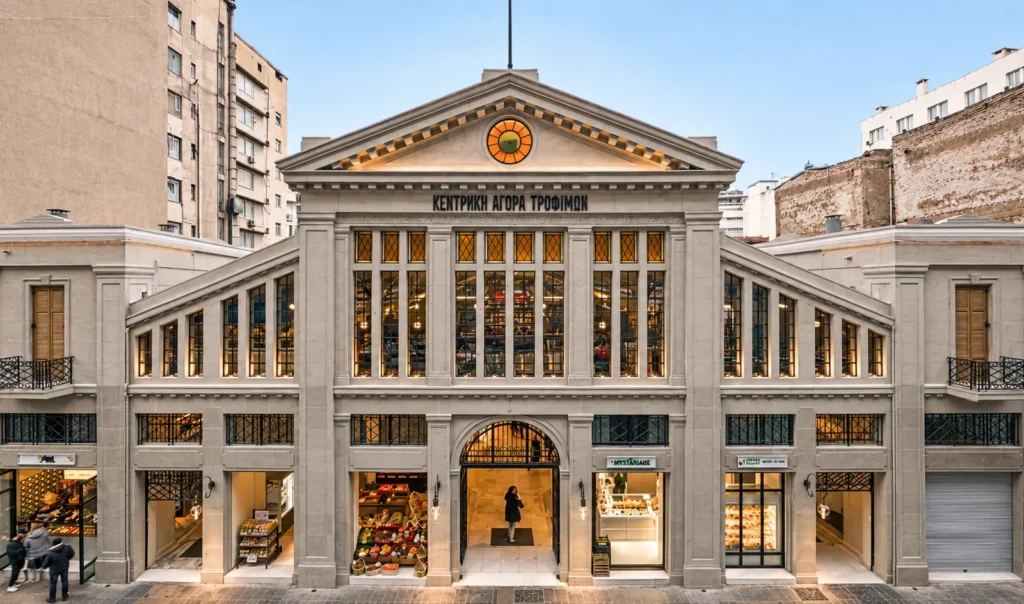
The rebuilt commercial centre gained another landmark with Modiano Market. Eli Modiano, a Thessaloniki-born Jewish architect and member of a prominent local family, designed the covered food market on part of the area destroyed by the fire. Work began in 1922, and the market opened during the interwar transformation of the city.
The Protest That Inspired Epitaphios
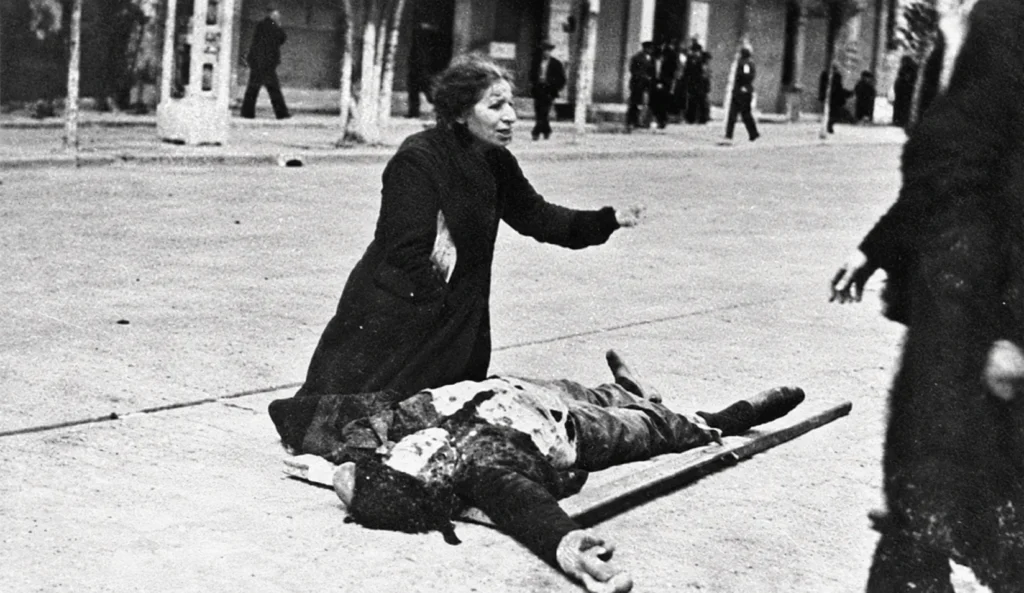
In May 1936, a tobacco workers’ strike grew into mass demonstrations involving workers from several professions. Police fired on protesters and killed several people. A newspaper photograph of Katina Toussi grieving over the body of her 25-year-old son, professional driver Tasos Toussis, moved the poet Yiannis Ritsos to write Epitaphios. The composer Mikis Theodorakis later set the poem to music, creating one of the defining works of modern Greek culture.
The German Occupation and the Holocaust
The interwar period ended with the German invasion of Greece. German forces entered Thessaloniki on 9 April 1941 and made the city the administrative centre of their occupation zone in northern Greece. Military control reached into public offices, transport, industry and daily life.
Requisitioning and the disruption of trade contributed to severe shortages of food, fuel and basic goods. Hunger spread, prices rose sharply and many residents depended on communal kitchens or the black market. Factories and warehouses were placed at the service of the occupying authorities, while arrests, censorship, torture, forced labour and executions created a climate of fear.
Resistance organisations operated in the city and across Macedonia, distributing clandestine newspapers, organising networks and carrying out acts of sabotage. German forces answered resistance activity with arrests and reprisals. The former Pavlos Melas military camp was used as a prison and place of execution, becoming one of the principal sites associated with occupation terror in Thessaloniki.
The port and railway network, essential to German military transport in the Balkans, made Thessaloniki strategically important. Wartime bombardment and the destruction carried out during the German withdrawal damaged transport installations, warehouses and parts of the urban fabric. By the time the city was liberated, its economy and infrastructure had been severely weakened.
The Destruction of Jewish Thessaloniki
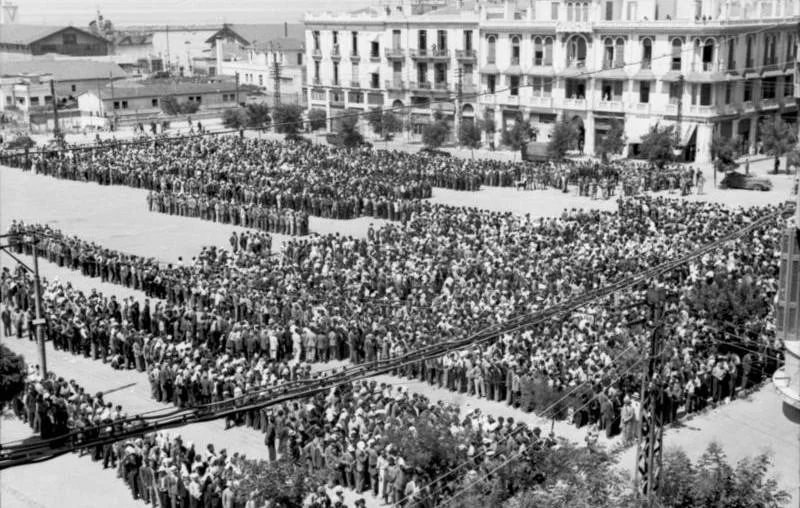
On 11 July 1942, thousands of Jewish men were ordered to assemble in Eleftherias Square. German soldiers subjected them to public humiliation before registering them for forced labour. The day became known as Black Saturday.
The German authorities and their collaborators destroyed the historic Jewish cemetery, a vast burial ground containing centuries of the community’s history. Building materials from graves were dispersed across the city, and Aristotle University later expanded over the site.
In 1943, Jewish residents were forced into ghettos. Deportation trains left from the old railway station between March and August. More than 46,000 Jews from Thessaloniki were deported, most of them to Auschwitz-Birkenau. Around 96 per cent were murdered.
The Holocaust erased a community that had shaped the city’s commerce, language, politics, music and daily life for centuries. Survivors returned to find homes occupied, property lost and families gone. Thessaloniki’s population and identity had been permanently changed.
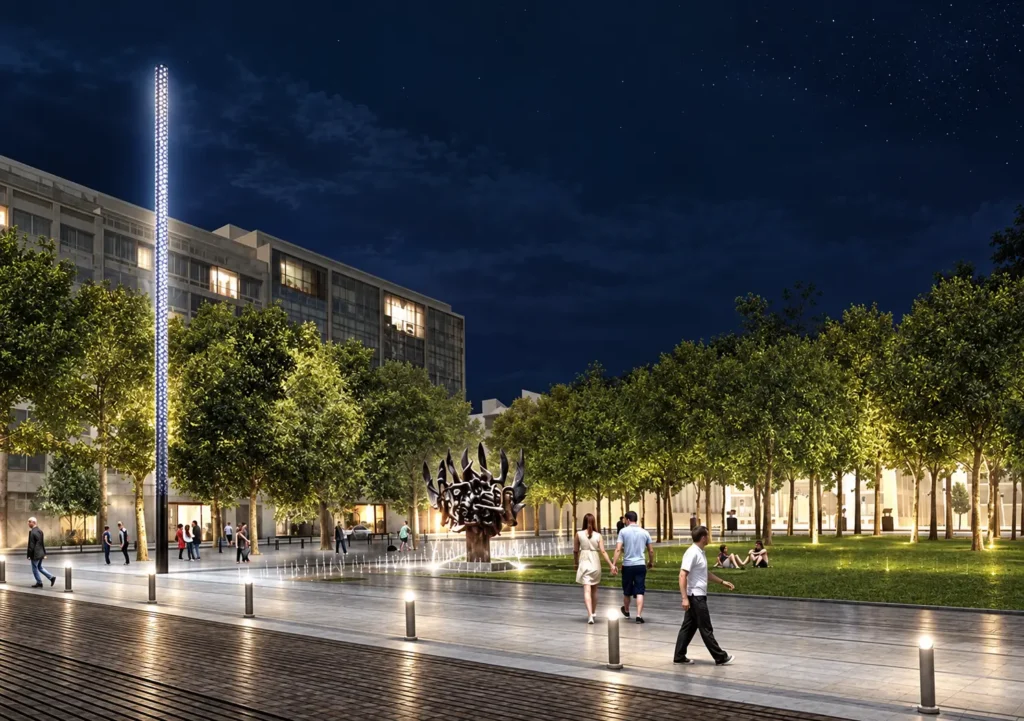
Units of the Greek People’s Liberation Army entered Thessaloniki on 30 October 1944, after German forces withdrew. Liberation ended three and a half years of occupation, although the city emerged divided, impoverished and soon caught in the political conflict that led to the Greek Civil War. The Jewish Museum of Thessaloniki, surviving synagogues, the memorials at Eleftherias Square and Aristotle University, and the Holocaust Museum of Greece project carry the responsibility of remembrance into public life.
Thessaloniki After the War and Today
After the war, Thessaloniki expanded at extraordinary speed. Rural migration and economic growth pushed the urban area far beyond the historic walls. Factories, new roads and dense residential districts spread around the Thermaic Gulf.
The antiparochi system drove the construction boom of the 1950s and 1960s. Landowners exchanged houses and plots for apartments in new blocks. The system met an urgent demand for housing and replaced much of the remaining low-rise city. Ano Poli, the surviving villas of Exoches and isolated historic buildings now provide rare glimpses of the streetscape that preceded the apartment era.
Industrial growth strengthened Thessaloniki’s position as the economic centre of northern Greece. Manufacturing districts developed to the west, while the port and railway connections continued to link the city with the Macedonian interior and the countries of southeastern Europe. The annual Thessaloniki International Fair resumed in 1951 and became both a commercial institution and a national political stage.
The Archaeological Museum of Thessaloniki opened in its present building in 1962. Designed by modernist architect Patroklos Karantinos, it is a protected work of Greek modernism. Its collections follow Macedonia from prehistory to late antiquity and include finds from excavations conducted across the region since 1912.
A powerful earthquake struck on 20 June 1978. It killed 49 people, injured more than 200 and damaged homes, public buildings and monuments. The disaster led to major restoration programmes and stricter attention to the safety of the modern building stock.
University life became another defining part of modern Thessaloniki. Aristotle University grew into the country’s largest university, while the University of Macedonia and other institutions strengthened the city’s role in education, research and the arts. Students from Greece and abroad give the centre a youthful population and sustain its bookshops, cafés, music venues and cultural organisations.
A Contemporary Cultural City
Thessaloniki served as European Capital of Culture in 1997. Museums, restored monuments and cultural spaces created for the programme broadened the city’s international reach. The Thessaloniki International Film Festival, whose history reaches back to 1960, has developed into one of southeastern Europe’s established film events. The Documentary Festival, the Biennale of Contemporary Art, Dimitria festival and an active theatre and music scene extend cultural life throughout the year.
Food remains one of the clearest expressions of the city’s history. Macedonian produce and recipes carried by refugees from Asia Minor, Pontus and Eastern Thrace meet Sephardic, Balkan and Ottoman influences in markets, bakeries, tavernas and family kitchens. In 2021, UNESCO admitted Thessaloniki to its Creative Cities Network as a City of Gastronomy.
The 2021 census recorded 319,045 residents in the Municipality of Thessaloniki, 802,392 in the continuous urban area and 1,092,919 in the Regional Unit. The port remains a gateway between southeastern Europe and the Mediterranean, while universities, hospitals, research centres, trade fairs and businesses draw people from northern Greece and the wider Balkan region.
A City Reconnected with the Sea and Its Past
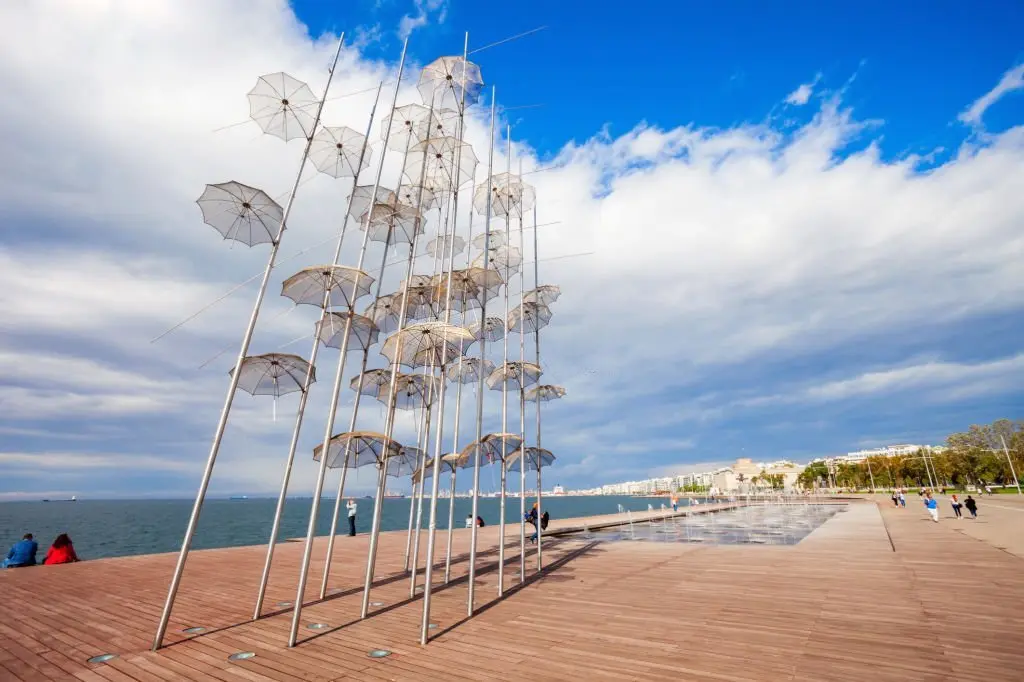
The New Waterfront, completed in 2014, extended public life along the Thermaic Gulf. Its themed gardens, cycle route and broad promenade connect the White Tower area with the Concert Hall. The waterfront remains Thessaloniki’s shared open space and its clearest view towards Mount Olympus.
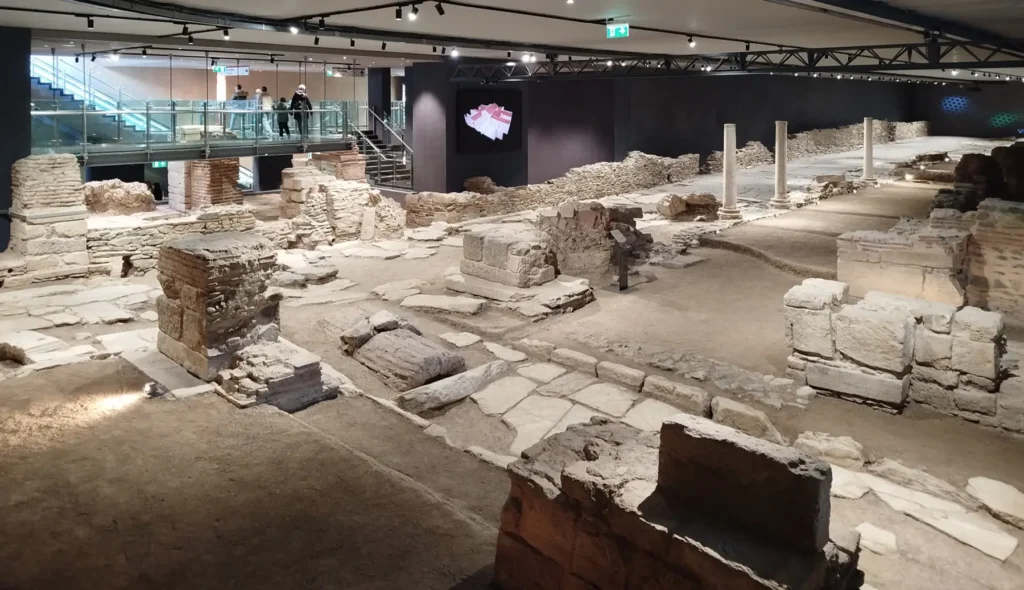
The opening of the first phase of the Thessaloniki Metro in 2024 placed archaeology directly inside the transport network. At Venizelou station, a monumental section of the Byzantine avenue and its shops is displayed where it was found. Passengers now move through the same urban axis used more than a thousand years ago.
Modern Thessaloniki remains shaped by its position between the Balkans and the Aegean. It is a university city, a major port, a centre of trade and culture, and the administrative heart of northern Greece. Its food, music, neighbourhoods and public life reflect successive movements of people across the region. Roman roads, Byzantine churches, Ottoman buildings, interwar markets and modern apartment blocks continue to occupy the same compact urban centre.
Thessaloniki is best understood on foot. The Roman Forum, the Kamara, Byzantine churches, Ottoman buildings and the streets of Ano Poli remain part of the modern city. A walk from the walls to Aristotelous Square and the waterfront crosses more than 2,300 years of history without leaving the centre.
Continue Exploring Greek History
For a wider view of the people, places and periods that shaped Greece, continue with:
👉 Athens Explained: The Extraordinary Story of Europe’s Oldest Capital
A guide to more than 6,000 years of Athenian history, from the city’s prehistoric origins and Classical Golden Age to the modern Greek capital.
👉 Vergina Royal Tombs & New Aigai Museum: A Full Journey Through Ancient Aigai
Explore the royal capital of ancient Macedon, the tomb of Philip II and the treasures displayed at the new museum.
👉 Greek History Explained: A Clear Timeline for Expats & Foreign Residents
A clear introduction to the periods that shaped Greece, from the Bronze Age to the present.
Sources
- Hellenic Ministry of Culture: Ancient Thessaloniki
- UNESCO World Heritage Centre: Paleochristian and Byzantine Monuments of Thessalonika
- Hellenic Statistical Authority: 2021 Population and Housing Census
- Municipality of Thessaloniki: Culture, history, districts and monuments
- The Byzantine Legacy: Thessaloniki
- Thessaloniki International Fair historical archive
- Aristotle University of Thessaloniki: History of Thessaloniki
- Jewish Museum of Thessaloniki
- United States Holocaust Memorial Museum: Greece
- WW2 Istories: Thessaloniki under German occupation
- Occupation Memories: Pavlos Melas Camp
- Archaeological Museum of Thessaloniki
- Museum of Byzantine Culture
- UNESCO Creative Cities Network: Thessaloniki
- Thessaloniki International Film Festival
- Encyclopaedia Britannica: Thessaloniki
- Tzitzibassi, Antigoni. Glimpses into the History of Thessaloniki Through the Collections of the Museum of Byzantine Culture, Museum of Byzantine Culture and Association of Friends of the Museum of Byzantine Culture, 2008.
- Keridis, Dimitris, ed. Thessaloniki, 1912–2012: A City in Transition, Epikentro, 2015.
- Anthoulias, Tasos. History of Thessaloniki: From Ancient Times to 2020, Chelidoni, 2025.
- Xpat.gr: Vergina Royal Tombs & New Aigai Museum






_(1893-95),_%CE%92%CE%B1%CF%83._%CE%8C%CE%BB%CE%B3%CE%B1%CF%82_108,_%CE%98%CE%B5%CF%83%CF%83%CE%B1%CE%BB%CE%BF%CE%BD%CE%AF%CE%BA%CE%B7.jpg)