
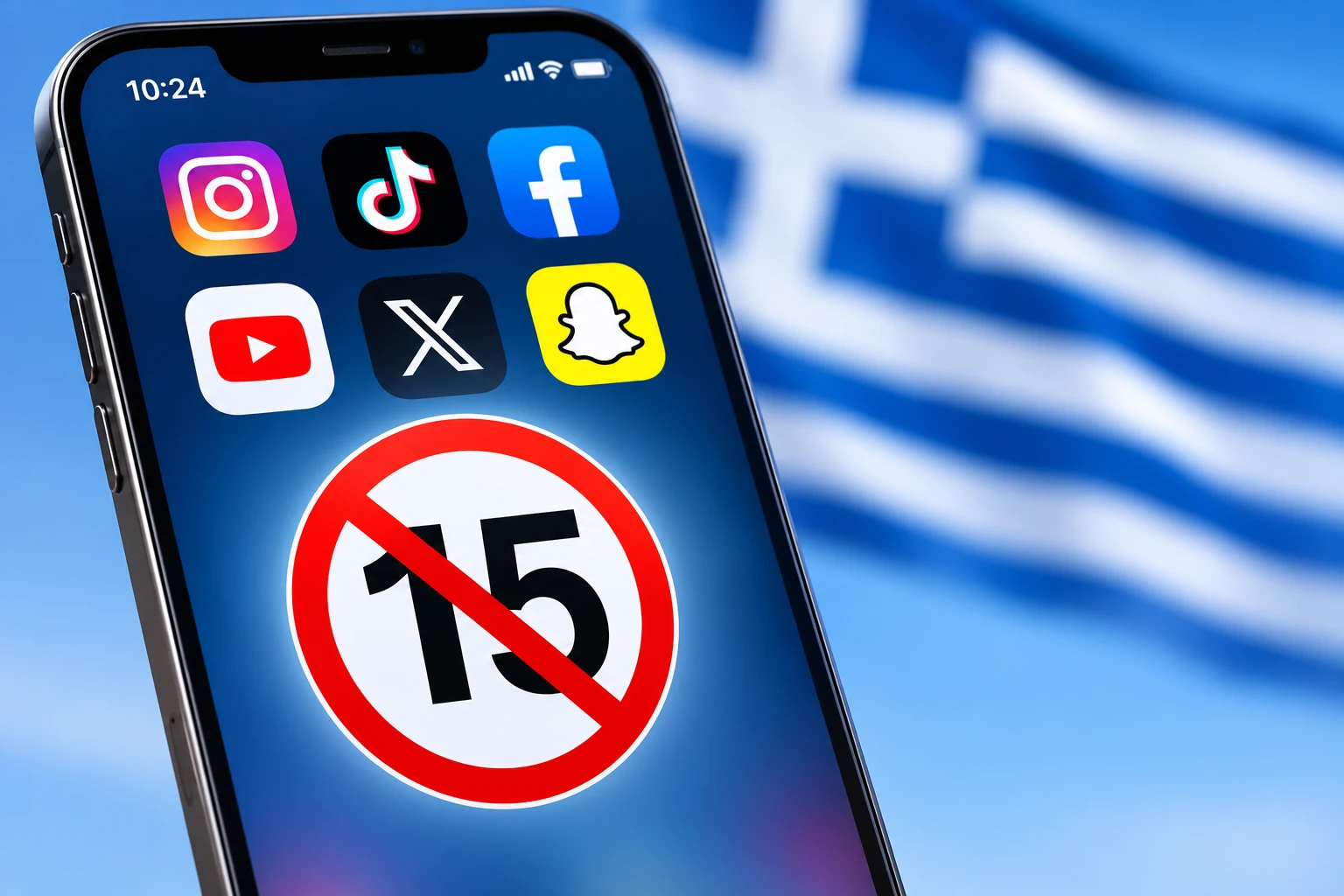
From 1 January 2027, children in Greece born in 2013 or later will be barred from using social media. Children born in 2012 will meet the age requirement from that date, whatever their birthday, because the law treats everyone born in the same year as having been born on 1 January.
Law 5350/2026 covers existing accounts as well as new registrations, and platforms must establish users’ ages reliably, including where children have entered a false birth date. Following a meeting with TikTok on 3 November, the government has asked platforms to present age-verification plans and working demonstrations in early December.
The key facts
- Start date: 1 January 2027
- Age threshold: Under 15, calculated by birth year
- Children affected in 2027: Those born in 2013 or later
- Platforms covered: Online social networking services, including Instagram, TikTok and Facebook
- Age verification: Kids Wallet, Gov.gr Wallet or another reliable method
- Existing accounts: Platforms must address current users, including those registered with false birth dates
- Penalties for families: None under the new law
What parents should do before January
- Check your child’s birth year. Children born in 2012 meet the legal threshold from 1 January 2027. Children born in 2013 or later do not.
- Review existing accounts. Download photographs, videos and other material your child wants to keep.
- Explore Kids Wallet. It offers parental-control and age-verification functions, and installation is optional.
- Watch for platform announcements. Companies have been asked to explain their verification procedures to users in Greece before the restrictions begin.
Why Greece is introducing the ban
Prime Minister Kyriakos Mitsotakis raised online addiction among minors at the United Nations General Assembly in September 2024. Greece then developed a national strategy and joined France, Spain, Denmark, Cyprus and Italy in seeking stronger European protections.
The initiative addresses children’s mental health, psychosocial development, privacy and exposure to harmful online content.
A study of more than 10,000 adolescents at Children’s Hospital of Philadelphia found an association between owning a smartphone by age 12 and higher risks of depression, insufficient sleep and obesity.
OECD research on young people’s digital experiences found that:
- Around 17% of 11–15-year-olds experienced cyberbullying in 2021–2022.
- 17% of 15-year-olds frequently felt nervous or anxious without their digital devices.
- 20% of 15-year-old social media users regularly neglected activities such as sport or hobbies because of social media.
- Nearly 40% of 15-year-olds reported being upset when personal information about them was shared online without their consent.
Greece restricted mobile phone use in schools in 2024 and launched Kids Wallet in spring 2025. The new law extends these child-protection measures beyond the classroom.
Which social media platforms are covered?
The law follows the European definition of online social networking services: platforms where users create profiles, publish content and interact through posts, stories, videos, comments, likes and followers. Instagram, TikTok, Facebook and X belong to this category.
Educational websites, search engines, government services and other online activities outside the definition of social networking stay accessible.
What about WhatsApp and Viber?
Private communication services sit outside the ban. Applications that combine messaging with public social features may need further clarification, and the law lists no exempt applications.
How will age verification work?
Social media companies must introduce reliable systems to establish whether users meet Greece’s age requirement. Date-of-birth entry can be bypassed with a false date, so platforms need stronger checks.
Two Greek government applications are available:
- Kids Wallet offers parental-control and age-verification functions.
- Gov.gr Wallet, Greece’s digital identity application, can confirm age eligibility.
Both can establish that a user meets the age threshold without revealing their full name or exact date of birth to the platform.
Platforms may also develop their own verification methods that meet requirements for reliability, proportionality and personal data protection. One proposed process has the platform display a QR code that a parent scans with Kids Wallet. The final procedure may differ between services.
Platforms must present their plans by December
On 3 November 2026, State Minister Akis Skertsos and Digital Governance Minister Dimitris Papastergiou met representatives of TikTok to discuss implementation. Talks with Meta, Snapchat, Google and Microsoft are expected to follow.
Platforms have been asked to return in early December with detailed implementation plans and demonstrations of their systems. Each plan must cover:
- Existing and new accounts, including users who previously supplied false birth dates.
- Age calculation, applying Greece’s calendar-year rule.
- Privacy safeguards, including data retention and protection of personal information.
- Verification errors, with procedures for correcting incorrect assessments and addressing attempts to bypass the checks.
- Technical readiness, supported by testing results and implementation milestones.
- Accountability, with a named senior executive responsible for readiness by 1 January 2027.
Companies have also been asked to inform users in Greece about the coming changes and the verification procedures they will need to follow.
The birthday rule: why birth year matters
Everyone born in the same calendar year counts as born on 1 January of that year for the purposes of the age restriction. For 2027:
- Born in 2012 or earlier: Meets the age threshold from 1 January 2027.
- Born in 2013 or later: Below the threshold throughout 2027.
A child born in December 2012 therefore qualifies from 1 January 2027, almost a year before their fifteenth birthday. Platforms must build this rule into their verification systems.
What happens to existing accounts on 1 January?
Platforms must verify existing users as well as new registrations. Accounts opened with inaccurate birth dates are included.
Companies must explain how they will prevent access by users below the threshold. Whether accounts are suspended, restricted or deleted has yet to be settled, so families may wish to save photographs, videos and other content before January, especially where the account belongs to a child born in 2013 or later.
Platforms are expected to be ready on 1 January 2027, and December’s technical presentations will show how prepared they are.
Who will enforce the ban?
Enforcement runs through the European Union’s Digital Services Act (DSA) framework. The Hellenic Telecommunications and Post Commission (EETT), Greece’s Digital Services Coordinator, works with the National Council for Radio and Television (ESR) and the Hellenic Data Protection Authority.
Cases involving platforms established elsewhere in the EU are referred to the relevant national regulator or the European Commission, according to the applicable division of responsibilities.
The DSA’s enforcement powers include:
- Fines of up to 6% of worldwide annual turnover for relevant infringements.
- Periodic penalty payments to secure compliance.
- Operational restrictions in exceptional circumstances, subject to legal safeguards.
Data-protection violations can also bring penalties under the GDPR, depending on the infringement and the authority responsible.
Platforms carry the compliance responsibility. Children and parents face no fines under the Greek law.
What this means for international families in Greece
The age limit applies regardless of nationality, and several practical questions remain open for foreign residents and visitors.
Children living in Greece
Children using accounts registered abroad should expect the restriction when they access covered services in Greece. Eligibility is determined under the Greek framework.
Families without Greek digital identification
Kids Wallet and Gov.gr Wallet are optional. Platforms may use other reliable systems, and they have been asked to provide accessible alternatives and procedures for correcting errors.
Arrangements for foreign families without Greek digital identification are still to be announced.
Families visiting Greece
The law provides no specific exemption for visiting children. How verification works for accounts used temporarily from Greece remains an implementation question for each platform.
Children born in 2013 or later
Parental consent gives no general exemption from the Greek age threshold. Families with younger children should review existing accounts and follow the verification instructions each platform issues.
Greece’s wider European initiative
Greece is seeking a common European approach to children’s access to social media, including a digital age of majority of 15 and stronger age-verification requirements. Greek proposals also include regular re-verification of users’ ages and closer cooperation between European regulators.
The Greek framework will cease to apply if an EU regulation covering the same issue takes effect.
Frequently asked questions
Does the ban apply to foreign children living in Greece?
Yes. The age restriction covers Greek and foreign children alike.
Can a child born in 2013 use Instagram with parental permission?
No. The law provides no general parental-consent exemption, and children born in 2013 remain below the threshold throughout 2027.
Is WhatsApp banned?
Private communication services sit outside the ban. Applications that combine private messaging with public social features may need clarification.
Will existing social media accounts be deleted on 1 January?
Platforms must verify existing users and restrict access where required. Procedures for deleting, suspending or preserving accounts have yet to be settled.
Do parents have to install Kids Wallet?
No. Kids Wallet and Gov.gr Wallet are options, alongside other reliable verification methods.
What if my family has no Greek digital identification?
Platforms have been asked to provide accessible verification alternatives. Arrangements for foreign residents are still to be confirmed.
Will parents face fines?
No. The Greek law sets no fines for parents or children.
Sources
- Hellenic Parliament — Law 5350/2026, Prohibition of the Use of Online Social Networking Services by Minors. Government Gazette A΄ 177, 26 October 2026.
- Greek Government — Establishing an Age Limit for Social Media Access and Protecting Minors from Digital Addiction, 8 April 2026.
- Euro2day — How Users’ Ages Will Be Verified on Social Media, 3 November 2026.