

The freezer holds an ice cream tub that last held ice cream under the previous government. Someone has paid the restaurant bill behind your back. At the front door, guests who announced their departure twenty minutes ago are still discussing what is wrong with the current government.
“Tell me you’re Greek without telling me you’re Greek” is a social media challenge that asks for a revealing detail: a family habit, an overheard exchange, something at home that has never once been questioned. A Greek can supply an answer within four seconds, usually while holding a container of something. A mother recommending a jacket to her middle-aged child qualifies. So does a “quick coffee” that ends with someone searching for nearby restaurants.
The pleasure lies in recognising the scene, and in the slow horror of realising that the person being described is you. Here are fourteen everyday Greek habits that may feel familiar. Every household has its variations, and newcomers may find they have picked up a few without noticing, much as one picks up a cold.
Illustrations created with AI for Xpat.gr.
1. The ice cream tub has changed careers
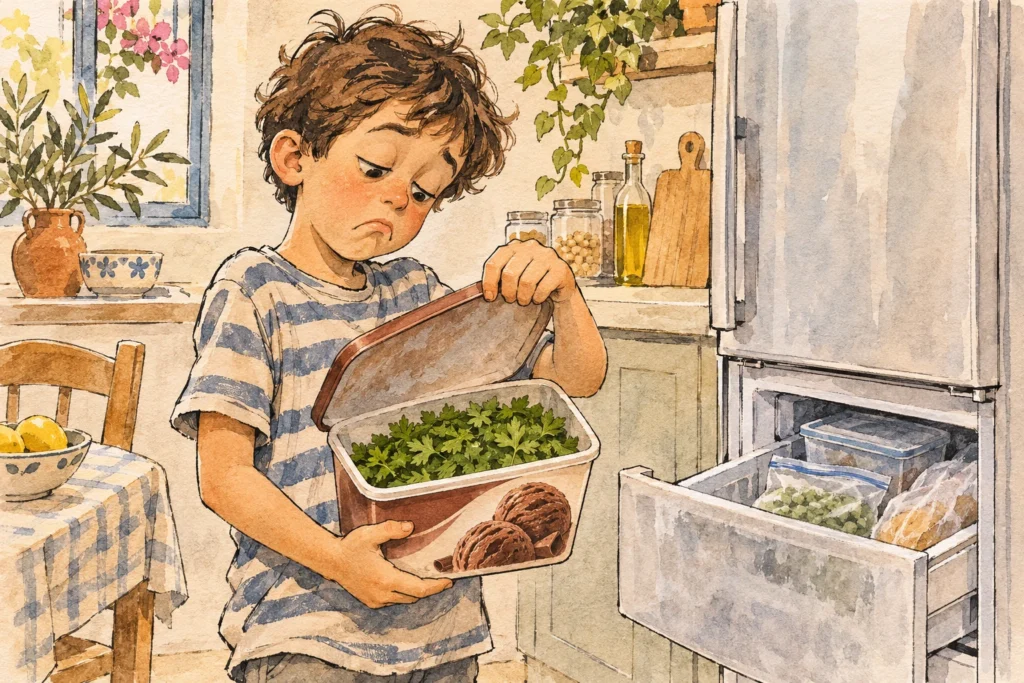
The label on the ice cream tub promises chocolate with great confidence, and a ten-year-old boy believes every word of it. He carries it to the table with a spoon and the look of someone who has just been handed a gift, lifts the lid and finds chopped parsley. His face falls the way a face falls when it has just learned something about the world, and the tub, unmoved, goes back to the freezer. The tub beside it holds dill, and the person who chopped them can tell the two apart from across the room.
In Greece, packaging is a form of fiction. Adults, who ought to know better, still lift the lid in the hope of dessert, the way a man keeps checking an empty mailbox.
When the herbs run out, the tub is washed and returned to service, because anything this useful deserves a pension.
2. The feta completes the table

Lunch is on the table, with green beans in tomato sauce, bread within reach and every plate in place. The family surveys the spread with the quiet satisfaction of people who have done a good job, and then someone frowns and asks, “Φέτα έχουμε;” (Féta échoume?) Have we got any feta?
The question is rhetorical, because the answer is always yes. A household without feta would have been reported to the authorities. A slab appears from the fridge on a small plate, dressed with olive oil and a pinch of oregano, and the meal begins the moment it lands, like a flag raised over a castle. A guest who declines the feta is asked whether they are feeling all right, and a second person offers to take their temperature.
3. The leftovers come with conditions
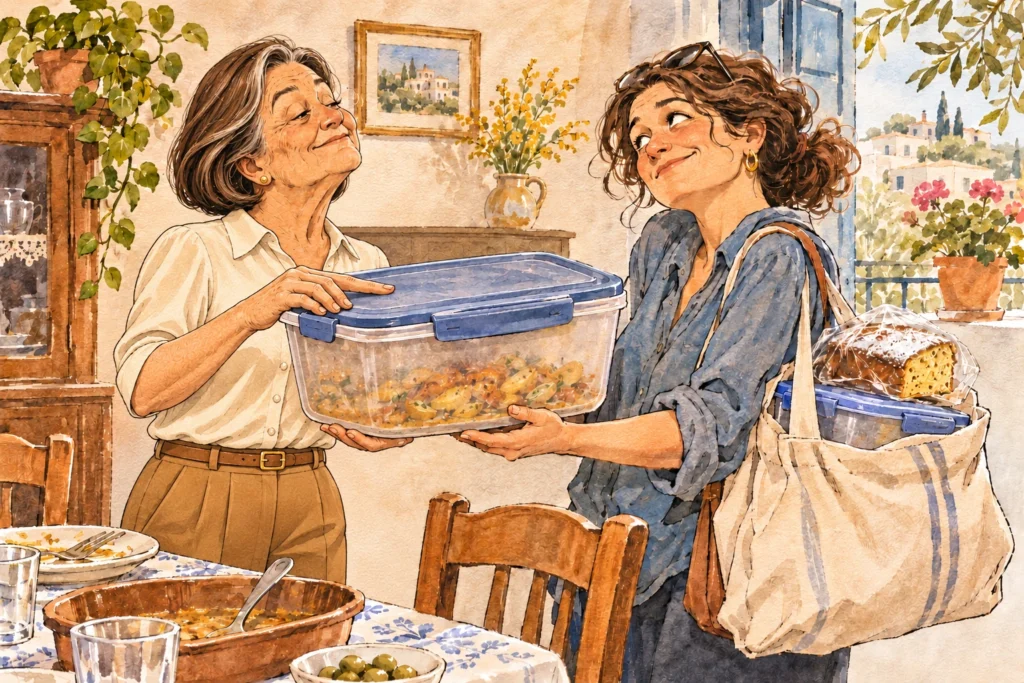
Sunday lunch ends with the guests having eaten so much that the drive home will be uncomfortable. In the kitchen, the packing has already begun, and it proceeds with the speed of a rescue operation. The leftovers go into containers larger than the guest would have chosen, and then the host calls out, “Do you want some dessert for tonight?” The guest explains, sincerely, that there is no need. Half a cake goes into the bag anyway.
At the door comes the most important instruction of the day: “Τα τάπερ να μου τα φέρεις.” (Ta táper na mou ta féreis.) Bring the containers back. The food is a gift, and the containers have terms. Their owner will remember them long after everyone has forgotten what was inside.
4. The coffee order is exact and the appointment is open-ended

The person ordering knows everyone’s preferences without asking: a freddo espresso, μέτριο (métrio, medium sweet) for one friend and a Greek coffee, σκέτο (skéto, no sugar) for another. The finishing time is the only detail left open. A quick coffee starts with an update about work. Two hours later, the conversation has reached someone’s plan to move abroad. A friend passes the table and is invited to sit, which means everything has to be explained again from the beginning, with commentary from the people who have already heard it.
Then someone checks the time and looks sincerely shocked, as though the clock had been moved while nobody was watching, although a nearly identical incident took place the previous weekend. Dinner is suggested. The waiter, who has been refilling the water all afternoon, brings the menus.
5. The draught and the slippers
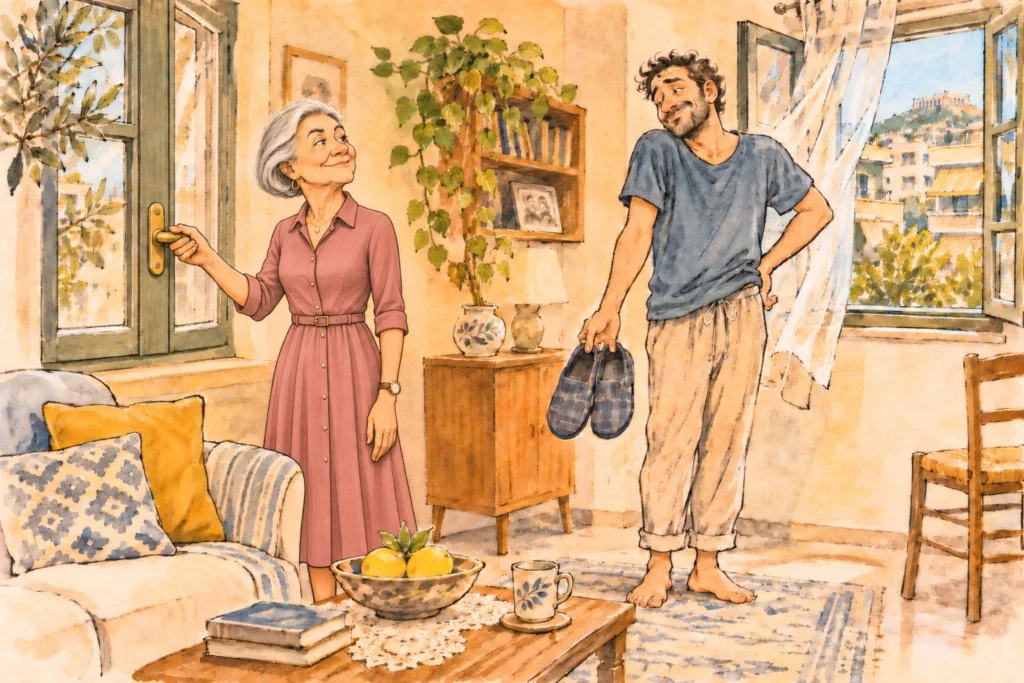
The ρεύμα (révma, a draught) is the most feared intruder in the Greek home, and two open windows are enough to let it in. “Κλείσ’ το, κάνει ρεύμα,” says someone from the far end of the room, who somehow felt it from there. (Klis’ to, kánei révma.) Close it, there’s a draught. Moving air has an extensive criminal record in Greece. A sore throat leads to detailed questions about where the sufferer sat and whether their hair was wet, and the investigation has been known to stretch back to the previous week.
Doctors mention viruses, and the family listens politely and keeps its verdict. A cold, a cough and a fever all trace back to the same window, and no germ has ever been convicted in this house.
The slippers are the defence. “Βάλε παντόφλες, θα παγώσει η κοιλιά σου.” (Vále pantófles, tha pagósei i koiliá sou.) Put your slippers on, your belly will freeze. The warning arrives the moment a bare foot touches the floor, August included. The route from the sole of the foot to the stomach is well known to every grandmother and unknown to anatomy.
6. The jacket is essential

You are forty-three and leaving your parents’ house when your mother says, “Ζακέτα να πάρεις.” (Zakéta na páreis.) Take a jacket. It is warm outside, and you mention this, although earlier conversations suggest that evidence has little bearing on the recommendation. “It gets cold later,” she says. You point out that you are driving straight home, a journey of eleven minutes, and your mother listens with the patient expression she once used when you explained that you were not tired and did not need to go to bed.
Your father has been listening, and you wait for him to say something sensible. He goes to the wardrobe and comes back with the olive-green jacket from 2009.
7. A missed call becomes a family matter

Your phone sits on silent during a meeting, and forty minutes later you find two missed calls from your mother and a text from your sibling: “Πάρε τη μαμά.” (Páre ti máma.) Call Mum. Everyone is fine. She wants to know whether you are coming on Sunday.
By the time you ring back, the news that you did not answer has travelled through two cousins and an aunt, and a neighbour has been asked to check whether your lights are on. Your sibling, who has been keeping score, sends a second text: “Did you call her?”
8. The evil eye gets the blame

Someone leans over a pram and says the baby is the most beautiful child they have ever seen, and three relatives answer at once: “Φτου φτου φτου.” (Ftou ftou ftou.) The sounds imitate spitting and ward off the μάτι (máti), the evil eye, which a compliment or an envious glance is believed to cause. They follow the compliment so fast that a newcomer may briefly wonder whether it was one.
When a headache arrives with no obvious cause, the evil eye is blamed more often than not. The cure is the ξεμάτιασμα (xemátiasma), a ritual involving water, oil and a whispered prayer, believed to lift the evil eye. Only a few people know it, because the words are passed down in secret from one relative to another and never written down. In most families this person is an aunt whose calls everyone avoids because they last an hour. When a headache arrives, she is the first number dialled.
9. “Ela” does considerable work

Έλα (Éla) means “come”. A host at the door says “Έλα μέσα.” (Éla mésa.) Come in. A parent at the foot of the stairs says “Έλα, θα αργήσουμε.” (Éla, tha argísoume.) Come on, we’ll be late. From there the word travels. A phone call is answered with “Έλα.” (Éla.) Go ahead, I’m listening. A friend whose account of events seems to have benefited from editing gets “Έλα τώρα.” (Éla tóra.) Come on now. One word covers “hello”, “come in”, “hurry up”, “I don’t believe you” and, in the right voice, “please stop”.
Tone carries the meaning, so “ela” can welcome a guest or announce that an explanation has failed to survive scrutiny. Learners discover its usefulness early, and it soon slips into conversations held entirely in English, where it works so well that nobody asks for a translation.
10. Popular name days need work
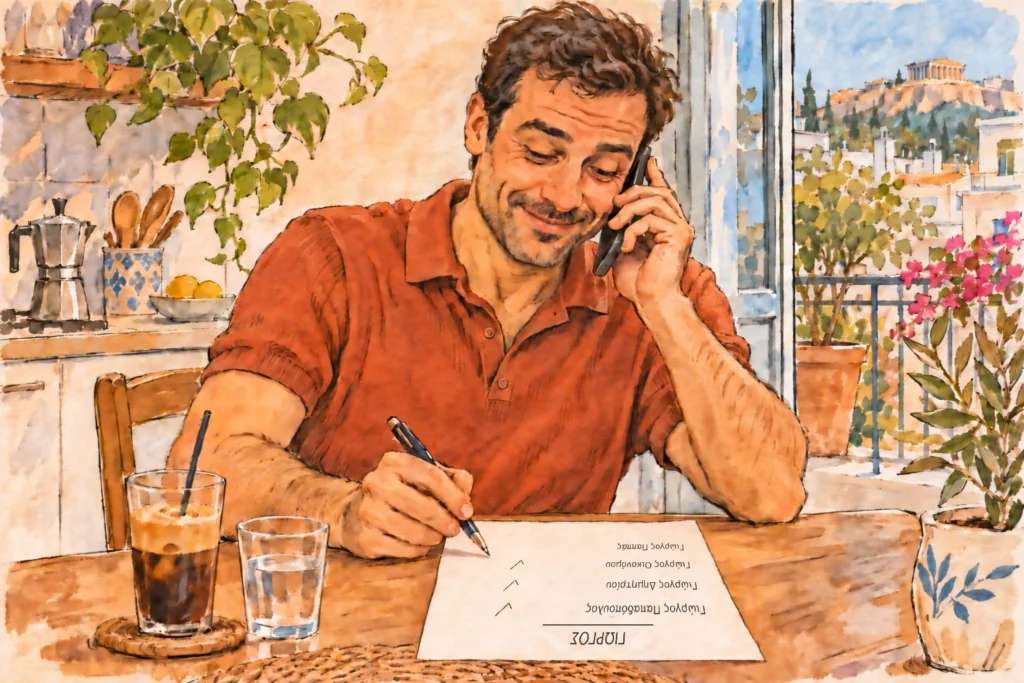
In Greece, certain names are so common that their feast days turn your contact list into a nightmare. The dread arrives on dates such as 7 January, when you are expected to call every Giannis and Ioanna you know, or 15 August, when you work your way through the Marias and Panayiotises. And there is the name day for Giorgoses and Georgias, when half of Greece seems to be celebrating and expecting your call.
Every call opens the same way: “Χρόνια πολλά!” (Chrónia pollá!) Many happy years. For many people, the name day matters as much as the birthday or more, which is how a man named Giannis can be congratulated by forty people who have no idea when his birthday is.
11. Two chairs can become a bed

At a wedding, a tired child is laid across two chairs and covered with an adult’s jacket. Anywhere else the arrangement would draw questions from a social worker, but here an aunt checks that the chairs are close enough together and returns to the dance floor. The band is playing at full volume a few metres away, and the child sleeps through the entire evening.
Years later, these children attend weddings as adults and help position the chairs, with the confidence of people who survived it.
12. Nobody leaves the village empty-handed
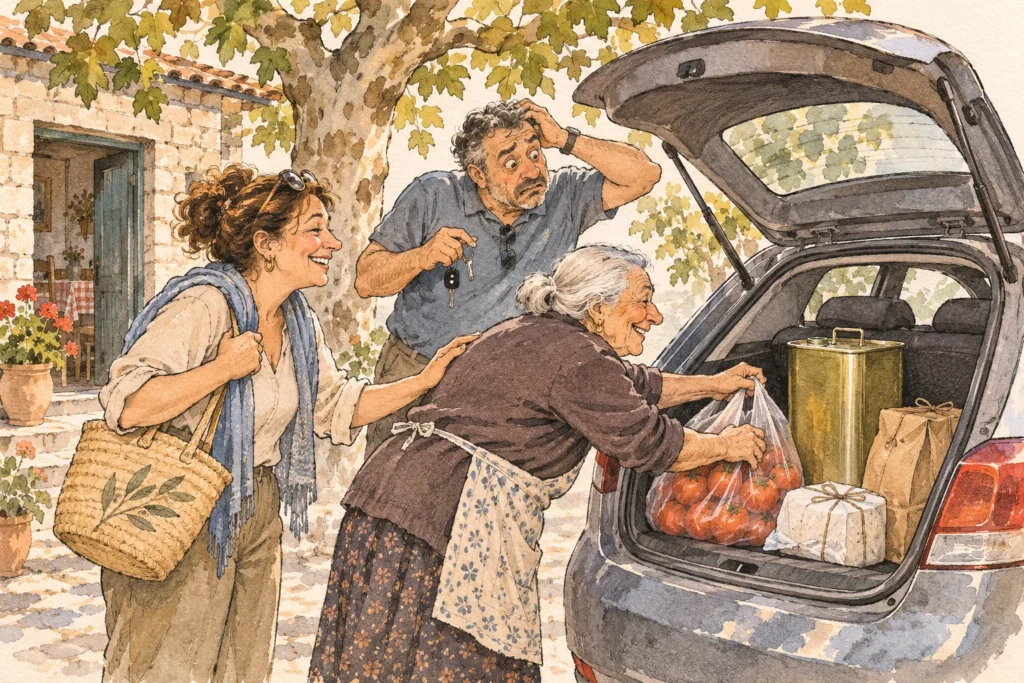
In Greece, almost everyone has a village. You may have been born in Athens and spent your entire life there, but the village your parents or grandparents came from remains “the village”.
You travel there with a weekend bag and return with enough produce to suggest you have given up your job and opened a small shop. Relatives arrive at the car carrying olive oil and bags of vegetables, followed by a parcel for an uncle who lives “near you”, provided you consider the other side of Athens nearby.
13. Someone has already paid

Near the end of a restaurant meal, someone says they are going to the toilet and stays at the counter long enough to raise suspicions. By the time the bill is requested, it has been settled, and the waiter delivers the news with the calm of a man who was part of the plan.
Objections follow. Someone insists it was their turn, while the person who paid puts on their coat and pretends the matter is closed. The argument follows them out onto the pavement. Eventually, a future meal is agreed upon. The same argument will take place then, because next time someone else will have been fast enough to pay the bill.
14. Departure has been announced

“Λοιπόν, να πηγαίνουμε,” someone announces. (Lipón, na pigénoume.) Right, we should get going. Everyone stands up, but leaving takes a little longer.
The guests put on their coats. At the door, the host mentions the coming elections. Ten minutes later, everyone is still there, dressed for outside and explaining what is wrong with the country.
Finally, the hosts walk them to the car. The guests get in, promise to send a message when they arrive home and start the engine. Everyone waves goodbye.
Then the host leans towards the passenger window. It comes down. There is one more thing…
Which giveaway would you add, and which have you picked up since moving to Greece?
You may also like
Navigating Greek Etiquette: A Comprehensive Guide for Expats
Inside Greek Superstitions: My Childhood with Science and Magic
Why Every Greek Family Seems to Have a Maria, a Giorgos and a Nikos
August Panigiria in Greece: A Guide to Traditional Greek Village Festivals
Greek Culture Explained: Why Greek Politeness Can Sound Rude to Foreigners