
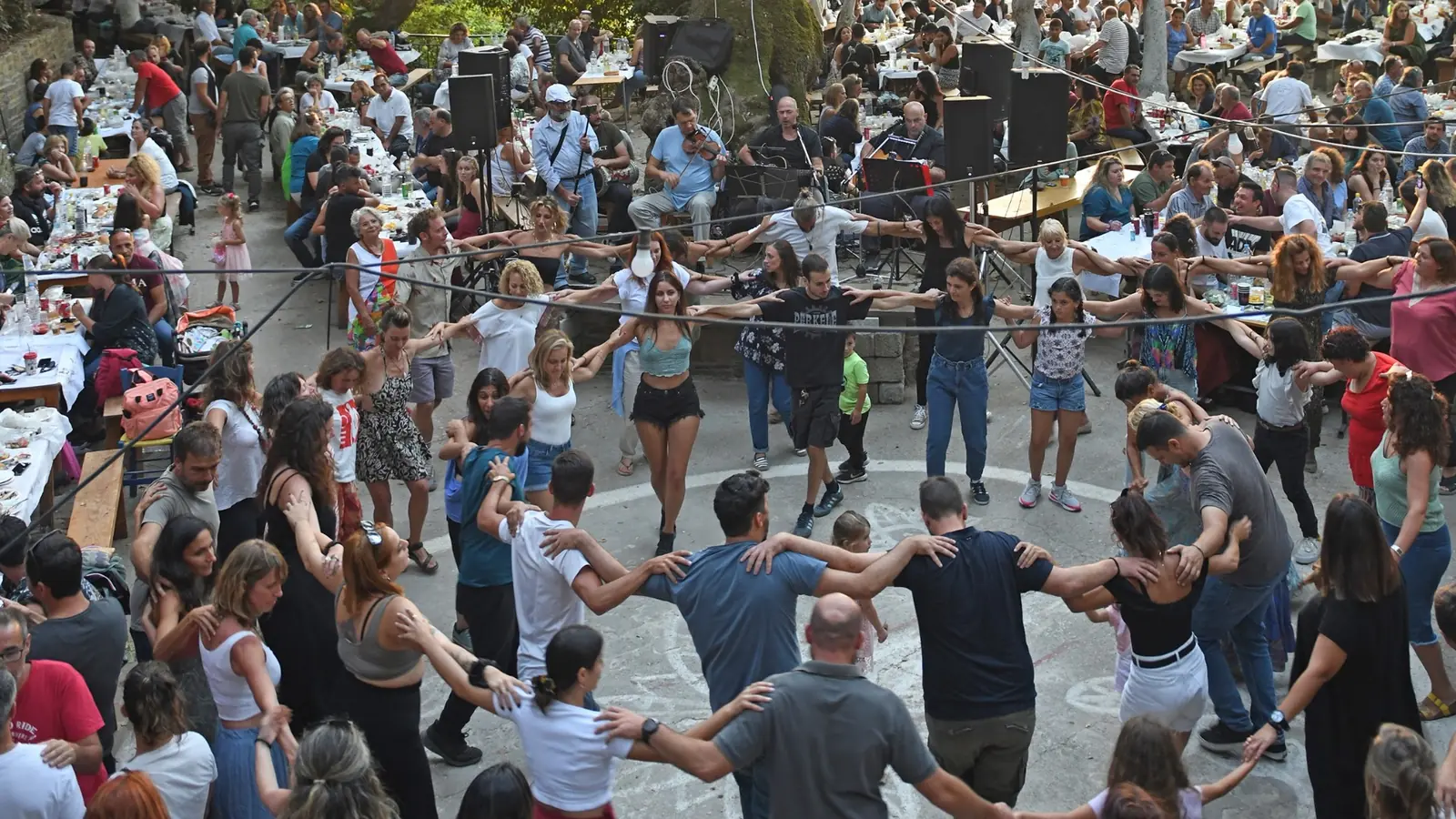
On summer evenings across Greece, village squares and church courtyards fill with long tables, live music and people returning to places their families have known for generations.
These gatherings are called panigiria (πανηγύρια). A panigiri (πανηγύρι) is a traditional Greek village festival and local community celebration associated with a religious feast. It usually begins with worship at a church or monastery dedicated to the Virgin Mary, a saint or an important event in the Orthodox calendar. Food, music and dancing follow, although the order and character of the celebration differ from place to place.
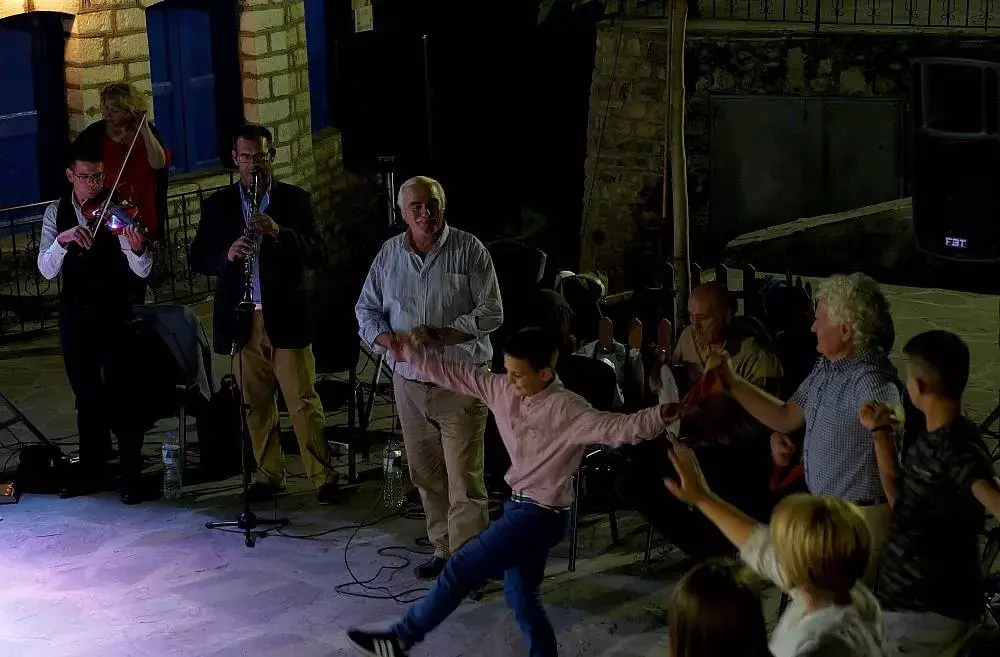
Music gives each region a recognisable sound. Violins and laouta, long-necked string instruments related to the lute, accompany many island festivals. The lyre and tsampouna, a traditional Greek bagpipe, are closely associated with parts of the Dodecanese. Across much of mainland Greece, the klarino (Greek clarinet) often leads the dancing.
Dekapentavgoustos: the culmination of the month
The panigiri season reaches its height on 15 August with Dekapentavgoustos (Δεκαπενταύγουστος), the Feast of the Dormition of the Virgin Mary. It is the most important feast dedicated to the Virgin Mary in the Orthodox calendar and one of the largest religious celebrations in Greece. In Greece, Dekapentavgoustos is often called “the Easter of summer” (to Pascha tou kalokairiou, το Πάσχα του καλοκαιριού), reflecting its spiritual importance and place in Greek life. A two-week fast and evening prayers lead towards services, processions, pilgrimages, village homecomings and some of the country’s largest panigiria. The island of Tinos becomes the principal focus of pilgrimage, as worshippers gather at the Church of Panagia Evangelistria. It is also one of Greece’s biggest name-day celebrations, with many people named Maria, Panagiotis, Panagiota and Despina receiving wishes. Read more about Dekapentavgoustos and the Dormition of the Theotokos.
August has the greatest concentration of panigiria. The Transfiguration of the Saviour is celebrated on 6 August, followed by Dekapentavgoustos (Δεκαπενταύγουστος) and the Dormition of the Virgin Mary on 15 August. The Enniamera (Εννιάμερα) are observed on 23 August. The Greek word literally means “nine days”. Here it refers to the ninth calendar day of the Dormition feast when 15 August is counted as the first day. In the Orthodox calendar, 23 August is the Apodosis, or leave-taking, that closes the liturgical celebration of the Dormition. Churches dedicated to the Virgin Mary hold services, while some communities also mark the occasion with processions, food, music and dancing. The month continues with Agios Fanourios on 27 August and the Beheading of Saint John the Baptist on 29 August.
These fixed feast days provide the framework, while the arrangements remain local. Cultural associations, parishes and village committees announce musicians, starting times and any changes closer to the occasion. Confirm the programme locally before travelling to a particular panigiri.
A quick language guide
Panigiri is pronounced approximately pa-nee-YEE-ree. The plural is panigiria, pronounced pa-nee-YEE-ree-a. Greek posters may use the words glenti (γλέντι), meaning a celebration with live music and dancing, and paramoni (παραμονή), meaning the eve of a feast. Esperinos (Εσπερινός) is Vespers, the evening church service, while Theia Leitourgia (Θεία Λειτουργία) is the Divine Liturgy.
A poster headed nisiotiko glenti, laikodimotiki vradia or politistiki ekdilosi may describe a community music night rather than a religious panigiri. The experience can look similar once the dancing begins, but the organising purpose is different.
Navigate Greece’s August village festival calendar
Browse by Date
Click below to explore events in early, mid or late August.
| Part of August | Main feast days and celebrations | Go to section |
|---|---|---|
| Early August, 1–10 | Transfiguration of the Saviour, Nisyros novena, early Ikarian gatherings | Early August |
| Middle of August, 11–20 | Dekapentavgoustos, UNESCO-recognised traditions, major pilgrimages and village homecomings | Middle of August |
| Late August, 21–31 | Enniamera, Agios Fanourios, Agios Ioannis and late-summer food festivals | Late August |
| Before you go | Invitations, timing, payment, church etiquette, dancing and transport | Your first panigiri |
Find panigiria by place
Browse by Place
Click a place below to jump directly to its events. Places are listed alphabetically.
| Place | Key August date(s) | Main tradition |
|---|---|---|
| Amorgos | 5–6, 14–15 August; other dates vary | Transfiguration, Dekapentavgoustos and late-August cultural traditions |
| Andros | 6 August | The Transfiguration panigiri in Arni |
| Astypalaia | 14–16 August | Panagia Portaitissa and the Koukania games |
| Corfu | 5–6, 11, 14–15, 23 and 27 August | The Transfiguration, Agios Spyridon, the Dormition, Enniamera and Agios Fanourios |
| Crete | Mainly 14–15 August; local programmes vary | Dormition feasts shaped by Cretan lyra, song and regional dance |
| Ikaria | 3, 6, 8, 10, 12, 15, 17, 24 and 27 August | A month-long network of village panigiria |
| Karpathos | 6, 15, 23 and 29 August | Transfiguration, Dormition, the Enniamera and Agios Ioannis |
| Kasos | 15 August | The great feast in Panagia village |
| Kea | 15 August | Dekapentavgoustos at Panagia Kastriani |
| Naxos | 6, 15, 23 and 29 August | The Saviour, Filoti, the Enniamera and Agios Ioannis |
| Nisyros | 6–15 and 22–23 August | Panagia Spiliani and Panagia Kyra |
| Paros | 6, 15, 23, 27 and 28–29 August; Karavolas date varies | Ekatontapyliani, Karavolas, the Enniamera and Agios Fanourios |
| Samos | 15 August; village programmes vary | Dormition gatherings with eastern Aegean music and local wine |
| Siatista, Kozani | 15 August | The Siatista horsemen’s pilgrimage to Mikrokastro |
| Syrrako, Ioannina — UNESCO | 15 August | The UNESCO-recognised Dormition festival and communal ritual dance |
| Tinos — National pilgrimage | 15, 23 and 29 August; village calendar varies | The pilgrimage to Panagia Evangelistria and village panigiria |
| Vlasti, Kozani — UNESCO | 15 August | The UNESCO-recognised Tranos Choros, or Grand Dance |
What is a Greek panigiri?
A panigiri is a community festival connected with the feast day of a saint, the Virgin Mary or another important date in the Orthodox calendar. It usually combines religious observance with a public celebration involving food, live music and dancing. The Greek word comes from panigiris, a gathering of the whole community, and that original meaning still lives in the experience. The church, village association, musicians, cooks, returning families and guests all contribute to the occasion.
The religious observance establishes the day. Vespers may take place on the eve of the feast, followed by the Divine Liturgy the next morning. An icon can be carried in procession, food may be blessed and shared, and the music begins according to local custom. Some gatherings start at lunchtime. Others begin in the evening and continue until sunrise.
The panigiri also supports community life. Proceeds may fund a cultural association, maintain a church or pay for improvements in the village. On Ikaria, this connection between celebration and collective purpose remains especially visible.
The dance carries its own social order. Strong dancers may lead, older residents often shape the pace and the circle grows as the evening continues. Newcomers usually join towards the end of the line, watching the person beside them and following the shared rhythm.
Early August: the month begins to gather pace
The first ten days establish the religious and musical rhythm of the month. The Transfiguration of the Saviour on 6 August is the major fixed feast of this period. In Greek it is known as the Metamorfosi tou Sotiros, and churches dedicated to the Saviour hold services and local celebrations across the country.
The Transfiguration on 6 August
On Naxos, the feast is associated with Glinado, Damarionas and Kourounochori. On Paros, Aliki and Marpissa celebrate the Saviour. Karpathos marks the Transfiguration in Aperi and other communities.
Amorgos celebrates on the eve and the feast day itself. The gathering traditionally moves between Ormos Aigialis and Chora, joining religious observance with a communal island celebration.
The feast also appears across the Ikarian calendar. Villages including Christos Rachon, Kalamos, Christos near Agios Kirykos, Oxe, Frantato, Dafni and Stavlos are associated with 6 August. Several can celebrate on the same feast day, giving residents and visitors a choice of setting.
Andros: the Transfiguration in Arni
runs from 21:00 on 6 August into the early hours of 7 August.
The mountain village of Arni holds one of Andros’s largest traditional gatherings for the Transfiguration. The Cultural Association of Arni organises the panigiri at the village cultural centre, around 500 metres above sea level in the green interior of the island.
The celebration falls on 6 August and continues after midnight with island music, dancing, food and wine. The exact orchestra and transport arrangements are announced each year. For 2026, the Andros Guide listing confirms free entry, a 21:00 opening and a shuttle from the parking area.
Corfu: the Transfiguration at mountain and waterfront settings
are confirmed annually.
Corfu marks the Transfiguration in contrasting landscapes. Strinylas, high below Mount Pantokrator, is associated with a mountain celebration connected with the pilgrimage to the summit monastery. At Kanoni, the feast is observed beside the water near Pontikonisi across 5 and 6 August.
Corfiot village glentia (γλέντια, celebrations with live music, food and dancing) are usually led by local folk ensembles. The island’s famous philharmonic tradition takes centre stage in formal processions, giving Corfu a musical identity distinct from the Aegean islands.
Nisyros: nine days for Panagia Spiliani
the main celebration.
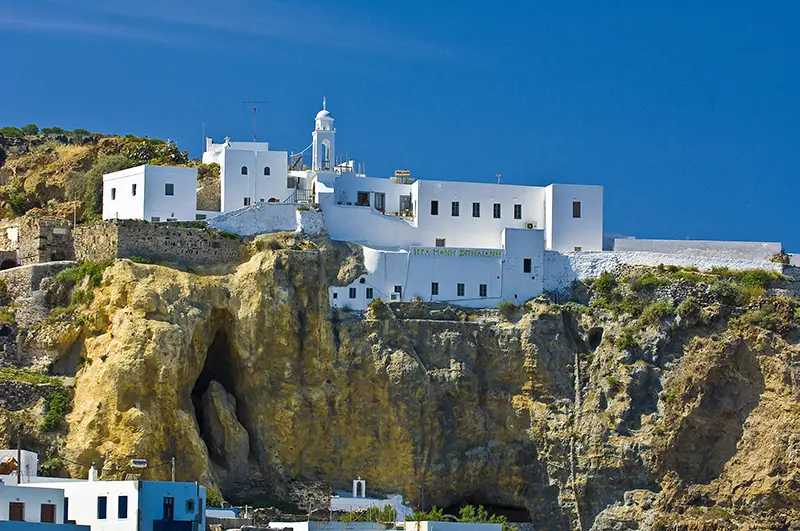
On Nisyros, the great August cycle begins on 6 August with the novena of Panagia Spiliani. Women stay at the monastery above Mandraki and follow a demanding devotional routine that includes fasting, prostrations, hymns and prayers. The observance continues until the Dormition.
The final celebration on 14 and 15 August draws people from across the Dodecanese. The procession descends from the monastery and passes through Mandraki. A communal meal follows, and the evening dance known as the Cup of the Virgin Mary gives the feast its distinctive local character.
The public celebration on 15 August follows the extended period of devotion at the monastery, an important part of the feast that visitors arriving only for the final evening may otherwise miss.
Ikaria: an island-wide calendar
August. Confirm each village event locally because the island
calendar can change.
Ikaria offers an unusually dense succession of August panigiria. Early-month gatherings are traditionally associated with Agios Dimitrios in Raches on 3 August, the Transfiguration celebrations on 6 August, Mandria on 8 August and Faros on 10 August. Karres follows on 12 August before the island reaches the great cluster of 15 August.
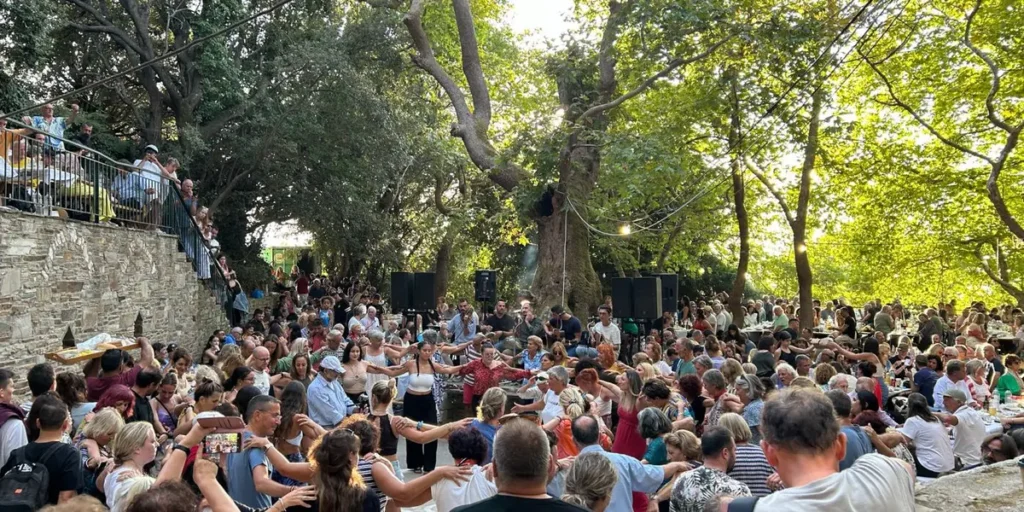
An Ikarian panigiri develops around communal tables, local red wine, boiled goat and hours of dancing. The Ikariotikos draws the circle together as the music gathers speed. Food and drink sales often support the organising village association.
The Robertina Ikaria 2026 calendar, checked alongside the Visit Ikaria list of local feasts, provides a useful annual framework. Each association announces practical details closer to the date. Unexpected circumstances within a small community can lead to postponement or cancellation, so same-day confirmation is particularly valuable.
In 2022, the Panigiria of Ikaria (Τα Πανηγύρια της Ικαρίας) were entered in Greece’s National Inventory of Intangible Cultural Heritage. The official entry records their place in Ikarian community life, bringing together the Ikariotikos dance, traditional music, religious customs, communal work and the renewal of family and village ties. The panigiria preserve shared memory and local identity while passing these living traditions to younger generations. Read more in Xpat.gr’s guide to Intangible Cultural Heritage in Greece.
Early August Panigiria
Middle of August: Dekapentavgoustos, Greece’s great summer feast
On 15 August, Greece celebrates the Dormition of the Virgin Mary, the Koimisi tis Theotokou. The day is widely called Dekapentavgoustos, meaning “the fifteenth of August”, and it stands at the centre of the country’s religious and social summer calendar.
It is also a public holiday in Greece. Banks, public services and many businesses close, while ports, ferries and roads serving popular pilgrimage destinations become especially busy.
For Orthodox Christians, the Dormition commemorates the Virgin Mary’s falling asleep and her passage into eternal life. The feast carries a spirit of hope, protection and closeness to the Panagia. Her many local names express the relationship between communities and particular icons, churches or landscapes. Panagia Evangelistria, Panagia Spiliani, Panagia Portaitissa and Panagia Ekatontapyliani each belong to the shared devotion of the day and to the identity of a particular place.
Preparations begin before 15 August. The Orthodox Dormition fast runs from 1 to 14 August, and Paraklisis services are held in churches. On 14 August, solemn Vespers open the feast. The Divine Liturgy, processions and communal meals follow on the day itself. Village music often begins after the religious observance and continues well into the night.
The date also acts as Greece’s great summer homecoming. City residents return to their family villages, islanders arrive from overseas and local associations organise their largest gathering of the year. Church courtyards and squares become places where family memory, religious faith and regional culture meet.
Read Xpat.gr’s dedicated guide to Dekapentavgoustos and the Feast of the Dormition of the Theotokos for its religious meaning, fasting traditions, name-day customs and importance as a public holiday.
UNESCO recognition
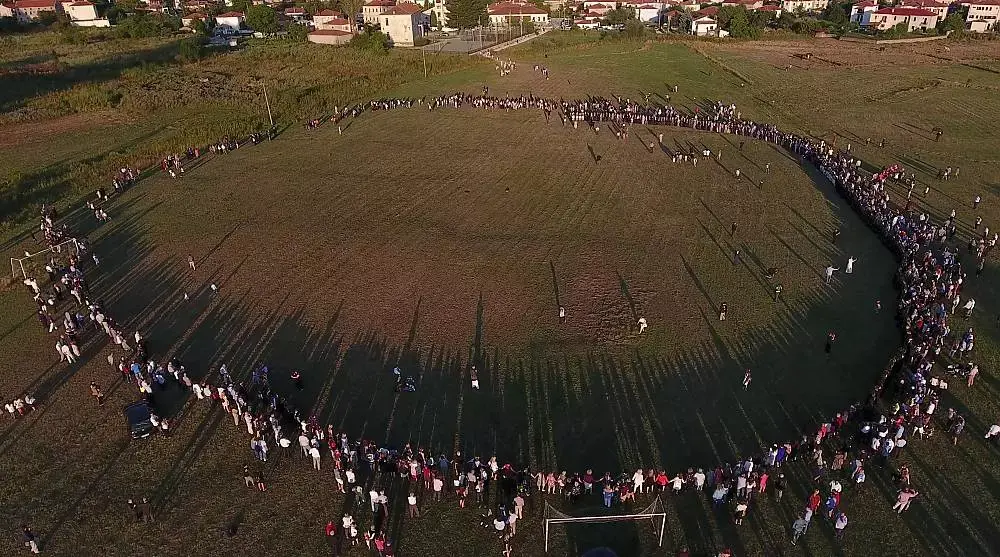
In 2022, UNESCO inscribed the August 15 festivities of Vlasti and Syrrako on the Representative List of the Intangible Cultural Heritage of Humanity. One inscription brings together two mountain-community traditions associated with the Dormition of the Virgin Mary: the Tranos Choros, or Grand Dance, in Vlasti in Western Macedonia and the festival of Syrrako in Epirus.
Historically, both gatherings marked the annual reunion of pastoral communities before livestock farmers moved to their winter pastures. They continue to reunite residents, returning families and younger generations through ritual, song and dance. The official UNESCO inscription recognises the festivities as living expressions of the identity of both villages. Our guide to Intangible Cultural Heritage in Greece explains how communities and institutions work to record and safeguard living traditions.
Vlasti, Kozani: the Tranos Choros
Vlasti is a highland village in the Kozani regional unit of Western Macedonia, in northern Greece. On 15 August, people of different ages form a large open circle for the Tranos Choros. The dancers move with a slow, solemn rhythm while singing a cappella, guided by the order of the community and the presence of older participants. Children encounter the custom through family participation and observation long before they take their own place in the circle.
Syrrako, Ioannina: a mountain homecoming
Syrrako is a stone-built highland village in the Ioannina regional unit of Epirus, in northwestern Greece. During the festival, singers and traditional musicians accompany the communal dance. The Dormition celebration draws people back to the mountain community and renews relationships between permanent residents, families living elsewhere and younger generations learning the celebration’s sequence.
UNESCO-recognised Dekapentavgoustos traditions
The Cyclades
Tinos: Greece’s national pilgrimage and the Megalochari
place throughout the month, including celebrations around 23 and 29
August.
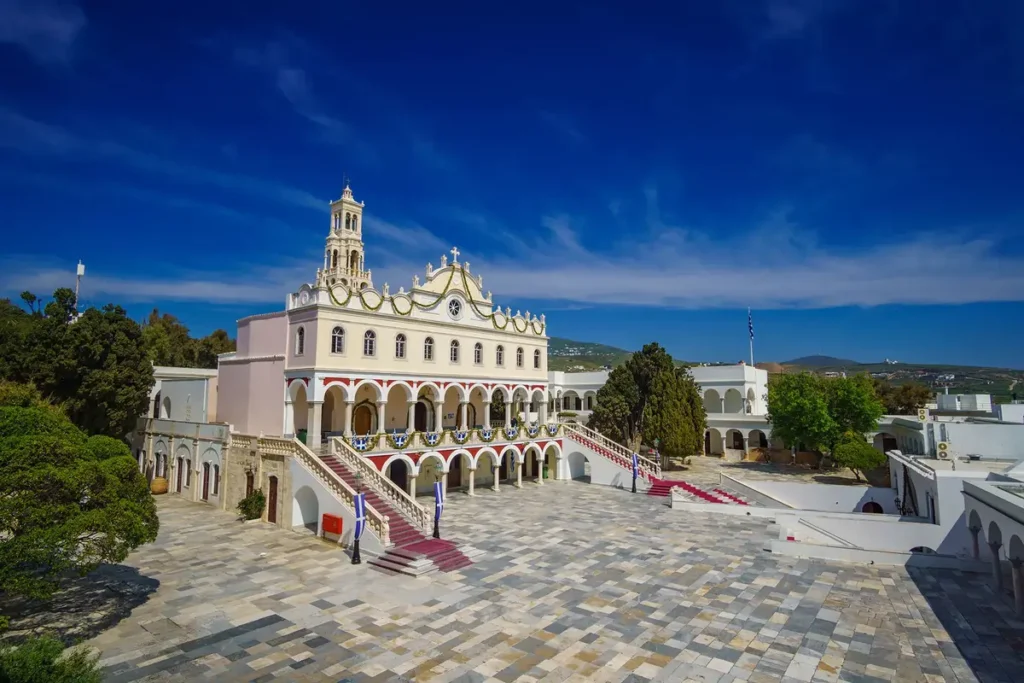
Tinos is the most prominent pilgrimage destination for Dekapentavgoustos in Greece. Worshippers travel to the Church of Panagia Evangelistria, home of the icon known as the Megalochari. Some pilgrims make their way from the port to the church on their knees, following a carpeted strip laid along the route.
The icon is carried in procession towards the harbour as church bells, military honours and crowds fill Chora. The day also commemorates the torpedoing of the Greek light cruiser Elli outside Tinos harbour on 15 August 1940. The memorial service and wreath-laying at sea connect the religious feast with a defining moment in modern Greek history.
Village celebrations across Tinos add another layer to the day. Island music, local food and dancing continue after the great public ceremonies in Chora. Travel requires early planning, as ferries and accommodation fill quickly.
The Cyclades
Paros: from Ekatontapyliani to the late-August feasts
August in Ampelas and 28–29 August for Agios Ioannis Detis. The
Karavolas Festival is held on the first Saturday after 15 August.
Parikia becomes the centre of the Parian celebration at the Church of Panagia Ekatontapyliani. The liturgy is followed by the procession of the icon and epitaph through the town. In the evening, fishing boats carrying red flares and a firework display animate the harbour, while traditional music and dancing continue on the waterfront.
The church’s importance gives the day the character of a major pilgrimage, while the harbour celebration keeps its island identity. Visitors can experience the solemn and festive parts of Dekapentavgoustos within the same town.
The first Saturday after 15 August brings the annual Karavolas Festival to Lefkes. The village serves large snails with skordalia, potatoes, local cheeses, baked chickpeas and wine. Residents prepare for days, and local musicians accompany dancing beneath the pine trees until dawn.
Paros returns to the Enniamera on 23 August with Koursariki Pirate Night in Naoussa. The re-enactment recalls the island’s history of pirate raids through an arrival from the sea, movement through the narrow streets, music and dancing. Agios Fanourios is celebrated in Ampelas on 27 August, followed by the feast of Agios Ioannis Detis on 28 and 29 August.
Naxos: a sequence of mountain and village feasts
August in Apeiranthos, Apollonas and Agersani. The
Transfiguration is also celebrated on 6 August.
Naxos celebrates the Virgin Mary across the island on 15 August, with Filoti holding the most prominent panigiri. The large mountain village has a strong musical tradition and a natural gathering point beneath the plane tree in its central square.
The violin and laouto guide the dancing, and the celebration draws people from throughout Naxos. Filoti’s scale makes it an accessible introduction for visitors, while the village’s deep connection to Naxian music keeps the gathering rooted in local life.
The island’s calendar continues with the Enniamera in Tripodes on 23 August. On 29 August, Apeiranthos, Apollonas and Agersani hold celebrations associated with Agios Ioannis. The sequence allows travellers to encounter the same island through mountain, farming and coastal communities.
Amorgos: from the Transfiguration to Anefotara
August for Dekapentavgoustos. Late-August cultural-event dates
should be checked each year.
Amorgos holds its great Dekapentavgoustos celebrations in Lagada and Katapola. One setting looks out from the mountain landscape above Aigiali, while the other gathers around the life of the port.
The island’s August calendar connects several forms of local tradition. The Transfiguration opens the cycle early in the month. Late-August programmes may add food festivals and village customs. In 2026, the programme places the Pasteli Festival in Chora on 23 August and Anefotara in Tholaria on 31 August. These cultural-event dates should be checked each summer.
Kea: Panagia Kastriani above the Aegean
On Kea, the Monastery of Panagia Kastriani stands high on the island’s northeastern coast and holds a major celebration for the Dormition. The monastery courtyard becomes the setting for worship and a communal feast, traditionally accompanied by local sweet wine and patatato, meat braised with potatoes.
Reaching the monastery takes visitors away from the main port and villages to a religious landmark overlooking the Aegean.
The Dodecanese
Astypalaia: Panagia Portaitissa and the Koukania
religious feast is 15 August and the Koukania follow on 16 August.
Astypalaia’s largest annual celebration honours Panagia Portaitissa from 14 to 16 August. Vespers on the first evening lead into music and dancing in the church courtyard. On the feast day, the community prepares lambrianos, lamb stuffed with rice and liver, and shares food with residents and visitors.
The Koukania games take place on 16 August at Pera Gialos. Their playful contests include swimming and balance games, extending the feast into a third day. The combination of worship, communal food and public games gives Astypalaia one of the most distinctive Dekapentavgoustos traditions in the Aegean.
Karpathos: Olympos and the order of tradition
Dormition celebrations take place on 15 August.
Karpathos holds Dormition celebrations in Aperi, Diafani, Menetes and Olympos. The feast in Olympos is especially renowned for the strength of its inherited ritual and music.
The gathering begins with a seated phase of singing. Old narrative songs and improvised mantinades create a conversation between musicians and participants. The Kato Choros develops at a measured pace before the dancing gains momentum. Lyra, laouto and tsampouna carry a sound closely tied to northern Karpathos.
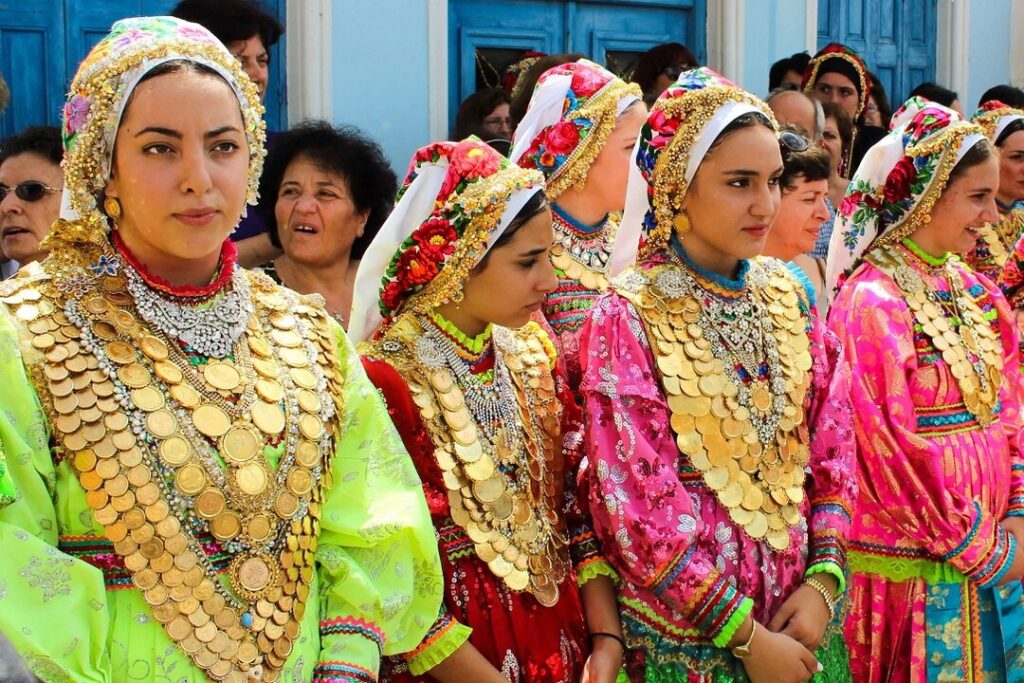
Traditional dress retains an active ceremonial place in Olympos. Visitors gain most by allowing the local order to unfold, watching how residents enter the dance and joining when the moment feels welcoming.
Kasos: a feast shaped by return
The largest feast on Kasos takes place in Panagia village. It draws Kasiots home from mainland Greece and from communities abroad, turning Dekapentavgoustos into a powerful expression of island continuity.
The shared meal features the island’s tiny stuffed vine leaves and richly flavoured pilaf. Lyra and laouto accompany the dancing, while mantinades can be composed in the moment. Food preparation, music and return all belong to the same communal act.
The eastern Aegean
Ikaria on 15 August
follows on 17 August.
Ikaria reaches the busiest point of its calendar with Dormition panigiria in villages across the island. The annual list includes Kampa, Panagia, Perdiki, Monokampi, Gialiskari, Kouniadi, Lagada, Akamatra, Kosoikia and Chrysostomos.
Lagada has gained the greatest reputation among visitors and can attract very large crowds. Other villages offer their own version of the same feast, sometimes within a more intimate setting. Local advice can help visitors choose according to distance, road access and the character of the gathering.
Karavostamo traditionally follows on 17 August, carrying the island’s festive rhythm into the second half of the month.
Samos: an eastern Aegean sound
announced each summer.
On Samos, Dormition gatherings bring together violin, laouto and the musical influence of the eastern Aegean. The island’s Muscat wine often accompanies summer celebrations, while communities such as Vathy and places associated with Megali Panagia observe the feast of the Virgin Mary.
Samos’s proximity to Asia Minor and the history of refugee settlement contribute to a repertoire with clear eastern Aegean colour. Exact village programmes develop each summer, making local announcements the best guide to individual events.
The Ionian Islands and Crete
Corfu: philharmonic tradition and village feasts
August for the Dormition and 23 August for the Enniamera. Corfu
also holds numerous village events throughout the month.
Corfu’s August calendar carries both village panigiria and one of Greece’s most important urban religious processions. On 11 August, the litany of Agios Spyridon commemorates the island’s deliverance from the Ottoman siege of 1716, which Corfiot tradition attributes to its patron saint. The saint’s relic is carried through Corfu Town with the island’s philharmonic bands, turning the historic centre into a landscape of ceremony and brass music.
Dekapentavgoustos is celebrated across the island. Kassiopi honours Panagia Kassopitra with a procession and waterfront festivities, while the Monastery of Platytera holds a major celebration in Corfu Town. Village gatherings add folk orchestras and dancing to the wider observance.
The Enniamera on 23 August are associated with Pelekas, where live music and dancing fill the village square. Corfu’s combination of philharmonic processions, kantades and village orchestras gives its August celebrations a recognisably Ionian sound.
Crete: panigiria in the villages
programmes vary across Crete and are announced locally each summer.
Across Crete, the Dormition is celebrated in parish churches, monasteries and village squares. The Cretan lyra and laouto lead the music, while local dance traditions and improvised mantinades shape the glenti. In western Crete, rizitika songs carry the musical memory of the White Mountains.
The island’s scale makes local calendars especially important. Villages across Apokoronas and Sfakia hold August gatherings, while the Monastery of Chrysoskalitissa near Elafonissi is a prominent place of worship for the Dormition. Programmes can include food festivals and cultural events alongside the church feast, so the municipality and organising association should be checked for the character of each event.
Mainland Greece
The summer return to the village
village dates and programmes are announced each summer.
Across mainland Greece, Dekapentavgoustos fills mountain and rural villages with returning families. Epirus, Thessaly, Macedonia, Central Greece and the Peloponnese each bring a distinct musical language to the feast.
In Epirus, the clarinet leads measured circle dances that can continue for hours. Village squares in Zagori and the wider region become gathering points for communities dispersed throughout Greece and abroad. Thessaly’s annual programme stretches across villages in the Trikala, Karditsa, Larissa and Magnesia regional units. Pelion combines mountain settings with nearby coastal communities. Western Macedonia hosts traditional dancing and music in villages around Kastoria.
Mainland programmes are often published by municipalities, regional authorities and cultural associations during July or early August. The exact village and orchestra may change from year to year, while the pattern of homecoming remains constant.
Siatista, Kozani: the Kavalarides of Dekapentavgoustos
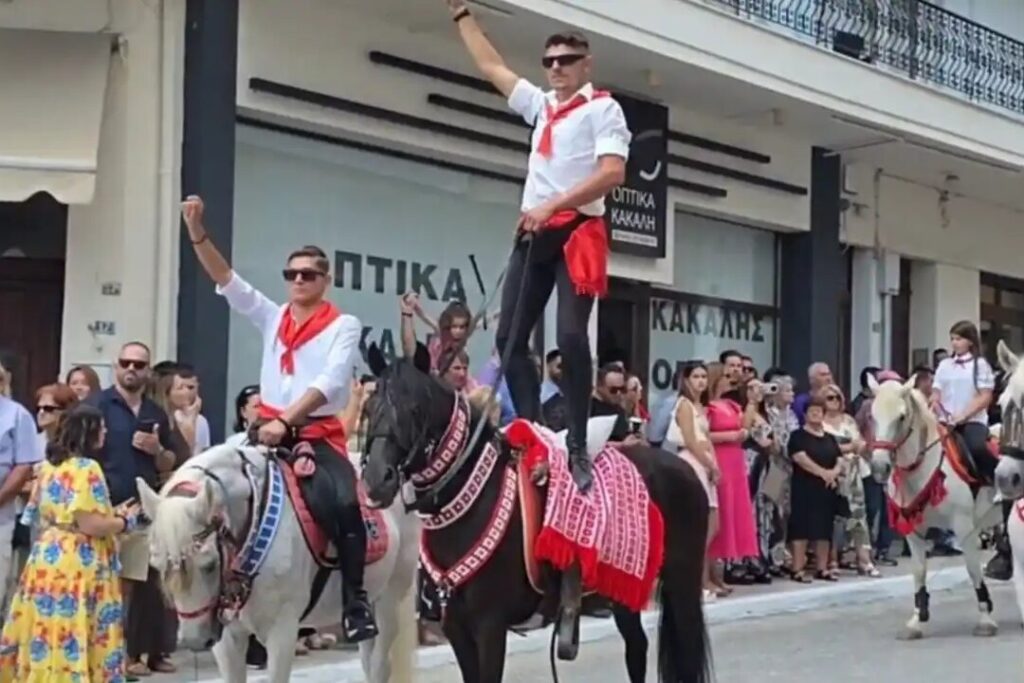
In Western Macedonia, the Kavalarides (Καβαλάρηδες, horse riders) of Siatista ride decorated horses to the Monastery of the Dormition of the Virgin Mary at Mikrokastro on 15 August. After worship, the riders return to Siatista and the celebration continues with music and dancing.
The custom gives the national feast a distinct mainland form. Horsemanship, pilgrimage and public celebration come together in one of the most striking Dekapentavgoustos traditions in northern Greece.
Dekapentavgoustos Across Greece
Late August: the celebrations continue
The Dormition’s liturgical cycle continues until 23 August. The Enniamera renew devotion to the Virgin Mary and bring another group of panigiria. The final week then turns towards Agios Fanourios and Agios Ioannis.
23 August: the Enniamera of the Virgin Mary
Enniamera literally means “nine days”. In this context, the term refers to 23 August, the ninth day when 15 August is counted as the first day. In the Orthodox calendar, 23 August is the Apodosis, or leave-taking, of the Dormition. It brings the liturgical celebration of the feast to its close, as ERT’s explanation of the date also notes.
Greek popular tradition treats the date in a way that resembles the ninth-day remembrance held after a person’s death. This is why people commonly speak of ta Enniamera tis Panagias, the Nine Days of the Virgin Mary. Several churches and monasteries hold their principal panigiri on this date.
Tripodes on Naxos holds one of the best-known Cycladic celebrations. On Nisyros, Panagia Kyra is honoured on 22 and 23 August. Karpathos holds celebrations associated with the Virgin Mary in Aperi and at Kira Panagia.
Tinos continues its wider August religious cycle through 23 August. On Paros, Naoussa connects the date with Koursariki Pirate Night, combining the Enniamera with a dramatic local re-enactment.
The feast offers a second opportunity to experience an August panigiri after the intense movement of Dekapentavgoustos has eased.
27 August: Agios Fanourios and the fanouropita
Agios Fanourios is celebrated on 27 August and is closely associated with the fanouropita. People bake the fragrant fasting cake while asking the saint to help reveal something lost or deeply sought. The custom draws on the connection between the saint’s name and the Greek verb fanerono, meaning “to reveal”.
On Ikaria, the feast is associated with Agios Dimitrios in Raches, Agios Panteleimon near Agios Kirykos, Maratho, Vrakades and Avlaki. Avlaki’s gathering is known as a psaropanigiri, with fish at the centre of the meal. Ampelas on Paros also holds an Agios Fanourios celebration.
29 August: Agios Ioannis
The Orthodox calendar commemorates the Beheading of Saint John the Baptist on 29 August. The date is observed as a fast day. Local panigiria associated with Agios Ioannis take place in several parts of Greece, often beginning with Vespers on the evening before.
On Naxos, Apeiranthos, Apollonas and Agersani celebrate on the same date. In northern Karpathos, the remote church of Agios Ioannis at Vroukounta draws worshippers to one of the island’s most atmospheric gatherings. Some people reach the site on foot or by boat and stay overnight around the church.
Paros marks Agios Ioannis Detis on 28 and 29 August at the monastery in the Environmental and Cultural Park near Naoussa. The late-August setting brings together worship and the landscape of the rocky peninsula.
The final days of August
Late food festivals and community customs often join the religious calendar. Paros holds the Karavolas Festival on the first Saturday after 15 August, so its calendar date changes each year. Local programmes on Amorgos and elsewhere may add village reunions, food celebrations and music nights.
By the end of August, the main holiday rush has begun to ease, while local celebrations continue in villages across the country.
How food tells you where you are
The communal table reveals the landscape surrounding each panigiri. Ikaria is associated with boiled goat and local red wine. Kasos serves its celebrated pilaf and tiny dolmadakia. Astypalaia prepares lambrianos for Panagia Portaitissa. Lefkes on Paros builds an entire festival around karavoles, the local name for large snails.
Church committees and volunteers may begin cooking long before guests arrive. In some places food is offered after the service. Elsewhere, visitors buy portions or coupons and the proceeds support the village association. Asking how the meal was prepared often opens the warmest conversation of the evening.
Your first panigiri: what a foreigner needs to know
Can anyone attend?
Most public panigiria are open village festivals that welcome residents, returning families and visitors. An invitation is generally unnecessary when the event is advertised by a church, municipality or cultural association. A feast held at a privately maintained family chapel can be more personal. Ask locally when the setting or announcement is unclear.
Is there an entrance charge?
Many religious panigiria have free admission. Food and drink may be offered by the church, sold by the organising association or served by tavernas around the square. Some music nights advertised as glentia charge admission to cover the orchestra. Read the poster carefully and carry cash. Remote venues may have no card terminal or nearby cash machine.
What time should you arrive?
The advertised religious service may begin in the early evening, while the music starts later. A poster showing 20:00 can refer to Vespers rather than the first dance. Arriving before the meal and music gives you time to park, understand the layout and see how the celebration develops. On major feast days, the Divine Liturgy and procession may take place in the morning, followed by an evening glenti.
Greek village timetables can remain flexible. The musicians may wait for the square to fill, and the dancing can continue until the early morning. Confirm the sequence locally if attending the service matters to you.
What should you wear?
Comfortable summer clothes suit the outdoor celebration. Cover shoulders and knees when entering a monastery or a church with a conservative dress code. A light layer is useful in a mountain village, even in August. Choose shoes that can handle stone paving, dust and several hours of standing or dancing.
How does the dancing work?
The first position in a line or circle carries status and responsibility. Experienced dancers and people closely connected with the village often lead. Watch one complete dance before joining. Enter near the end when space opens, keep a light hold and follow the dancer beside you. Each region has its own steps, tempo and way of holding hands.
Applause and encouragement are welcome. Pushing towards the front, attempting elaborate steps in a tightly packed line or treating traditional dress as a costume for photographs will jar with the occasion.
Are children welcome?
Panigiria are usually multigenerational gatherings. Children may be present late into the evening and often join the dancing. Crowds, loud amplification and limited seating can be tiring for young children, so bring water and agree on a meeting point with older children in case the family becomes separated.
Can you take photographs?
Photography is common in public squares. During the service, procession or a personal act of devotion, follow signs and the behaviour of worshippers. Ask before taking a close portrait, particularly of a child, an older resident or someone in traditional dress.
How should you plan transport?
Many panigiria take place beyond the evening public-transport network. Parking can extend along narrow approach roads, and leaving after midnight may involve a long walk to the car. Ask about festival buses, boats or local taxis before departure. Choose a designated driver when drinking and avoid blocking gates, homes or emergency access.
What should you bring?
Cash, water and a charged phone cover the essentials. A light layer, comfortable shoes and any necessary medication make a long night easier. In a rural or mountain setting, check wildfire restrictions and road conditions. Leave candles, barbecues and anything that can create a spark to the organisers.
The simplest rule
Take your cue from the people hosting the feast. Join generously, buy food or make a contribution when appropriate and allow the religious moments their space. A few words of Greek help. Chronia polla (χρόνια πολλά) means “many years” and is the customary greeting on a feast or name day.
How to find current details
The feast dates in this guide remain stable, while the practical arrangements change each year. Cultural associations often announce musicians, starting times and other details through posters, Facebook pages and local noticeboards in the days leading up to a panigiri.
Check with the municipality, regional authority or village association before travelling. Accommodation owners and local tavernas can also be valuable sources of same-day information. For Ikaria, the Visit Ikaria list of local feasts provides the annual framework, while the locally based Robertina Ikaria calendar carries information for 2026. The Naxos & Small Cyclades guide to the island’s panigiria lists Naxos’s principal annual feast dates. The Nisyros festival guide, published by Diakomichalis Travel and Shipping Agency on Nisyros, covers the island’s principal religious celebrations.
Weather, wildfire risk and unforeseen events within a small community can affect a gathering. A final check on the day can prevent a wasted journey and helps visitors follow the organisers’ latest guidance.
Sources and annual calendars
This guide draws on national tourism and heritage bodies, municipal and regional pages, church calendars and established destination sources. Local calendars provide event-level detail that national sources rarely carry.
National and ecclesiastical sources
- UNESCO: Tranos Choros in Vlasti and the Syrrako Festival
- Greek Ministry of Culture: the Panigiria of Ikaria in the National Inventory of Intangible Cultural Heritage
- Greek Ministry of Culture: the Kouppa and Kamares dance traditions of Nisyros
- Visit Greece: August religious festivals on the Greek islands
- Visit Greece: Panagia Ekatontapyliani and the 15 August celebration
- Visit Greece: the Church of Panagia Evangelistria on Tinos
- Visit Greece: the Siatista Kavalarides and traditions of Kozani
- Hellenic Ministry of National Defence: the Tinos commemoration of the cruiser Elli
- Orthodox Church in America: fasting seasons and fast days
- ERT News: the Enniamera and the leave-taking of the Dormition
Island, municipal and destination sources
- Visit Ikaria: annual panigiria calendar
- Naxos & Small Cyclades: annual panigiria and feast dates
- Diakomichalis Travel and Shipping Agency: Nisyros festival guide
- Nisyros Geopark: Panagia Spiliani customs
- The Aegean Islands: the Panagia Spiliani nine-day celebration, procession and Koupes dance
- Municipality of Karpathos: fairs and local events
- Municipality of Paros: the island’s festivals
- Municipality of Paros: Karavolas Festival in Lefkes
- Municipality of Paros: Koursariki Pirate Night
- Visit Corfu: the procession of Agios Spyridon on 11 August
- Amorgos destination guide: annual events and religious celebrations
- Andros Guide: the Transfiguration panigiri in Arni
Detailed local sources
- Robertina Ikaria: 2026 panigiria calendar and local introduction
- Ikariaki Radio: locally updated Ikaria panigiria list
Local calendars should be rechecked each summer because organising associations may change dates, musicians and venues.
You may also like
Celebrating Dekapentavgoustos: The Feast of the Dormition of the Theotokos
The religious meaning of 15 August, its fasting traditions, name-day customs and place in the Greek summer calendar.
Public Holidays in Greece (2026–2030): Complete Guide
National and religious holidays in Greece, including dates, observances and information about business and public-service closures.
Greece’s Intangible Cultural Heritage: Living Traditions Worth Preserving
How festivals, dances, rituals, songs and traditional skills are recorded, safeguarded and passed to future generations.