
The same spoken answer can leave different impressions of certainty depending on what the speaker’s face is doing.
Raised eyebrows and eye closure can make speakers look more confident, while lowered brows and tightened eyes suggest doubt.
The findings come from a University of Glasgow study titled Dynamic facial movements shape how confident speakers appear, published on 21 October 2026 in Proceedings of the Royal Society B.
The researchers created computer-generated speakers and varied their facial movements while keeping the words and vocal delivery consistent. Listeners then judged how confident the speakers appeared.
How the Study Worked
The study involved 44 participants: 22 native British English speakers and 22 native Mandarin Chinese speakers. The Mandarin Chinese speakers had lived in the UK for less than three months.
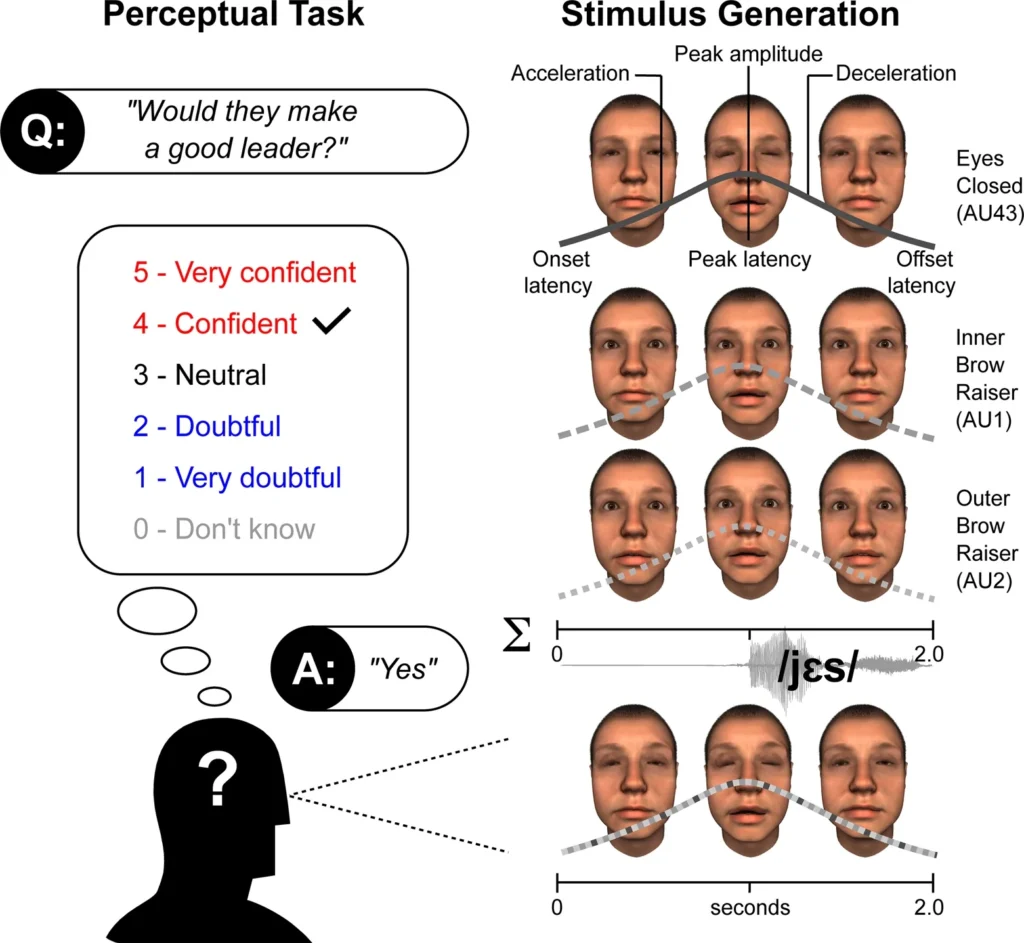
Each participant watched 1,800 short videos of computer-generated speakers answering “yes” or “no” to questions, including whether someone would make a good leader.
The researchers varied movements around the eyes and eyebrows in random combinations at five levels of intensity. The spoken words and vocal delivery remained consistent, allowing the researchers to isolate the effects of facial movements.
After each video, participants rated how confident the answer appeared on a five-point scale from “very doubtful” to “very confident”.
What Made an Answer Look Confident or Doubtful
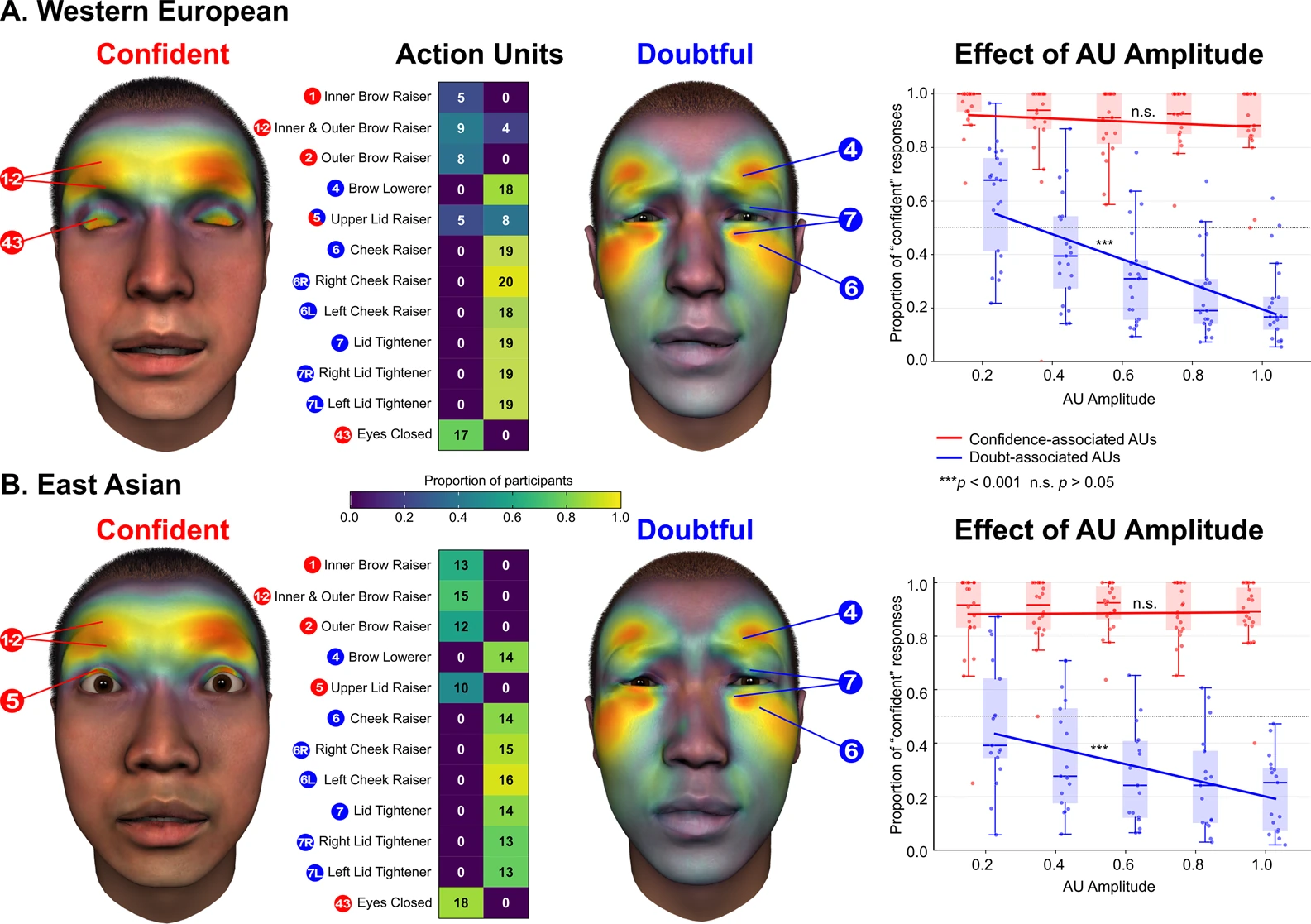
Across both groups, raised eyebrows and eye closure were associated with confidence, while lowered brows and tightened eyes suggested doubt.
More pronounced brow lowering and squinting made speakers appear increasingly doubtful. Raised eyebrows and eye closure produced high confidence ratings even at lower intensities, with little additional effect as the movements became stronger.
Professor Rachael Jack, Honorary Senior Research Fellow at the University of Glasgow and corresponding author of the study, said facial movements “do not merely accompany speech but actively shape how it is understood”.
Where the Two Groups Differed
British English speakers associated squinting more strongly with doubt, while Mandarin Chinese speakers placed greater weight on raised eyebrows as a sign of confidence.
Wide-open eyes also split the groups. Mandarin Chinese speakers associated them more consistently with confidence, whereas British English speakers interpreted the movement as a possible signal of either confidence or doubt.
The broad patterns were similar, although the groups gave different weight to particular facial signals. Both groups consisted of young, university-educated adults, limiting how widely the findings can be applied.
What This Might Mean If You Live Abroad
The study did not examine second-language communication or life abroad. Yet for many of us in Greece, conversations across languages and cultures are part of everyday life, from speaking with neighbours to dealing with a public office.
The findings suggest that raised eyebrows can convey confidence, while narrowed eyes may suggest doubt, and that listeners from different cultural backgrounds may interpret these signals differently. That is worth keeping in mind when we concentrate on finding the right words in another language. Whether Greek listeners interpret these movements in the same way remains an open question.
Sources
Featured image credit: Nölle et al. (2026), Proceedings of the Royal Society B, Figure 2, CC BY 4.0.