
Christopher Nolan’s The Odyssey has brought one of the greatest Greek stories ever told back into global conversation. Yet Homer’s epic poem was never simply an ancient text waiting to be rediscovered. For centuries, The Odyssey and the figure of Odysseus, known in Latin as Ulysses, the king of Ithaca who struggles to return home after the Trojan War, have shaped the way the West tells stories about travel, exile, temptation, endurance and return.
Its influence continues to echo through modern culture. James Joyce’s Ulysses reimagined Homer’s epic over the course of a single day in Dublin. The Coen brothers’ O Brother, Where Art Thou? transformed the journey home into a modern American road tale. And in C.P. Cavafy’s “Ithaka”, the island became a destination with a deeper meaning, a way of thinking about life, experience and the value of the journey itself.
At the heart of The Odyssey is a question that still feels urgent today. How do we survive crisis, temptation, displacement and loss without forgetting who we are? Ithaca becomes the symbol of home, belonging, memory and values. Odysseus becomes the flexible survivor, a man who does not rely on strength alone, but on patience, intelligence, endurance and self-control. The obstacles he faces, from the Lotus-Eaters’ fruit of forgetfulness to the Sirens’ deadly song, still feel recognisable in a world of distraction, temptation, disorientation and constant movement.
Seen this way, Nolan’s film is not simply a new adaptation of an old Greek myth. It is the latest return to a story that has never stopped returning. The Odyssey speaks to something every age understands. We need to keep moving through crisis, change and temptation without losing sight of home, memory and identity.
What follows is a rhapsody-by-rhapsody guide to Homer’s own narrative order, so that readers can understand not only what happens to Odysseus, but how the poem gradually reveals absence, memory, danger, recognition and return.
The Odyssey is not only the account of a man trying to get back to Ithaca. It is the story of a person trying to remain faithful to what he loves, what he remembers and what he owes, while the world repeatedly tries to make him forget.
In this article
Click on any section below to jump directly to it.
Story and context
Ithaca without Odysseus
The return begins
Wanderings and tests
Odysseus in Ithaca
α–δ / Books 1–4
ε–θ / Books 5–8
ι–μ / Books 9–12
ν–ω / Books 13–24
What Kind of Story Is The Odyssey?
The Odyssey is an epic poem, a long narrative poem about heroic figures, gods, journeys, danger and human endurance. It is traditionally attributed to Homer, the ancient Greek poet also associated with The Iliad. The two poems are closely connected, but they do not tell the same story. The Iliad is centred on the Trojan War, the legendary war between the Greeks and the city of Troy, also called Ilion. The Odyssey begins after that war has ended.
The poem is set in the heroic world after the Trojan War, a mythic past linked to the Mycenaean period, roughly 1600–1100 BCE. The Trojan War itself is usually placed, within this tradition, around the beginning of the 12th century BCE. The poem, however, was shaped much later, probably in the late 8th or early 7th century BCE, in the Greek-speaking world of western Asia Minor.
The distance between the heroic world and the later shaping of the poem matters because The Odyssey looks back to an older age while also reflecting a Greek world of seafaring, travel, colonisation, hospitality, political change and contact with other peoples.
The Odyssey was also not originally experienced like a modern novel. Early epic poetry belonged to a world of performance. The first epic singers were known as aoidoi, meaning singers, and later came the rhapsodes, professional reciters who travelled from place to place and performed epic poetry, especially at major Greek festivals.
The poem was first something to be heard, remembered and recited. It was later divided into 24 rhapsodies, which we can loosely think of as parts of the poem, although they belong to this older world of recitation rather than to modern chapters. These rhapsodies are marked by the 24 small letters of the Greek alphabet, from α to ω, and the poem contains 12,110 verses.
The word rhapsody is used here for the poem’s traditional Greek division. In most English editions, readers will see the same parts called Books 1–24, so the labels below include both forms.
Its hero, Odysseus, is the king of Ithaca, a Greek island in the Ionian Sea. He has spent ten years fighting at Troy, and when the war ends, he tries to return home to his wife, Penelope, and his son, Telemachus. But his journey is shaped by the anger of Poseidon, who blocks his return, and the protection of Athena, who repeatedly helps him find his way back. His journey home takes another ten years, and during that time he loses his ships, his companions and almost everything that once defined him.
The Greek word often used for this return is nostos, meaning homecoming. In The Odyssey, homecoming is not simply about reaching a place on a map. It means returning to one’s family, identity, name and place in the world after years of war, absence and suffering.
Odysseus’ return is the difficult movement from life as a warrior back to life as a husband, father, ruler and member of a household. This is why Ithaca matters so much. It keeps together the poem’s ideas of home, memory, belonging and the values that allow a person to remain oriented.
The places in The Odyssey are never only scenery. Pylos, Sparta and Phaeacia show hospitality and social order, while the Cyclops’ cave shows a world without laws or respect for guests. Circe, the Sirens and Calypso test memory, desire and delay, while Ithaca tests whether Odysseus can recover his identity inside a home that has almost forgotten him.
Homer does not tell the poem in simple chronological order. He does not begin with Odysseus leaving Troy. Instead, he begins near the end of Odysseus’ wanderings, while Odysseus is trapped on the island of Calypso, a nymph who keeps him with her, and while Ithaca is already in crisis.
The full story covers about twenty years, made up of ten years at Troy and ten years of wandering. The present action of the poem is compressed into 41 days, yet within those days Homer makes room for memory, storytelling, delay, recognition and return.
Ithaca Without Odysseus
The first surprise of The Odyssey is that Odysseus does not appear immediately as the active hero of his own poem. Homer begins elsewhere, with absence, and with the slow collapse that follows when the man who once gave shape, authority and moral order to Ithaca is no longer there.
Odysseus is alive, but far away from Ithaca, trapped on the island of Calypso. In Ithaca, his house is collapsing into disorder. Penelope is still waiting after twenty years, Telemachus has grown up without his father, and the palace is full of suitors, men who want to marry Penelope and take control of Odysseus’ household.
Before Homer shows monsters, storms or magical islands, he shows a home under pressure. The palace has become a place of disorder, while the people who should protect it are either powerless, silent or afraid.
Rhapsody α / Book 1
A House Without Its King
The Odyssey begins with a traditional Invocation to the Muse. The poet prays to the goddess of song and poetry to speak through him, asking for divine inspiration to tell the story of Odysseus’ painful return home after the fall of Troy. Homer does not start at the beginning of that return, but in the middle of a long absence. Troy has fallen, years have passed, and Odysseus has suffered through many lands and dangers. Yet he is still not home.
At this point, Odysseus is trapped on Ogygia, the island of the nymph Calypso, who has kept him there for seven years. Poseidon is still angry with him and continues to block his return, while Athena speaks before the gods in his favour. Zeus agrees that Odysseus must finally be released, and the movement toward home begins.
But the poem does not turn first to Odysseus. It turns to Ithaca, where his absence has left his household exposed. The suitors are consuming his wealth, pressuring Penelope to remarry and treating the palace as if it already belongs to them. The crisis of the poem is therefore not only at sea. It is also at home.
Athena goes to Ithaca disguised as Mentes, lord of the Taphians and an old family friend of Odysseus. She finds Telemachus still young, uncertain and inwardly longing for someone to drive the suitors out. Before she gives advice, Telemachus welcomes the stranger properly, offering food and drink. From the beginning, the poem shows that hospitality is not a small social gesture, but a measure of character.
Athena tells Telemachus that Odysseus may still be alive and urges him to call an assembly, confront the suitors and travel to Pylos and Sparta to seek news of his father. She also reminds him of Orestes, who avenged his father Agamemnon, giving Telemachus a heroic example of what a son may be called to do.
This first disguise matters. Gods disguise themselves, Odysseus will later hide his own identity, and recognition becomes one of the poem’s deepest themes. But here, disguise is also a form of awakening. Athena does not simply give Telemachus information. She gives him courage. The search for Odysseus begins as Telemachus starts to become more than the son of an absent hero. He begins to act.
Rhapsody β / Book 2
Penelope’s Weaving and Telemachus’ First Public Stand
The next morning, Telemachus calls an assembly of the men of Ithaca. This is his first public act of authority. He speaks of the disgrace in his house. The suitors are dishonouring Penelope, consuming Odysseus’ wealth and acting as if the household has no master. Telemachus admits that he is still young and lacks his father’s strength, but his grief and anger now push him into action.
The suitors try to shift the blame onto Penelope. Antinous tells the assembly how she delayed them for years by weaving a funeral shroud for Laertes by day and unweaving it at night. The story shows Penelope’s own kind of intelligence. While Odysseus survives through disguise and invention abroad, Penelope resists through patience, weaving and delay at home.
Telemachus refuses to send his mother away and demands that the suitors leave. At that moment, Zeus sends an omen. Two eagles appear above the assembly, warning that the suitors’ violence will not go unpunished. Some men understand the sign, but the suitors dismiss it and continue to trust in their own power.
Telemachus then asks for a ship and twenty men so he can travel to Pylos and Sparta in search of news of Odysseus. If his father is alive, he will wait. If Odysseus is dead, he will give him proper honour and allow Penelope to remarry. Either way, Telemachus is no longer simply waiting inside a broken household. He is beginning to act like the son of Odysseus.
Rhapsody γ / Book 3
Telemachus in Pylos
Telemachus arrives at Pylos, in the Peloponnese, accompanied by Athena, now disguised as Mentor, a loyal Ithacan friend of Odysseus. The first thing he sees is a great public sacrifice to Poseidon. Pylos immediately feels different from Ithaca. Here, the gods are honoured, strangers are welcomed and order still exists.
Telemachus is shy at first, but Athena urges him to speak. Nestor’s son Pisistratus welcomes the strangers with food and wine before asking who they are. This matters because it shows proper xenia, the sacred guest-host code of the ancient Greek world. A stranger is fed before he is questioned.
When Telemachus asks for news of his father, Nestor remembers Odysseus as a man of exceptional cunning, but he cannot tell him where he is. Instead, he tells stories from the aftermath of Troy, including the murder of Agamemnon and the revenge taken by his son Orestes. Once again, Telemachus is reminded that a son may have to defend the honour of his father’s house.
Pylos does not give Telemachus the answer he wants, but it gives him something else. He learns how a respected king speaks, how a well-ordered household behaves and how memory of the Trojan War still shapes the living. His journey is becoming an education in courage, hospitality and responsibility.
Rhapsody δ / Book 4
Sparta, Helen, Menelaus and the News of Odysseus
Telemachus and Pisistratus arrive in Sparta, at the palace of Menelaus, where a wedding celebration is taking place. Menelaus welcomes the strangers with food, washing, clothing and honour, remembering the hospitality he himself received during his long travels. Sparta appears rich and magnificent, but Menelaus does not present wealth as happiness. He speaks with sorrow about the men lost at Troy and says he grieves especially for Odysseus, who worked hardest and suffered most.
When Telemachus hears his father’s name, he begins to cry. Helen notices his resemblance to Odysseus and guesses who he is. His father is still absent, yet something of Odysseus has already returned through the son.
Helen then tells a story from Troy. Odysseus once entered the city disguised as a beggar, gathered information and escaped with his secret intact. Menelaus adds another story, remembering how Odysseus kept the Greek warriors silent inside the wooden horse when Helen tried to draw them out by imitating the voices of their wives. These stories show Telemachus the kind of man his father is. Odysseus is not only strong. He survives through disguise, patience and control under pressure.
Sparta gives Telemachus what Pylos could not. Menelaus eventually tells him that Odysseus is alive but trapped far away on Calypso’s island. The news is painful, but it is also hope. Telemachus has not found his father, but he has found proof that the search is not empty.
Meanwhile, the danger in Ithaca grows. The suitors discover that Telemachus has sailed in search of news of Odysseus and plan to ambush him on his return. His journey has changed his position. He is no longer only the quiet son of an absent father. He has begun to act, and that makes him a threat.
By the time Odysseus finally enters the action, we understand that his return is not only a private wish. It is necessary because without him the household is under siege, the son is in danger, the wife is trapped and the island has lost its moral centre.
Odysseus’ Return Begins
After four rhapsodies centred on Ithaca and Telemachus, Homer finally turns directly to Odysseus. This part of the poem is the Nostos, the return home. It begins with Odysseus still far from Ithaca and ends with him reaching his island, although not yet openly as himself.
The sea is the route home, but it is also the space where Odysseus remains suspended. Behind him is the warrior he was at Troy. Ahead of him is the husband, father and king he must become again in Ithaca.
Rhapsody ε / Book 5
Calypso and the Choice of Home
The story now returns to Odysseus, who is still trapped on Ogygia, the island of Calypso. Athena again speaks for him before the gods, and Zeus sends Hermes to order Calypso to let him go. Odysseus has been with her for seven years, but he has not forgotten Ithaca. He sits by the shore, weeping for his wife, his home and the life he cannot reach.
Calypso offers him what no mortal can normally have. She can make him immortal and keep him beside her forever. Yet Odysseus still chooses the difficult human life waiting for him in Ithaca. He knows that Penelope is mortal and that home will not be perfect, but he wants it more than divine comfort. This is one of the poem’s most moving choices. Odysseus does not simply want to survive. He wants to return to the life that is truly his.
Calypso finally gives him tools and provisions, and Odysseus builds a raft. After many days at sea, he comes close to the land of the Phaeacians, but Poseidon sees him and sends a violent storm. The sea becomes once again the force that tests him between death and return.
At his lowest point, the sea goddess Ino takes pity on him and gives him a sacred veil to help him survive. Athena then calms the winds and helps him reach shore. Odysseus arrives exhausted, naked and alone, but alive. He has left behind immortality, pleasure and captivity. Ahead of him lies the final human path toward home.
Rhapsody ζ / Book 6
Nausicaa Finds the Shipwrecked Stranger
As Odysseus sleeps on the shore, Athena quietly prepares the next stage of his rescue. She appears in a dream to Nausicaa, daughter of King Alcinous and Queen Arete of the Phaeacians, and encourages her to go with her maids to wash clothes by the river. Athena does not carry Odysseus to safety herself. She works indirectly, through another human being.
By divine design, the girls’ voices wake Odysseus. He appears before them exhausted, naked and covered with salt from the sea, shielding himself with leaves. The other girls run away, but Nausicaa stays. Odysseus keeps a respectful distance, speaks carefully and asks for help without frightening her. After so much violence and suffering, survival now depends on humility, tact and the ability to ask for mercy.
Nausicaa shows proper xenia, the sacred duty to help strangers and beggars. She gives Odysseus food, clothing and oil so that he can wash and recover. Yet she also acts with intelligence. To avoid gossip, she tells him not to enter the city beside her. Instead, he should wait in a grove and then go to the palace, where he must appeal especially to Queen Arete.
The scene is gentle, but important. Odysseus has lost ships, companions, weapons and status. He reaches Phaeacia with almost nothing, and the first person to help him is a young woman who chooses courage, courtesy and hospitality over fear.
Rhapsody η / Book 7
Odysseus at the Palace of Alcinous
As Odysseus walks toward the Phaeacian city, Athena protects him with a mist and appears disguised as a young girl to guide him. She tells him to go boldly to the palace and appeal especially to Queen Arete, whose judgement carries great authority among the Phaeacians.
Odysseus enters the palace while the nobles are feasting. Instead of announcing his name or claiming heroic honour, he approaches Arete as a suppliant and begs for safe passage home. This is another important moment of humility. The man who once fought at Troy now survives by lowering himself, speaking carefully and trusting the laws of xenia.
King Alcinous receives him kindly, gives him food and drink, and promises that the Phaeacians will help send him home. Odysseus still does not reveal his full identity. He says only that he is a suffering mortal who wants to see his family and homeland again.
Arete notices that Odysseus is wearing clothes from her own household and questions him. Odysseus then tells part of the truth. He explains his captivity on Calypso’s island, his storm-tossed escape and his meeting with Nausicaa, who gave him clothing and directed him to the palace. He does not tell everything, but he gives enough truth to earn trust.
In Phaeacia, Odysseus begins to move from silence toward revelation. He is still unnamed, but he is no longer entirely hidden. The Phaeacians honour the unknown stranger, and their hospitality becomes the bridge between his suffering at sea and his final return to Ithaca.
Rhapsody θ / Book 8
Odysseus Among the Phaeacians
The next day, Alcinous prepares a ship and crew to carry the unknown stranger home. Before the journey begins, the Phaeacians gather for feasting, song and athletic games. Their world is ordered, graceful and hospitable, a strong contrast to the lawless spaces Odysseus has survived.
The bard Demodocus sings of Troy, and the song moves Odysseus to tears. He hides his face under his cloak, but Alcinous notices. This is another moment when grief almost reveals identity. Odysseus can conceal his name, but he cannot fully conceal memory.
Later, during the games, a young Phaeacian challenges Odysseus and suggests that he may not be skilled in athletics. The insult touches his pride. Odysseus takes up the discus and throws it farther than anyone else, proving that the exhausted stranger is still a heroic man. Yet even then, he remembers the rules of hospitality and does not challenge Alcinous, his host.
Demodocus also sings of Ares, Aphrodite and Hephaestus, a story in which cleverness traps power. The song fits the larger world of The Odyssey, where strength alone is rarely enough and intelligence often decides who survives.
By the end of the feast, Odysseus is still unnamed, but his tears, strength and reactions have begun to expose him. Phaeacia becomes the place where his hidden identity can no longer remain completely hidden. Before he can return to Ithaca, he must first tell the story of everything he has endured.
The Wanderings and the Tests of Return
At this point, Homer does something remarkable. He lets Odysseus tell a large part of the poem himself. The episodes many readers associate most strongly with The Odyssey, including the Cyclops, Circe, the Underworld, the Sirens, Scylla and Charybdis, are not told as they happen. They are remembered and recounted by Odysseus at the Phaeacian court.
These wanderings are not random adventures. They reveal the forces that delay his return, including divine anger, his companions’ recklessness, temptation, violence, curiosity, pride and the constant danger of forgetting home.
Odysseus survives not only because he acts, but because he can understand and tell what has happened to him. The Odyssey is a poem about action, but it is also a poem about memory, interpretation and storytelling.
Rhapsody ι / Book 9
The Cicones, the Lotus-Eaters and the Cyclops
After the feast in Phaeacia, Odysseus finally names himself. He is no longer only the unknown stranger at Alcinous’ court. He becomes the narrator of his own suffering, telling the Phaeacians what happened after Troy and why the journey home has taken so long.
Odysseus begins his account with the first stop after Troy. He sails with twelve ships and roughly 600 companions to Ismarus, the city of the Cicones in Thrace. There, the Greeks sack the city, kill the men and take spoils. Odysseus spares only Maron, a priest of Apollo, who rewards him with gifts, including the powerful sweet wine that will later help him overcome the Cyclops Polyphemus.
Odysseus wants to leave at once, but his men stay on the shore to feast, giving the Cicones time to gather an organised force from inland. The next morning, the Cicones counterattack, and the Greeks are forced back to their ships after losing six men from each vessel, seventy-two companions in total.
The journey begins with a warning that feels painfully human. Before monsters or divine punishments dominate the story, Odysseus’ men suffer because they cannot stop, listen and leave at the right moment.
Next, after a nine-day storm drives them off course, Odysseus and his men reach the land of the Lotus-Eaters. The people there are not violent, but they offer a sweet fruit, the lotus, which makes those who eat it forget their desire to return home. Odysseus sends three men to explore the land. When they taste the lotus, they no longer want to leave. Odysseus has to drag them back to the ships by force and tie them beneath the rowing benches before ordering the crew to sail away at once.
For a poem about homecoming, this is terrifying because the danger is not death, battle or a monster. It is forgetfulness, what the Greeks called lethe (λήθη), the loss of memory, purpose and the desire to return.
Then comes the Cyclops episode, one of the great turning points of The Odyssey. Odysseus reaches the land of the Cyclopes, isolated shepherd-giants who live without cities, laws or organised community. He enters the cave of Polyphemus, the son of Poseidon, with twelve men. His companions want to take food and leave, but Odysseus waits, hoping to meet the owner and receive the gifts owed to a guest.
The decision costs lives. Polyphemus returns, blocks the cave with a huge stone and violates xenia, the sacred guest-host code of the ancient Greek world. Instead of welcoming the strangers, he eats six of Odysseus’ men. Odysseus survives not by strength, but by cunning. He gives Polyphemus the sweet wine of Maron, tells him his name is Nobody, and blinds him with a heated wooden stake while he sleeps. When the other Cyclopes ask who is hurting him, Polyphemus answers that Nobody is killing him.
Odysseus and his men escape by tying themselves beneath the Cyclops’ sheep. But once they are back on the ship and sailing away, Odysseus cannot resist shouting his real name, his father’s name and his homeland. This is hubris, the overreaching pride that makes a person forget caution, limits and wisdom. Polyphemus now knows who blinded him, so he prays to Poseidon, his father, asking him to punish Odysseus, delay his return and destroy his companions. Odysseus’ intelligence saves him in the cave, but his pride gives Poseidon’s anger a name.
Rhapsody κ / Book 10
Aeolus, the Laestrygonians and Circe
After the Cyclops episode, Odysseus reaches Aeolus, the keeper of the winds. Aeolus welcomes him for a month and gives him a bag in which the dangerous winds are tied up, leaving only the favourable West Wind, Zephyrus, to carry the ships toward Ithaca. For a moment, home is almost in sight.
Then, while Odysseus sleeps, his men open the bag because they think it contains treasure. The winds burst out and drive the ships away from Ithaca. This is one of the poem’s most painful reversals, because the goal is visible, but lack of trust and discipline destroys the moment.
Next they reach the Laestrygonians, giant cannibals who attack the fleet. Eleven of the twelve ships are trapped inside a narrow harbour and destroyed, while Odysseus’ own ship, moored outside, escapes. The journey is now becoming the story of one ship, one shrinking group of men and a leader who is losing almost everything.
The survivors then reach Aeaea, the mystical island of the goddess-sorceress Circe. Odysseus first scouts the area himself, then divides his men into two groups. The group led by Eurylochus goes to Circe’s palace, where she welcomes them, drugs them and turns them into pigs with her magic wand. Only Eurylochus escapes, because he has stayed outside.
Odysseus goes to rescue them alone, but Hermes appears and gives him the magical herb moly, which allows him to resist Circe’s spell. When her magic fails, Odysseus makes her swear that she will not harm him. He then shares her bed and persuades her to restore his men to human form. Yet Circe’s island becomes a place of seductive delay. The danger is not only magic, but comfort, pleasure and forgetfulness. Odysseus and his men remain there for about a year.
When they finally ask to leave, Circe agrees, but she tells Odysseus that he must first go down to the world of the dead and consult the prophet Tiresias, who will show him the way home. As they prepare to depart, the young Elpenor, drunk and confused, falls from Circe’s roof and dies.
Rhapsody λ / Book 11
The Descent to the Underworld
After Circe’s island, Odysseus must make the strangest journey of all. Before he can return to Ithaca, he has to travel to the Underworld, the world of the dead and consult the blind prophet Tiresias. This episode, known as the Nekyia, fills an entire book of The Odyssey and becomes one of the poem’s deepest moments.
Following Circe’s instructions, Odysseus performs the required rituals of libations and sacrifice so that the souls of the dead can speak. He first meets Elpenor, the young companion who has just died after falling from Circe’s roof, and who asks to be properly buried. He then speaks with Tiresias, who warns him about the dangers still ahead, especially the sacred cattle of the Sun.
The Underworld also brings Odysseus face to face with memory and loss. He sees his mother, Anticleia, and learns that she died while waiting for him. He also meets figures from the Trojan War, including Agamemnon, Achilles and Ajax. Through them, the poem looks back at the world of heroic glory and asks what it is worth after death.
The journey to the dead is not only about finding directions home. Odysseus has to pass through grief, guilt and memory before he can continue. In a poem about return, the dead remind him what is at stake among the living.
Rhapsody μ / Book 12
The Sirens, Scylla, Charybdis and the Cattle of the Sun
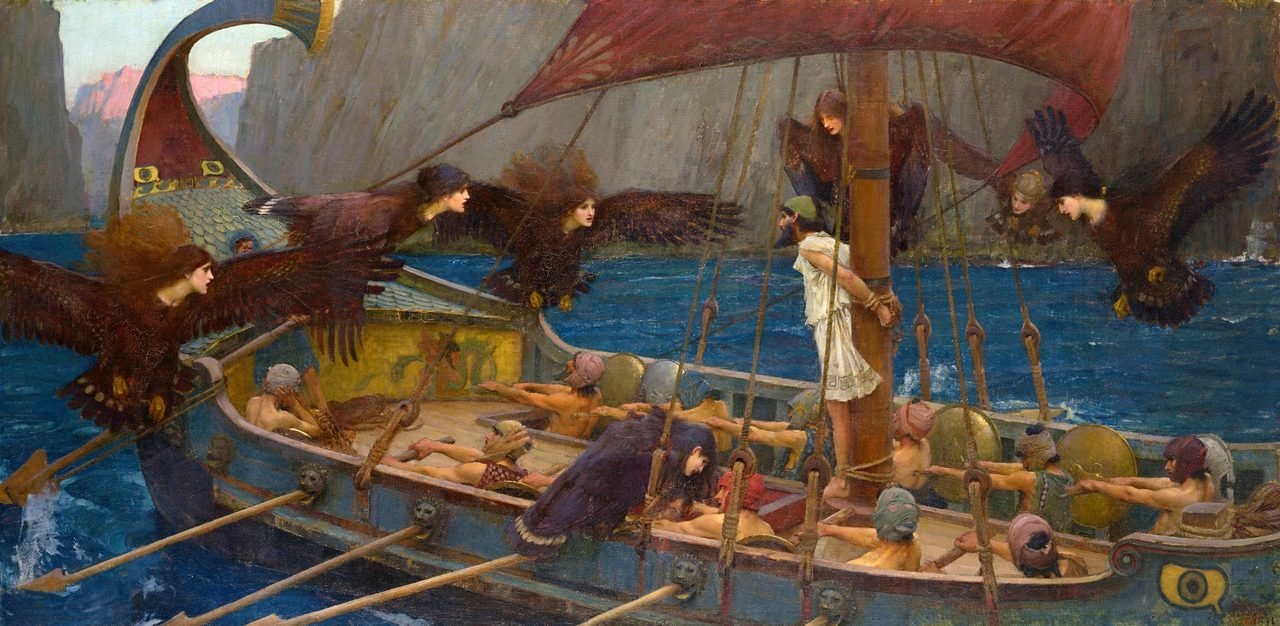
After the journey to the Underworld, Odysseus and his men return to Aeaea and perform the funeral rites for Elpenor. Before they leave, Circe warns Odysseus about the dangers ahead. First come the Sirens, whose song can make sailors forget everything else and sail towards death. Odysseus wants to hear them, so he orders his men to block their ears with wax and tie him to the mast. He hears the song, but because he is physically restrained, he survives his own desire.
Then the ship must pass between Scylla and Charybdis. Charybdis is a deadly whirlpool that can swallow the whole ship, while Scylla is a six-headed monster who will take six men. Circe tells Odysseus to choose the lesser disaster. He does not tell the crew everything, because fear would paralyse them. They avoid Charybdis, but Scylla devours six men, one for each head.
Finally, they reach the island of the Sun god Helios, where the sacred cattle must not be touched. Odysseus makes his men swear an oath, but bad winds trap them there for a month, and hunger weakens their discipline. While Odysseus sleeps, Eurylochus persuades the men to slaughter the cattle. This act seals their fate. When they sail again, Zeus destroys the ship with a storm, and all the remaining companions die. Odysseus alone survives.
These episodes are full of impossible choices. Odysseus can resist the Sirens only by admitting that he needs restraint. He can pass Scylla and Charybdis only by accepting loss. And he can warn his men about the cattle, but he cannot control them when hunger, fear and exhaustion take over. By the end, the fleet, the companions and the shared journey are gone. The homecoming has become Odysseus’ burden alone.
Odysseus in Ithaca
With Odysseus’ arrival in Ithaca, the sea journey is over, but the poem is not. The deepest part of the homecoming now begins.
Once Odysseus reaches Ithaca, the conflict changes. The question is no longer whether he can survive the sea, but whether he can reclaim his identity inside a house that has almost forgotten him.
Odysseus has reached his island, but he has not yet recovered his life. He cannot simply walk into the palace and say, “I am back.” The suitors are inside his house, his wife has been forced to defend herself for years, his son is in danger, and the loyalty of the household has to be tested. The last part of The Odyssey is about becoming Odysseus again.
Rhapsody ν / Book 13
Ithaca, Disguise and Athena’s Plan
Odysseus finally reaches Ithaca, but not in triumph. The Phaeacians carry him home while he is in a deep sleep, place him safely on the shore with the gifts they have given him, and leave before he wakes. His return is strangely quiet, almost like a passage between death and life after twenty years away.
Poseidon is furious that the Phaeacians have helped Odysseus despite his anger. As punishment, he turns their returning ship to stone, showing that even an act of hospitality can become dangerous when it interferes with a god’s revenge.
When Odysseus wakes, he does not recognise Ithaca at first because Athena has covered the land in mist to protect him. She appears disguised as a young shepherd, and Odysseus immediately hides his own identity, inventing a false story about being a fugitive from Crete. Athena then reveals herself and praises his cunning. Even on home soil, Odysseus must still be careful. He has returned to Ithaca, but he cannot yet return openly as king, husband or father.
The homecoming is therefore incomplete. Odysseus has reached the place he longed for, but he must first pass through disguise, patience and self-control before Ithaca can truly become home again.
Rhapsody ξ / Book 14
Eumaeus and the Ethics of Hospitality
Still disguised as a beggar, Odysseus goes to the hut of Eumaeus, his loyal swineherd. Eumaeus does not recognise him, but he welcomes him with food, wine and shelter. His hospitality matters because he treats the unknown stranger with respect, even though he is poor and powerless. For Eumaeus, Zeus protects beggars and strangers, and kindness to them is a sacred duty.
This makes Eumaeus the opposite of the suitors. While they consume Odysseus’ household without shame, Eumaeus remains loyal to the absent king and still believes that injustice will eventually be punished. Ithaca has been corrupted, but not completely. In the swineherd’s hut, Odysseus finds the first sign that his old world has not disappeared.
Odysseus, still hiding his identity, tells Eumaeus an invented story about being a wanderer from Crete. The story is false, but it contains echoes of Odysseus’ real suffering: war, shipwreck, loss, exile and the need to survive through humility. He also tests Eumaeus’ generosity by indirectly asking for a cloak, and Eumaeus gives him one.
The scene is full of dramatic irony. Eumaeus is serving the master he mourns without knowing it. Odysseus is finally home, but he must listen, wait and test the loyalty of others before he can reveal himself.
Rhapsody ο / Book 15
Telemachus Returns to Ithaca
While Odysseus remains hidden in the hut of Eumaeus, Athena urges Telemachus to return from Sparta to Ithaca. She warns him that the suitors are planning to ambush and kill him on the way, so he must come home carefully.
On the journey back, Telemachus offers protection to Theoclymenus, a fugitive prophet’s son who asks for hospitality. This small detail matters because Telemachus is becoming more like the man he needs to be. He left Ithaca as an uncertain young son, but he returns with greater confidence, judgement and respect for the sacred duties of a host.
Back in Ithaca, Odysseus continues to test Eumaeus, who proves his loyalty again by urging the unknown beggar to stay with him until Telemachus returns. Eumaeus also tells his own story. He was born into a royal household on the island of Syrie, but was taken away as a child and eventually bought by Laertes in Ithaca. His life shows how quickly status can change in the world of The Odyssey, and how nobility is measured less by birth than by loyalty, kindness and conduct.
When Telemachus finally reaches Ithaca, he does not go straight to the palace. He goes first to the farm of Eumaeus. This prepares one of the most important reunions in the poem. Father and son are now close to each other, but recognition still has to wait.
Rhapsody π / Book 16
Father and Son Recognise Each Other
When Telemachus reaches the farm, Eumaeus welcomes him with joy and asks him to care for the unknown stranger. Telemachus immediately shows hospitality, offering the beggar clothes, a sword and help. Odysseus, still in disguise, listens to the news from the palace and says that if he were Odysseus, he would rather die fighting the suitors than tolerate their insults.
Telemachus then sends Eumaeus to the palace to tell Penelope that he has returned safely, but to keep the news quiet from everyone else. Once Eumaeus has gone, Athena appears to Odysseus and tells him it is time to reveal himself to his son. She restores his true appearance, and when Odysseus returns inside, Telemachus is stunned. At first, he thinks he must be looking at a god.
Odysseus finally tells him the truth. “I am your father.” Telemachus struggles to believe it, but the disguise has fallen away, and the recognition that has been delayed for so long can finally happen. The reunion is deeply emotional, but it quickly becomes practical. Father and son must now plan how to face the suitors.
Odysseus tells Telemachus to return to the palace and keep his arrival secret. He will come later, still disguised as a beggar. Even now, after revealing himself to his son, Odysseus does not reveal himself to everyone. His return depends on patience, secrecy and self-control. Recognition has begun, but restoration still has to be won.
Rhapsody ρ / Book 17
The King Enters His Own House as a Beggar
Telemachus returns to the palace, where the suitors greet him politely while still hiding their violent intentions. Soon after, Eumaeus brings Odysseus into the city, still disguised as a beggar. On the way, they meet Melanthius, the disloyal goatherd, who insults Odysseus and even kicks him. Odysseus wants to strike back, but he restrains himself.
This restraint matters. Earlier in the poem, Odysseus could not resist shouting his name to Polyphemus. Now, back in Ithaca, he accepts humiliation because revenge must wait for the right moment. His pride is no longer allowed to rule him.
As Odysseus approaches the palace, he sees Argos, the old dog he had raised before leaving for Troy. Argos recognises his master at once, but Odysseus cannot reveal himself. The dog dies quietly after seeing him one last time. It is one of the poem’s most moving recognitions, because it happens without words. Before Penelope, before the servants and before the suitors, the first creature in the palace world to know Odysseus is his dog.
Odysseus then enters his own house for the first time in twenty years. The suitors see only a beggar. Some give him food, but Antinous insults him and throws a stool at him. Again, Odysseus controls his anger, while Telemachus also hides his pain. Father and son must both endure the shame of the moment so that the household can be restored later.
The scene shows how much Odysseus has changed. He is still cunning, but now his greatest strength is patience. To reclaim Ithaca, he must first suffer being treated as nobody in his own home.
Rhapsody σ / Book 18
Irus, Penelope and the Last Public Illusion
Inside the palace, Odysseus is tested again. A rude beggar called Arnaeus, known as Irus, insults him, and the suitors turn the quarrel into entertainment. Odysseus accepts the fight, but he does not lose control. He reveals enough of his strength to frighten Irus, then defeats him quickly without going too far. Even in violence, he measures himself.
One suitor, Amphinomus, treats the disguised Odysseus more kindly than the others. Odysseus warns him, indirectly, that disaster is coming and that he should leave the palace. But Amphinomus stays, caught in the fate of the suitors as a group.
Then Penelope appears before the suitors and cleverly asks them for gifts, as custom demands from men who wish to marry her. Odysseus is pleased by her intelligence, even though she still does not know he is there. Husband and wife are not yet reunited, but their minds are already moving in similar ways.
The insults continue, especially from Eurymachus, but Odysseus remains calm. The palace has become a theatre of testing. The suitors reveal their arrogance, Penelope reveals her intelligence, Telemachus learns control, and Odysseus proves that the final victory will depend not only on strength, but on timing.
Rhapsody τ / Book 19
The Weapons Are Hidden, and Eurycleia Recognises Odysseus
That night, Odysseus and Telemachus quietly remove the weapons from the hall as part of their plan against the suitors. Later, Penelope comes to speak with the strange beggar. Odysseus is still hidden behind his disguise, so he tells her an invented story, claiming that he once hosted Odysseus. Penelope listens carefully and tests him by asking for details. When he describes Odysseus’ clothes and companion, she is moved, because she recognises details from her own past with her husband.
This scene is powerful because Penelope is not passive. Like Odysseus, she tests, questions and listens beneath appearances. Their reunion has not happened yet, but their intelligence is already meeting.
Penelope then asks the old nurse Eurycleia to wash the stranger’s feet. As she does, Eurycleia notices a scar that Odysseus received long ago while hunting with his grandfather Autolycus. The scar reveals what the disguise hides. Eurycleia recognises him at once, but Odysseus makes her keep silent, and she agrees.
The scar is one of the poem’s most important signs of identity. Odysseus can change his clothes, his name and his story, but his body still carries the truth of who he is. Recognition is coming closer, but it still has to be controlled.
Penelope later speaks of a dream and announces that she will set an archery contest with Odysseus’ bow. The disguised Odysseus tells her that her husband will return before any suitor can string it. The bow now becomes more than a weapon. It carries the weight of Odysseus’ identity, and only the man who truly belongs in the house will be able to command it.
Rhapsody υ / Book 20
The Palace Before the Storm
That night, Odysseus lies awake, worrying not only about the suitors but about what may happen after they are killed. Revenge will not end with the battle. Their families may come for blood in return. Athena appears and reassures him, helping him sleep.
Elsewhere in the palace, Penelope also cannot sleep. Her suffering has reached its limit, and she prays for release rather than being forced into a marriage she does not want. Odysseus hears her grief and asks Zeus for a sign. A clap of thunder answers him.
The next day, the house prepares for the feast and the contest with the bow. Odysseus is insulted again, but he continues to restrain himself. The suitors, meanwhile, become more reckless. Ctesippus throws an animal’s hoof at the disguised Odysseus, and Telemachus angrily rebukes him, but father and son still hold back.
The signs of disaster gather around the palace. Theoclymenus, the prophet Telemachus brought with him, sees dark omens: blood on the walls, ghosts at the doors and a strange shadow over the sun. The suitors mock him, unable or unwilling to understand that their world is about to collapse.
The palace is now full of warnings, but the suitors ignore them. Odysseus, Penelope and Telemachus are all awake to danger in different ways. The suitors alone continue to feast, laugh and insult, blind to the judgement that is almost upon them.
Rhapsody φ / Book 21
The Bow
Penelope now brings out Odysseus’ bow and announces the test that will decide her marriage. Whoever can string the bow and shoot an arrow cleanly through the axes will win her hand. The challenge looks simple, but it is really a test of identity. The bow belongs to Odysseus, and only the true master of the house can command it.
Telemachus tries first, almost as if testing how close he has come to his father’s strength. He cannot string it. The suitors try next and fail one after another. The bow resists them, just as the household itself has resisted their claim to it.
Outside the palace, Odysseus reveals himself to Eumaeus and Philoetius, the loyal cowherd. He shows them his scar as proof and brings them into the plan. Eumaeus must bring him the bow, the women must be kept inside, and Philoetius must lock the courtyard so that no suitor can escape.
When the disguised Odysseus asks to try the bow, the suitors are outraged, but Penelope sees no shame in allowing the stranger a chance. Telemachus then takes control and sends his mother upstairs, protecting her from what is about to happen.
The bow now carries the full weight of Odysseus’ identity. It is not only a weapon. It is memory, authority and belonging. The men who have consumed his house cannot even string it, while the man they mock as a beggar is about to reveal who he truly is.
Rhapsody χ / Book 22
The Killing of the Suitors
The contest with the bow becomes the beginning of the suitors’ punishment. Odysseus shoots Antinous first, just as he is drinking, and then reveals who he truly is. The suitors are horrified. They try to blame Antinous and offer repayment for what they have consumed, but Odysseus refuses. Their crime is not only theft. They have dishonoured his house, threatened his son and tried to force Penelope into a new marriage.
The battle begins. Eurymachus tries to rally the suitors, but Odysseus kills him, and Telemachus, Eumaeus and Philoetius join the fight. The loyal servants help close the exits, while the disloyal goatherd Melanthius tries to arm the suitors and is caught. Athena also appears, still guiding the action, though Odysseus and his allies must fight the battle themselves.
The scene is violent, but it is not presented as random violence. In the world of The Odyssey, the suitors have broken the sacred rules of hospitality, abused a household that was not theirs and ignored every warning. Odysseus spares those who are not guilty, including the bard Phemius and the herald Medon. The punishment is harsh, but the poem frames it as the restoration of order after years of corruption.
Once the suitors are dead, the palace must be cleansed. The house that had been filled with feasting, insults and disorder now has to become Odysseus’ home again. His identity has finally been revealed, but return is still not complete. The household has been reclaimed by force; now it must be purified, recognised and restored.
Rhapsody ψ / Book 23
Penelope’s Test
After the suitors are killed, Eurycleia tells Penelope that Odysseus has finally returned. She mentions the scar as proof, but Penelope refuses to believe too quickly. Her caution is not coldness. After twenty years of waiting, she must be certain that the man before her is truly her husband and not another deception.
Athena restores Odysseus’ appearance, but even this is not enough. Penelope tests him with the one thing only the real Odysseus would know. She orders that their marriage bed be moved, and Odysseus reacts at once. The bed cannot be moved, because he built it himself around the trunk of a living olive tree.
This is the final recognition. The scar proved his identity to Eurycleia, but the bed proves it to Penelope. It belongs to their private life, their marriage and their shared memory. Rooted in the earth itself, it becomes the deepest symbol of home in the poem.
Only then does Penelope embrace him. Odysseus has returned not only as warrior and king, but as husband. Yet even this reunion is not the absolute end. He still has to make peace with Poseidon, travelling inland with an oar until he reaches people who do not know the sea. The return to Ithaca is complete, but the work of restoring balance with the gods remains.
Rhapsody ω / Book 24
Laertes, Revenge and Peace
After the suitors are killed, their spirits descend to the Underworld, where the dead heroes of Troy hear what has happened in Ithaca. Agamemnon learns of Penelope’s loyalty and contrasts it with the betrayal he suffered from his own wife, Clytemnestra. In this final comparison, Penelope’s patience and intelligence receive the honour they deserve. She has not fought monsters or sailed through storms, but she has endured, tested, waited and protected the household in her own way.
Odysseus then goes to the farm of Laertes, his ageing father. Once again, recognition is delayed. Odysseus first tests him with an invented story, but when Laertes breaks down in grief, Odysseus reveals himself. He proves his identity with the scar and with memories from childhood, especially the trees Laertes once gave him. Father and son are reunited, and the return reaches back across three generations: Laertes, Odysseus and Telemachus.
Yet peace is still fragile. The families of the dead suitors gather and demand revenge, threatening to begin another cycle of violence. At this point, the poem needs divine intervention. Athena, with the authority of Zeus behind her, stops the fighting and orders peace.
The ending matters because Odysseus’ return cannot be complete through revenge alone. The house has been reclaimed, Penelope has recognised him, Laertes has embraced him, and the violence threatening Ithaca has been halted. Only then can home become more than a place reached after wandering. It becomes a restored order, a family rejoined and a community allowed to begin again.
Odysseus’ journey has taken him through war, wandering, temptation, loss and humiliation, but the deepest challenge was always to return without forgetting who he was, what he loved and what he owed to others.
That is why the poem does not end when he reaches the shore. It ends only when recognition has passed through the broken circle of his life, including Telemachus, Argos, Eurycleia, Penelope, Laertes and finally Ithaca itself.
The Odyssey remains powerful because every age understands the fear that we may move through crisis, temptation and change, and forget who we are. Odysseus’ greatness is not that he never falls. It is that, again and again, he remembers the way back.
Source note: This rhapsody-by-rhapsody guide follows Homer’s narrative order in The Odyssey and draws on the ancient Greek text together with the Modern Greek translation by D. N. Maronitis, as presented in the Μνημοσύνη Digital Library of Ancient Greek Literature of the Centre for the Greek Language.
Further reading
For additional context, readers can consult The Cambridge Guide to Homer,
the Perseus Digital Library / Scaife Viewer for the Greek text and English translation of The Odyssey,
and Oxford World’s Classics for a modern published translation with introduction and notes.
You may also like
Greek Mythology in Hamnet: Why the Story of Orpheus Still Moves Us
Modern Greek Literature in English: Essential Writers and 20 Books to Start With
Greek History Explained: A Clear Timeline for Expats & Foreign Residents
Athens Explained: The Extraordinary Story of Europe’s Oldest Capital
World Greek Language Day: Why This First Celebration Matters