
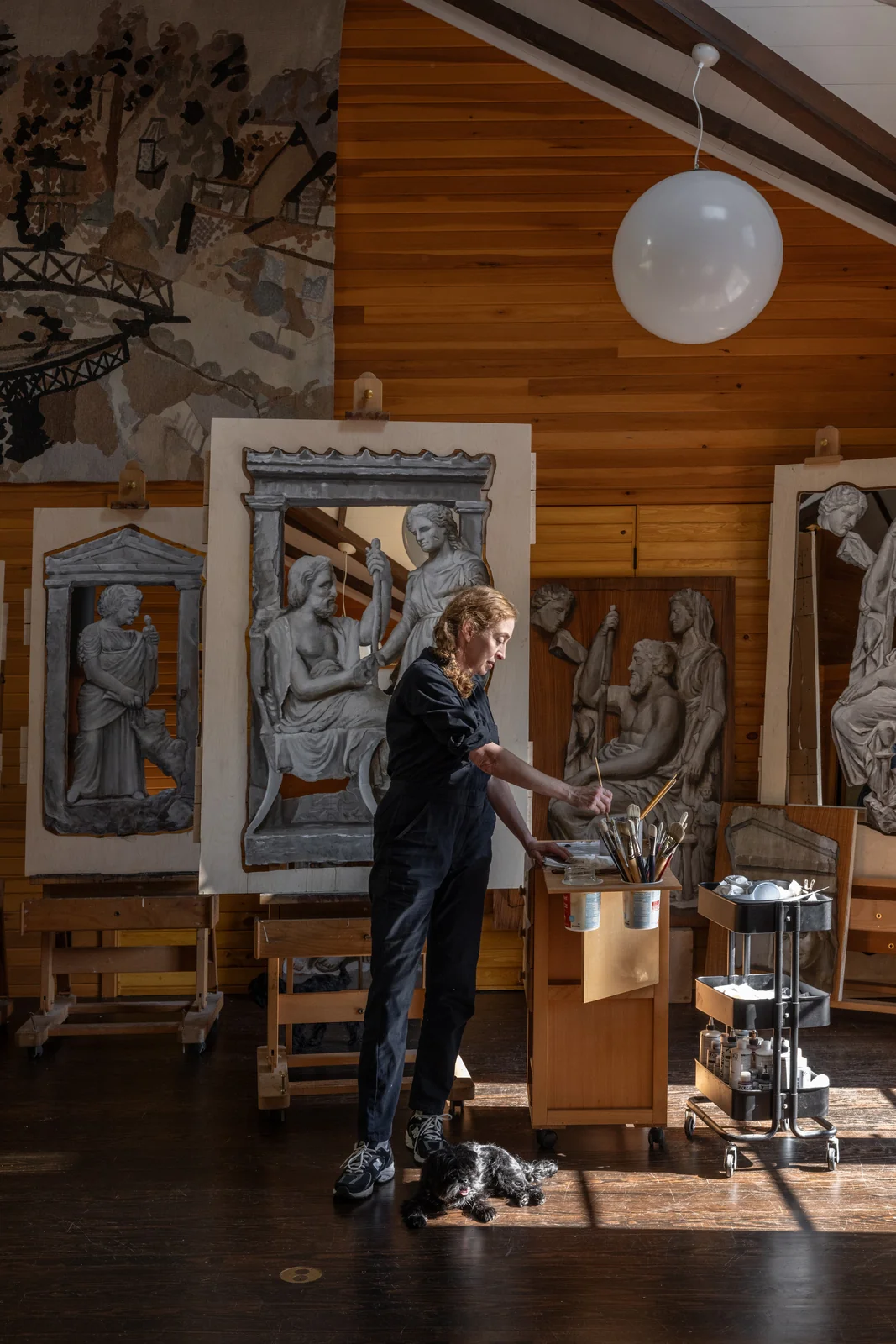
In Athens, the caryatid is a familiar figure: a woman who carries the weight of a building on her head. In Fates, Rachel Feinstein takes that architectural role as the starting point for work about women, the stories told about them and the responsibilities they carry. Her first exhibition in Greece, with sculptures, mirror paintings and works on paper, opened at Gagosian Athens on 24 September 2026 and runs until 9 January 2027.
Helen of Troy meets Petra von Kant
Two caryatids, Helen and Petra, stand at the centre of the exhibition. Each is a life-size terracotta figure joined to a base and an architectural capital, which brings the sculptures to about 2.3 metres in height. Porzellan Manufaktur Nymphenburg, a German ceramics manufactory founded in eighteenth-century Munich, fabricated both.
Each figure has distinct features, clothing and an identifying object. Helen clutches an apple, part of the myth of Helen of Troy. Petra takes her name and inspiration from the central character in Rainer Werner Fassbinder’s 1972 film The Bitter Tears of Petra von Kant. An ancient mythological figure and a character from twentieth-century cinema share the same architectural form.
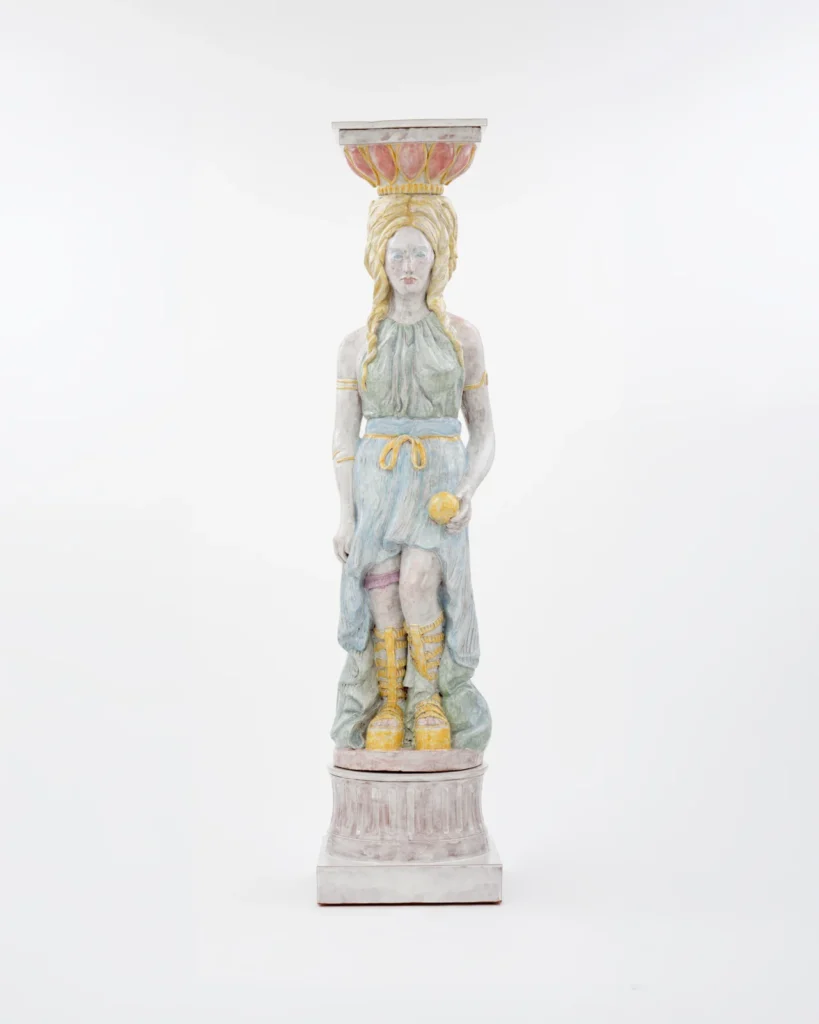
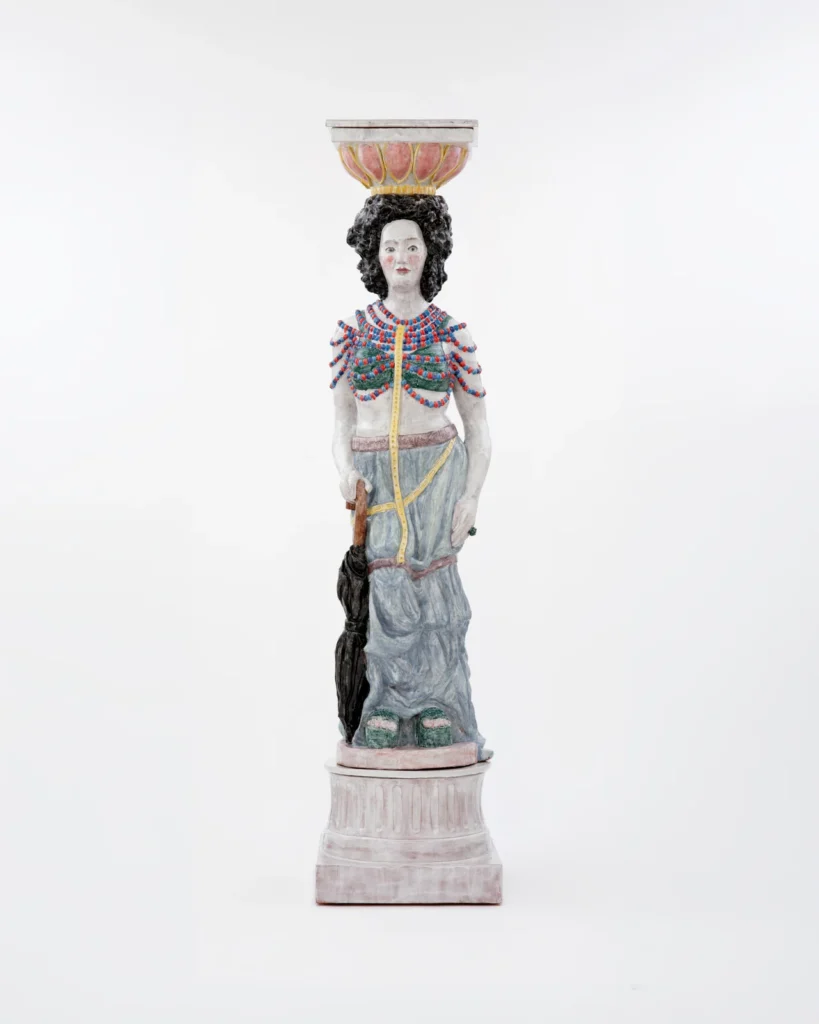
Feinstein reads the caryatid as a symbol of how women uphold the world and its social order, and the figures belong to her long interest in the representation of women across art history and popular culture. They also draw on a long line of predecessors: the Greek originals, Roman, Renaissance and Neoclassical versions, Auguste Rodin’s Fallen Caryatid Carrying Her Stone (1881–82) and Agnès Varda’s short film Les dites cariatides (1984).
In Athens, the reference point is the Erechtheion on the Acropolis, whose porch rests on six caryatids. Five of the originals are in the Acropolis Museum and the sixth is in the British Museum. Those figures were brightly painted, and Feinstein’s pastel glazes echo their colour. Terracotta is heavy, so she modelled each form for stability, and the poses interpret contrapposto and drapery.
Looking at the past through a mirror
Feinstein’s mirror paintings borrow figures and architectural frames from the steles that marked ancient Greek graves. A memorial keeps the image of someone absent, and a mirror shows whoever stands in front of it. Together they treat the past as a mirror of the present, and the duality of life and death runs through the whole exhibition. Viewers see the painted figures, the room and their own reflection at the same time.
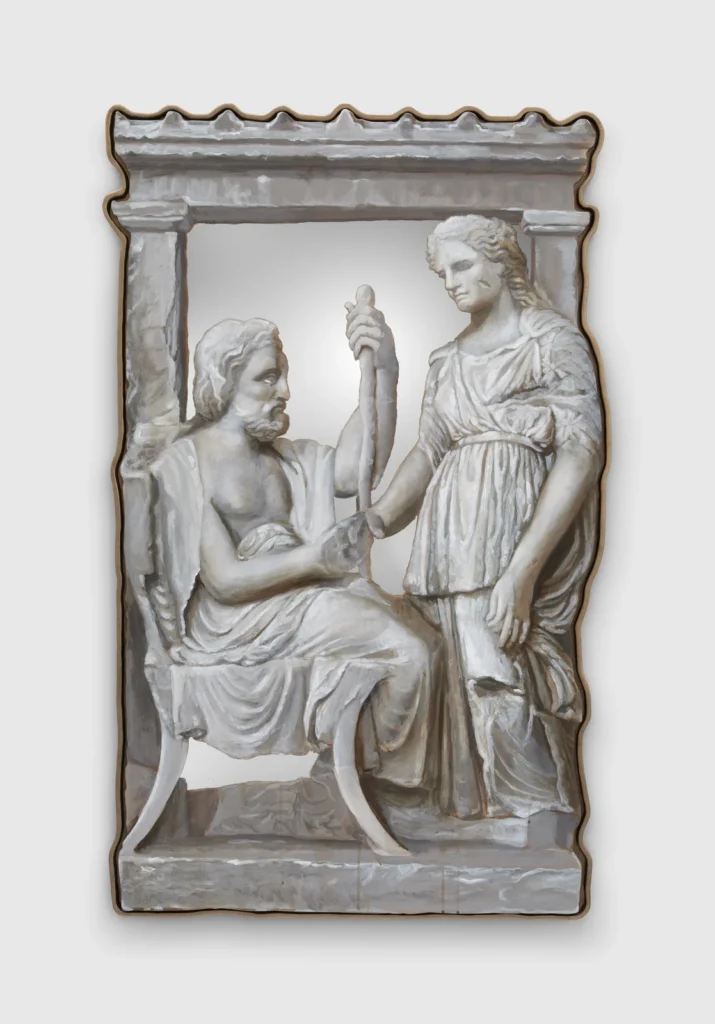
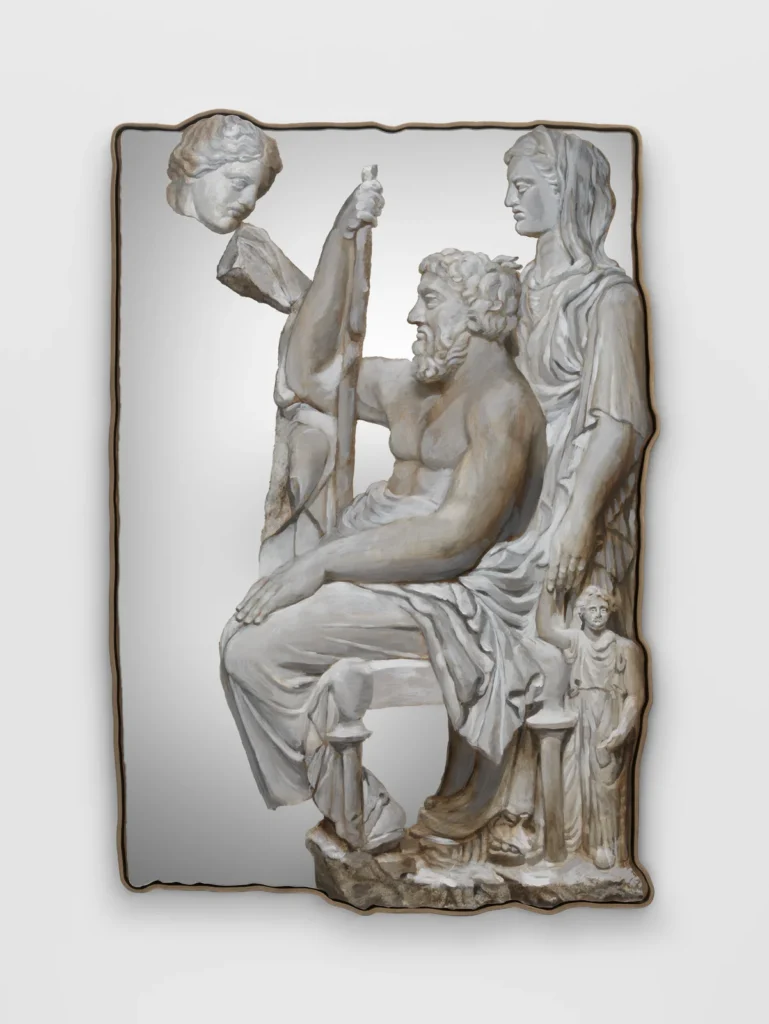
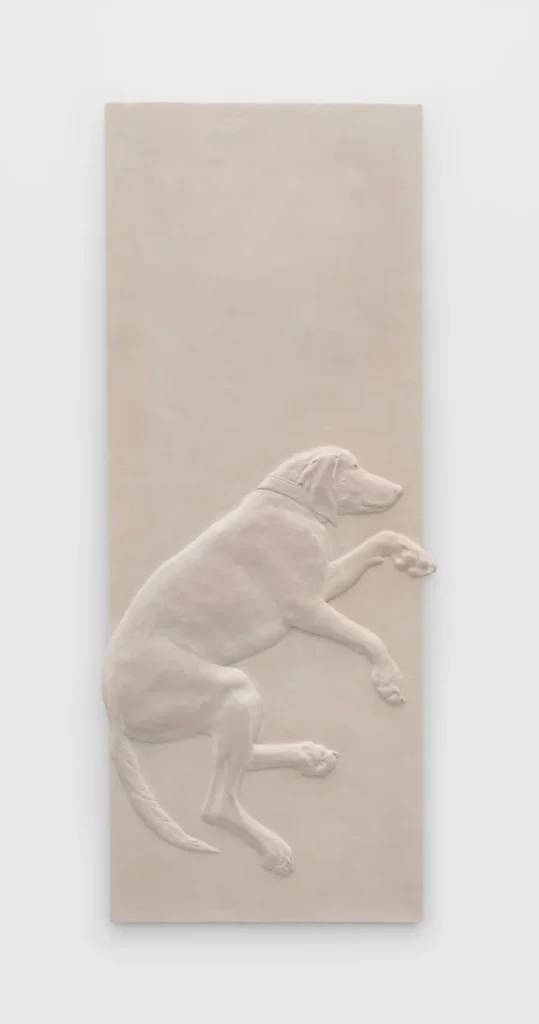
The mirror paintings include Plato’s Brother, Family, Jewelry Box, Perfume Bottle, Melisto and Pet Doves. They are installed with Red, a sculptural relief of a dog lying on a slab. Feinstein made Red to commemorate a friend, and it sparked her interest in the stele form.
Ancient stories and everyday life
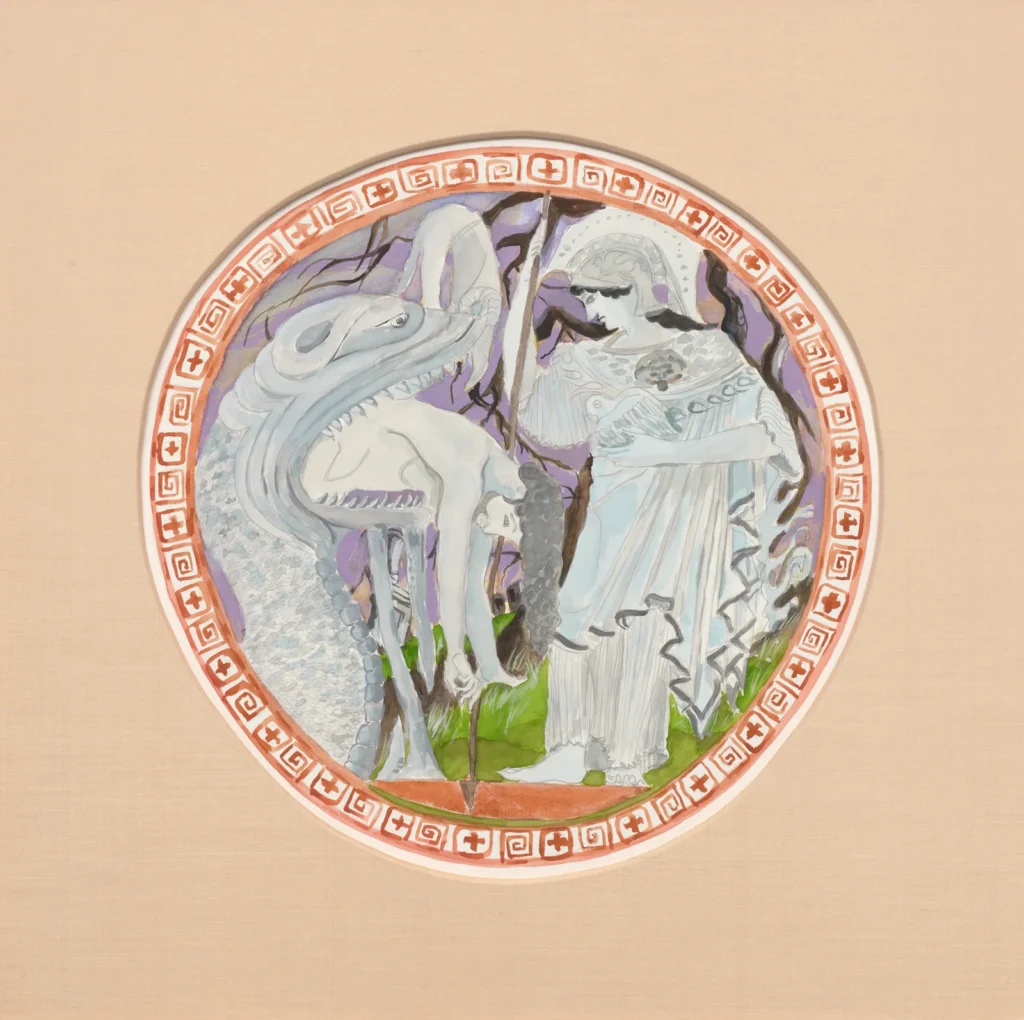
The circular watercolours on paper take their motifs from paintings on classical ceramics. Their titles include Symposium, Kylix, Taking the Cat for a Walk, Eos and Tithonos, Athena and Jason, The Sacred Tree and Old Man and Companion. The vase scenes appeal to Feinstein because they set mythic symbolism inside everyday life, including athletic competitions, fashion and sex, which connects them to the present.
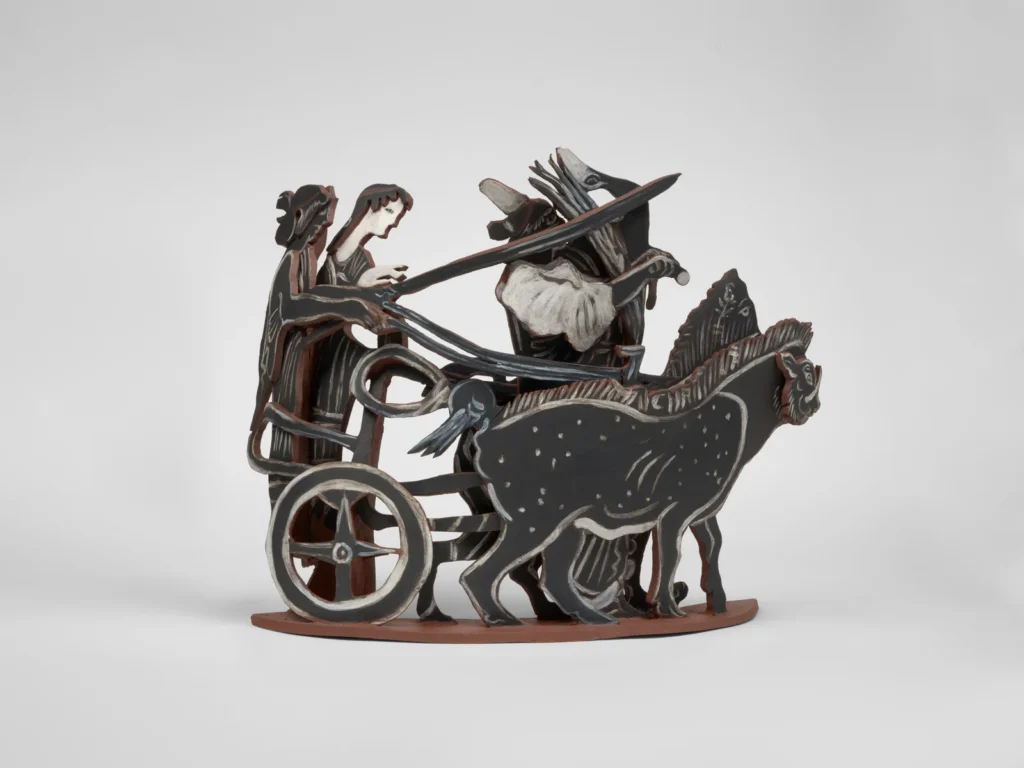
A related group of sculptures adapts painted and incised designs from ancient Athenian black- and red-figure vases. The figures wrap around hollow, amphora-shaped volumes, turning painted vase imagery into sculptural forms that can be viewed from several sides. Feinstein sculpted these works in copper and terracotta. She associates copper with Father Sky and masculinity, and terracotta with Mother Earth and femininity.
Residents who know the caryatids and painted vases from Athens’ museums and archaeological sites will recognise the sources. The upright caryatids, the mirror memorials and the circular scenes each draw on a different part of ancient Greek art, which makes Fates a good companion to a visit to the Acropolis Museum.
Visiting the exhibition
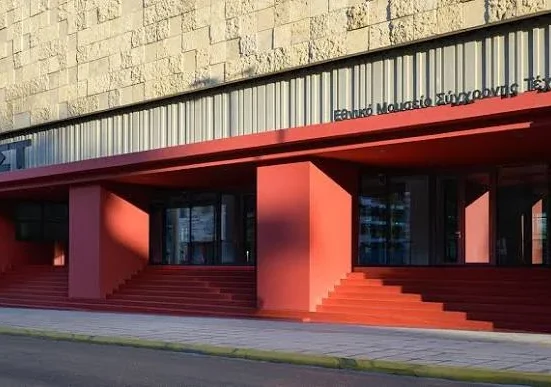
Rachel Feinstein: Fates is at Gagosian, 22 Anapiron Polemou Street, Athens 11521, until 9 January 2027. The gallery opens Tuesday to Saturday, 11am–7pm, with extended hours until 8pm on Thursdays. The telephone number is +30 210 36 40 215. The gallery’s exhibition page provides artwork details and current opening hours.
Sources
Gagosian’s official press release, 14 September 2026, and the official exhibition page, which also provides the image captions and credits.
You may also like
Greek mythology words and expressions
Greek History Explained: A Clear Timeline for Expats & Foreign Residents
Vergina Royal Tombs & New Aigai Museum: A Full Journey Through Ancient Aigai