
A sudden, unusually loud alarm from your mobile phone can be unsettling, particularly when you are in another country and do not immediately know what has happened.
In Greece, this is often an emergency warning sent through the 112 Emergency Communications Service. The message may concern a wildfire, flood, severe storm, earthquake or another dangerous situation affecting the area where you are located.
The warning is not simply a news notification. It may contain an instruction requiring immediate action, such as leaving an area, avoiding a road, remaining indoors or preparing for a possible evacuation.
Remain calm, read the entire message and follow the instructions issued by the authorities.
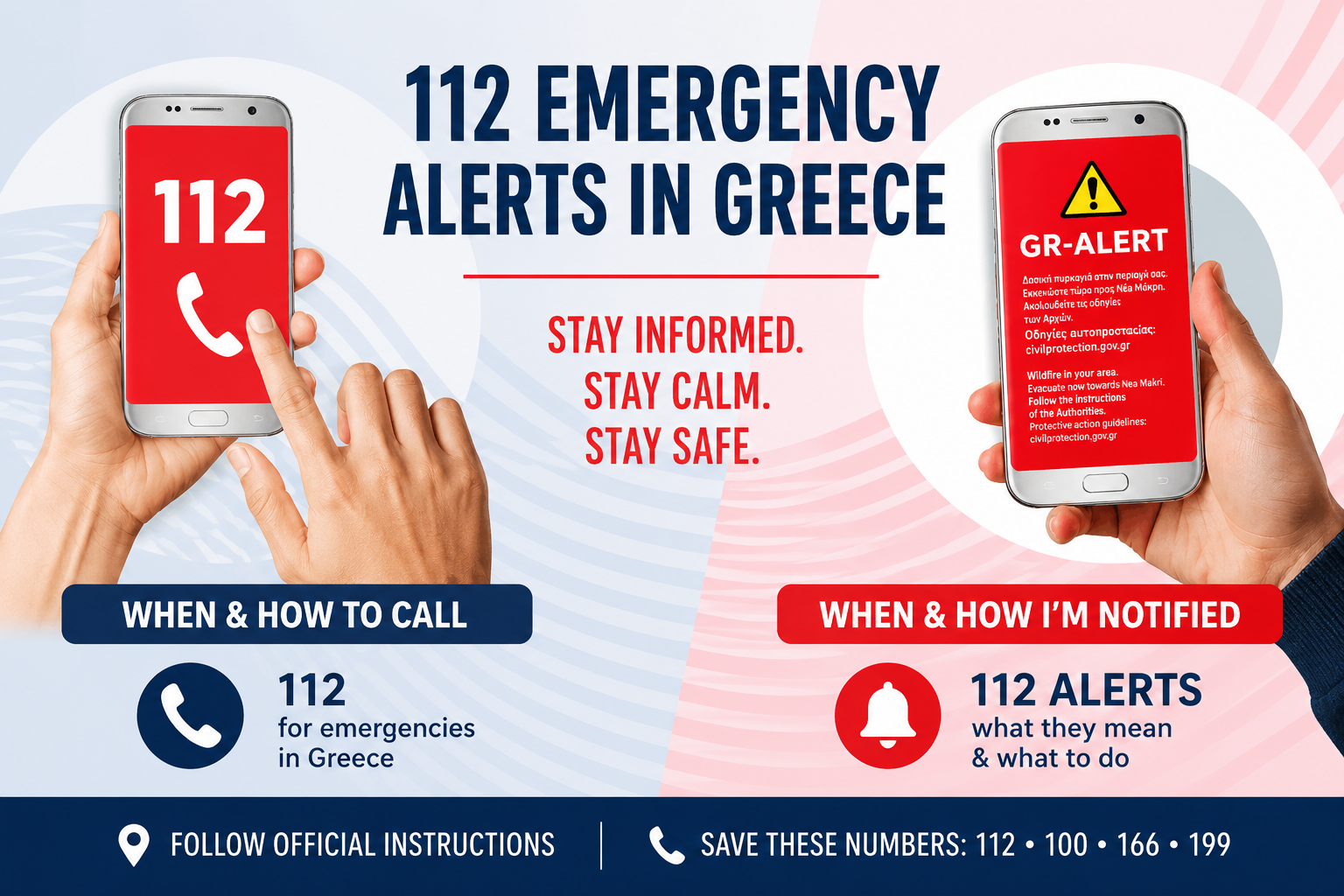
The number 112 has two important functions. You can call it when you require urgent assistance, while Greece’s Civil Protection authorities can also use it to send warnings and safety instructions to people in a particular geographical area.
What Is 112?
112 is the single European emergency number. It can be called free of charge in Greece and throughout the European Union when someone is in danger and requires immediate assistance.
In Greece, 112 can connect callers with the appropriate emergency service, including:
- the Hellenic Police;
- the Hellenic Fire Service;
- the National Centre for Emergency Care, known as EKAB;
- the Hellenic Coast Guard;
- the National Child Protection Helpline 1056;
- the European Hotline for Missing Children 116000;
- the EU Helpline for Children and Teenagers 116111.
You do not need to decide which service is responsible before calling. Explain what has happened, and the 112 operator will connect you with the appropriate local emergency service.
The service operates 24 hours a day, seven days a week, every day of the year. Operators in Greece speak at least Greek, English and French, making the service accessible to many foreign residents and visitors who do not speak Greek.
When Should You Call 112?
Call 112 when you or someone else is facing an emergency and requires immediate assistance.
Examples may include:
- a serious road or workplace accident;
- a fire;
- a medical emergency;
- a person facing immediate danger;
- someone missing at sea or in the mountains;
- a situation requiring urgent police assistance;
- a developing natural disaster.
Do not call 112 simply to request general information, ask why an alert was sent or obtain ordinary weather or traffic updates. Unnecessary calls may delay assistance to someone facing a genuine emergency.
How Can You Contact 112?
You can contact 112 in Greece:
- by calling from a landline;
- by calling from a mobile phone;
- from a mobile phone without available credit;
- from a public telephone without a phone card;
- by sending a text message to 112;
- by emailing contact@112.gov.gr;
- through the free gov.gr mobile application.
Calls to 112 are free. If your own mobile provider has no coverage, the call may be carried through another available mobile network covering the area.
What Should You Tell the Operator?
Give the operator clear and concise information. Explain:
- what has happened;
- where it has happened;
- when it happened;
- whether anyone is injured;
- whether an immediate danger remains.
Your location is especially important. Mention the nearest street, village, neighbourhood, beach, hotel, motorway exit, hiking trail, harbour or recognisable landmark.
If you are in a remote location, open the map application on your phone and provide your coordinates where possible. Although emergency technology may help identify a caller’s position, you should still describe your location as accurately as you can.
A Useful Tip for Travellers
Learn the name of your accommodation, beach, village or hiking route before setting out. Saying only that you are “near Athens” or “on an island” may not be enough during an emergency.
Calling 112 and Receiving a 112 Alert Are Different
When you call 112, you are asking for emergency assistance.
When a 112 warning appears on your phone, the authorities are contacting you because a dangerous situation may affect the area where you are located.
These alerts may be sent when a serious event is expected, already developing or creating an immediate threat to life, health or safety. They may also communicate urgent preventive measures introduced during an emergency.
Situations that may trigger a warning include:
- wildfires;
- floods;
- severe storms and dangerous weather;
- earthquakes;
- industrial or technological accidents;
- urgent road closures or movement restrictions;
- other threats requiring immediate protective action.
Why Does the Alert Sound So Loud?
The distinctive alarm is intentional. It is designed to sound different from an ordinary telephone call, message or application notification so that people notice the warning immediately.
The sound may be startling, but do not close the notification without reading it. The message may contain a time-sensitive instruction that affects your safety.
How Do 112 Alerts Reach Your Phone?
Emergency warnings are commonly delivered through Cell Broadcast technology.
Unlike an ordinary text message sent to a list of individual telephone numbers, a Cell Broadcast warning is transmitted through mobile-network cells covering a particular geographical area.
This allows the authorities to warn compatible mobile phones located near a danger without requiring every person to download a separate application or subscribe in advance.
Compatible smartphones with updated operating software should normally receive the alert automatically, provided emergency warnings have not been disabled in the device settings.
Will Tourists and Foreign Residents Receive the Alert?
Yes. Cell Broadcast warnings are based on the phone’s location rather than the nationality of its owner or telephone number.
This means that foreign residents and visitors using roaming services may also receive an alert when connected to a compatible mobile network in the affected area.
However, a warning may not reach a particular device when:
- the phone is switched off;
- airplane mode is enabled;
- there is no compatible network coverage;
- the operating system is outdated;
- emergency alerts have been disabled;
- the device does not support the required technology.
Do not rely exclusively on your telephone during a developing emergency. Follow announcements from Civil Protection, the Fire Service, the police, the Coast Guard, your municipality and other competent authorities.
Are 112 Alerts Available in English?
Yes. Emergency Cell Broadcast alerts sent by 112 in Greece are issued in Greek and English.
The Greek text appears first and is followed by the English version, allowing foreign residents and visitors to understand the warning and its instructions directly on their phones.
Local place names may still be unfamiliar or may be spelled differently from the version used on an English-language map. Read the complete message and carefully check the municipality, settlement, road or destination mentioned.
You Do Not Need to Translate the Message Yourself
Continue reading past the Greek section to find the English version. However, always check the location and direction carefully before taking action.
What Should You Do When an Alert Arrives?
Read the Complete Message
Do not stop after reading the opening sentence. The warning may identify:
- the area affected;
- the nature of the danger;
- a road that must be avoided;
- a direction in which people should move;
- an evacuation destination;
- whether you should remain indoors;
- whether immediate evacuation is required.
The most important instruction may appear near the end of the message.
Check the Location
You may receive an alert even when you cannot see smoke, floodwater or another obvious sign of danger. The incident may be developing nearby, moving towards your area or affecting a route that authorities expect to become unsafe.
Cell Broadcast areas do not always follow exact neighbourhood or municipal boundaries. You may receive a warning because your phone is connected to a mobile-network cell serving a wider area.
Identify the Instruction
A 112 warning may tell you to:
- remain ready;
- avoid a particular area;
- stay indoors;
- close doors and windows;
- avoid travelling;
- move towards a named destination;
- evacuate immediately.
These instructions are not interchangeable. A message telling you to remain ready does not necessarily mean you should leave immediately. Equally, an evacuation order should not be treated as a suggestion to wait and see.
Follow the Route Provided
During a wildfire, flood or other fast-moving emergency, your normal route may no longer be safe.
If the message provides a destination or direction of travel, follow that instruction and any directions given by police officers, firefighters or local authorities. Do not choose a different route simply because it usually appears faster.
Make Sure Everyone Understands
Check that everyone with you has received and understood the warning, particularly:
- children and teenagers;
- older relatives;
- neighbours living alone;
- visitors unfamiliar with the area;
- people with visual, hearing or mobility difficulties;
- anyone who does not have a compatible mobile phone.
What If You Accidentally Close the Alert?
Many smartphones retain a history of emergency warnings. The exact location differs according to the manufacturer and operating-system version.
Search your phone settings for terms such as:
- Emergency Alerts;
- Wireless Emergency Alerts;
- Government Alerts;
- Safety and Emergency;
- Alert History.
During an active emergency, check current announcements through official Civil Protection and emergency-service channels. Do not rely on screenshots or instructions circulated through unverified social-media accounts.
Should Emergency Alerts Remain Enabled?
Yes. Emergency warnings should remain enabled on your phone.
They may interrupt your sleep or make a loud sound at an inconvenient moment, but their purpose is to attract your attention when immediate protective action may be necessary.
It is also sensible to check the settings on phones used by children, older relatives or visitors who may have disabled government notifications without realising what the setting controls.
Do You Need to Register for Alerts?
Most people with a compatible and updated smartphone do not need to register to receive Cell Broadcast warnings in the area where they are currently located.
A separate registration service is available for people who want to receive warnings through alternative channels, such as ordinary SMS, email or an automated voice message connected to a selected geographical area.
This differs from Cell Broadcast, which targets compatible phones according to their current mobile-network location.
Emergency Numbers to Save in Greece
- 112 — European emergency number
- 100 — Police
- 166 — Ambulance and emergency medical assistance, EKAB
- 199 — Fire Service
- 108 — Coast Guard
- 1056 — National Child Protection Helpline
- 116000 — European Hotline for Missing Children
- 116111 — EU Helpline for Children and Teenagers
When you are uncertain which emergency service is required, call 112.
What Not to Do
After receiving a warning, do not:
- dismiss it before reading the complete message;
- assume it applies only to Greek citizens or permanent residents;
- wait for a second alert when the first one orders immediate action;
- drive towards smoke, floodwater or another danger;
- choose an unofficial evacuation route without reliable information;
- share unverified instructions through social media;
- call 112 merely to ask why the alert was sent;
- make unnecessary emergency calls.
A Simple 112 Checklist for Expats and Visitors
Before an emergency occurs:
- save 112, 100, 166, 199 and 108;
- keep emergency alerts enabled;
- learn the name of your municipality or local area;
- know the name and address of your accommodation;
- keep your phone charged;
- carry a power bank during severe weather or high fire-risk periods;
- explain the alert system to children and visiting relatives;
- check on neighbours or family members who may need help;
- follow official Civil Protection and local-authority channels.
Call for Help. Read Every Alert.
The number 112 may appear during two very different situations.
You may use it to request urgent help, or it may appear on your phone because the authorities need you to take protective action.
When a 112 warning arrives, remain calm, continue to the English version, read the complete message and follow the latest official instructions.
This article provides general safety information. Emergency conditions and official instructions can change rapidly. Always follow the latest 112 warning and directions issued by Civil Protection, the Fire Service, the police, the Coast Guard and other competent authorities.
Sources and Official Information
Updated 01/08/2026